




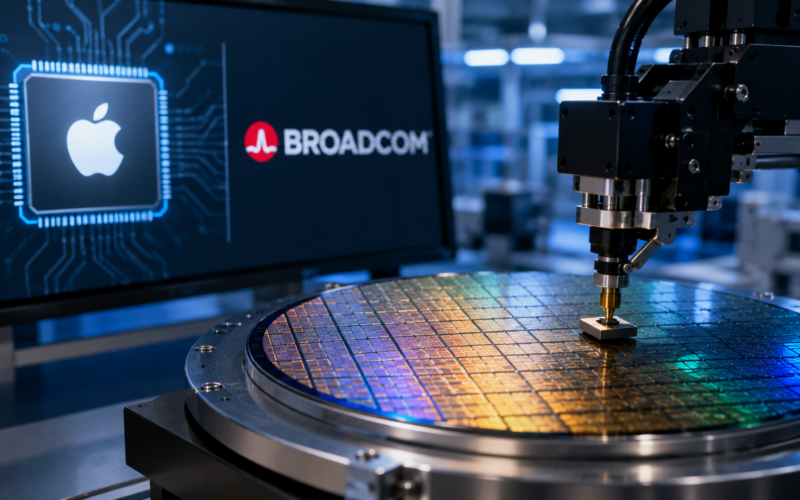
Apple Inc.’s US$30 billion-plus chip commitment to Broadcom Inc. (Nasdaq: AVGO) is more than another supplier agreement for the iPhone ecosystem. It is a signal that custom silicon, wireless connectivity and domestic semiconductor manufacturing are becoming central to the next stage of artificial intelligence infrastructure. The multiyear deal is expected to produce more than 15 billion U.S.-made chips, deepen Apple’s long-running dependence on Broadcom’s specialist radio-frequency and custom ASIC capabilities, and support Broadcom’s expanded Fort Collins, Colorado manufacturing footprint. For investors, the feature question is not simply why Broadcom shares rose after the announcement. It is whether the Apple agreement adds enough durable revenue visibility to justify a valuation near US$1.9 trillion while Broadcom also scales custom AI accelerators, AI networking and VMware-backed infrastructure software.
Why does Apple’s US$30 billion Broadcom commitment matter beyond one supplier contract?
Apple’s new commitment is expected to exceed US$30 billion and support the production of more than 15 billion chips in the United States. The chips will be used across a wide range of Apple products, covering custom silicon components and advanced wireless-connectivity technologies.
The scale matters because Apple is not merely placing a short-term component order. The agreement extends the Apple-Broadcom technology relationship through 2031, giving Broadcom a longer revenue runway in one of the world’s most demanding consumer electronics supply chains.
That visibility is especially important because Apple has spent years bringing more semiconductor design work in-house. The company’s internal silicon programme has transformed Macs, iPhones, iPads and other devices, creating recurring concern that major external suppliers could eventually be displaced.
The Broadcom extension shows that Apple still sees strategic value in outside partners for specialised components. Some wireless and radio-frequency functions remain technically difficult, volume-intensive and deeply integrated into product performance. Broadcom’s position in that part of the stack is therefore more durable than a simple commodity-chip supplier role.
The deal also gives Apple a domestic-supply-chain story at a politically sensitive moment for semiconductors. U.S. manufacturing commitments have become part of corporate strategy, industrial policy and investor positioning. Broadcom benefits because it is now tied more closely to Apple’s public commitment to source critical chips from American facilities.
What will Broadcom actually supply to Apple under the expanded agreement?
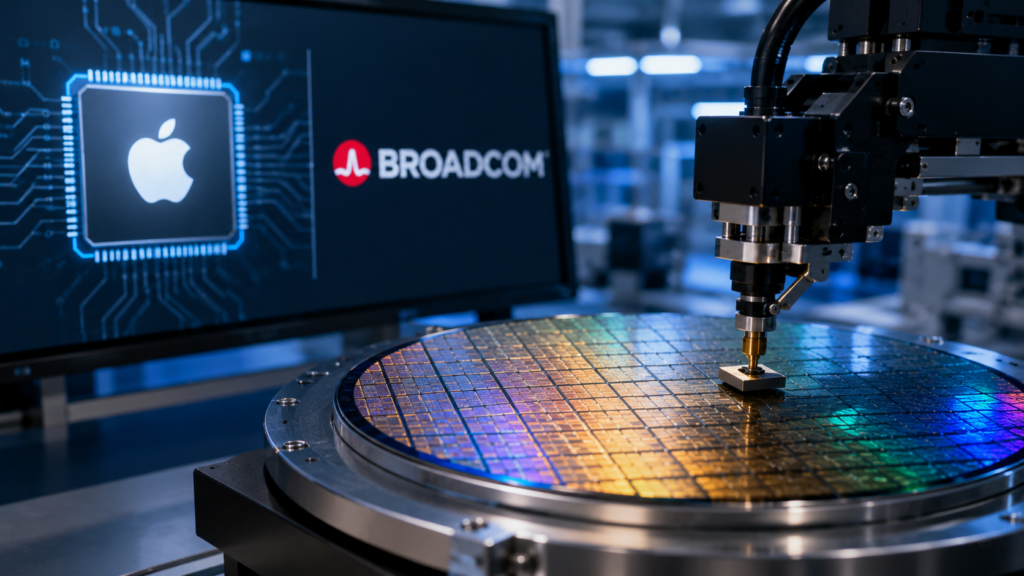
The agreement covers custom silicon components and cutting-edge wireless-connectivity technologies. Broadcom’s separate filing described new multiyear agreements to develop and supply custom ASIC silicon products for multiple generations of Apple products.
Reuters reported that the supply arrangement includes FBAR filters, a type of radio-frequency component used in wireless connectivity. These components help devices communicate efficiently across cellular and wireless networks, making them essential to the performance expected from Apple products.
This is not the same as Apple outsourcing its flagship processors. Apple continues to design its own major application processors and system-on-chip products. Broadcom’s role is more specialised, involving components that sit inside the device architecture and support connectivity, performance and potentially future custom functions.
The custom ASIC element is important because it places Broadcom deeper into Apple’s future product roadmap. Application-specific integrated circuits are designed for defined workloads, product requirements or system functions. They are not interchangeable commodity chips.
That distinction helps explain the market reaction. A supplier of commodity components can be replaced more easily. A company that co-develops custom silicon across multiple device generations becomes harder to remove without technical risk, redesign costs and qualification delays.
Apple gains supply stability and specialist engineering. Broadcom gains multiyear visibility, manufacturing justification and a stronger answer to investors worried about Apple’s internal chip strategy.
How does the Fort Collins expansion fit into the U.S. semiconductor manufacturing story?
A major part of the agreement is tied to Broadcom’s Fort Collins, Colorado facility. Reuters reported that Broadcom will invest US$1.5 billion to expand the factory as part of the Apple arrangement.
The Fort Collins site is strategically important because it gives the deal a domestic manufacturing angle rather than only a design or procurement angle. Apple has been increasing U.S. supplier commitments as governments and large technology companies respond to supply-chain concentration risk.
The semiconductor industry has become a national-security and industrial-policy priority. Chips underpin smartphones, artificial intelligence servers, defence systems, vehicles, data centres and telecommunications equipment. Companies able to produce or package critical components in the United States can therefore gain strategic value beyond the direct economics of a single customer order.
For Apple, the agreement supports its broader effort to expand U.S.-based manufacturing participation without fully moving final product assembly to the United States. For Broadcom, it strengthens the case for investing in domestic capacity while anchoring that investment to one of the world’s largest technology customers.
The manufacturing angle also helps explain why the deal has attracted attention outside the semiconductor market. It connects consumer electronics, supply-chain security, U.S. jobs, industrial policy and artificial intelligence infrastructure into one transaction.
The risk is that domestic expansion must still meet strict cost, quality and yield requirements. Apple’s supply chain is unforgiving. If Broadcom expands capacity, it must deliver at Apple’s volume, performance and reliability standards.
Why does the Apple deal strengthen Broadcom’s custom silicon and AI infrastructure thesis?
Broadcom has become one of the most important alternatives to Nvidia in the artificial intelligence hardware ecosystem. Nvidia dominates general-purpose AI accelerators, while Broadcom is building strength in custom accelerators, networking silicon and application-specific chips for large platform customers.
The Apple deal reinforces that strategy because it confirms Broadcom’s ability to win and retain deep, multiyear custom silicon relationships. Even if much of the Apple revenue is tied to wireless connectivity, the custom ASIC language matters because it points to continued design collaboration across future device generations.
Broadcom’s latest financial results show the importance of this theme. The company reported US$10.8 billion in AI semiconductor revenue during fiscal Q2 2026, up 143% from a year earlier. It expects AI semiconductor revenue to reach US$16.0 billion in fiscal Q3, more than triple the prior-year level.
That growth is being driven by demand for custom AI accelerators and AI networking. Hyperscale customers want chips designed for their own workloads, power budgets, data-centre layouts and software stacks. Broadcom’s role is to convert those requirements into manufacturable silicon and the networking architecture needed to move data efficiently.
Apple’s agreement does not mean Broadcom has suddenly replaced Nvidia or become a pure AI accelerator company. The importance is broader. It shows that the company’s custom silicon model is relevant across consumer devices, connectivity, cloud infrastructure and artificial intelligence workloads.
For investors, this makes Broadcom a different kind of AI stock. It is not only selling the most visible accelerator. It is embedded in the design, networking and connectivity layers that large technology companies increasingly want to control.
How does Broadcom’s financial performance support the feature investment case?
Broadcom’s fiscal Q2 FY26 results were already strong before the Apple announcement. Revenue rose 48% year on year to US$22.19 billion, while adjusted EBITDA reached US$15.24 billion, equal to 69% of revenue.
The company also generated US$10.26 billion of free cash flow during the quarter, or 46% of revenue. That level of cash conversion gives Broadcom far more flexibility than many semiconductor companies riding the artificial intelligence cycle.
The Q3 outlook is equally important. Broadcom guided to revenue of approximately US$29.4 billion, implying 84% year-on-year growth. Non-GAAP operating income is expected to be approximately 67% of projected revenue.
Those numbers show that Broadcom is not being valued only on future hopes. It is already producing large revenue, high margins and substantial free cash flow from semiconductor and software businesses that are scaling quickly.
The infrastructure software segment adds another layer. Following the VMware acquisition, Broadcom has a large recurring software engine alongside its semiconductor business. Software revenue does not remove semiconductor cyclicality, but it gives the group a second cash-flow base.
That financial profile explains why investors are willing to apply a premium valuation. The concern is not whether Broadcom is a real AI and infrastructure company. It clearly is. The concern is how much of that success is already priced into a stock trading near a US$1.9 trillion market value.
What does VMware add to Broadcom’s AI and custom silicon story?
VMware makes Broadcom more than a chip supplier. The infrastructure software business gives the company exposure to virtualisation, private cloud, hybrid cloud, enterprise data-centre management and large corporate technology budgets.
This matters because artificial intelligence infrastructure is not only about chips. Enterprises and cloud providers need compute, networking, storage, virtualisation, workload orchestration, security and management software. Broadcom now participates in more of that infrastructure stack.
The VMware acquisition also strengthens Broadcom’s cash-generation profile. Infrastructure software can provide recurring revenue and high margins, which can support dividends, debt reduction and future investment in semiconductor design.
Broadcom’s acquisition model has historically focused on disciplined cost control and high returns. That playbook can create strong profitability, though it can also create customer friction if pricing or licensing changes move too aggressively.
For investors, VMware adds durability but also complexity. Broadcom must prove that it can retain enterprise customers, grow software revenue and integrate VMware without damaging the customer relationships that made the asset valuable.
The Apple deal does not directly change VMware’s outlook. It does, however, make Broadcom’s overall platform story stronger. The company now has Apple supply-chain visibility, hyperscale AI silicon growth, AI networking exposure and enterprise infrastructure software cash flow.
What are the key risks hiding behind the Broadcom and Apple deal?
The biggest risk is customer concentration. Apple is a major customer, and Broadcom’s AI custom silicon growth also depends heavily on a small number of very large technology companies. These customers have enormous purchasing power and strong incentives to reduce dependency on outside suppliers where possible.
Apple’s internal silicon strategy remains a long-term threat. The new agreement extends Broadcom’s role through 2031, but it does not guarantee that Apple will never internalise additional chip functions. It only confirms that Broadcom remains critical for the next phase.
The second risk is valuation. Broadcom’s share price has already captured a large part of the AI custom silicon thesis. A stock with a market value close to US$1.9 trillion must keep delivering exceptional growth to avoid multiple compression.
The third risk is AI capital-spending cyclicality. Hyperscale customers are investing aggressively in artificial intelligence infrastructure, but spending could slow if returns are delayed, cloud customers become more cautious, or model-training economics change.
The fourth risk is manufacturing execution. The Fort Collins expansion adds strategic value, but it must be delivered on time, at competitive cost and at Apple-grade reliability.
The fifth risk is software integration. VMware can strengthen Broadcom’s recurring revenue, but customer pushback, migration to alternatives or weaker renewal behaviour could damage the software part of the story.
These risks do not weaken the strategic importance of the Apple deal. They explain why the market may remain volatile even after a transaction that clearly improves long-term visibility.
How has Broadcom’s share price changed by the July 10 publication window?
By the July 10 publication window, Broadcom’s immediate Apple-led rally had largely held. AVGO was trading around US$400 during the U.S. session, compared with roughly US$370 before the expanded Apple commitment became a broader market story.
The stock remains below its 52-week high of US$495, meaning investors are still not paying the peak multiple reached during the earlier artificial intelligence surge. At the same time, AVGO is far above its 52-week low, showing that the market continues to treat Broadcom as one of the strongest AI infrastructure compounders.
The price action matters because it changes the article from a one-day reaction into a feature about valuation support. The Apple agreement did not create Broadcom’s AI thesis from scratch. It strengthened an existing thesis after the stock had cooled from its high.
For retail investors, this is a more useful frame. Broadcom is not a beaten-down speculative chip name. It is a mega-cap semiconductor and software platform that must justify a very large valuation through execution.
That means the Apple deal is supportive, not decisive by itself. A US$30 billion-plus customer commitment improves visibility, but Broadcom’s next valuation test will still come from quarterly AI semiconductor revenue, margins, free cash flow, VMware performance and guidance quality.
The stock’s recovery into July 10 suggests investors are willing to revisit the AI custom silicon trade. Whether they continue paying a premium will depend on whether Broadcom can keep turning strategic relationships into measurable revenue and cash flow.
Why does this deal matter for the wider semiconductor industry?
The Broadcom-Apple agreement shows how semiconductor competition is shifting from standard chips to deeply customised platforms. The most valuable technology companies increasingly want chips designed around their own products, workloads, software and power requirements.
This trend benefits companies that can design custom silicon at scale. Broadcom’s role is not merely to manufacture chips. It helps develop specialised components that integrate with complex products and customer roadmaps.
The deal also highlights the growing importance of radio-frequency and connectivity components. AI receives the most attention, but devices still need reliable wireless performance, efficient connectivity and advanced signal processing. Those functions remain critical as smartphones, wearables, edge devices and AI-enabled hardware become more complex.
Domestic manufacturing is another industry-wide signal. Apple’s commitment to U.S.-made chips and Broadcom’s Fort Collins expansion show that supply-chain location now affects strategic value. Large customers increasingly want not only performance and cost, but also geographic resilience.
The agreement may encourage other platform companies to secure longer-term chip commitments. As AI infrastructure grows and geopolitical risks remain elevated, companies may prefer deeper supply partnerships over short-term procurement flexibility.
For Broadcom, this is the central strategic opportunity. The company sits at the intersection of custom AI silicon, networking, device connectivity, enterprise infrastructure software and trusted long-term supply relationships.
Key takeaways from Apple’s US$30 billion Broadcom chip commitment
- Apple’s new Broadcom commitment is expected to exceed US$30 billion and support production of more than 15 billion U.S.-made chips.
- Broadcom’s expanded technology collaboration with Apple runs through 2031 and includes custom ASIC silicon products for multiple generations of Apple products.
- The deal strengthens Broadcom’s position as a key Apple supplier despite Apple’s broader internal silicon strategy.
- Reuters reported that Broadcom will invest US$1.5 billion to expand its Fort Collins, Colorado manufacturing facility.
- Broadcom reported US$22.19 billion in fiscal Q2 revenue, US$15.24 billion of adjusted EBITDA and US$10.26 billion of free cash flow.
- AI semiconductor revenue reached US$10.8 billion in fiscal Q2, and Broadcom expects the figure to reach US$16.0 billion in fiscal Q3.
- The Apple agreement supports Broadcom’s custom silicon story, but the stock’s valuation near US$1.9 trillion still requires strong execution across AI, Apple supply, networking and VMware.
Share this:
Discover more from Business-News-Today.com
Subscribe to get the latest posts sent to your email.