


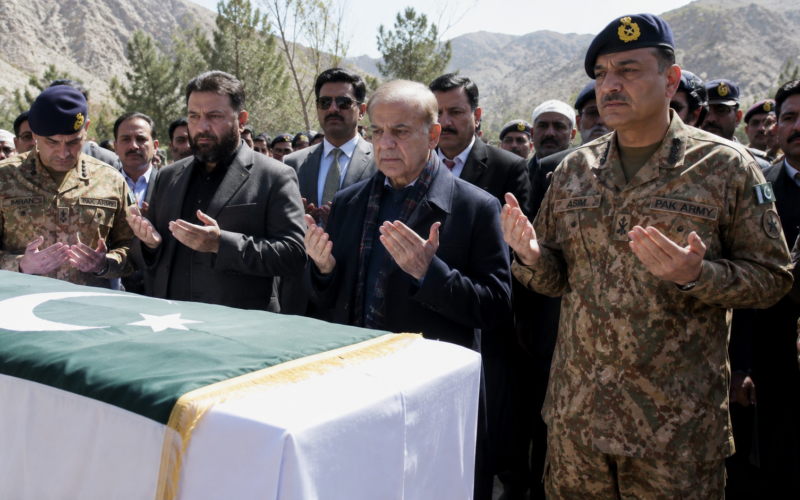
Pakistan Prime Minister Shehbaz Sharif vowed on July 9, 2026, to continue military and police operations in Balochistan after a wave of insurgent attacks killed 42 people, mostly security personnel, in one of the province’s deadliest weeks of violence this year.
Sharif travelled to Quetta, the provincial capital, to meet families of the dead and chair a high-level security meeting attended by army chief Field Marshal Asim Munir and Balochistan Chief Minister Sarfraz Bugti. Pakistani authorities said security operations launched since Monday had killed at least 54 insurgents.
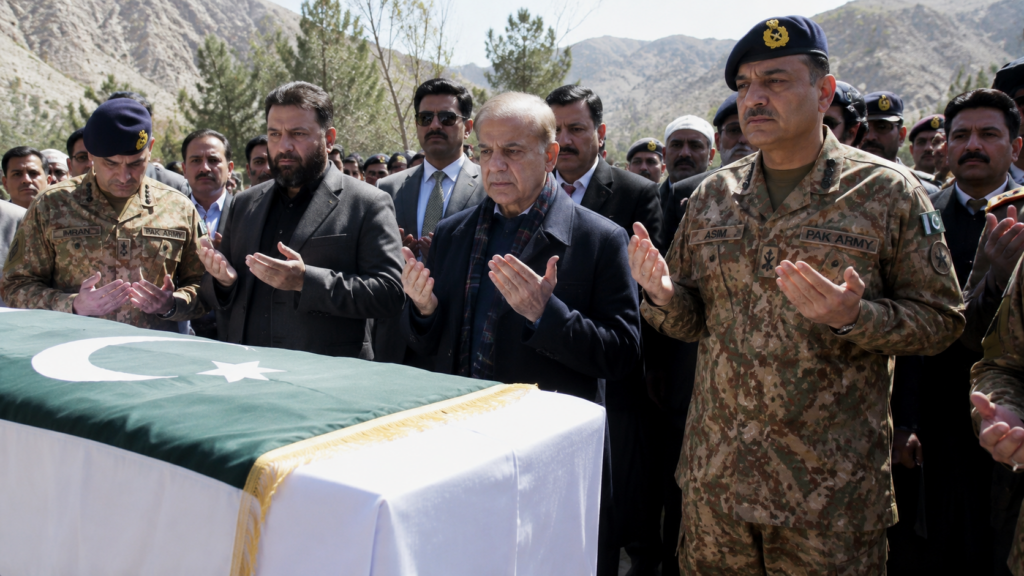
The deadliest assault took place in Ziarat district, where militants attacked a police post, killed nine police officers and abducted 18 others who were later shot dead. Relatives of the slain officers staged a sit-in in Quetta beside ambulances carrying coffins, demanding justice and stronger action against the attackers.
Sharif also accused Pakistan’s “eastern neighbor” of supporting the insurgency with weapons, money and assistance, without directly naming India, and alleged that militants were using Afghan territory for attacks in Balochistan and Khyber Pakhtunkhwa. New Delhi and Kabul have previously rejected similar Pakistani allegations.
Why has the Balochistan violence become a major national security test for Pakistan?
The latest attacks are significant because they targeted state authority directly. Police posts, abducted officers and army personnel are not random targets. They are symbols of the Pakistani state’s presence in a province where separatist groups have long challenged Islamabad’s control.
Balochistan is Pakistan’s largest province by area but one of its least populous and least developed regions. Its geography makes it strategically important because it borders Iran and Afghanistan, includes long stretches of difficult terrain and hosts key transport, energy and port infrastructure.
Militant attacks in Balochistan are not new, but the scale and sequencing of this week’s violence are politically alarming. Multiple attacks within days suggest coordination, confidence and operational capacity. The killing of abducted police officers also appears designed to shock the public and demoralise frontline security forces.
The state’s response has already moved beyond ordinary policing. Sharif’s visit, the presence of the army chief and the announcement of operations killing dozens of insurgents show that Islamabad is treating the violence as a national security challenge rather than a provincial law-and-order problem.
The test now is whether Pakistan can disrupt militant networks without deepening resentment among local communities. Heavy military operations may produce short-term results, but they can also worsen grievances if civilians feel targeted, displaced or ignored.
What do the Ziarat police killings reveal about insurgent strategy in Balochistan?
The Ziarat attack shows that insurgents are aiming to weaken security confidence by targeting police personnel in isolated or vulnerable posts.
Killing nine officers in an initial assault was already a severe blow. Abducting 18 others and later killing them created an additional psychological impact because it demonstrated that militants could seize personnel, move them and execute them before the state could recover them.
Such tactics serve several purposes. They generate fear among police deployed in remote areas. They create pressure on the government to retaliate. They provide militants with propaganda value. They also force authorities to divert resources towards protecting small posts, roads, convoys and families of personnel.
The sit-in by relatives in Quetta shows the human and political cost of these attacks. Security personnel are often drawn from ordinary communities, and their deaths can quickly become a public test of whether the government values those placed on the front line.
For insurgents, attacks on police may be easier than attacks on heavily fortified army positions. Police units can be more exposed, less equipped and spread across wider areas. That makes them vulnerable in a province where terrain, distance and intelligence gaps favour mobile militant groups.
Pakistan’s security challenge is therefore not only offensive operations against militant hideouts. It must also improve protection, communications, rapid reinforcement and intelligence for police units posted in high-risk districts.
Why is the Baloch Liberation Army central to Pakistan’s current security concerns?
The outlawed Baloch Liberation Army has become one of Pakistan’s most visible separatist militant groups. It has claimed or been linked to attacks on security forces, infrastructure and interests connected with the Pakistani state.
Baloch separatist groups argue that the province’s resources have been exploited while local communities remain poor, underrepresented and heavily policed. Islamabad rejects separatism and treats armed groups as terrorist organisations that threaten national unity and foreign investment.
The Baloch Liberation Army’s importance lies in its ability to connect local grievances with high-profile violence. Attacks on soldiers and police undermine the state. Attacks on infrastructure threaten economic plans. Attacks near strategic routes or foreign-linked projects create international concern.
The latest violence suggests that separatist groups may be trying to show that they can sustain attacks despite years of security operations. If they can repeatedly strike police and military targets, they can challenge Islamabad’s claim that the insurgency is being contained.
However, insurgent violence also carries political limits. Killing abducted police officers may harden public support for a crackdown and reduce the possibility of political dialogue. It may also allow the state to frame the entire Baloch issue through counterterrorism rather than governance, rights and resource-sharing.
The danger for Balochistan is that each militant attack and each military response pushes the province further away from a political settlement.
How do India and Afghanistan allegations complicate Pakistan’s response?
Sharif’s allegation that Pakistan’s eastern neighbor is supporting the insurgency brings India into the political frame even though he did not name it directly. Pakistan has long accused India of supporting Baloch separatists, while India has denied involvement and accused Pakistan of deflecting attention from its internal problems.
The Afghanistan angle is equally sensitive. Pakistan says militants use Afghan soil to launch or support attacks in Balochistan and Khyber Pakhtunkhwa. Kabul has denied allowing its territory to be used for attacks against Pakistan.
These accusations matter because they can transform a domestic security crisis into a regional confrontation. If Islamabad frames the insurgency primarily as externally sponsored, it may increase pressure on India and Afghanistan through diplomatic, military or border measures.
At the same time, external-blame narratives can weaken domestic reform. Balochistan’s instability is not caused only by foreign interference allegations. The province has long-standing grievances involving political representation, missing persons allegations, resource control, security operations, poverty and distrust of federal authority.
A durable response must therefore handle both dimensions. Pakistan has the right to investigate external support for militants, but it also needs a credible domestic political strategy that addresses why insurgent messaging continues to find space in parts of Balochistan.
If Islamabad focuses only on foreign sponsorship, it may miss the deeper governance problem that keeps the insurgency alive.
Why does Balochistan’s geography make the insurgency hard to contain?
Balochistan is vast, sparsely populated and difficult to secure. Its deserts, mountains, long roads and remote settlements create ideal conditions for insurgents to move, hide and strike.
The province borders Afghanistan and Iran, which adds cross-border complexity. Militants, smugglers and criminal networks can exploit weak surveillance, informal routes and local tribal connections. Even when the state controls major cities and highways, remote districts may remain vulnerable.
Security forces must defend police posts, military convoys, highways, energy routes, mines, construction sites and government buildings across huge distances. That stretches manpower and increases response times after attacks.
The terrain also makes intelligence work difficult. Communities may distrust state agencies, fear militant reprisals or avoid cooperation because of past abuses. Without reliable human intelligence, security forces may rely heavily on raids, checkpoints and sweeps, which can produce resentment if civilians are caught in the middle.
Balochistan’s strategic projects add another layer. The province is central to Pakistan’s port, mineral and energy ambitions. Militants understand that attacks in Balochistan can have economic and diplomatic impact beyond the immediate casualty count.
This is why the province remains a security priority for Islamabad. Losing control of the narrative in Balochistan affects not only internal order but also Pakistan’s regional credibility and investment plans.
Can a harder crackdown reduce violence or deepen the Balochistan crisis?
Sharif’s promise of continued operations is politically understandable after the killing of police and army personnel. The state cannot allow armed groups to abduct and kill officers without a response.
The question is whether the response is precise enough to degrade militant networks without broadening the conflict. Counterinsurgency requires intelligence, local legitimacy, economic planning and legal accountability, not only armed force.
If operations kill militants directly involved in attacks, protect vulnerable posts and disrupt supply networks, they may reduce the immediate threat. If operations are seen as collective punishment, they may increase anger and create new recruitment opportunities for insurgent groups.
Pakistan also faces a messaging challenge. Families of dead officers want justice. Baloch communities want rights and security. Foreign partners want stability. Political leaders want to appear strong. These pressures can pull policy in different directions.
A purely military answer may satisfy public anger in the short term, but Balochistan’s conflict has survived many crackdowns. The province needs security, but it also needs credible political engagement, economic inclusion, transparent resource sharing and human-rights safeguards.
The government’s real test is whether it can fight militants while reducing the grievances that allow militancy to regenerate.
What should be watched after Sharif’s Quetta visit?
The first issue is whether attacks continue after the latest operations. If insurgents strike again quickly, it would suggest that the state has not disrupted their operational networks.
The second issue is the fate of relatives protesting in Quetta. Their demands for justice could strengthen public pressure on the government and shape how the killings are remembered.
The third issue is Pakistan’s language towards India and Afghanistan. Stronger accusations could lead to diplomatic escalation, border pressure or renewed regional tension.
The fourth issue is the conduct of security operations. Arrests, casualties, detentions and civilian complaints will determine whether the crackdown is viewed as targeted or indiscriminate.
The fifth issue is whether the provincial and federal governments announce political or development measures alongside military action. Without such steps, Islamabad may appear to be repeating earlier cycles of force without reform.
The sixth issue is how the Baloch Liberation Army and other groups respond. If militants claim the attacks as evidence of strength, Pakistan may face a propaganda battle as well as a battlefield one.
Balochistan has entered another dangerous phase. Sharif has promised escalation against militants, but the outcome will depend on whether the state can combine force with legitimacy.
What are the key takeaways from the Balochistan insurgent attacks?
- Pakistan Prime Minister Shehbaz Sharif visited Quetta on July 9, 2026, after 42 people, mostly security personnel, were killed in multiple insurgent attacks across Balochistan during one of the province’s deadliest weeks of violence.
- Pakistani authorities said security operations launched since Monday killed at least 54 insurgents, signalling that Islamabad is treating the attacks as a national security emergency rather than a routine law-and-order crisis.
- The deadliest attack took place in Ziarat district, where militants killed nine police officers at a post and abducted 18 others who were later shot dead by their captors.
- Relatives of slain police officers staged a sit-in in Quetta beside ambulances carrying coffins, demanding justice and intensifying public pressure on the government to protect frontline security personnel.
- Sharif accused Pakistan’s eastern neighbor of supporting the insurgency with money, weapons and assistance, without directly naming India, and also alleged that militants were using Afghan territory for cross-border attacks.
- India and Afghanistan have previously rejected Pakistani allegations of involvement, but Islamabad’s latest claims risk turning a domestic security crisis in Balochistan into a wider regional diplomatic dispute.
- Balochistan’s vast terrain, remote districts, borders with Iran and Afghanistan, and long-running grievances over resources and political representation make the insurgency difficult to defeat through military operations alone.
- The next test for Pakistan is whether its crackdown can disrupt militant networks while avoiding civilian resentment, protecting police posts and addressing the deeper political causes that keep Balochistan unstable.
Share this:
Discover more from Business-News-Today.com
Subscribe to get the latest posts sent to your email.