


Two improvised bombs exploded in central Damascus on July 7, 2026, during French President Emmanuel Macron’s landmark visit to Syria, injuring 18 people and exposing the security risks surrounding the country’s attempt to restore international relations and attract reconstruction investment.
Four police officers were among those wounded in the explosions near Syria’s Ministry of Tourism, the Damascus National Museum and the Four Seasons Hotel, where Emmanuel Macron had reportedly stayed. No deaths were immediately recorded, and no organisation claimed responsibility for the attack.
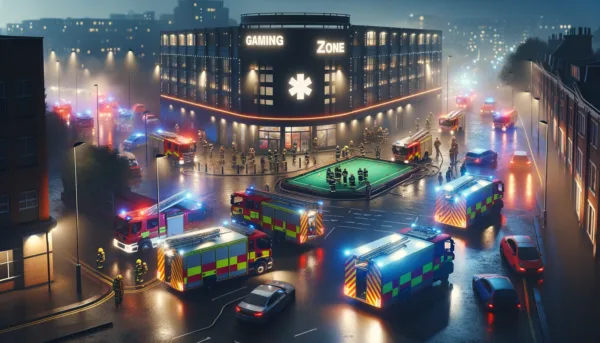
One explosive device had been concealed inside a roadside vehicle, while the second was hidden in a rubbish container. Syrian security forces detected both devices and were preparing to defuse them when the explosions occurred. The second blast detonated near an ambulance after security personnel and bystanders had gathered at the site.
Emmanuel Macron’s motorcade had left the hotel area shortly before the first explosion. The French president was safe at the presidential palace, where his meeting with Syrian President Ahmed al-Sharaa continued without interruption. The attack did not halt the visit, which produced renewed diplomatic representation and agreements covering reconstruction, banking, logistics, healthcare, transport and investment.
What happened during the July 7 bomb explosions near the Four Seasons Hotel in Damascus?
The explosions occurred in a busy government and cultural district between the Ministry of Tourism and the Damascus National Museum, across the road from the Four Seasons Hotel.
Syrian security personnel had identified two suspicious devices during field operations. Specialist teams began preparing to neutralise the explosives, but the devices detonated before the procedures could be completed.
The first bomb was located in a vehicle parked beside the road. The second was concealed in a rubbish container several metres away. Flames and thick smoke rose from the street after the first explosion, while the second device detonated close to an ambulance and people who had approached the scene.
The blasts damaged vehicles and left blood visible on the street. Syrian internal security personnel rapidly established a cordon, cleared nearby areas and began search operations for additional devices or suspects.
The Interior Ministry placed the injury toll at 18, including four police officers. The absence of reported deaths distinguished the attack from the July 2 café bombing elsewhere in central Damascus, which killed at least 10 people and wounded more than 20.
Investigators had not identified the perpetrators by the time Emmanuel Macron completed his official programme. The lack of an immediate claim meant responsibility could not be assigned to Islamic State, former Assad government loyalists or any other armed organisation without further evidence.
Was Emmanuel Macron directly threatened by the bombs during his historic Syria visit?
The devices exploded shortly after Emmanuel Macron’s motorcade departed the hotel area for the presidential palace. The timing created immediate concern that the bombs may have been connected with the French president’s presence, but Syrian authorities said the explosions occurred outside the security perimeter established for his accommodation.
Emmanuel Macron had already reached the People’s Palace and was meeting Ahmed al-Sharaa when the blasts occurred. The French delegation did not hear the explosions from the presidential convoy, and the visit continued as planned.
No available evidence established that the devices were designed specifically to attack Emmanuel Macron. Investigators will need to examine when the explosives were planted, whether the perpetrators knew the presidential schedule and whether the devices were intended to detonate during the passage of the motorcade.
The location nevertheless carried obvious political sensitivity. The Four Seasons Hotel has frequently accommodated foreign delegations, diplomats, United Nations personnel and senior officials visiting Damascus. An attack near the building during the first visit by a European Union head of state since Bashar al-Assad’s removal created a powerful international message regardless of the original target.
The incident will probably lead Syria and visiting governments to review hotel security, vehicle screening, roadside surveillance and the protection of diplomatic routes. International visits cannot become routine if security authorities remain unable to prevent explosive devices from being planted in central government districts.
Why is the Damascus attack a major security test for Ahmed al-Sharaa’s government?
Ahmed al-Sharaa has made international recognition, economic reconstruction and the restoration of central government authority the defining objectives of Syria’s post-Assad transition.
The July 7 explosions challenged all three objectives at the same time. The attack demonstrated that hostile actors retained the ability to plant multiple explosive devices near ministries, major hotels and cultural institutions in the centre of the capital.
Damascus had remained comparatively stable despite continuing violence in other parts of Syria. Two significant bomb attacks within five days therefore risk creating a perception that organised networks are attempting to establish a sustained campaign inside the capital.
The first attack struck a café near the Palace of Justice on July 2. The second occurred during a major presidential visit. The locations suggest an effort to target public confidence, government institutions and internationally visible areas rather than remote military positions.
Ahmed al-Sharaa’s government must now determine whether the two attacks were connected. Investigators will examine similarities in explosive construction, triggering systems, materials, surveillance methods and the movements of suspects before each incident.
A connection would suggest an organised cell with the ability to conduct repeated operations. Separate attacks would indicate that several hostile networks may be exploiting gaps in the capital’s security system.
The political consequences extend beyond public safety. Foreign investors, airlines, banks and governments will judge whether Syria can protect personnel, assets and diplomatic missions before increasing their presence in the country.
Could Islamic State be rebuilding an urban bombing network inside post-Assad Syria?
Islamic State has not claimed responsibility for the July 7 explosions, and any conclusion about its involvement would be premature. The organisation nevertheless remains one of the principal security threats facing Syria’s new government.
Islamic State lost its territorial caliphate in 2019 but retained underground cells, weapons networks and experienced operatives across parts of Syria and Iraq. Its activities have included ambushes, roadside bombs, assassinations and attacks on security forces.
The organisation declared a new phase of operations against Ahmed al-Sharaa’s government earlier in 2026. Islamic State considers the new Syrian leadership an enemy despite Ahmed al-Sharaa’s earlier history within armed Islamist movements.
Urban attacks can offer Islamic State strategic value even when they cause limited physical damage. Bombings in Damascus can attract international attention, undermine claims of national stability and discourage foreign governments from supporting the transition.
Former officers and soldiers connected with Bashar al-Assad’s government also remain potential sources of armed resistance. Syria experienced serious fighting in 2025 involving government forces and insurgents from the Alawite minority, as well as separate clashes involving Druze armed groups.
The government must avoid treating every security incident as part of one organisation’s campaign. Accurate attribution is necessary because countering Islamic State cells requires different intelligence and political responses from addressing former-regime networks, sectarian armed groups or criminal organisations.
Why did France and Syria continue diplomatic talks despite the central Damascus attack?
Ending the visit after the explosions could have handed the perpetrators a political victory by demonstrating that a limited attack was sufficient to interrupt Syria’s return to international diplomacy.
Emmanuel Macron instead continued his meetings with Ahmed al-Sharaa, Syrian officials, civil society representatives and business leaders. France and Syria presented the decision as evidence that the attack would not derail political and economic cooperation.
The visit marked the first journey to Syria by a European Union head of state since Bashar al-Assad was removed in late 2024. Emmanuel Macron had previously hosted Ahmed al-Sharaa in Paris and supported the removal of broad Western sanctions that restricted Syria’s financial and commercial relationships.
France and Syria agreed to restore full diplomatic representation by appointing ambassadors. France closed its embassy in Damascus in 2012 during the civil war and later restored a limited diplomatic presence without maintaining full ambassadorial representation.
Restoring ambassadors gives both governments a permanent channel for political, security and commercial engagement. It also places France in a stronger position to influence Syria’s approach to minority protection, terrorism, Lebanon, Kurdish integration and institutional reform.
The attack made security cooperation more urgent. France indicated that it was examining a redefined military and counterterrorism partnership with Syria, potentially including support from French special forces against Islamic State.
Any French military role would require clear legal authority, operational limits and coordination with Syrian institutions. It would also need to avoid creating the perception that Syria’s new government depends on foreign forces to secure its own territory.
What economic and reconstruction agreements survived the bombing during Macron’s visit?
The visit produced more than a dozen agreements and arrangements involving the French government, Syrian institutions and major French companies.
France and Syria began a process to return approximately €51 million in confiscated assets linked to Rifaat al-Assad, the late uncle of Bashar al-Assad. Returning the funds offers the Syrian government a symbolic recovery of wealth connected with the former ruling family, although the amount is small compared with the country’s overall reconstruction requirements.
CMA CGM reached a partnership covering logistics and air cargo handling at Damascus International Airport. Strengthening cargo infrastructure could help Syria import medicines, machinery and industrial components while improving access for exporters.
TotalEnergies entered discussions about a possible offshore energy exploration agreement. The company’s leadership indicated that unresolved insecurity continued to make a return to onshore oil operations impractical, showing how commercial interest remains constrained by security risk.
French support is also expected to cover damaged water and electricity systems in Homs, technical assistance for reforms at the Central Bank of Syria and institutional cooperation involving transport, healthcare and investment.
These projects are strategically important because Syria cannot rebuild through public finances alone. More than a decade of conflict damaged housing, power systems, roads, hospitals, schools and industrial facilities across the country.
International companies will require contracts that can be enforced, payments that can move through the banking system and security arrangements protecting workers and equipment. The July 7 explosions demonstrated that diplomatic recognition can advance more rapidly than the operating environment required for large private investments.
How could repeated Damascus bombings affect Syria’s investment and sanctions recovery?
Syria has achieved substantial diplomatic progress since the removal of Bashar al-Assad. Western sanctions have been reduced, governments have reopened official channels and companies have begun examining commercial opportunities.
Security incidents can slow this recovery even when governments remain politically committed. Companies assess risk differently from states because executives are responsible for employee safety, insurance costs, contractual performance and shareholder capital.
A bomb near a hotel used by an international delegation may lead insurers to raise premiums and companies to limit the number of foreign staff deployed in Syria. Businesses may prefer short visits, remote management or partnerships with local operators rather than permanent offices.
Banks may also apply greater scrutiny to Syrian transactions if security conditions threaten project completion or increase the risk of corruption, diversion and contract disputes.
The attack does not mean Syria has returned to nationwide civil war. Government institutions continued functioning, the presidential visit proceeded and there was no immediate indication that the explosions threatened control of Damascus.
However, reconstruction depends on confidence as well as physical control. Investors must believe that security conditions will improve over several years rather than fluctuate between diplomatic breakthroughs and sudden attacks.
Ahmed al-Sharaa’s government will therefore be judged on the investigation’s results. Arresting those responsible, explaining how the devices reached the area and preventing further attacks would provide greater reassurance than political declarations alone.
What should observers watch as Syria investigates the bombs and deepens ties with France?
The first question is whether Syrian investigators establish a connection between the July 7 devices and the July 2 café bombing. Similar components, communications or suspects could reveal an organised campaign targeting central Damascus.
The second question concerns the intended target. Evidence showing surveillance of Emmanuel Macron’s hotel or motorcade would transform the case from a general terrorist attack into a possible attempt against an international leader or diplomatic mission.
The third issue is whether the injury toll changes. Several victims required medical treatment, and authorities will need to provide updated information on their conditions.
The fourth issue is whether France converts security discussions into an operational agreement. Intelligence sharing, specialist training and assistance against Islamic State could become an early practical outcome of the restored diplomatic relationship.
The fifth issue involves implementation of the economic agreements. Cargo infrastructure, banking assistance, utilities projects and asset recovery will provide a measurable test of whether the visit produced lasting cooperation.
Syria’s transition now faces a difficult contradiction. International isolation is ending, but the state remains vulnerable to attacks intended to show that diplomatic recognition has moved faster than security consolidation.
What are the key takeaways from the Damascus bombings during Emmanuel Macron’s visit?
- Two improvised explosive devices detonated near the Ministry of Tourism, Damascus National Museum and Four Seasons Hotel on July 7, 2026, injuring 18 people, including four members of Syria’s police and internal security services.
- One bomb had been concealed inside a vehicle parked beside the road, while the second had been placed in a rubbish container and exploded near an ambulance after security teams and bystanders gathered nearby.
- Syrian security forces discovered the devices and began preparations to defuse them, but both exploded before the disposal operation could be completed, prompting a wider search and security cordon across the surrounding district.
- Emmanuel Macron’s motorcade departed the hotel area shortly before the first blast, and the French president was safely meeting Ahmed al-Sharaa at the presidential palace when the explosions occurred.
- No organisation immediately claimed responsibility, and the available evidence did not establish whether the bombs targeted Emmanuel Macron, Syrian institutions, civilians or the broader diplomatic symbolism of the visit.
- The explosions represented the second major bombing in central Damascus within five days, following a July 2 café attack near the Palace of Justice that killed at least 10 people.
- France and Syria continued the visit and agreed to restore ambassador-level diplomatic relations while advancing arrangements involving logistics, energy, banking reform, infrastructure, healthcare and the return of confiscated Syrian assets.
- The incident exposed the central challenge facing Syria’s transition: international recognition and commercial engagement are advancing, but sustained reconstruction will depend on whether the government can prevent repeated attacks and provide credible security.
Share this:
Discover more from Business-News-Today.com
Subscribe to get the latest posts sent to your email.