



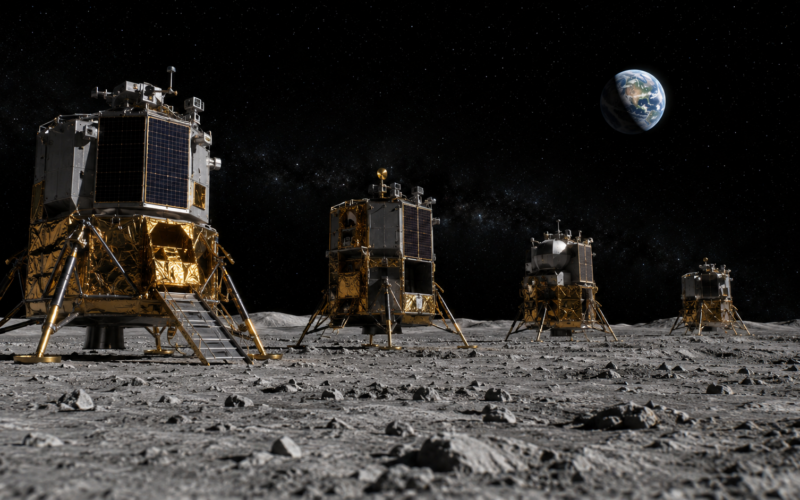
NASA has awarded four lunar-delivery task orders worth a combined $590.4 million to Astrobotic Technology Inc., Firefly Aerospace Inc. (Nasdaq: FLY) and Intuitive Machines Inc. (Nasdaq: LUNR) under the Commercial Lunar Payload Services initiative. Astrobotic Technology Inc. will receive $297.9 million for two missions, Firefly Aerospace Inc. has secured $144.2 million for one Blue Ghost delivery, and Intuitive Machines Inc. has received a contract valued at up to $148.3 million for a Nova-C mission. The four missions are expected to reach the Moon in late 2028 and will carry identical groups of NASA instruments designed to study landing hazards, radiation and lunar navigation. The awards move commercial lunar logistics closer to a repeatable procurement model rather than a sequence of isolated experimental missions. However, contract profitability will depend on manufacturing standardisation, launch reliability, milestone execution and whether the companies can avoid the cost overruns that have affected earlier fixed-price lunar programmes.
NASA is deliberately spreading the work across three providers rather than placing the full mission package with a single contractor. This reduces programme concentration while creating a direct comparison between different lander designs, production systems and operating teams.
The agency is also ordering the missions on an accelerated schedule. Each contractor is expected to use an updated version of a previously flown lander and apply lessons from earlier missions rather than begin another bespoke spacecraft design from scratch.
How is NASA’s $590 million lunar contract package divided among the three companies?
Astrobotic Technology Inc. received the largest share of the procurement, with $297.9 million covering two lunar deliveries. NASA has not publicly separated that amount into individual mission values, meaning the two awards should not automatically be treated as contracts of approximately $149 million each.
Firefly Aerospace Inc. received a $144.2 million task order for a new Blue Ghost mission to the Moon’s near side. The company expects to design, manufacture, test and deliver the mission in about two years, targeting launch during 2028.
Intuitive Machines Inc. received a firm-fixed-price award valued at up to $148.3 million. Unlike the Firefly Aerospace and Astrobotic announcements, Intuitive Machines provided a detailed division between the committed mission component and the performance-linked component.
The Intuitive Machines contract includes a $68.6 million base award for mission execution using the Nova-C lander. The remaining $79.7 million is a performance incentive tied to demonstrating a qualified production line capable of supplying landers on a repeatable and accelerated schedule.
That distinction makes the contract materially different from a simple $148.3 million fixed order. Intuitive Machines must achieve the production qualification requirements before the full incentive can be treated as earned revenue.
The combined NASA figure is therefore a procurement package involving several different commercial structures. It should not be presented as one contract, one backlog addition or one revenue opportunity attributable to a single supplier.

Why is NASA ordering the same scientific instruments on four separate lunar missions?
Each mission will carry the Stereo Camera for Lunar Plume Surface Studies, a Laser Retroreflector Array and a Linear Energy Transfer Spectrometer. Flying the same instruments on different landers and at different lunar locations will allow NASA to compare environmental conditions and vehicle performance across a broader operating sample.
The Stereo Camera for Lunar Plume Surface Studies will record how engine exhaust interacts with lunar soil during descent and landing. This information becomes increasingly important as NASA and commercial companies plan to land larger spacecraft, cargo and infrastructure near existing equipment.
Lunar dust can damage sensors, obscure surfaces and create risks for nearby systems. A heavier lander may throw soil and particles over a much wider area than the smaller vehicles used during early Commercial Lunar Payload Services missions.
The Laser Retroreflector Array acts as a permanent location marker. Orbiting spacecraft and future landers can use reflected laser signals to improve navigation, position measurement and the development of a wider lunar reference network.
The Linear Energy Transfer Spectrometer will measure radiation during transit and on the lunar surface. Radiation data will influence vehicle shielding, astronaut operations, equipment placement and the design of long-duration surface infrastructure.
Using identical payloads across four missions also gives NASA a form of operational benchmarking. The agency can compare data quality, landing conditions and mission performance without every scientific package being completely different.
Can Firefly Aerospace cut the Blue Ghost development cycle to approximately two years?
Firefly Aerospace intends to complete the new Blue Ghost mission in roughly half the time required for its first lunar mission. The company plans to rely on a build-to-print approach, using a standardised design rather than substantially redesigning the lander for every customer.
This strategy could improve manufacturing efficiency by allowing components, testing procedures and operating software to be reused across missions. It could also make supplier ordering more predictable and reduce engineering hours that do not generate additional customer value.
Firefly Aerospace has a significant advantage because its first Blue Ghost mission completed a successful lunar landing and surface operations. Real flight data can help engineers improve thermal management, landing procedures, communications and subsystem reliability.
The company is building several additional lunar missions for the Moon’s far side, the Gruithuisen Domes and the south polar region. That pipeline creates the possibility of producing landers and orbital vehicles in overlapping cycles rather than waiting for one mission to finish before beginning the next.
The challenge is that parallel production can increase cash requirements and operational complexity. Firefly Aerospace must procure long-lead components, staff several teams and maintain quality controls across vehicles at different stages of assembly.
Firefly Aerospace reported first-quarter revenue of $80.9 million but recorded a net loss of $96.7 million and negative free cash flow of $78.9 million. The company held $326.2 million of cash and $225.4 million of short-term investments at March 31, providing meaningful liquidity but also demonstrating the capital intensity of scaling launch and spacecraft operations.
The $144.2 million NASA contract is therefore strategically important but not automatically profitable. Firefly Aerospace must show that standardisation reduces unit costs faster than operating expenses and research spending continue to rise.
Why is Intuitive Machines’ $79.7 million performance incentive commercially important?
The performance incentive is intended to encourage Intuitive Machines to move beyond building landers as individual engineering projects. NASA wants evidence that Nova-C can be manufactured through a qualified production line with predictable quality and faster delivery cycles.
This creates meaningful upside if Intuitive Machines can demonstrate repeatability. The $79.7 million incentive is larger than the $68.6 million base mission value, showing that NASA places substantial value on industrial capacity rather than merely reaching the lunar surface once more.
The structure also transfers risk to Intuitive Machines. The company may need to invest in facilities, tooling, inventory, workforce and manufacturing systems before the full incentive becomes payable.
The contract is firm-fixed-price, meaning cost overruns may not be reimbursed automatically. Intuitive Machines must control design changes, supplier delays, launch costs and mission-specific engineering while meeting the qualification conditions.
This risk is not theoretical. Previous Intuitive Machines lunar task orders have become loss contracts when expected costs exceeded the consideration available under the fixed-price arrangements.
The new award may offer better economics if the Nova-C platform is sufficiently mature and production processes can be reused. However, the company must prove that manufacturing several similar vehicles creates genuine cost savings rather than several versions of the same expensive prototype.
Intuitive Machines entered the quarter with $1.1 billion of backlog after completing its acquisition of Lanteris Space Systems. The company generated first-quarter revenue of $186.7 million and positive adjusted EBITDA of $2.7 million, although it still reported a net loss attributable to common shareholders of $37.5 million.
The company also used $54.8 million of operating cash and held $231.6 million of unrestricted cash at March 31. Earning the full performance incentive could therefore matter materially to cash recovery and the economics of the Nova-C manufacturing expansion.
Why did NASA award Astrobotic two missions despite its earlier lunar setback?
Astrobotic Technology Inc. received the largest total award even though its earlier Peregrine mission failed to achieve a lunar landing. NASA’s decision indicates that the agency remains willing to fund companies that experienced technical failure when they can present a credible recovery plan and incorporate lessons from the mission.
Commercial Lunar Payload Services was designed partly to accept greater mission risk than traditional flagship NASA programmes. The agency is purchasing transportation services from private providers rather than designing, owning and controlling every spacecraft itself.
That model cannot function if one failed mission permanently removes every provider from future competitions. Early commercial aviation, launch services and satellite manufacturing all required repeated attempts before operational reliability became routine.
The award does not mean NASA has ignored the Peregrine outcome. Astrobotic will be expected to show how propulsion, spacecraft integration, testing, supplier oversight and mission operations have changed before the new missions proceed.
Receiving two missions also creates concentration within Astrobotic’s own operating schedule. The private company must manage two lander programmes while maintaining adequate financing, engineering capacity and supplier support.
Astrobotic does not publish the same detailed financial information as Firefly Aerospace and Intuitive Machines. This makes it harder for external observers to assess liquidity, expected margins and the amount of corporate capital needed before milestone payments are received.
The $297.9 million award provides a major commercial opportunity, but mission success will matter more than order size. Another failure would raise serious questions about whether NASA can continue assigning large delivery packages to the company.
Does NASA’s multi-provider strategy reduce risk or create unnecessary duplication?
Awarding four missions to three providers gives NASA redundancy. A delay or technical problem at one contractor should not automatically stop the entire lunar science campaign.
The structure also preserves competition. Firefly Aerospace, Intuitive Machines and Astrobotic must continue improving reliability, pricing and delivery speed if they want to win subsequent Commercial Lunar Payload Services task orders.
Competition can prevent the commercial lunar market from becoming dependent on a single lander architecture. It also gives NASA access to different payload capacities, landing capabilities and mission profiles.
The disadvantage is duplication. Three companies must maintain engineering teams, manufacturing facilities, mission-control systems, supplier networks and regulatory capabilities for a market that remains heavily dependent on NASA demand.
If commercial customers do not emerge at sufficient scale, the industry may struggle to support several financially sustainable lander providers. NASA could eventually face pressure to consolidate awards around the contractors with the strongest reliability and balance sheets.
The current procurement appears designed to delay that consolidation while the agency collects more evidence. By ordering similar instruments on multiple missions, NASA can compare providers under more consistent operating requirements.
The strategy therefore resembles a competitive flight test conducted through commercial contracts. The companies are being paid to deliver science, but they are also proving whether their business and production models can support a higher mission cadence.
Could the late-2028 schedule create launch, supply-chain and working-capital bottlenecks?
Four lunar missions targeting the same broad period will compete for launch availability, specialised components, testing infrastructure and experienced personnel. Even when contractors use different landers, many suppliers serve the same wider spacecraft and launch markets.
Long-lead items such as propulsion components, radiation-hardened electronics, communications hardware and precision sensors may need to be ordered well before final assembly. A delay in one critical component can affect integration and environmental testing.
Launch procurement represents another risk. Lunar missions require specific performance, trajectory and scheduling conditions, while launch providers must balance government, commercial and national security customers.
The companies may also face milestone mismatches. Suppliers frequently require deposits or progress payments before the contractor receives the corresponding customer milestone from NASA.
This creates working-capital pressure even when a contract is expected to generate an acceptable margin. Companies with several overlapping missions may need to fund inventory and engineering across multiple vehicles simultaneously.
Insurance and mission failure provisions will also influence economics. The public announcements do not provide enough detail to determine which costs remain with the contractors if launch or landing objectives are not achieved.
The late-2028 target is ambitious but achievable if the companies truly reuse qualified designs. It becomes far more difficult if mission requirements expand, manufacturing changes prove larger than expected or launch schedules move.
Why did Firefly Aerospace and Intuitive Machines shares react differently to the awards?
Firefly Aerospace shares closed at $28.90 on July 2 and were up approximately 13.2% over five trading days. The stock remained down around 19.9% over one month and traded within a 52-week range of $16.00 to $73.80.
Intuitive Machines shares closed at $19.58 and were down approximately 1.1% over five trading days. The stock had fallen around 33.3% over one month and remained within a 52-week range of $7.78 to $46.75.
The different performance does not necessarily mean investors preferred Firefly Aerospace’s smaller contract. Share prices were also responding to broader space-sector sentiment, company-specific developments, valuation changes and profit-taking after earlier rallies.
Firefly Aerospace’s successful Blue Ghost landing provides a clear operational reference for the new contract. Investors may view the company’s plan to reuse a proven design as reducing technical risk.
Intuitive Machines has broader backlog and higher current revenue after the Lanteris Space Systems acquisition, but the market must evaluate a more complex company and a contract where more than half the potential value depends on performance qualification.
Short-term trading also reflects expectations already embedded in each stock. A contract can be strategically positive and still produce a weak market reaction when investors had anticipated the award or remain concerned about valuation and cash use.
The market response therefore reinforces the need to examine contract economics rather than simply headline value. Investors are distinguishing between successful landing history, conditional revenue, manufacturing risk and the capital needed to execute.
What future NASA procurements could expand the commercial lunar contract pipeline?
NASA has indicated that it expects to seek proposals for additional science payload deliveries, a power and avionics technology demonstration and a south polar optical imaging mission. The agency is also considering future cargo opportunities involving the PROMISE rover.
A separate communications and navigation relay constellation could create contract opportunities for companies offering lunar orbiters, ground stations, positioning services and data networks. This would expand the market beyond transportation to the infrastructure required for regular surface operations.
Firefly Aerospace and Intuitive Machines are both developing broader space-service portfolios. Firefly Aerospace combines launch, lunar landers, orbital vehicles and defence-oriented software, while Intuitive Machines is building communications, navigation, spacecraft manufacturing and mission operations capabilities.
Astrobotic is also seeking to participate across lunar transportation, power and surface systems. The competition may therefore shift from individual landing contracts toward bundled infrastructure services.
Future awards will depend heavily on the performance of the current mission pipeline. NASA will examine schedule discipline, data delivery, landing accuracy, payload survival and the contractors’ ability to resolve anomalies.
Successful missions could generate follow-on orders and attract non-NASA customers. Repeated failures could cause NASA to narrow the supplier base, impose additional oversight or redesign the commercial procurement model.
The $590.4 million package is therefore both a substantial revenue opportunity and an industry qualification exercise. NASA is not only buying four trips to the Moon. It is testing which companies can turn lunar transportation from an occasional spectacle into a dependable service.
Key takeaways on what NASA’s $590 million lunar contracts mean for the space industry
- NASA awarded four late-2028 lunar-delivery missions worth a combined $590.4 million across three providers.
- Astrobotic Technology Inc. received $297.9 million for two missions, the largest total allocation in the package.
- Firefly Aerospace Inc. received a $144.2 million Blue Ghost contract designed around a two-year development cycle.
- Intuitive Machines Inc. received a $68.6 million base award plus a $79.7 million performance incentive.
- The full $148.3 million Intuitive Machines value should not be treated as guaranteed revenue before production qualification is achieved.
- NASA is using repeated instruments and previously flown lander designs to compare reliability and environmental data across providers.
- Fixed-price structures create margin risk when launch delays, supplier problems or design changes increase mission costs.
- Firefly Aerospace enters the programme with a successful Blue Ghost landing but continues to report substantial losses and cash consumption.
- Intuitive Machines has a $1.1 billion backlog and positive adjusted EBITDA, but earlier lunar missions have demonstrated the risk of loss-making contracts.
- Mission execution in 2028 will influence which providers receive larger cargo, communications and lunar infrastructure awards.
Discover more from Business-News-Today.com
Subscribe to get the latest posts sent to your email.