




Strategic Minerals plc, listed on London’s AIM market under the ticker SML, has spent the past year transforming from a sleepy small-cap magnetite producer into one of the more closely watched names in UK critical minerals. The company’s Redmoor project in Cornwall has just returned an updated resource estimate showing a 49% jump in tonnage, and planning permission for a major expansion of drilling has just been approved. With a pre-feasibility study now underway and a share price that has moved sharply over the past year, retail investors on AIM forums are asking whether Redmoor can genuinely become a domestic source of tungsten for Western supply chains, and what has to happen next for that thesis to play out.
What does Strategic Minerals actually do across its Cornwall, US and Australian mining assets?
Strategic Minerals is not a single-project explorer. The company generates real, if modest, revenue today from the Cobre magnetite operation in New Mexico, which has been producing since 2012 and sells magnetite into markets ranging from cement and fertiliser to water jet cutting and coal cleaning. Cobre brought in $4.2 million of revenue in 2025 with operating margins around 85%, giving the group a cash-generative base that is unusual for a company of its size.
The strategic significance of Cobre is that it funds activity elsewhere. Strategic Minerals also holds an interest in the Leigh Creek copper project in South Australia, which the company has been progressing toward disposal, and a 50% interest in the Redmoor tungsten-tin-copper-silver project in Cornwall through its wholly owned subsidiary Cornwall Resources Limited. Redmoor is where almost all of the market’s attention is currently focused.
The risk for investors is that Cobre’s cash flow, while real, is small relative to the capital Redmoor will eventually require. The company has said it does not intend to return to the market for further dilutive fundraising to complete feasibility work, but that intention has not yet been tested against the full cost of a pre-feasibility and definitive feasibility study, both of which remain pending.
Why is the Redmoor tungsten project being called Europe’s highest grade undeveloped deposit?
Redmoor sits in the historically significant Tamar Valley Mining District in Cornwall, on ground that was originally mined in the 18th century until falling tin prices closed it in 1892. Strategic Minerals acquired the project in 2019 and has spent recent years re-exploring it with modern techniques. A JORC-compliant inferred mineral resource estimate published in March 2026 put the resource at 17.4 million tonnes at 0.65% tungsten trioxide equivalent, a 49% increase in tonnage compared with the previous 2019 estimate.
The scale of the potential is what has drawn attention. The company has said Redmoor has the potential to supply around 30% of Europe’s tungsten needs alongside meaningful tin and copper output, positioning it within the broader push to build Western critical minerals supply chains that do not depend on China, which dominates global tungsten production. An economic sensitivity analysis published alongside the resource update indicated a base-case after-tax net present value of $1.54 billion and a 40% internal rate of return, using a tungsten price of $1,200 per metric ton unit of ammonium paratungstate, a figure the company noted was below market prices of $2,500 to $2,800 per metric ton unit at the time.
None of this is a resource in production, and the numbers are sensitivity modelling rather than a completed feasibility study. The 29-year mine life quoted alongside the analysis assumes a production rate carried over from a 2020 scoping study, and management itself has said the forthcoming pre-feasibility study will test whether that production rate can be improved. Investors reading the headline valuation figures should treat them as an indication of scale rather than a confirmed investment case.
What happened in the June drilling campaign that has AIM investors watching drill hole CRD044?
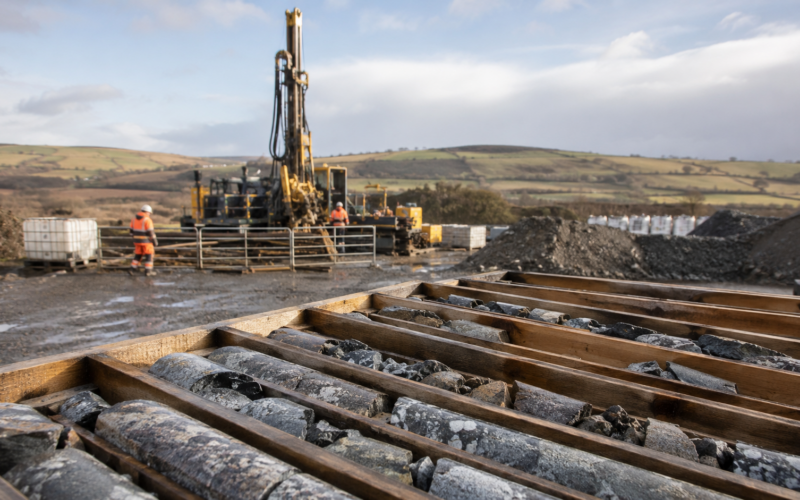
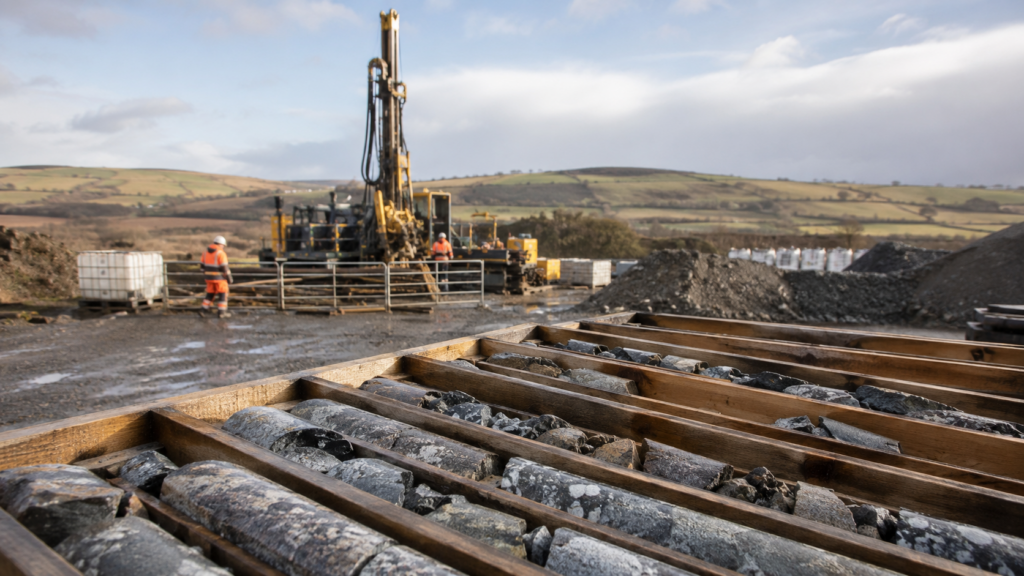
The company’s resource infill drilling programme has been the main newsflow driver through the first half of 2026. Drill hole CRD042 was completed in early May at a depth of 464.4 metres, intersecting the full extent of what the company calls the Redmoor Sheeted Vein System, the main mineralised structure containing wolframite, cassiterite and chalcopyrite, the ore minerals for tungsten, tin and copper respectively. CRD043 followed in early June at a similar depth, extending further than planned because mineralised structures continued below the main vein system.
Drill hole CRD044, completed on 25 June at 526.1 metres, intersected both the full thickness of the vein system and the Kit Hill granite beneath it, including a mineralised granite roof zone. A daughter hole, CRD044_D1, is now underway specifically to collect metallurgical samples for the pre-feasibility and feasibility work, rather than to extend the resource itself.
For a retail investor, the pattern to watch is straightforward. Each hole that successfully intersects the vein system adds confidence to the resource model and moves the project closer to converting inferred tonnes into the higher-confidence indicated category, which is a prerequisite for any bank or partner to take a development decision seriously. The risk sits in assay turnaround and in the possibility that later holes intersect narrower or lower-grade sections, which would not necessarily kill the story but would complicate the market’s current enthusiasm.
How does the newly approved expanded drilling programme change Redmoor’s timeline toward 2027?
Cornwall Council’s Mineral Planning Officer has approved, under delegated authority, an expanded diamond drilling programme at Redmoor that the company describes as likely to be the largest continuous drilling programme in Cornwall and Great Britain this century. The approval allows Cornwall Resources to mobilise two additional drill rigs, with the option of a third, and permits up to three years of continuous operations. The expanded programme itself, covering 22,500 metres across at least 44 drillholes, is currently planned for completion by the second quarter of 2027.
The purpose of the expansion is to advance the resource from inferred to indicated status while simultaneously gathering geotechnical, metallurgical and hydrogeological data needed for the pre-feasibility study. Running these workstreams in parallel is a deliberate attempt to compress the multi-year timeline that a typical underground project would otherwise take.
The trade-off for shareholders is that a three-year drilling permission does not mean the company intends to spend three years before delivering the pre-feasibility study; management has indicated it wants to move faster than that. But planning permission of this scale also signals that the company itself expects Redmoor’s development pathway to run well beyond 2026, and retail investors pricing in a near-term production decision should recalibrate against that longer runway.
What do the economic sensitivity numbers actually mean for shareholders watching the share price?
Strategic Minerals shares have moved dramatically over the past year, trading as low as 0.27p and as high as 7.30p, and changing hands around 5.00p in mid-June 2026 with a market capitalisation of roughly £140 million. That represents an extraordinary re-rating from where the stock traded before the Redmoor resource work began attracting attention, and the company’s own six-month share price performance has outpaced both the broader UK market and the UK metals and mining sector by a wide margin.
Consensus analyst coverage, where it exists, has been broadly positive, with at least one tracked price target implying substantial further upside from current levels. Zeus Capital has published research initiating coverage on Redmoor that included commentary on additional value from the project’s silver by-product. However, some independent screening services have flagged the stock as technically overbought and have pointed out that conventional valuation metrics such as price-to-earnings ratios are not meaningful given the company’s small underlying losses at the group level.
The practical read for a retail investor is that the share price today is already reflecting a significant amount of optimism about Redmoor’s eventual development, not just its exploration success to date. That means the stock’s near-term direction is likely to be more sensitive to drilling results, the pre-feasibility study outcome and tungsten price moves than to Cobre’s steady but modest cash generation.
How exposed is Strategic Minerals to global tungsten prices and the Western critical minerals push?
Tungsten sits on most Western governments’ critical minerals lists because of its use in cutting tools, armour-piercing ammunition, aerospace components and electronics, and because China controls the large majority of global mine supply and processing capacity. That concentration has pushed tungsten prices well above the levels used in Strategic Minerals’ own base-case economic analysis, with the company explicitly noting its modelling used a conservative price assumption relative to the market price at the time.
This macro backdrop is central to the retail investment case. A UK-based, fully permitted tungsten resource of scale would sit directly in the path of government and industrial buyers looking to reduce dependence on Chinese supply, and the UK government’s Shared Prosperity Fund has already provided match grant funding to support Redmoor’s exploration work, an indication of some public sector interest in the project’s strategic framing.
The risk is that tungsten prices, like most commodity prices, are cyclical and geopolitically sensitive. A period of falling prices, or a shift in trade policy that increases Chinese export availability, would compress the economics the company has presented, even if the underlying geology remains unchanged. Investors should treat the current pricing environment as a tailwind rather than a permanent feature of the investment case.
Why does the Cobre magnetite business in New Mexico matter to a story about Cornish tungsten?
It is easy for a retail investor scrolling AIM forums to focus entirely on Redmoor and overlook Cobre, but the magnetite operation plays a specific structural role. Cobre has produced consistent revenue since 2012, and management has pointed to Cobre’s cash flow as part of the reason the company believes it can fund Redmoor’s pre-feasibility work without further dilutive equity raises, alongside the roughly $10.76 million cash balance reported at the end of May 2026 following two fundraisings earlier in the year.
The company has also been progressing the disposal of its Leigh Creek copper interest in South Australia, which forms part of a broader strategy of simplifying the portfolio and redirecting capital and management attention toward Redmoor. A successful sale would add to the cash position, though the timing and terms of any such disposal remain pending.
The dependency risk runs in both directions. If Cobre’s magnetite sales were to soften, or if commodity or operational issues in New Mexico disrupted output, the company’s stated intention to avoid further dilution while funding Redmoor’s feasibility work would come under pressure sooner than current cash projections suggest.
What are AIM forum investors saying about Strategic Minerals ahead of the pre-feasibility study?
Strategic Minerals has developed an active retail following on UK share forums, visible in the reaction to its recent fundraisings and drilling updates. Commentary around the company’s March 2026 placing, which was priced at a discount to the prior close and led by an international investor, generated debate among forum participants about who the investor was and what it signalled about institutional confidence in the story. Other posts have focused on the multi-metal nature of the deposit, with some investors highlighting the tin, copper and silver credits at Redmoor as an underappreciated source of additional value beyond the headline tungsten numbers.
This kind of forum engagement matters commercially because AIM small-caps depend heavily on retail liquidity, and a stock that generates sustained community discussion tends to see more consistent trading volume around news events than one that does not. Strategic Minerals’ presence at industry events, including a June appearance at the UK Mining Conference in Cornwall where the company presented a project update, has reinforced that visibility.
The caution worth flagging is that forum sentiment on any AIM stock tends to be strongly bullish by nature, since it self-selects for existing or prospective holders. Retail investors should weigh community enthusiasm alongside the company’s own regulatory news announcements rather than as a substitute for them, particularly given how far the shares have already re-rated over the past year.
Key takeaways for retail investors watching Strategic Minerals
- Strategic Minerals (AIM: SML) combines a small but cash-generative US magnetite business with a UK tungsten project, Redmoor, that has driven almost all of the recent share price movement.
- Redmoor’s March 2026 resource update showed a 49% increase in tonnage to 17.4 million tonnes, with an economic sensitivity analysis pointing to a base-case NPV of $1.54 billion, though this is preliminary modelling rather than a completed feasibility study.
- Newly approved planning permission allows an expanded drilling programme of 22,500 metres, with completion currently planned for the second quarter of 2027, indicating a longer development runway than some recent share price enthusiasm may imply.
- A cash balance of roughly $10.76 million as of end-May 2026, built from two 2026 fundraisings plus Cobre’s revenue, is intended to fund the company through completion of the pre-feasibility study without further dilution, though this has not yet been tested.
- The shares have moved from 0.27p to as high as 7.30p over the past year, trading around 5.00p in mid-June 2026 with a market capitalisation near £140 million, meaning much of the exploration optimism is already reflected in the price.
- Tungsten’s status as a Western critical mineral, given China’s dominance of global supply, underpins the strategic case for Redmoor, but commodity price cycles and geopolitical shifts remain a genuine risk to the project’s economics.
- Active AIM forum engagement has supported trading liquidity in the stock, but retail investors should treat forum sentiment as a supplement to, not a substitute for, the company’s own regulatory announcements.
Discover more from Business-News-Today.com
Subscribe to get the latest posts sent to your email.