





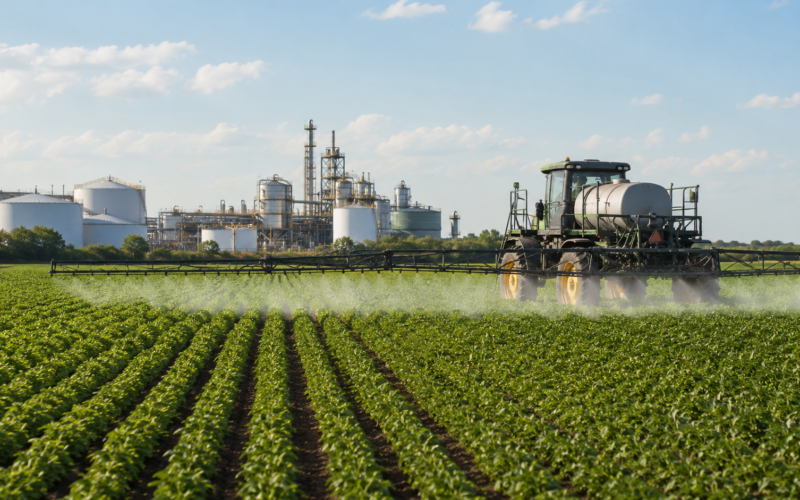
Bayer Group has consolidated its U.S. glyphosate business, including Roundup-branded herbicides, into Ruveon LLC, a distinct Bayer-owned entity responsible for pricing, go-to-market strategy, production and logistics. The restructuring places the business under dedicated leadership as Bayer Group confronts commodity pricing pressure, import competition, farmer affordability concerns and a changing litigation environment.
Why Bayer’s Ruveon structure is a commercial separation rather than a true corporate exit
Ruveon LLC should not be interpreted as a sale, spin-off or withdrawal by Bayer Group from the U.S. glyphosate market. The new entity remains within Bayer Group and is based in St. Louis, Missouri, while the product and commercial teams previously handling U.S. glyphosate operations have moved into the dedicated structure. Alfonso Alba Ordóñez has been appointed chief executive officer, while Steve Knodle will oversee commercial activities covering agricultural, industrial, turf and ornamental customers.
The most important change is therefore operational accountability. Glyphosate will no longer compete as directly for management attention with Bayer Group’s broader seeds, traits and crop-protection portfolio. Ruveon can make decisions around inventory, pricing, customer segmentation and distribution based on the economics of glyphosate rather than the priorities of a diversified agricultural platform.
This distinction matters because glyphosate is increasingly managed as a high-volume, price-sensitive product exposed to global manufacturing capacity and generic competition. Its commercial requirements differ from those of proprietary crop-protection technologies or genetically engineered seed traits, where intellectual property, regulatory exclusivity and product differentiation can support higher margins.
A dedicated business could improve transparency and execution, but the announcement does not establish that historical Roundup liabilities have been transferred to Ruveon or legally isolated from Bayer Group. The structure may ring-fence commercial decision-making, yet there is no disclosed basis for assuming that it creates a liability shield, removes litigation provisions from Bayer Group’s accounts or reduces the parent organisation’s financial responsibility for existing claims.
How dedicated control of glyphosate pricing and logistics could change Bayer’s U.S. economics
Glyphosate-based product sales have been under visible pressure. Bayer Group reported that first-quarter 2026 sales from glyphosate-based products declined 15.1% on a currency-adjusted and portfolio-adjusted basis to €478 million. Customers delayed purchases in North America and Europe, while lower-cost generic supply continued to influence purchasing behaviour and market prices.
Ruveon gives management a narrower platform from which to respond. Pricing, production scheduling, logistics and customer strategy can now be evaluated together rather than across separate Bayer Group functions. That could allow Ruveon to adjust manufacturing volumes more quickly when distributors reduce inventories, improve working-capital discipline and tailor commercial terms to different agricultural regions.
The potential advantage is not necessarily higher prices in every market cycle. A specialised operator could instead pursue greater consistency between production and demand, reducing the risk of excess inventory when global glyphosate prices weaken. It could also place greater emphasis on service, formulation quality, domestic availability and supply reliability when imported products are cheaper.
However, the commodity nature of glyphosate limits how far organisational restructuring alone can improve profitability. Farmers and distributors can compare products largely on price, concentration, formulation, availability and application performance. Ruveon will therefore need to demonstrate that domestic production, branded products and customer support create enough value to justify any price difference from generic alternatives.
The business also remains exposed to agricultural commodity prices and farm income. When corn and soybean margins are compressed, growers may delay purchases, reduce discretionary applications or choose lower-priced formulations. Dedicated management may improve reaction speed, but it cannot eliminate the underlying cyclicality of the agricultural inputs market.
Why the timing after Bayer’s Supreme Court victory matters for the Roundup business reset
The Ruveon launch follows a major legal development for Bayer Group. On June 25, 2026, the U.S. Supreme Court ruled 7-2 in the Durnell case that federal pesticide law preempts certain state failure-to-warn claims where the U.S. Environmental Protection Agency has approved a product label without the warning sought by plaintiffs.
The ruling substantially improves Bayer Group’s position because failure-to-warn allegations have formed the central theory in much of the Roundup litigation. It could make many existing claims more difficult to pursue and reduce the likelihood of similar warning-based cases succeeding in the future.
That legal shift creates a more stable environment in which to redesign the commercial business. Before the ruling, Bayer Group had warned that persistent litigation uncertainty could threaten the economic viability of domestic glyphosate production. Establishing Ruveon shortly after the decision suggests that Bayer Group now sees a clearer path to operating the business rather than preparing for a complete U.S. exit.
The decision does not erase every legal risk. It addresses a specific preemption question and does not automatically eliminate claims based on different legal theories, disputes already governed by settlement arrangements or challenges to the proposed nationwide resolution. Bayer Group’s $7.25 billion class settlement also remains an important part of its wider strategy for addressing current and potential future claims involving alleged non-Hodgkin lymphoma injuries.
Ruveon will consequently begin operating during a legal transition rather than after the litigation has been conclusively closed. Its management will need to rebuild customer confidence and improve commercial performance while Bayer Group continues addressing settlement approvals, objections and remaining legal proceedings.
How the Chinese import dispute creates opportunity and affordability risk for Ruveon
The formation of Ruveon also coincides with Monsanto Company’s petitions seeking antidumping and countervailing duties on glyphosate imported from China. Bayer Group has argued that subsidised and unfairly priced imports are undermining the sustainability of domestic production. Monsanto Company is currently the only U.S. manufacturer of glyphosate, giving the trade dispute direct implications for Ruveon’s future economics.
Trade protection could support domestic prices and improve capacity utilisation at U.S. manufacturing operations. A successful petition may reduce the price gap between Ruveon products and Chinese imports, allowing the Bayer-owned entity to recover a greater portion of its manufacturing and regulatory costs.
The strategic logic is straightforward. Creating a dedicated domestic glyphosate operator has limited value if imported material can consistently enter the market at prices that make U.S. production uneconomic. Ruveon’s commercial restructuring and Monsanto Company’s trade petitions therefore appear to address different parts of the same problem: improving the long-term viability of Bayer Group’s U.S. glyphosate presence.
The risk is that duties could increase costs for farmers. Corn and soybean producers have faced pressure from weak agricultural margins, elevated equipment expenses and volatile fertiliser and chemical prices. Agricultural organisations have warned that restricting lower-priced imports could reduce competition and raise herbicide costs at an already difficult point in the farm cycle.
Ruveon must therefore navigate a sensitive position. It needs pricing that supports domestic manufacturing without appearing to use trade remedies merely to raise prices. Its ability to explain supply reliability, manufacturing standards and product value may become as important as the legal outcome of the trade proceedings.
What Ruveon could change for farmers, distributors and industrial customers
For agricultural customers, the most immediate benefit could be clearer accountability. A business focused exclusively on U.S. glyphosate may respond faster to regional demand changes, seasonal inventory requirements and transportation disruptions. Distributors could also gain a more direct commercial interface for pricing, forecasting and product allocation.
That operational focus may be particularly valuable during planting and weed-control windows, when delays can affect crop performance and growers have limited flexibility to wait for replacement supply. Domestic production can provide a strategic advantage when shipping, tariffs or international trade flows become unpredictable.
Ruveon could also develop differentiated approaches for agricultural, industrial, turf and ornamental customers rather than treating them as extensions of one broad crop-protection market. These segments have different purchasing cycles, application requirements, formulation preferences and distribution channels.
Nevertheless, customers will judge the new entity by measurable outcomes rather than its organisational identity. Reliable delivery, competitive prices, formulation consistency and responsive technical support will matter more than the creation of a separate corporate name.
There is also a branding challenge. Roundup remains one of the world’s most recognisable herbicide brands, while Ruveon has no comparable customer history. Bayer Group appears likely to preserve Roundup as a product brand while using Ruveon as the operating organisation behind the U.S. glyphosate portfolio. Managing that relationship carefully will be essential to avoid customer confusion.
Why Bayer still faces scientific and reputational uncertainty despite legal progress
The Supreme Court ruling resolves an important question concerning federal and state labelling requirements, but it does not settle the broader scientific and public debate surrounding glyphosate.
The U.S. Environmental Protection Agency has maintained that glyphosate is not likely to be carcinogenic to humans when evaluated under its regulatory framework and used in accordance with approved labels. The International Agency for Research on Cancer classified glyphosate as probably carcinogenic to humans in 2015, based on limited evidence in humans, sufficient evidence in experimental animals and mechanistic evidence.
These conclusions arise from different assessment frameworks. Hazard classification examines whether an agent is capable of causing cancer under some circumstances, while regulatory risk assessment also considers exposure levels, approved uses and the likelihood of harm under expected conditions. The distinction is scientifically important, but it has often been lost in public discussion and courtroom arguments.
Ruveon inherits this reputational complexity even if Bayer Group retains responsibility for litigation strategy. The new operator will need to maintain regulatory compliance, product stewardship, worker-safety communication and transparent engagement with customers. A more commercially focused structure cannot afford to treat safety communication as secondary to pricing or distribution.
Regulatory requirements may also evolve. Glyphosate remains subject to registration reviews, ecological assessments and political scrutiny. Changes affecting permitted uses, application practices, environmental protections or label language could alter the commercial outlook even after Bayer Group’s Supreme Court victory.
Why stabilising glyphosate cash flow could matter to Bayer’s pharmaceutical investment capacity
Although Ruveon operates within Crop Science, its performance has implications for Bayer Group’s pharmaceutical and biotechnology strategy. Roundup litigation has absorbed substantial cash, increased provisions and contributed to years of investor concern following the acquisition of Monsanto Company.
Bayer Group recorded a net loss of €3.62 billion for 2025 after significant litigation-related charges. The group also projected that litigation payments would place heavy pressure on free cash flow during 2026. These financial demands compete with investment requirements across pharmaceutical research, clinical development, product launches and business development.
Bayer Group is simultaneously managing declining revenue from mature pharmaceutical products and investing behind newer medicines such as Nubeqa, Kerendia and recently launched pipeline assets. Restoring predictable cash generation from Crop Science would provide greater flexibility to fund those priorities while reducing debt.
Ruveon will not solve Bayer Group’s balance-sheet constraints on its own. Glyphosate remains only one part of Crop Science, and the group’s financial position continues to depend on pharmaceutical performance, settlement payments, currency movements, operational savings and broader agricultural market conditions.
However, a commercially stable glyphosate operation combined with reduced legal uncertainty could remove one of the most persistent distractions facing management. For healthcare-sector observers, that is the primary significance of Ruveon. The entity may be an agricultural business, but its success or failure could influence how much capital Bayer Group can direct toward pharmaceutical innovation.
What investors and industry observers should watch as Ruveon begins operating independently
The first test will be whether Ruveon can reverse declining glyphosate sales without relying exclusively on higher prices. Volume trends, distributor inventory levels and domestic production utilisation will indicate whether the specialised structure is improving execution.
The second test concerns trade policy. Any preliminary determination on Chinese glyphosate imports could influence Ruveon’s pricing power, farmer purchasing costs and relationships with major agricultural associations. A favourable trade ruling for the producer may not be viewed as favourable by its customers.
Legal developments will remain equally important. Progress toward final approval of Bayer Group’s proposed settlement, the treatment of claims outside the settlement and the practical application of the Supreme Court decision will determine how much litigation uncertainty truly remains.
Ruveon’s financial disclosure will also matter. Bayer Group has not indicated whether the entity will report detailed standalone sales, earnings, cash flow or liabilities. Greater transparency would help stakeholders determine whether the restructuring is generating operational value or merely moving existing activities into a new organisational container.
The creation of Ruveon is therefore a meaningful strategic action, but not yet proof of a successful turnaround. Bayer Group has created the structure for faster decisions and sharper commercial accountability. The next phase will reveal whether that structure can protect domestic manufacturing, remain affordable for farmers, restore glyphosate profitability and reduce the financial strain that the Roundup business has imposed on the wider Bayer Group.
Share this:
Discover more from Business-News-Today.com
Subscribe to get the latest posts sent to your email.

