



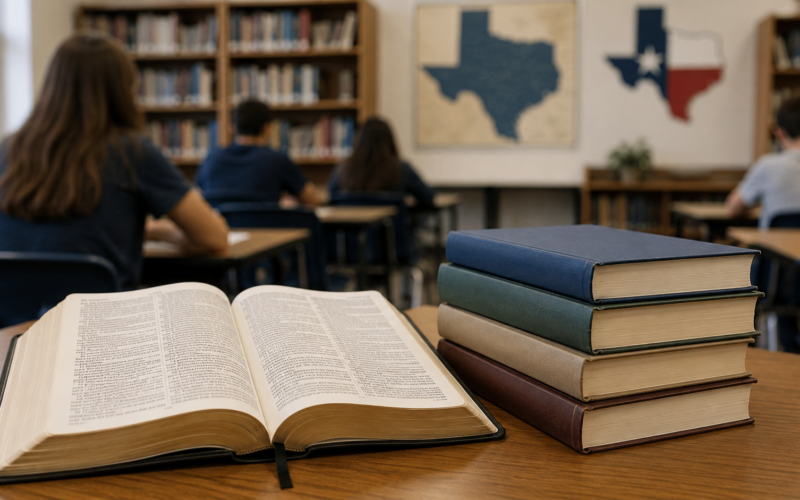
The Texas State Board of Education approved a mandatory reading list on June 26, 2026, that requires Bible stories and passages to be taught to more than five million public-school students from elementary through high school. The Republican-controlled board adopted the list in a 9 to 5 vote, with one member absent, and the requirements are scheduled to begin taking effect in the 2030 academic year.
The list contains about 200 books, essays, poems and supporting texts. Most selections are not religious, but required materials include the stories of David and Goliath and Daniel in the lions’ den, passages about Jesus, the Sermon on the Mount, sections of Job and Lamentations, the story of Adam and Eve and the parable of the prodigal son. Students will also read established literary works including Charlotte’s Web, Great Expectations, Pride and Prejudice and The Tragedy of Julius Caesar.
Supporters argue that biblical literature has influenced American language, political thought, culture and moral traditions and should therefore be studied alongside other foundational texts. Opponents say Texas is moving beyond neutral literary instruction and requiring public schools to privilege Christian teachings in classrooms attended by children from many religions and by students with no religious affiliation.
The decision is likely to become a major test of the constitutional boundary between teaching about religion and conducting state-directed religious instruction. The United States Supreme Court has previously ruled that public schools may teach the Bible objectively as literature or history, but may not organise devotional Bible readings or use government authority to advance religious belief.
What Bible stories and religious passages will Texas students be required to read?
Elementary-school selections include illustrated versions of David and Goliath and Daniel in the lions’ den. By fourth grade, students will encounter passages concerning Jesus in the New Testament, while third-grade students will also read E.B. White’s Charlotte’s Web. A proposed Noah’s Ark picture book was removed from the first-grade list after concerns were raised about its limited text and descriptions of animals dying in the flood.
Middle-school students will study several passages about Jesus, including portions of the Sermon on the Mount and a passage encouraging people to reject earthly anxiety and seek the kingdom of God. The list also connects the Book of Lamentations, which describes the destruction of Jerusalem, with materials concerning the Holocaust.
High-school students will read the parable of the prodigal son, sections of the Book of Job and the account of Adam and Eve. Some biblical passages are listed as supporting materials for major literary works by authors including Charles Dickens and Jane Austen, allowing teachers to explore religious references, themes and language that appear throughout Western literature.
The wider list includes classical literature, Aesop’s fables, Native American stories and a children’s adaptation of Don Quixote. Students reading Shakespeare’s The Tragedy of Julius Caesar will also be required to study a eulogy for former United States President Ronald Reagan written by former British Prime Minister Margaret Thatcher.
Why did Texas create a mandatory statewide list instead of allowing teachers to choose?
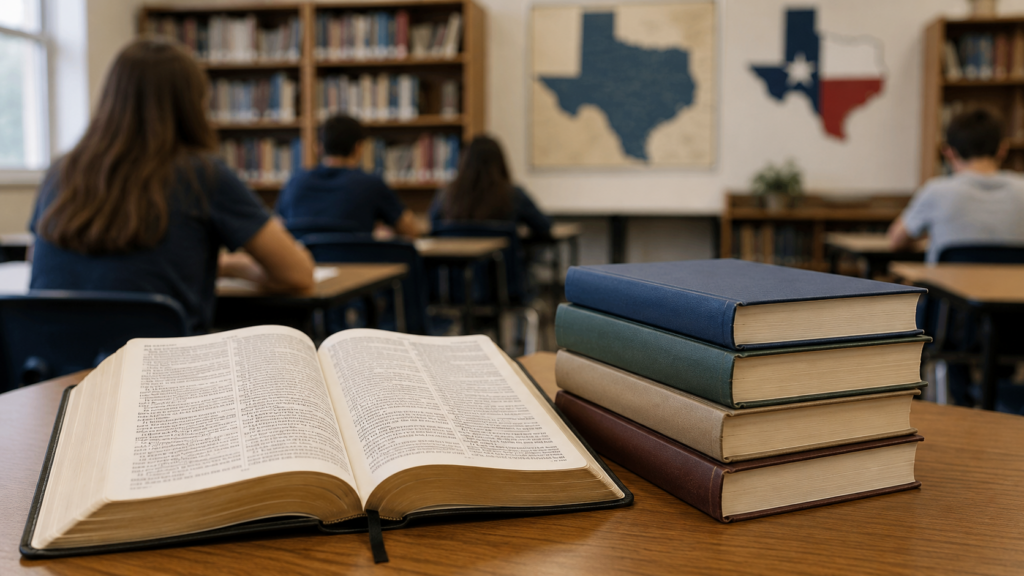
A Texas law passed in 2023 required the State Board of Education to establish at least one literary work that students must study at every grade level. The board’s final list goes considerably further, containing roughly 200 texts and supporting materials across elementary, middle and high school.
School districts and teachers normally retain substantial authority over which novels, plays, essays and poems are used to meet state educational standards. Under the Texas policy, the listed works become compulsory, although teachers may still add other books and materials during the school year.
Supporters say a common list will reduce differences between schools and ensure that students share a basic foundation of significant literature. They argue that students should understand expressions and cultural references derived from the Bible because such language appears frequently in speeches, political documents, novels, poetry and public debate.
Teachers who oppose the mandate say it reduces their ability to select texts that match their students’ reading abilities, cultural backgrounds and classroom needs. They also argue that a statewide political board is taking control of decisions that were previously made by educators, librarians, schools and local communities.
Why do supporters say biblical texts belong in the public-school curriculum?
Supporters distinguish between religious worship and academic study. They argue that students can examine biblical narratives in the same way they study Greek mythology, Shakespeare, classical philosophy or other works that influenced language and civilisation.
Mandy Drogin of the conservative Texas Public Policy Foundation told the board that biblical passages had shaped American culture, history and generations of leaders and thinkers. Supporters say those works contain themes involving virtue, liberty, responsibility, sacrifice, justice and human nature that remain relevant to literature and civic education.
Some advocates also connect the policy with a broader belief that the United States was profoundly influenced by Judeo-Christian traditions. They argue that removing biblical material from schools does not produce neutrality but instead prevents students from understanding important cultural and historical references.
That argument has support within constitutional law up to a point. Courts have not prohibited the academic study of religion, and the First Amendment does not require public institutions to display hostility towards religious belief. The constitutional question is whether instruction is educational and neutral or whether the state is using compulsory schooling to advance a particular faith.
Why do critics say the Texas reading mandate could favour Christianity?
Critics say the required materials rely heavily on the King James Bible and more recent evangelical translations, while the mandatory list does not give comparable treatment to texts from Islam, Hinduism, Buddhism or other religious traditions. They argue that this imbalance makes the policy look less like comparative religious education and more like state preference for Christianity.
Texas classrooms include Muslim, Hindu, Buddhist, Jewish, Christian, atheist and agnostic students. Teachers have warned that children may not experience required Bible instruction as a neutral literary exercise, particularly when the selected passages contain teachings about God, salvation, moral duties and the kingdom of heaven.
The state allows parents to remove a child from a class or activity that conflicts with the family’s religious or moral beliefs. However, the United States Supreme Court previously found that an opt-out provision did not cure the constitutional problem created by school-directed devotional Bible reading because the government was still organising the religious exercise.
Whether Texas crosses that line will depend partly on the lessons, teacher guidance, assessments and classroom presentation developed before 2030. A Bible passage taught to explain literary symbolism may be treated differently by a court from a lesson that presents a religious claim as historical, moral or spiritual truth.
How does the decision fit Texas’s wider effort to introduce religion into schools?
Texas has become one of the most influential states in the national movement to increase the role of religion in public education. The state educates roughly one in every ten public-school students in the United States, meaning its curriculum decisions affect a particularly large population and may influence educational publishers and policymakers elsewhere.
In 2023, Texas became the first state to permit public schools to hire chaplains as student counsellors. The State Board of Education subsequently approved an optional elementary curriculum containing extensive biblical content, and lawmakers later required the Ten Commandments to be displayed in public-school classrooms.
The new reading requirement differs from the optional curriculum because districts and teachers cannot simply decide not to use the listed passages. It also differs from a classroom display because students will actively read and discuss the material as part of their assigned academic work.
The change is part of a wider debate across Republican-led states over religious expression, parental authority and the cultural content of public education. Supporters describe such policies as restoring history and religious liberty, while opponents describe them as government endorsement of Christianity.
What constitutional precedents could shape an expected legal challenge?
The First Amendment prohibits government from establishing religion while also protecting religious exercise. Public schools occupy a particularly sensitive position because attendance is compulsory, teachers exercise state authority and children may feel pressure to accept material presented by schools.
In the 1963 case School District of Abington Township v. Schempp, the United States Supreme Court struck down state-required Bible readings in public schools. The Court found that allowing students to opt out did not change the fact that schools were organising a religious exercise.
The Court has nevertheless recognised that schools may study religion objectively. The Bible can be examined for its literary, historical and cultural significance, provided the instruction does not become devotional or present religious doctrine as government-approved truth.
More recently, the Supreme Court moved away from the older framework commonly known as the Lemon test. In Kennedy v. Bremerton School District, the Court said Establishment Clause disputes should be evaluated with reference to historical practices and understandings, while also protecting an individual public employee’s personal religious expression.
Texas supporters may argue that the policy requires academic reading rather than prayer, worship or profession of belief. Challengers are likely to argue that the list’s selection, translations, surrounding curriculum and repeated emphasis on Christianity show a government purpose of promoting one religious tradition.
Why are teachers and literacy groups also concerned about the list’s diversity?
Criticism is not limited to religion. Some educators say the selection is dominated by older works and white male authors and does not reflect the racial, cultural and linguistic composition of Texas classrooms. Latino and Black students together constitute a majority of the state’s public-school population.
Supporters say students should encounter demanding, influential classics even when the authors come from distant historical periods or different backgrounds. Critics respond that a common literary foundation can include recognised classics without leaving students with limited exposure to contemporary, female, Latino, Black, Asian and Indigenous voices.
A mandatory list also creates practical pressure on classroom time. Requiring around 200 works and supporting texts could restrict how much space teachers have for locally chosen novels, modern writing, remedial instruction and books that respond to students’ interests.
The National Council of Teachers of English and PEN America representatives described the Texas approach as highly unusual. State governments often publish recommended or approved reading lists, but educators told the Associated Press they were unaware of another state imposing a comparable mandatory statewide list that includes religious passages.
What happens before the Texas Bible reading mandate begins in 2030?
The delayed implementation gives the state, school districts and publishers several years to prepare lesson plans, teacher training, assessments and classroom materials. It also gives civil-rights organisations, parents and religious groups time to examine whether the policy can be implemented without violating constitutional protections.
Legal action could begin before students receive the materials if challengers establish that the final curriculum itself promotes religion. A court could also wait to evaluate how the policy operates in classrooms, including whether teachers are instructed to present biblical claims neutrally and whether students from other faiths face pressure or exclusion.
The distinction between reading the Bible and teaching religious belief will be central. Texas can argue that the passages are literature required for cultural literacy, while opponents can examine the selection process, curriculum language and treatment of non-Christian traditions for evidence of religious preference.
The national significance extends beyond Texas. A successful implementation could encourage other states to create mandatory religious reading requirements. A court ruling against Texas could instead clarify that public schools may teach about the Bible but cannot impose a curriculum that advances Christianity through compulsory instruction.
What are the key takeaways from Texas’s mandatory Bible reading policy?
- The Texas State Board of Education voted 9 to 5 on June 26, 2026, to approve a required reading list for more than five million public-school students, with implementation scheduled to begin in 2030.
- Required religious materials include David and Goliath, Daniel in the lions’ den, passages about Jesus, sections of Job and Lamentations, Adam and Eve and the parable of the prodigal son.
- The complete list contains around 200 works, including classical novels, plays, essays, Native American stories and children’s literature, going far beyond the 2023 law requiring one mandatory literary work per grade.
- Supporters argue that biblical passages are essential to understanding American history, language and literature, while critics say the selections privilege Christianity and exclude comparable texts from other religious traditions.
- Parents may remove children from activities conflicting with their beliefs, but previous Supreme Court precedent found that opt-out rights did not automatically make state-organised Bible readings constitutional.
- The legal question will depend heavily on whether Texas presents the passages as neutral literary and historical material or uses compulsory classroom instruction to advance religious doctrine.
- Teachers also object to reduced control over classroom reading and argue that the list relies too heavily on older white male authors in a state where most students are Latino or Black.
- The policy could influence education debates nationwide because Texas teaches roughly one in ten United States public-school students and frequently shapes curriculum publishing and conservative education initiatives.
Discover more from Business-News-Today.com
Subscribe to get the latest posts sent to your email.