

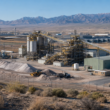


Titan Mining Corporation (NYSE American: TII; TSX: TI) shares surged between 34 and 42 percent on Friday after the Gouverneur, New York-based zinc and graphite producer disclosed that its wholly owned subsidiary Empire State Mines LLC had received Conditional Selection Notices from the United States Army for Enhanced Use Lease opportunities at Pine Bluff Arsenal in Arkansas and Anniston Army Depot in Alabama. The selections, awarded under US Army Request for Proposal DACA27-1-26-204 and the Army’s newly launched Strategic Capital Initiatives program, give Empire State Mines authority to design, finance, construct and operate the Kilbourne Graphite Purification Plant across approximately 245 acres at Pine Bluff and 97 acres at Anniston under leases extending up to five decades, with the Army retaining land ownership while Titan Mining Corporation absorbs all construction and operational expenses. The awards give operational effect to Executive Order 14241, which directed the Department of War to use Enhanced Use Lease authority to establish commercial mineral refining enterprises on United States military bases, and represent the first commercial graphite purification facility ever sited on a US military installation. The strategic context could not be more pointed. America currently imports 100 percent of its natural flake graphite, while China controls more than 90 percent of global battery-grade graphite processing.
What the US Army Enhanced Use Lease award actually signals about American critical minerals strategy
The Enhanced Use Lease structure represents a meaningful policy innovation that converts unused or underutilized military land into commercial industrial infrastructure for critical minerals processing. Under EUL authority, the Army leases land to private operators for extended periods, with the operators absorbing all capital and operating costs while the Army retains the underlying land asset. The model resolves several structural problems simultaneously, including the chronic difficulty of permitting greenfield industrial sites for critical minerals processing, the security advantages of locating sensitive defense-relevant production on military installations, and the federal land use efficiency that converts dormant assets into productive economic capacity.
The strategic urgency behind the policy framework reflects the structural vulnerability that the United States has accumulated in critical minerals supply chains over the past three decades. Graphite specifically anchors both defense applications and the broader battery industry, with battery-grade graphite required for electric vehicle batteries, grid storage systems and various military applications that include missile guidance, armor and propulsion components. The Department of War has identified graphite as one of the most acute supply chain dependencies, and the 100 percent import reliance combined with Chinese dominance of processing infrastructure creates the kind of single-point-of-failure exposure that defense planning frameworks are explicitly designed to eliminate.
The second-order observation concerns the institutional mechanism the federal government has constructed to address critical minerals dependence. The Strategic Capital Initiatives program, under which the Titan Mining Corporation award was issued, represents a coordinated policy response that combines Enhanced Use Lease authority with Department of Defense procurement frameworks and broader industrial policy support. The integration of these mechanisms into a single program structure reduces the bureaucratic friction that has historically slowed private-sector participation in critical minerals development, and the Titan Mining Corporation selection demonstrates that the program is capable of producing actionable awards rather than remaining a planning exercise.
The competitive read-across to other critical minerals companies is direct and immediate. REalloys (NASDAQ: ALOY) and Ioneer (NASDAQ: IONR) received concurrent awards under the same broader initiative, and the implied federal commitment to standing up domestic critical minerals processing capacity through military base leasing creates an investment thesis that extends across the broader rare earths, lithium, cobalt, nickel and graphite ecosystems. Companies that can demonstrate technical capability to process critical minerals at commercial scale, particularly those with existing demonstration facilities or feedstock relationships, become candidates for similar policy support that flows through the same Enhanced Use Lease framework.
The fifty-year lease duration matters substantially for the financial framework. Industrial processing facilities at commercial scale typically require multi-decade depreciation timelines to recover the capital investment, and the fifty-year lease structure provides the operational visibility that supports project finance commitments from commercial lenders and equity investors. The lease structure also signals federal confidence that the critical minerals processing capacity will remain strategically important across multiple administrations and changing political conditions, which is the kind of long-term commitment that converts policy initiatives into durable industrial infrastructure.
Why the Kilbourne Graphite Project anchors the Titan Mining Corporation transformation thesis
The Kilbourne Graphite Project provides the upstream feedstock that converts the Army base processing leases into a vertically integrated commercial operation. Titan Mining Corporation commissioned a demonstration facility last year to process material from the Kilbourne deposit adjacent to its Empire State Mine in upstate New York, with the operational target of scaling to 40,000 metric tons of natural graphite concentrate production per year. The 40,000-metric-ton target, according to the company’s framework, represents approximately half of current United States graphite demand, which positions Titan Mining Corporation as the meaningful domestic supplier across multiple end markets including defense, battery and industrial applications.
The vertical integration story is the analytical centerpiece of the Titan Mining Corporation transformation. The company operates upstream graphite concentrate production at Kilbourne, midstream purification at the new Pine Bluff and Anniston facilities, and the planned business model captures the full value chain from raw material extraction through battery-grade refined product. The vertically integrated structure differentiates Titan Mining Corporation from most other critical minerals participants, which typically operate at either the upstream extraction or downstream processing layer but rarely span the full chain.
The zinc business that anchors Titan Mining Corporation’s existing operational cash flow provides important financial context for evaluating the graphite transformation. The Empire State Mine is expected to produce 62 million to 66 million pounds of payable zinc in 2026, providing a base revenue stream that supports the graphite development capital expenditure without requiring excessive external financing. The zinc operations are not the strategic centerpiece of the equity thesis, but they provide the cash flow base that distinguishes Titan Mining Corporation from pure-play exploration companies that depend entirely on capital markets to fund development activity.
The third-order observation concerns the broader graphite supply chain economics. Natural flake graphite production in the United States has been essentially nonexistent for several decades, with the closure of domestic mines during the 1990s and 2000s ceding the entire supply chain to foreign producers, primarily in China and Madagascar. The Titan Mining Corporation positioning as the only end-to-end producer of natural flake graphite in the United States provides a structural moat that competitors cannot easily replicate, because rebuilding the upstream mining and concentration capacity requires multi-year permitting, capital investment and operational learning curves.
The relationship with the broader battery and defense supply chains will determine the eventual scale of the commercial opportunity. Battery-grade purified graphite trades at significantly higher prices than natural flake concentrate, with the purification process adding meaningful value through the removal of impurities and the achievement of the chemical specifications that battery manufacturers require. The Kilbourne Graphite Purification Plant at Pine Bluff and Anniston is designed to capture this value-added segment, which positions Titan Mining Corporation in the highest-margin layer of the graphite supply chain.
How the Executive Order 14241 framework reshapes the broader critical minerals investment landscape
Executive Order 14241 directs the Department of War to use Enhanced Use Lease authority to establish commercial mineral refining enterprises on United States military bases, and the operational framework that the Strategic Capital Initiatives program has implemented to execute that directive creates a repeatable model for additional critical minerals partnerships. The Titan Mining Corporation award is among the first commercial selections under the program, but the policy framework explicitly contemplates additional awards across multiple critical minerals categories and additional military installations.
The geographic distribution of the eligible military installations matters strategically. The Pine Bluff Arsenal in Arkansas has historically housed defense chemical and munitions operations, with substantial industrial infrastructure that can support critical minerals processing operations. The Anniston Army Depot in Alabama maintains a similar industrial profile with workforce capabilities that align with the technical requirements of critical minerals refining. Other Army installations across the southeastern United States, the Midwest and the Mountain West region possess analogous characteristics, providing a substantial inventory of potential future sites for additional Enhanced Use Lease awards.
The capital allocation structure of the Enhanced Use Lease model effectively privatizes the financing of critical minerals infrastructure while retaining federal control over the underlying land and oversight of strategic operations. The structure addresses one of the persistent challenges in critical minerals development, where private capital has been reluctant to fund processing infrastructure due to the long payback timelines and the volatility of commodity prices. By eliminating the land acquisition cost and providing fifty-year operational visibility, the Enhanced Use Lease structure improves the project finance economics in ways that lower the required hurdle rate for private capital participation.
The strategic competition with China provides the macro framework that justifies the policy intensity. China’s 90 percent dominance of global battery-grade graphite processing, combined with similar leadership positions in rare earth elements, lithium processing and various other critical minerals categories, creates the kind of strategic vulnerability that defense planning frameworks identify as unacceptable. The Executive Order 14241 framework represents one element of a broader policy response that also includes Inflation Reduction Act provisions for domestic critical minerals, Defense Production Act investments in specific projects and bilateral mineral security partnerships with allied nations.
The bipartisan political support for critical minerals development reduces the policy continuity risk that typically affects industrial policy frameworks. While specific implementation details may vary across administrations, the underlying strategic logic of reducing dependence on Chinese-controlled supply chains commands support across both major United States political parties, providing investors with reasonable confidence that the Enhanced Use Lease framework will persist through future political cycles. The fifty-year lease duration explicitly contemplates this policy continuity, and the federal commitment embedded in the lease structure provides a measure of insulation from short-term political volatility.
What the financial structure and operational execution risks mean for Titan Mining Corporation positioning
The financial structure that supports the Kilbourne Graphite Purification Plant construction will determine whether the operational opportunity flows through to equity returns. Titan Mining Corporation must finance the construction, equipment procurement and initial operational ramp at both Pine Bluff and Anniston, with the total capital requirement likely measured in hundreds of millions of dollars across the two facilities. The company’s existing zinc cash flow provides a base, but external financing through some combination of debt, equity issuance or strategic partnerships will be required to fund the full project scope.
The June 18 appointment of Richard Pozzebon as chief financial officer provides early signaling that the management team is preparing for the capital markets activity that the project financing will require. CFO appointments at small-cap natural resources companies frequently coincide with planned capital raises, debt facility negotiations or strategic partnership announcements, and the timing of Pozzebon’s appointment shortly before the Army EUL disclosure suggests coordinated preparation for the financing activity ahead. The execution quality of the eventual financing structure will materially affect the dilution profile and the equity returns available to current Titan Mining Corporation shareholders.
The execution risk concentrates in three operational variables that are typical for critical minerals development projects at this stage. First, the technical execution of the purification facility design and construction requires specialized engineering expertise that the company will need to recruit or contract, with the Kilbourne demonstration facility providing useful operational learning but not a one-to-one template for commercial-scale operations. Second, the commercial off-take arrangements that will absorb the eventual production output require negotiation with battery manufacturers, defense procurement entities and other downstream consumers, with the strategic value of domestic supply offset by the typically higher cost structure of new production capacity. Third, the operational ramp from demonstration scale to commercial scale historically encounters technical challenges that extend the timeline and require additional capital beyond initial estimates.
The competitive landscape in domestic critical minerals processing remains fragmented and still forming. REalloys and Ioneer received concurrent EUL awards under the same broader initiative, but each operates in different specific mineral categories and faces its own execution risk profile. The broader peer set includes various rare earths, lithium and nickel processing development projects that have received Department of Defense or Department of Energy support, each at different stages of operational maturity. The eventual market structure across domestic critical minerals processing will depend on which companies successfully execute their development projects through to commercial operation, and the survivorship dynamics will determine the long-term equity value created.
The valuation framework for Titan Mining Corporation at current levels requires careful consideration of the timeline for the graphite transformation to flow through to financial results. The Kilbourne Graphite Purification Plant construction timeline likely extends multiple years from the current Conditional Selection Notice through Business Terms Agreement finalization, construction, commissioning and commercial ramp. Equity returns during this development phase depend more on milestone progress and policy support than on near-term financial results, which creates a different investment risk profile from typical commodity producer equities. The current 42 percent rally reflects the recognition that the EUL award represents a meaningful inflection point, but the equity will likely require sustained operational progress to support continued appreciation.
What the Titan Mining Corporation award means for critical minerals peers and the broader defense industrial base
The read-across from the Titan Mining Corporation award extends across the broader critical minerals and defense industrial base ecosystems. The most direct beneficiaries are other domestic critical minerals development projects that can credibly position themselves for similar Enhanced Use Lease awards. Companies with existing demonstration facilities, technical credibility in their specific mineral category and the financial capacity to fund development should expect elevated investor interest as the policy framework demonstrates that commercial awards are achievable.
The defense industrial base read-across includes the broader contractor ecosystem that supports military installation operations and industrial development. Engineering and construction firms with security clearances and military base experience will participate in the design and construction of the Kilbourne Graphite Purification Plant and similar future facilities. Equipment suppliers for critical minerals processing represent another beneficiary category, with the specialized requirements of high-purity graphite production creating demand for furnaces, chemical processing equipment and analytical instruments.
The battery industry implications are meaningful but indirect. Domestic battery manufacturers including Tesla, the various automaker captive battery operations and the dedicated battery cell manufacturers benefit from improved domestic graphite supply security, but the actual cost economics of domestic graphite versus imported alternatives will determine commercial uptake patterns. If domestic graphite carries a meaningful price premium over imported alternatives, the strategic value will need to be supported through procurement preferences or other policy mechanisms beyond pure commercial economics.
The defense procurement ecosystem benefits from improved supply chain resilience across multiple weapons systems and platforms that incorporate graphite components. The strategic value calculation for defense applications differs from commercial applications, with the willingness to absorb higher domestic production costs typically greater than in price-competitive commercial markets. The Department of War’s involvement in the Enhanced Use Lease program signals that defense procurement preferences will likely flow toward domestic graphite output from the Kilbourne Graphite Purification Plant once commercial production commences.
The China policy response to the United States critical minerals strategy represents a wildcard variable. China has historically responded to United States industrial policy initiatives through export controls, dumping practices and various other commercial actions that affect the price competitiveness of domestic alternatives. Investors in critical minerals equities should explicitly weight the possibility of Chinese market actions that could pressure pricing or operational economics for domestic producers, even as the strategic value of domestic supply persists through any such pricing volatility.
Key takeaways on what the Titan Mining Corporation award means for the company, peers and the critical minerals ecosystem
- The 34 to 42 percent single-day rally reflects the strategic significance of the first-ever commercial graphite purification facility sited on United States military installations, breaking the China-dominated graphite processing chokehold.
- The Enhanced Use Lease structure provides fifty-year operational visibility at Pine Bluff Arsenal in Arkansas and Anniston Army Depot in Alabama, with Titan Mining Corporation absorbing all capital and operating costs while the Army retains land ownership.
- Executive Order 14241 and the Strategic Capital Initiatives program create a repeatable policy framework for additional critical minerals awards, with REalloys and Ioneer receiving concurrent selections under the same broader initiative.
- The vertical integration thesis combining Kilbourne Graphite Project upstream production with the new Army base purification facilities positions Titan Mining Corporation as the only end-to-end natural flake graphite producer in the United States.
- The 40,000 metric tons per year target production from the Kilbourne deposit represents approximately half of current United States graphite demand, providing substantial commercial scale relative to the addressable market.
- The Empire State Mine zinc operations producing 62 to 66 million pounds of payable zinc in 2026 provide an operational cash flow base that supports the graphite development capital expenditure.
- The June 18 appointment of Richard Pozzebon as chief financial officer signals preparation for the capital markets activity required to finance the Kilbourne Graphite Purification Plant construction across both facilities.
- The strategic competition with China’s 90 percent global graphite processing dominance provides the macro framework that justifies bipartisan political support and policy continuity across future administrations.
- The execution risk concentrates in three operational variables including technical execution of purification facility construction, commercial off-take arrangements with battery and defense customers, and operational ramp from demonstration to commercial scale.
- The principal risks ahead are financing structure dilution as the project capital requirement materializes, potential Chinese market actions to pressure domestic production economics, and the multi-year timeline for construction to flow through to commercial operations.
Discover more from Business-News-Today.com
Subscribe to get the latest posts sent to your email.