





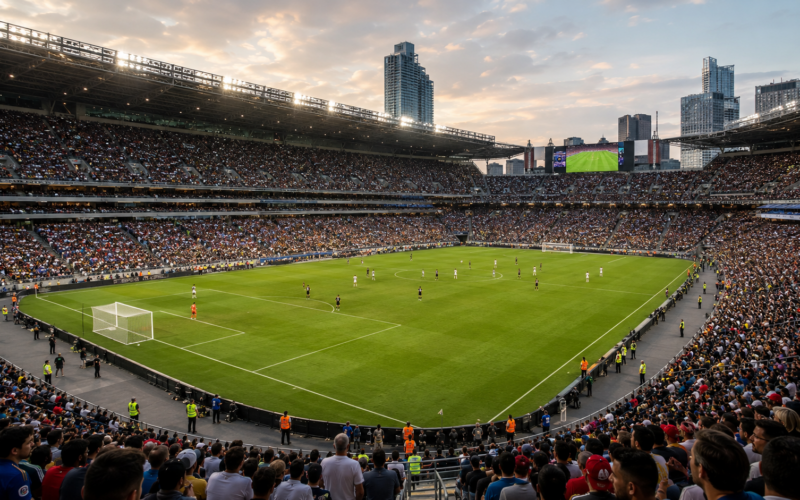
Norway defeated Senegal 3-2 at New York/New Jersey Stadium in East Rutherford on June 22, 2026 local time, with the match concluding early on June 23 in India, as Erling Haaland scored twice to send his country into the FIFA World Cup 2026 Round of 32. Marcus Holmgren Pedersen opened the scoring in the 43rd minute before Haaland struck in the 48th and 58th minutes.
Ismaïla Sarr scored both Senegal goals, first reducing the deficit in the 53rd minute and then creating a tense finish with another goal in the third minute of stoppage time. Senegal nearly completed the comeback when Sarr headed over from a late corner, but Norway survived ten minutes of added time.
The victory gave Norway six points from two Group I matches and confirmed their first World Cup knockout-stage appearance since 1998. Ståle Solbakken’s side are level with France but remain second because their +4 goal difference is one lower than the French total.
Senegal remain without a point after defeats by France and Norway. Pape Thiaw’s team can still reach three points by defeating Iraq, but qualification would depend on the winning margin and comparisons with the other third-placed teams.
Norway vs Senegal FIFA World Cup 2026 match scorecard
How did substitute Marcus Holmgren Pedersen change Norway’s difficult first half?
Senegal began with greater control of possession and prevented Haaland from receiving regular service during the opening half-hour. Their midfield pressure restricted Ødegaard’s influence, while Sarr and Mané threatened whenever the African side moved forward.
Norway also suffered an early disruption when Julian Ryerson was forced off in the 13th minute. Pedersen replaced him and initially concentrated on stabilising the right side against Senegal’s wide attackers.
The substitute became the unlikely scorer shortly before half-time. Kalidou Koulibaly failed to clear cleanly, allowing Pedersen to collect the loose ball and attack the exposed defensive area.
Pedersen struck powerfully from an angle, and Mendy could not prevent the ball from reaching the net. The goal arrived in the 43rd minute and transformed a first half in which Senegal had often looked the more comfortable team.
It was Pedersen’s first international goal. He also became only the sixth substitute to score during the first half of a men’s World Cup match.
The timing was especially damaging for Senegal. Thiaw’s team had limited Haaland’s opportunities and appeared close to reaching half-time without conceding.
Norway nearly doubled the lead immediately. Haaland moved around Mendy following another defensive error but struck the near post from a difficult angle.
Senegal reached the interval only one goal behind, but the two late incidents showed that Norway had begun finding space behind a previously secure defence.
Why did Erling Haaland score twice within ten minutes after half-time?
Norway required only three minutes after the restart to create a classic Haaland goal. Ødegaard received possession and recognised the striker’s movement before Senegal’s defence could reorganise.
The captain played a precise through ball into Haaland’s path. The forward accelerated into the area and drove a powerful shot into the upper part of the goal.
The combination reflected one of Norway’s most important attacking relationships. Ødegaard has assisted Haaland more frequently than any other teammate during the striker’s international career.
Senegal responded through Sarr in the 53rd minute, but Norway restored the two-goal advantage five minutes later. Patrick Berg delivered a low ball across the penalty area after entering at half-time.
Haaland adjusted his stride and met the cross on the volley. The finish struck the underside of the crossbar before crossing the line.
The two goals demonstrated different aspects of his finishing. The first required acceleration and power after receiving a through ball, while the second demanded positioning, rapid adjustment and close-range technique.
Haaland has now scored four goals in his first two World Cup appearances after also striking twice against Iraq. He became the first Norwegian to score in consecutive World Cup matches.
He is also only the second player in the last 50 years to score at least twice in each of his first two World Cup appearances, following Harry Kane in 2018.
How did Ismaïla Sarr keep Senegal’s qualification hopes alive until the final whistle?
Senegal refused to collapse after Haaland’s first goal made the score 2-0. Mané moved into a more central creative position and began finding space between Norway’s midfield and defence.
The first response arrived in the 53rd minute. Mané controlled possession near the edge of the area and released Sarr into the penalty area.
Sarr held off David Møller Wolfe and managed to direct the ball beyond Ørjan Nyland while losing his balance. The finish briefly reduced the deficit to one goal.
Norway restored their two-goal lead almost immediately, but Senegal continued attacking rather than protecting their goal difference. Thiaw introduced fresh players and increased the number of runners around Norway’s penalty area.
Sarr scored again in the third minute of stoppage time following a pass from Nicolas Jackson. He controlled the ball and finished calmly, creating a final period of intense pressure.
Senegal received one last major opportunity from an Ismail Jakobs corner. Sarr reached the delivery but directed his header over the crossbar.
The forward’s disappointment was understandable. His two goals had taken Senegal close to an extraordinary comeback, but the missed header prevented him from completing a hat-trick and earning the team’s first point.
Sarr became only the third Senegal player to score twice in a World Cup match. Henri Camara and Papa Bouba Diop had previously achieved the feat during the country’s memorable 2002 campaign.
Why did Senegal lose despite controlling 59 percent of possession and producing more attempts?
Senegal recorded 16 attempts compared with Norway’s 13 and held their highest possession share in a World Cup match. Those numbers suggest a balanced contest rather than a match dominated by the European side.
The difference was the quality of the finishing and the cost of defensive mistakes. Norway placed seven attempts on target and converted three, while Senegal tested Nyland only four times.
Pedersen’s opening goal followed Koulibaly’s failed clearance and Mendy’s inability to stop the shot. Haaland’s first came when Ødegaard’s pass broke the defensive line before Senegal could recover.
The third goal exposed another weakness. Berg reached a crossing position without enough pressure and delivered into an area where Haaland had been allowed to move ahead of the defenders.
Senegal’s possession was often accumulated away from Norway’s goal. The team moved the ball through midfield but did not always create a clear final pass before Norway regained its shape.
Norway were more direct. Solbakken’s players did not require prolonged possession because Ødegaard, Berg and Haaland could convert a single recovery into a dangerous attack.
The match therefore became a contest between Senegal’s volume and Norway’s efficiency. Norway’s seven shots on target ultimately carried greater value than Senegal’s territorial control.
Why did Édouard Mendy’s injury add to Senegal’s defensive problems?
Mendy experienced an increasingly difficult evening as Norway’s pressure intensified. He was unable to stop Pedersen’s opening shot and then committed an error that nearly allowed Haaland to score before half-time.
The goalkeeper was beaten twice more during the opening stages of the second half. Haaland’s finishes were powerful and difficult to save, but the surrounding defensive structure left Mendy exposed.
He required treatment after the third Norway goal and was replaced in the 63rd minute by Mory Diaw. Senegal also removed Lamine Camara during the same substitution window.
Diaw entered with his team two goals behind and handled the remaining Norwegian attempts effectively. He benefited from Senegal pushing Norway farther back during the closing stages.
The injury creates another concern before the final match against Iraq. Senegal must pursue a convincing victory, which may require greater attacking risk and could leave the replacement goalkeeper exposed.
Thiaw must also evaluate the defence around Koulibaly. Norway’s goals resulted from a combination of individual mistakes, poor recovery positioning and Haaland’s elite finishing.
Senegal can still advance, but another defensive performance of similar quality would make a large victory over Iraq extremely difficult.
What does Norway’s qualification reveal about their first World Cup campaign since 1998?
Norway returned to the World Cup after a 28-year absence and have already secured progression with one group match remaining.
Their opening 4-1 victory over Iraq demonstrated attacking power. The Senegal match provided a more demanding test because Norway faced stronger individual quality, greater possession pressure and a late comeback attempt.
Haaland remains the central figure, but the campaign has also depended on Ødegaard’s creativity, Berg’s second-half contribution, Pedersen’s unexpected goal and a defence capable of surviving difficult periods.
Norway’s ability to score seven goals across two matches makes them one of the tournament’s most dangerous attacking teams. Haaland has converted four, but the other three goals show the team is not entirely dependent on him.
The defensive record remains less convincing. Iraq and Senegal have scored three times against Norway, and Senegal generated enough late pressure to threaten an equaliser.
Stronger knockout opponents may punish those openings more consistently. Solbakken will therefore need to balance Norway’s attacking ambition with greater protection around the central defenders.
The post-match Viking rowing celebration reflected the significance of the achievement. Norway have not merely returned to the tournament. They have reached the knockout stage at the earliest possible opportunity.
What does the result mean for the FIFA World Cup 2026 Group I qualification race?
France and Norway have six points and are confirmed in the Round of 32. France lead because their +5 goal difference is one better than Norway’s +4.
Senegal sit third with no points and a -3 goal difference. Iraq also have no points but remain fourth because their goal difference is -6.
FIFA World Cup 2026 Group I points table
| Team | P | W | D | L | GF | GA | GD | Pts |
|---|---|---|---|---|---|---|---|---|
| France | 2 | 2 | 0 | 0 | 6 | 1 | +5 | 6 |
| Norway | 2 | 2 | 0 | 0 | 7 | 3 | +4 | 6 |
| Senegal | 2 | 0 | 0 | 2 | 3 | 6 | -3 | 0 |
| Iraq | 2 | 0 | 0 | 2 | 1 | 7 | -6 | 0 |
Norway will win Group I by defeating France. A draw would leave France first because of their superior goal difference, unless the match produces an unusual scoring change affecting the tiebreakers.
Senegal must defeat Iraq and improve their goal difference substantially. Three points cannot secure a top-two finish, so their only possible route is through the ranking of the eight best third-placed teams.
Iraq can also reach three points by defeating Senegal. Their -6 goal difference means they would probably require a convincing victory and favourable results from several other groups.
Why is Norway vs France now one of the most anticipated final group matches?
The final fixture creates a direct meeting between Haaland and Kylian Mbappé, two of the tournament’s leading scorers.
Both forwards have scored four goals from two matches. Lionel Messi leads with five, leaving the Golden Boot race closely balanced before the final group round.
France possess a deeper squad and a stronger defensive record, but Norway have scored one more goal. The contrast creates a compelling tactical contest between Norway’s direct attacking strength and France’s broader technical quality.
Norway do not require the result for qualification, but first place could shape their Round of 32 opponent and the difficulty of their route through the bracket.
France need only a draw to remain ahead on goal difference. Norway must therefore attack at some stage, even if Solbakken begins with a cautious structure.
The Senegal victory confirmed that Norway can defeat a strong opponent under pressure. The France match will reveal whether they can control a tournament favourite rather than simply outscore one.
Key takeaways from Norway vs Senegal at FIFA World Cup 2026
- Norway defeated Senegal 3-2 at New York/New Jersey Stadium on June 22, 2026 local time.
- Marcus Holmgren Pedersen scored the opening goal after replacing the injured Julian Ryerson in the 13th minute.
- Erling Haaland scored in the 48th and 58th minutes to reach four goals at FIFA World Cup 2026.
- Martin Ødegaard assisted Haaland’s first goal, while Patrick Berg created the second.
- Ismaïla Sarr scored twice for Senegal, including a stoppage-time goal that created a tense finish.
- Senegal held 59 percent possession and recorded 16 attempts but were punished by defensive errors and Norway’s clinical finishing.
- Haaland became the first Norwegian to score in consecutive World Cup matches.
- Norway qualified for the World Cup knockout stage for the first time since 1998.
- France and Norway have six points each, with France leading Group I by one goal on goal difference.
- Senegal must defeat Iraq and improve their goal difference to retain any chance of advancing as a third-placed team.
Share this:
Discover more from Business-News-Today.com
Subscribe to get the latest posts sent to your email.


