






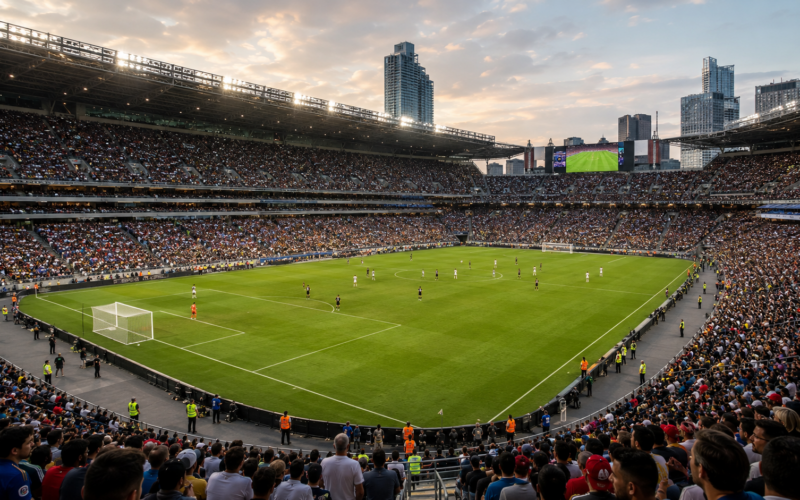
Argentina defeated Austria 2-0 at Dallas Stadium in Arlington, Texas, on June 22, 2026 local time, with the match concluding early on June 23 in India, as Lionel Messi scored twice and became the highest goalscorer in FIFA World Cup history. Messi recovered from an eighth-minute penalty miss to open the scoring in the 38th minute before completing the victory during fifth-minute stoppage time.
The first goal took Messi beyond Miroslav Klose’s men’s World Cup record of 16 goals. His second raised the Argentina captain’s tournament total to 18, also moving him beyond Marta’s previous overall World Cup scoring mark of 17.
Argentina did not dominate every phase against Ralf Rangnick’s organised Austrian side, but Lionel Scaloni’s team defended effectively and created the clearer opportunities. Austria managed only one shot on target despite holding 46.4 percent possession and reaching the Argentina penalty area on several occasions.
The victory moved the defending champions to six points from two Group J matches and confirmed their place in the FIFA World Cup 2026 Round of 32. Austria remain second with three points and now face Algeria in a decisive final group fixture.
Argentina vs Austria FIFA World Cup 2026 match scorecard
How did Lionel Messi recover from an early penalty miss to rewrite World Cup history?
Argentina received an opportunity to take control inside the opening ten minutes when Lautaro Martínez drove into the Austrian penalty area. Stefan Posch and Xaver Schlager challenged the striker as he attempted to advance toward goal.
Referee Amin Mohamed Omar initially allowed play to continue before being advised to review the incident at the pitchside monitor. The penalty was awarded following the video review, giving Messi the opportunity to break Klose’s record immediately.
Messi attempted to guide the kick toward the corner but dragged it wide. Alexander Schlager moved in the correct direction, although the goalkeeper did not need to make a save.
It was Messi’s third missed penalty at a World Cup, following unsuccessful attempts against Iceland in 2018 and Poland in 2022. The miss briefly appeared capable of changing the emotional direction of the contest.
Austria gained confidence and continued applying organised pressure through midfield. David Alaba intervened twice when Messi reached dangerous positions, first directing the ball back toward Schlager and later blocking a goal-bound attempt.
Messi nevertheless remained involved rather than allowing the penalty miss to affect his decision-making. He dropped into midfield, moved across the attacking line and waited for Austria’s compact structure to open.
The breakthrough arrived in the 38th minute. Thiago Almada carried the ball toward the penalty area and released Facundo Medina on the left.
Medina returned a low pass toward the edge of the area. Almada allowed the ball to travel through his legs, removing the nearest defender and creating a clear shooting route for Messi.
The captain placed a composed left-footed finish into the goal. It was a controlled conclusion to a move built through Almada’s forward running, Medina’s delivery and Messi’s understanding of the space developing behind them.
That goal took Messi to 17 World Cup goals and moved him beyond Klose as the leading scorer in the history of the men’s competition.
Why did Messi’s stoppage-time goal create an even larger historical milestone?
Argentina spent much of the second half attempting to find the goal that would remove Austria’s remaining hope. The defending champions created several promising moments but struggled to finish the contest.
Messi delivered a corner toward Nicolás González, whose near-post header travelled narrowly across the face of goal. Schlager also denied Messi during a later attack as Austria defended with increasing urgency.
The second goal finally arrived in the fifth minute of stoppage time. Julián Álvarez’s initial effort was saved by Schlager, but Argentina recovered the loose ball before Austria could clear the area.
Messi’s first attempt was blocked. He reacted immediately, reached the rebound and drove a low shot into the net from close range.
The goal increased his World Cup total to 18. It moved him beyond Marta’s 17-goal record across the women’s tournament and made him the highest scorer in the overall history of the World Cup.
Messi also moved to five goals at FIFA World Cup 2026 after scoring a hat-trick against Algeria in Argentina’s opening fixture. Every goal scored by Argentina through the first two group matches has come from their captain.
The timing added another layer of significance. The match was played on June 22, exactly 40 years after Diego Maradona scored the “Hand of God” goal and the “Goal of the Century” against England at the 1986 World Cup.
Argentina supporters had marked the anniversary throughout the day. Messi then produced another record-setting performance associated with a date carrying exceptional significance in the country’s football history.
How did Austria’s pressing system make the match more difficult than the scoreline suggests?
Austria entered the match after defeating Jordan 3-1 and showed greater ambition than many teams facing the defending champions.
Rangnick’s side pressed Argentina’s midfield, contested second balls and attempted to prevent Rodrigo De Paul, Enzo Fernández and Almada from progressing comfortably through central areas.
Austria retained 46.4 percent possession and completed more than 400 passes. Those numbers reflected a team willing to play rather than retreat continuously around its penalty area.
Alaba provided experience and defensive anticipation. He repeatedly recognised Messi’s movement and stepped forward before the Argentina captain could receive in a shooting position.
Konrad Laimer and Marcel Sabitzer applied pressure across midfield, while Schlager and Nicolas Seiwald helped prevent Argentina from establishing complete territorial control.
The limitation appeared once Austria reached the final third. Their possession did not consistently produce clear opportunities, and Argentina’s defensive line managed the central spaces effectively.
Austria recorded six attempts but placed only one on target. They also attempted 17 crosses, compared with Argentina’s four, but completed only three.
The pattern suggested Austria could reach wide areas without finding the delivery or movement required to trouble Emiliano Martínez regularly.
Rangnick’s team were competitive, organised and physically aggressive. However, their inability to convert respectable possession into decisive attacking moments ultimately separated them from the defending champions.
Why was Argentina’s defensive performance as important as Messi’s two goals?
Messi dominated the historical narrative, but Argentina’s second clean sheet of the tournament was equally important to their qualification.
Scaloni’s side did not always press Austria high up the pitch. At several stages, Argentina defended in a compact midfield and allowed Austria to circulate possession before closing the central route.
Cristian Romero and Facundo Medina dealt with direct balls, while Nahuel Molina and Nicolás Tagliafico protected the wide defensive areas. Nicolás Otamendi also entered during the second half to strengthen the structure.
Austria’s best effort on target came after Romero conceded a free-kick near the edge of the penalty area. Sabitzer struck powerfully, but Martínez moved across his goal and pushed the effort away.
Michael Gregoritsch later met a looping delivery but headed above the crossbar. Marko Arnautović was introduced as Austria searched for greater penalty-area presence, yet Argentina continued preventing clean service.
Argentina made 35 clearances compared with Austria’s 15. That figure showed the holders were willing to defend pragmatically rather than insisting on controlling every passage through possession.
They have now beaten Algeria 3-0 and Austria 2-0. Five goals scored and none conceded represents a controlled start to their attempt to retain the World Cup.
The attack remains unusually dependent on Messi for its goals, but the defensive performance means Argentina have not required a large margin in every match.
Why did Thiago Almada provide the creative movement Argentina needed around Messi?
Almada played an important role between Austria’s midfield and defensive lines. His mobility prevented Rangnick’s players from directing all their attention toward Messi and Martínez.
The decisive moment came before the opening goal. Almada drove forward with the ball, forcing Austria’s midfielders to retreat and creating space for Medina to overlap on the left.
After passing to Medina, Almada continued moving toward the penalty area. His decision to allow the return ball to run through his legs was the most intelligent action in the sequence.
Austria’s defenders expected Almada to control or shoot. Letting the ball continue removed them from the play and presented Messi with an unmarked finishing position.
The move reflected Argentina’s ability to combine individual intelligence with rehearsed positional relationships. Messi did not need to beat multiple defenders because Almada and Medina had already changed the shape of the defence.
Almada also helped Argentina carry possession during periods when Austria’s press reduced the influence of De Paul and Fernández.
Scaloni later introduced Álvarez and González to provide greater pace and directness. Those changes eventually contributed to the second goal, but Almada’s first-half movement had already given Argentina the platform required to control the result.
Why could Lautaro Martínez not convert Argentina’s attacking pressure into a goal?
Martínez contributed to the penalty incident but experienced another match in which his movement did not produce a goal.
He competed physically against Kevin Danso and Alaba, attempted to attack the space behind Austria’s defensive line and helped create room for Messi and Almada.
Austria’s compact structure restricted the number of clean deliveries reaching him. Martínez frequently received with a defender close behind and could not turn toward goal.
The striker’s run for the early penalty demonstrated his threat. He accelerated between Posch and Schlager before being brought down, creating the first major incident of the match.
However, Argentina increasingly found space through Messi’s deeper movement rather than through passes directly toward Martínez. The striker’s presence remained useful, but the chances developed around him.
Álvarez replaced Martínez during the second half and offered greater mobility across the front line. His late attempt was saved, but the resulting rebound eventually produced Messi’s second goal.
Scaloni therefore has a productive selection dilemma. Martínez offers penalty-area finishing and physical presence, while Álvarez supplies pressing, movement and combinations from different attacking positions.
Argentina have qualified without requiring either striker to score. That may be sustainable during the group stage, but the knockout rounds will demand goals from players other than Messi.
What does the result mean for the FIFA World Cup 2026 Group J qualification race?
Argentina lead Group J with six points after victories over Algeria and Austria. The defending champions have scored five goals without conceding.
Austria remain second with three points after beating Jordan and losing to Argentina. Their neutral goal difference keeps them in a strong position before the final match.
Jordan and Algeria remained without points after one match each when Argentina vs Austria concluded. Their second group meeting was scheduled for later on June 23 IST.
FIFA World Cup 2026 Group J points table after Argentina vs Austria
| Team | P | W | D | L | GF | GA | GD | Pts |
|---|---|---|---|---|---|---|---|---|
| Argentina | 2 | 2 | 0 | 0 | 5 | 0 | +5 | 6 |
| Austria | 2 | 1 | 0 | 1 | 3 | 3 | 0 | 3 |
| Jordan | 1 | 0 | 0 | 1 | 1 | 3 | -2 | 0 |
| Algeria | 1 | 0 | 0 | 1 | 0 | 3 | -3 | 0 |
Argentina have qualified for the Round of 32 and will finish first by defeating Jordan in their final match. A draw would take them to seven points and also guarantee the group lead.
Even if Argentina lose, their six points and +5 goal difference leave them in a very strong position to retain first place. The precise calculation will depend on the remaining Group J results.
Austria will guarantee qualification by defeating Algeria. A draw would take them to four points and may also be sufficient for a top-two or leading third-place position.
Jordan and Algeria still have opportunities to enter the qualification race. Their meeting will determine which team can challenge Austria during the final round.
Has Argentina become too dependent on Messi despite winning both opening matches?
Argentina’s results are almost perfect. They have six points, five goals, two clean sheets and confirmed qualification with one group match remaining.
The unusual detail is that Messi has scored all five goals. He delivered a hat-trick against Algeria and both goals against Austria.
That concentration demonstrates his extraordinary form, but it also creates a question for the knockout phase. Opponents will devote increasingly detailed plans to reducing his influence.
Martínez, Álvarez, Almada, González and Argentina’s midfielders have created opportunities without scoring. Their contributions remain important, but Scaloni will want the goals distributed more widely.
The positive interpretation is that Argentina have not required their full attacking potential. Their defence has remained secure, Messi has decided the major moments and the supporting players continue creating chances.
The concern is that knockout football may produce a match in which Messi receives less space or cannot convert every opportunity. Argentina will then require another forward to supply the decisive finish.
The final group fixture against Jordan gives Scaloni an opportunity to rotate players, protect key starters and test alternative attacking combinations before the Round of 32.
Key takeaways from Argentina vs Austria at FIFA World Cup 2026
- Argentina defeated Austria 2-0 at Dallas Stadium on June 22, 2026 local time.
- Lionel Messi scored in the 38th and 95th minutes to take his World Cup total to 18 goals.
- Messi surpassed Miroslav Klose as the leading scorer in the men’s World Cup and moved beyond Marta’s previous overall mark.
- Messi missed an eighth-minute penalty after a VAR review confirmed a foul on Lautaro Martínez.
- Thiago Almada and Facundo Medina created the movement that produced Argentina’s opening goal.
- Julián Álvarez’s saved attempt contributed to the sequence leading to Messi’s stoppage-time second goal.
- Argentina controlled 53.6 percent possession and recorded 12 attempts, with five on target.
- Austria produced six attempts but forced Emiliano Martínez into only one save.
- Argentina qualified for the Round of 32 with six points and have not conceded in their opening two matches.
- Austria remain second with three points and next face Algeria in a decisive final Group J fixture.
Share this:
Discover more from Business-News-Today.com
Subscribe to get the latest posts sent to your email.


