





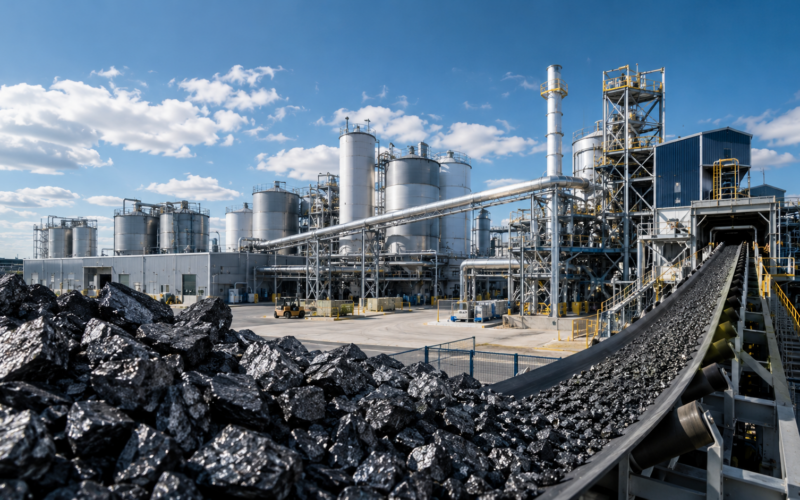
Graphite One Inc. (TSXV: GPH) (OTCQX: GPHOF) has advanced its planned Ohio advanced graphite materials facility by signing a production line integration contract for manufacturing equipment design and coordination. The move pushes the Vancouver-based critical minerals developer deeper into execution mode as it tries to connect its Graphite Creek deposit in Alaska with downstream battery-grade graphite processing in Ohio. The announcement matters because graphite remains one of the most strategically exposed battery materials in the United States, where domestic supply chain ambitions are running ahead of actual commercial production capacity. Graphite One stock recently traded around C$1.07 on the TSX Venture Exchange, well below its 52-week high, leaving investors to weigh whether this is a credible de-risking step or another early-stage milestone that still needs financing to become industrial reality.
Why does Graphite One’s Ohio production line integration contract matter for U.S. battery materials supply chains?
Graphite One Inc.’s latest contract is not a construction start, a financing close, or a customer offtake agreement. That distinction matters because early-stage critical minerals companies often stack development milestones long before revenue arrives. Still, the production line integration contract is commercially relevant because it moves the Ohio facility from broad concept into the more demanding phase of manufacturing design, equipment coordination, process flow planning, and operational readiness.
For a battery materials facility, this type of engineering work is not administrative housekeeping. Active anode material production depends on consistent quality, predictable throughput, thermal and chemical process control, equipment compatibility, and customer qualification. If these elements are not integrated early, companies can end up with a plant that looks impressive on paper but struggles to meet automaker or battery-cell specifications. That is where the graphite sector can be unforgiving. Batteries do not grade on effort, and customers do not buy strategic narratives by the tonne.
The strategic angle is bigger than Graphite One Inc. alone. The United States wants domestic capacity in battery materials, defense-related minerals, and energy storage supply chains, but the graphite bottleneck is difficult because mining, purification, shaping, coating, and anode qualification are all separate risk layers. By tying upstream Alaska resource development to downstream Ohio processing, Graphite One Inc. is trying to pitch itself as an integrated supply chain company rather than a single-asset mining developer.
How does the Alaska-to-Ohio strategy change the investment case for Graphite One Inc.?
Graphite One Inc.’s investment case rests on whether it can convert Graphite Creek in Alaska and the Ohio active anode materials facility into a bankable, customer-qualified domestic graphite platform. That is a more ambitious model than simply developing a mine and selling concentrate into the market. It also carries higher execution risk because Graphite One Inc. must manage permitting, mining development, logistics, processing technology, downstream manufacturing, customer qualification, and project finance.
The Ohio facility is central because value in battery graphite is captured further downstream. Mining graphite is important, but battery customers need material that can work inside lithium-ion cells at scale. That means the company’s ability to produce active anode materials, rather than only natural graphite concentrate, could determine whether the market treats Graphite One Inc. as a strategic battery supplier or as another long-dated resource story.
The planned logistics chain is also part of the thesis. Material would be mined from Graphite Creek in Alaska, moved through the Port of Nome, and processed into advanced graphite and anode materials in Ohio. That structure gives the company a domestic supply story that fits U.S. policy priorities, but it also introduces a complex physical chain across mining, transport, and manufacturing. Every link has to work. A vertically integrated strategy sounds elegant in investor decks, but in industrial reality it means more gates, more permits, more capital needs, and more chances for delays.
Why is the Ohio facility strategically important for electric vehicles, energy storage, and defense applications?
The Ohio facility matters because graphite is not a fringe ingredient in the battery economy. It is the dominant material in most lithium-ion battery anodes, and active anode materials are critical for electric vehicles, stationary storage systems, consumer electronics, and defense platforms. A domestic facility capable of producing qualified battery-grade graphite materials would therefore sit at the intersection of energy transition policy, industrial policy, and national security strategy.
For electric vehicle supply chains, the timing is awkward but important. EV adoption has been uneven, automakers are rethinking capacity plans, and battery investment has become more selective. However, the long-term need for localized battery materials has not disappeared. If anything, slower demand growth can make qualification, cost control, and supply security more important because buyers have less tolerance for speculative projects that cannot meet commercial standards.
Defense applications add another layer. Graphite is relevant to batteries, electronics, energy systems, and broader strategic materials planning. A U.S.-based graphite supply chain could benefit from policy attention if Washington continues to prioritize domestic critical mineral capacity. The opportunity for Graphite One Inc. is that policy support can improve project credibility. The risk is that policy support does not automatically fund a project, build a plant, qualify product, or guarantee margins. The market has learned that lesson the expensive way across several battery-materials subsectors.
What does the production line integration contract signal about execution risk at Graphite One Inc.?
The contract signals that Graphite One Inc. is trying to reduce execution risk before committing to full-scale facility development. Production line integration work can help identify equipment conflicts, process bottlenecks, throughput assumptions, layout constraints, and operational readiness gaps before they become costly construction or commissioning problems. In plain English, this is the stage where a battery materials project starts finding out whether the factory can behave like the spreadsheet.
That said, this milestone does not eliminate the largest risks. The Ohio facility remains subject to project financing, and the company still needs to convert engineering progress into capital, construction, permitting, customer qualification, and commercial delivery. Investors should therefore treat the contract as a de-risking step, not as proof that the project is fully de-risked.
The other risk is market timing. Battery materials projects need long development cycles, but demand, pricing, policy incentives, and customer procurement strategies can shift during that period. Graphite One Inc. is trying to build for a future domestic supply gap. If the company moves too slowly, competitors or imported alternatives could fill part of the market. If it moves too quickly without locked-in customers and financing, it could face the classic small-cap industrial problem: big ambition, small balance sheet, and a capital market that has suddenly discovered discipline.
How should investors read Graphite One stock after the Ohio battery materials update?
Graphite One Inc. shares recently traded around C$1.07 on the TSX Venture Exchange, with the stock still well below its 52-week high of about C$2.57 and above its 52-week low of about C$0.65. The U.S. OTC listing, GPHOF, has also traded far below its 52-week high, reflecting the market’s cautious view of long-duration critical minerals developers. That price context is important because the market appears to be giving Graphite One Inc. credit for strategic relevance, but not yet assigning full value to future production.
The stock setup is therefore more catalyst-sensitive than earnings-sensitive. Investors are likely to watch for project financing, Ohio lease formalization, permitting progress, engineering updates, customer qualification, offtake agreements, and any U.S. government-linked funding or incentive support. A production line integration contract helps the narrative, but a financing package or credible customer agreement would likely carry more weight for valuation.
Sentiment is mixed but understandable. Bulls can argue that Graphite One Inc. offers rare exposure to a U.S.-anchored graphite supply chain at a time when domestic battery materials security is strategically important. Skeptics can counter that the company is still pre-commercial, capital-intensive, and dependent on multiple external approvals and financing conditions. Both views can be true at once, which is why this remains a strategic optionality story rather than a conventional operating company story.
What competitive pressure could Graphite One Inc. create if the Ohio project succeeds?
If Graphite One Inc. succeeds, the competitive impact would not be limited to graphite mining peers. It could affect battery materials suppliers, synthetic graphite producers, cell manufacturers, automakers, and policy-backed critical minerals developers trying to secure a place in North American supply chains. A qualified U.S.-based active anode materials supplier would offer buyers another route to reduce import exposure and align procurement with domestic-content priorities.
The company could also create pressure on peers that have resource assets but lack downstream processing strategies. In critical minerals, the market increasingly prefers projects that can demonstrate customer relevance rather than just geological scale. Graphite One Inc.’s integrated approach is designed to answer that concern, though execution will decide whether the strategy becomes a moat or a management burden.
For incumbents, the main issue is not immediate displacement. Graphite One Inc. is not suddenly rewriting global graphite trade flows with one integration contract. The bigger signal is that U.S. supply chain localization is moving from policy language into plant-level design work. Once projects enter that stage, customers, governments, and financiers can begin comparing real execution pathways rather than simply ranking resource claims.
What needs to happen next for Graphite One Inc. to turn this milestone into commercial value?
The next phase needs to be about proof, not just progress. Graphite One Inc. must show that the Ohio facility can move from integration planning into a financeable development plan with credible capital costs, customer engagement, permitting visibility, and a realistic production timeline. The company also needs to demonstrate that its Alaska-to-Ohio model can support competitive economics, not just strategic alignment.
Financing is the most important near-term gate. Production line integration improves project definition, and better project definition can help financing discussions. However, capital providers will want clarity on cost, schedule, technology risk, customer demand, regulatory approvals, and contingency planning. In the current market, critical minerals companies do not get unlimited benefit of the doubt. The days of “strategic” being a magic word are over, which is healthy, even if it makes investor presentations less sparkly.
Customer qualification is the second gate. Battery supply chains are conservative because product failure can be expensive and reputationally damaging. Graphite One Inc. will need to prove consistency and reliability before major buyers treat the Ohio facility as a meaningful supply option. That process can take time, and it is often less glamorous than announcing a new facility. Unfortunately for impatient investors, battery chemistry does not care about press release cadence.
Key takeaways on what Graphite One’s Ohio battery materials contract means for investors and U.S. graphite supply chains
- Graphite One Inc.’s production line integration contract moves the Ohio battery materials facility deeper into execution planning, but it does not yet represent financing or construction approval.
- The milestone strengthens the company’s integrated Alaska-to-Ohio supply chain narrative at a time when U.S. graphite import dependence remains a strategic concern.
- The Ohio facility is central to the investment case because active anode materials carry greater downstream relevance than mined graphite concentrate alone.
- Execution risk remains high because Graphite One Inc. must still secure project financing, permits, customer qualification, equipment readiness, and commercial-scale production.
- Graphite One stock remains a catalyst-driven small-cap critical minerals trade rather than an earnings-based operating story.
- The market is likely to respond more strongly to financing, offtake, government support, or permitting updates than to engineering milestones alone.
- If successful, the project could give U.S. battery makers, energy storage developers, and defense supply chains a more localized graphite option.
- Competitors with mining assets but limited downstream plans may face pressure if integrated graphite supply chain models gain investor and customer traction.
- The main downside risk is that a complex vertically integrated strategy can become capital-heavy and slow if financing or permitting conditions deteriorate.
- The next major test is whether Graphite One Inc. can convert engineering progress into a bankable, customer-backed development plan.
Share this:
Discover more from Business-News-Today.com
Subscribe to get the latest posts sent to your email.
