


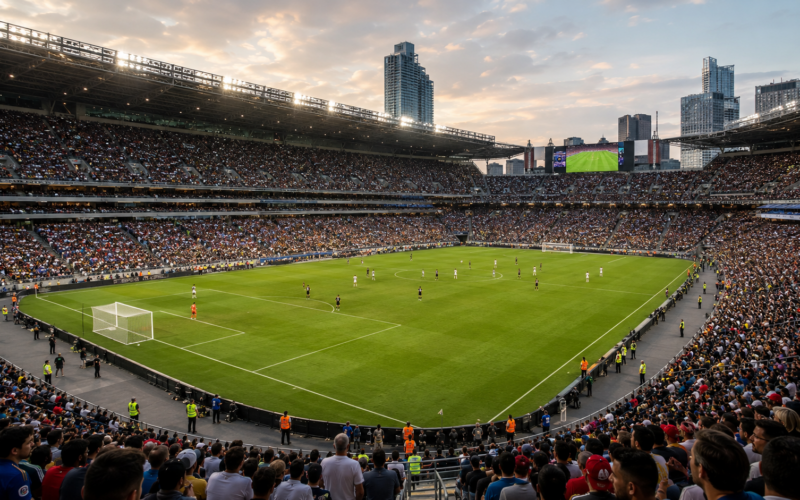
The United States beat Australia 2-0 at Seattle Stadium on June 19, 2026 local time, June 20 in India, to qualify for the FIFA World Cup 2026 Round of 32 with one Group D match remaining. Cameron Burgess diverted Folarin Balogun’s cross into his own goal in the 11th minute before Alex Freeman headed home in the 43rd minute following a VAR review.
Mauricio Pochettino’s team controlled the first half despite playing without injured captain Christian Pulisic, who missed the match because of a calf problem. Ricardo Pepi replaced him in the starting line-up, while Balogun moved into wider positions and became directly involved in the opening goal.
Australia improved after Tony Popovic introduced Nestory Irankunda, Connor Metcalfe and Aziz Behich at half-time, but the Socceroos rarely threatened a sustained comeback. Harry Souttar missed their best late opportunity, while Matt Freese and the United States defence secured the team’s first clean sheet in nine matches.
Paraguay’s subsequent 1-0 victory over Türkiye confirmed the United States as Group D winners with six points. Australia and Paraguay remain level on three points ahead of their decisive final meeting, while Türkiye have been eliminated after losing both matches.
United States vs Australia FIFA World Cup 2026 match scorecard
How did Folarin Balogun create the early breakthrough without Christian Pulisic?
Pulisic’s absence created the biggest pre-match question for the United States. The captain had been withdrawn at half-time during the opening 4-1 victory over Paraguay and was unable to recover from his calf injury in time to face Australia.
Pochettino selected Pepi alongside Balogun rather than attempting to replace Pulisic with a similar wide attacker. The change gave the United States two recognised centre-forwards but required Balogun to operate more frequently from the left.
That adjustment created the first goal. Antonee Robinson played forward into Balogun’s path, and the striker accelerated beyond Jacob Italiano before delivering a low ball across the penalty area.
Burgess attempted to prevent the cross from reaching Pepi but could not adjust his feet. The ball struck the defender and entered Patrick Beach’s goal in the 11th minute.
The move showed that the United States could create danger without depending on Pulisic carrying the ball from wide areas. Balogun provided speed, directness and the willingness to attack Australia’s defensive channels.
It was also the second consecutive match in which the United States benefited from an own goal. Paraguay defender Gustavo Gómez had diverted a cross into his own net during the opening fixture.
The repetition was not merely fortunate. Pochettino’s team repeatedly attacked the space between full-backs and centre-backs, forcing defenders to make emergency interventions while moving toward their own goal.
Balogun did not score, but his movement created the decisive early advantage and gave the United States control of the match.
Why was Alex Freeman’s first World Cup goal such an important breakthrough?
Freeman’s goal arrived after sustained pressure and reflected the young defender’s willingness to attack beyond his conventional position.
The move began when Malik Tillman fought to retain possession close to Australia’s byline and earned a free kick. Robinson played the set piece toward Sergiño Dest near the edge of the penalty area.
Dest’s shot was blocked by Souttar and looped into the air. Beach had already moved toward the original attempt and was unable to recover his position before Freeman reached the rebound.
Freeman headed the ball into the net in the 43rd minute, but the assistant referee initially raised the offside flag. The United States players waited while the incident was reviewed.
VAR established that Freeman was in an onside position, and the goal was awarded. The United States bench rushed onto the pitch, while Freeman completed his celebration near the opposite end of the ground.
The goal demonstrated the defender’s unusual attacking instincts. Freeman has spent time operating as both a full-back and centre-back, giving Pochettino a player capable of stepping into midfield and entering the penalty area.
His emergence has become one of the most significant developments in the United States’ tournament. The 21-year-old provided defensive security while also producing the moment that effectively ended Australia’s chances.
Pochettino described Freeman’s development as substantial and suggested he possesses the potential to become one of the strongest players in his position.
That assessment will face greater tests in the knockout rounds, but scoring during a home World Cup and securing qualification represents an important step.
How did Weston McKennie and the United States midfield control the first half?
McKennie was one of the most influential players during the United States’ dominant opening period. His physical strength, pressing and movement prevented Australia from establishing possession.
Tyler Adams protected the defence and recovered second balls, allowing McKennie and Tillman to move higher. Australia struggled to play through that pressure and frequently returned possession through hurried clearances.
The United States also gained an advantage in the wide channels. Robinson advanced from the left, while Dest pushed forward from the opposite side and forced Australia’s wing-backs to defend close to their own penalty area.
Popovic had selected a cautious starting team despite Australia’s 2-0 opening victory over Türkiye. Goalscorers Irankunda and Metcalfe began on the bench, reducing the immediate counterattacking threat available to the Socceroos.
Australia’s best first-half moment came shortly before the hydration break. Mathew Leckie delivered a dangerous ball across the area, but Freeman recovered and blocked the cross before it reached a teammate.
The United States repeatedly won individual duels and second balls, preventing Australia from building momentum. Popovic later acknowledged that his team appeared slow and struggled to match the hosts physically.
That midfield control gave Pochettino’s side the platform to score twice before half-time. It also ensured that Pulisic’s absence did not produce the creative decline many observers expected.
Why did Australia improve after three substitutions without threatening a comeback?
Popovic responded to the first-half performance by introducing Irankunda, Metcalfe and Behich at the interval.
The changes gave Australia more width, greater pace and a stronger willingness to attack. Irankunda immediately attempted to isolate Robinson and deliver balls toward Souttar and Mohamed Touré.
Metcalfe added energy from midfield and reached shooting positions that had been unavailable during the opening half. Behich also pushed further forward than Burgess had been able to do.
Australia’s possession improved, but the United States were prepared to defend deeper and protect the two-goal advantage. Adams remained close to the centre-backs, while Robinson and Dest became more selective about advancing.
Cristian Volpato later replaced Leckie and fired over the bar after an Irankunda run. Metcalfe also produced an effort that Freese collected without serious difficulty.
Souttar had Australia’s best late chance when he found space inside the penalty area with approximately five minutes remaining. His attempt failed to find the target, removing the possibility of a tense finish.
The second-half response showed that Australia’s substitutes should remain central to the final match against Paraguay. However, it also underlined the damage caused by the passive opening line-up.
At World Cup level, recovering from a two-goal deficit against a well-organised host nation is extremely difficult. Australia needed to begin with the energy they displayed after half-time.
What did the seven yellow cards reveal about the physical battle in Seattle?
The match became increasingly physical as Australia attempted to disrupt the United States’ rhythm and recover from the early deficit.
Jordan Bos received the first yellow card after making contact with McKennie’s face. Alessandro Circati was later cautioned after clipping Tillman.
Additional bookings followed as both teams contested transitions and second balls more aggressively. Seven yellow cards represented the highest total in a FIFA World Cup 2026 match at that stage of the tournament.
The physicality did not result in a red card, but it repeatedly interrupted the second half. Australia wanted to prevent the United States from counterattacking, while the hosts were willing to commit tactical fouls rather than allow Irankunda and Metcalfe to accelerate.
The referee also required treatment for cramp during stoppage time, producing an unusual delay before the final whistle.
For the United States, yellow-card accumulation may require monitoring before the knockout rounds. Pochettino must balance the need to maintain intensity against Türkiye with the risk of losing important players to suspension.
The final group match offers an opportunity to rotate because first place has already been secured. That could protect players carrying bookings while also giving Pulisic additional recovery time.
How significant was the United States’ first clean sheet in nine matches?
The United States had scored freely during the opening victory over Paraguay but conceded after defensive uncertainty. Keeping Australia scoreless therefore represented an important improvement.
Freese was not required to make a large number of difficult saves, but the clean sheet reflected the work of Richards, Tim Ream, Freeman and the midfield protection provided by Adams.
Australia’s main threat came through crosses and set pieces because they struggled to create central combinations. The United States defended those situations with greater concentration than they had shown in some pre-tournament matches.
Ream’s experience was important during the second half, when Australia increased its pressure and introduced more direct attackers. He helped maintain the defensive line and prevented the team from becoming unnecessarily stretched.
The clean sheet was the United States’ first in nine matches and arrived at an important time. Knockout football will eventually require the co-hosts to survive periods without possession against stronger attacking teams.
The performance did not eliminate all concerns. Australia found several promising positions after half-time, and more clinical opponents may punish similar openings.
However, protecting a lead, reducing the tempo and avoiding a late concession represented progress for a team attempting to move beyond its previous World Cup limits.
What does the result mean for the FIFA World Cup 2026 Group D points table?
Paraguay’s later 1-0 victory over Türkiye completed the second round of Group D matches. The United States lead with six points, while Australia and Paraguay have three each.
Australia remain second because their goal difference is better than Paraguay’s. Türkiye have zero points and cannot qualify.
FIFA World Cup 2026 Group D points table
| Team | P | W | D | L | GF | GA | GD | Pts |
|---|---|---|---|---|---|---|---|---|
| United States | 2 | 2 | 0 | 0 | 6 | 1 | +5 | 6 |
| Australia | 2 | 1 | 0 | 1 | 2 | 2 | 0 | 3 |
| Paraguay | 2 | 1 | 0 | 1 | 2 | 4 | -2 | 3 |
| Türkiye | 2 | 0 | 0 | 2 | 0 | 3 | -3 | 0 |
The United States have secured first place and can manage player workloads against Türkiye. Pochettino will also hope Pulisic recovers before the Round of 32.
Australia and Paraguay meet in a direct qualification contest in Santa Clara. Australia currently hold second place on goal difference, but both teams have three points.
A victory will guarantee either side a top-two finish. A draw would leave Australia second and Paraguay third, with Paraguay then depending on comparisons against third-placed teams from other groups.
Türkiye have been eliminated after losing to Australia and Paraguay without scoring. Their final match against the United States will determine only pride and the final group record.
Why does the United States victory matter beyond reaching the Round of 32?
The United States won their first two World Cup matches for the first time since 1930. That historical comparison reflects how rarely the national team has controlled a group so convincingly.
The co-hosts have scored six goals, conceded one and shown that they can win with or without Pulisic. Their opening victory demonstrated attacking power, while the Australia match showed patience and defensive management.
Freeman’s emergence has added another dimension. Pochettino now has a young defender capable of contributing in possession, competing physically and entering attacking areas.
The victory also strengthened the connection between the team and home supporters. Seattle produced one of the tournament’s strongest atmospheres, giving the United States a clear advantage during difficult periods.
However, the knockout stage will bring a different level of pressure. Australia’s first-half performance was passive, and stronger opponents will challenge the United States’ defence and midfield more consistently.
The immediate objective has been achieved. The larger question is whether the co-hosts can convert an excellent group campaign into their deepest World Cup run of the modern era.
Key takeaways from United States vs Australia at FIFA World Cup 2026
- The United States beat Australia 2-0 at Seattle Stadium on June 19, 2026, to qualify for the FIFA World Cup 2026 Round of 32.
- Cameron Burgess scored an own goal in the 11th minute while attempting to prevent Folarin Balogun’s low cross from reaching Ricardo Pepi.
- Alex Freeman scored in the 43rd minute after reacting first to a blocked Sergiño Dest shot.
- Freeman’s goal was initially ruled out for offside but was awarded following a VAR review.
- Christian Pulisic missed the match with a calf injury, but the United States controlled the first half without their captain.
- Australia improved after introducing Nestory Irankunda, Connor Metcalfe and Aziz Behich at half-time but failed to score.
- The United States recorded their first clean sheet in nine matches and won their opening two World Cup fixtures for the first time since 1930.
- Seven yellow cards were shown during an increasingly physical second half, although no player was dismissed.
- Paraguay’s 1-0 victory over Türkiye confirmed the United States as Group D winners.
- Australia and Paraguay will meet in a decisive final fixture, with both teams holding three points.
Share this:
Discover more from Business-News-Today.com
Subscribe to get the latest posts sent to your email.