





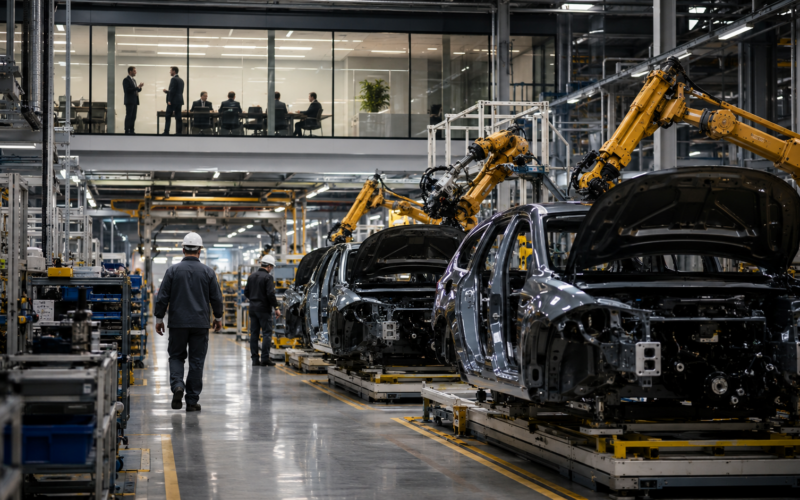
Bayerische Motoren Werke Aktiengesellschaft (XETRA: BMW) is preparing discussions with employee representatives after cutting its 2026 financial outlook and promising to accelerate structural cost reductions. The BMW Group expects its global workforce to decline by as much as 5% by the end of 2026, potentially representing approximately 7,700 positions from a workforce of just under 155,000 employees. Management has indicated that the reduction should continue through natural attrition rather than a sweeping compulsory layoff programme. The workforce adjustment is an early strategic test for new chief executive Milan Nedeljković as BMW confronts weaker Chinese demand, lower expected margins, rising cost pressure and the expensive transition to its Neue Klasse vehicle platform.
Why is BMW reconsidering its workforce structure immediately after cutting its 2026 outlook?
BMW’s workforce discussions are being driven by a sharp deterioration in the financial assumptions underpinning its 2026 plan. The company now expects the operating margin in its core automotive division to range between 1% and 3%, down from its previous forecast of 4% to 6%. Group profit before tax is expected to decline significantly, which BMW defines as a reduction of more than 15%, rather than the moderate decrease previously anticipated.
A lower automotive margin leaves considerably less room for inefficiency because the company must continue funding product development, battery technology, manufacturing conversion, software and the international rollout of Neue Klasse vehicles. BMW cannot simply pause its next-generation investment programme without risking its competitiveness against Mercedes-Benz Group, Volkswagen Group, Tesla and increasingly capable Chinese electric vehicle manufacturers. Cost reduction therefore becomes the mechanism through which management attempts to protect strategic investment while earnings weaken.
China is central to the pressure. BMW has faced weaker market momentum and aggressive competition in the world’s largest automotive market, where local brands are gaining share through faster product cycles, advanced digital features and intense pricing. Stronger conditions in Europe and the United States have not been sufficient to compensate for the Chinese slowdown.
The company has also pointed to higher energy costs and weaker global consumer confidence associated with the conflict involving Iran. These pressures affect manufacturing, logistics, components and household willingness to purchase expensive discretionary products. The combination of lower sales expectations and higher operating costs makes BMW’s existing organisational structure harder to defend.
The timing is important because the warning is the company’s third in three years to be linked at least partly to China. Investors are therefore less likely to view the current weakness as a brief disruption. The repeated downgrades suggest that BMW must reconsider where vehicles are produced, how quickly decisions are made and whether its European cost structure remains appropriate for a more regionalised automotive market.
Does BMW’s 5% headcount reduction represent layoffs or a controlled workforce contraction?
BMW has not announced a conventional mass-layoff programme. The company expects employment to decline through natural attrition, which usually includes retirements, voluntary departures, expiring contracts and decisions not to replace every employee who leaves. This approach can reduce political, legal and cultural disruption compared with compulsory redundancies.
Natural attrition also gives BMW flexibility to redesign the workforce without publicly identifying a fixed number of positions for elimination at individual plants or offices. Vacancies can be reviewed case by case, recruitment can be concentrated on priority capabilities and lower-priority positions can disappear gradually when employees depart.
However, a reduction through attrition is still a meaningful restructuring. If BMW employs approximately 154,500 people, a 5% contraction would represent roughly 7,700 positions. Even without dismissal notices, the reduction can increase workloads, narrow promotion opportunities and change the balance of skills across departments.
The central execution risk is whether departures occur in the areas BMW wants to shrink. Natural attrition is not strategically precise. Employees with valuable electric vehicle, software, battery, automation and artificial intelligence skills may leave, while positions in slower-growth functions may remain occupied. BMW will need strong workforce planning to prevent the headcount target from weakening the capabilities required for its transformation.
The company may also need to continue recruiting while total employment falls. A business can reduce overall headcount and still hire specialists in selected fields. The likely model is therefore not a complete hiring freeze but a more selective approach in which vacancies face greater scrutiny and every new position must support a priority programme, geography or measurable productivity objective.
What will BMW’s negotiations with German employee representatives need to resolve?
BMW’s German workforce strategy cannot be implemented solely through a management announcement. Employee representatives and works councils play an influential role in major organisational and employment decisions, particularly where changes affect staffing levels, working practices, locations or production allocation.
The initial negotiations are likely to focus on how much of the proposed workforce reduction can be achieved through retirements and voluntary departures. They may also address apprenticeship intake, graduate recruitment, temporary contracts, internal transfers and whether vacant positions should be filled. These details determine whether the change feels like a controlled adjustment or an unofficial hiring freeze.
Production allocation will be more sensitive. BMW may need to align manufacturing capacity with regional demand by producing more vehicles closer to customers in China and North America. Localisation can reduce tariffs, logistics costs and currency exposure, but it can also raise concerns that European facilities will receive fewer future models or lower volumes.
Employee representatives will therefore seek commitments around German plants, training and future product allocation. Management will want enough flexibility to adjust output if demand remains weak. The eventual agreement may involve lower headcount growth, voluntary programmes, retraining and productivity commitments rather than immediate factory closures.
The process will reveal how aggressively Milan Nedeljković intends to act. A negotiated programme would preserve BMW’s tradition of comparatively stable industrial relations. A prolonged dispute would delay savings and create uncertainty at precisely the moment when the company needs to execute a difficult product transition.
Why is Milan Nedeljković’s manufacturing background important to BMW’s restructuring?
Milan Nedeljković became chairman of BMW’s management board on May 14, 2026, after spending more than three decades at the company. His career has included factory leadership and responsibility for the global production network, giving him direct knowledge of plant economics, manufacturing efficiency and the operational requirements of electric vehicle production.
That background makes him well suited to evaluate whether BMW’s current footprint matches expected regional demand. Unlike a chief executive arriving from outside the automotive sector, Nedeljković already understands the internal dependencies between engineering, purchasing, production, logistics and labour agreements.
His appointment also signals that BMW’s board expects execution to be the central challenge of the next strategic phase. Neue Klasse is not merely a new vehicle range. It represents a change in electric architecture, software, battery technology, manufacturing processes and product development. Delivering those changes without allowing costs to overwhelm returns requires detailed operational discipline.
The risk is that a production-led approach may place too much emphasis on efficiency and not enough on customer-facing weaknesses. BMW’s difficulties in China involve local competition, pricing, software expectations and changing consumer preferences, not only manufacturing costs. Reducing headcount will improve the cost base only if products remain desirable and correctly positioned.
Nedeljković must therefore connect structural savings with a broader commercial response. Investors will judge him on whether BMW can regain momentum in China, preserve premium pricing and deliver Neue Klasse vehicles on schedule, rather than simply on the number of positions removed from the organisation.
Could BMW move more production and employment away from Europe?
BMW’s financial warning strengthens the economic argument for producing more vehicles in the regions where they are sold. Greater localisation in China and North America could reduce transport costs, import duties, currency risk and exposure to changing trade policies.
The United States remains strategically important because BMW already operates a major manufacturing base in Spartanburg, South Carolina. Local production provides access to the North American market and creates export capacity, while future investment decisions could be influenced by tariffs, incentives and supply-chain requirements.
China presents a different challenge. BMW needs competitive vehicles designed and manufactured for local preferences, but greater localisation also increases dependence on a market where domestic manufacturers are advancing rapidly. The company must balance the advantages of local speed and cost with the risks of overcapacity, pricing pressure and technology dependence.
Europe will remain central to BMW’s identity, engineering base and manufacturing network. However, protecting every existing activity regardless of cost would weaken the company’s ability to compete globally. The likely direction is not a sudden withdrawal from Europe but a gradual redistribution of investment, employment growth and model allocation.
This could produce an uncomfortable workforce pattern. German and European headcount may decline through attrition while BMW continues to recruit selectively in the United States, China and other growth markets. Such a shift would reflect business localisation rather than a simple reduction in global ambition.
The wider German automotive supply chain faces similar pressure. Suppliers are delaying domestic investments, reducing employment and expanding in regions closer to future demand. BMW’s decisions will therefore have consequences beyond its own workforce, affecting engineering contractors, component manufacturers, logistics companies and regional service providers.
Can workforce reductions protect BMW’s margins without damaging the Neue Klasse strategy?
The main investor argument for reducing headcount is that lower structural costs could protect cash flow and preserve funding for future vehicles. Personnel costs are recurring, so even gradual employment reductions can generate continuing savings once positions are removed.
BMW also has opportunities to simplify administrative processes, reduce management layers and automate repetitive work. Artificial intelligence, digital engineering and data-driven manufacturing can shorten development cycles and improve decision-making. The savings could be redirected toward battery systems, software platforms and competitive vehicle pricing.
However, Neue Klasse increases the danger of cutting too deeply. Launching a new technology platform requires coordination across design, engineering, purchasing, production, quality, software, sales and after-sales support. Removing experienced personnel during this transition could create delays, quality problems or loss of institutional knowledge.
The margin challenge cannot be solved by headcount alone. BMW’s revised automotive operating margin of 1% to 3% is far below the profitability normally associated with a premium manufacturer. Recovering toward stronger returns will require better pricing, improved product mix, lower material costs, efficient capacity utilisation and a stabilisation of Chinese demand.
Workforce reduction should therefore be treated as one component of a wider operating redesign. If BMW uses attrition merely to hit a numerical target, the programme may produce short-term savings without improving competitiveness. If management uses it to remove duplication, accelerate decisions and redirect talent toward strategic programmes, the impact could be more durable.
Why has the BMW share price fallen close to its six-year low?
BMW shares closed at approximately €59.98 on June 19, 2026. The stock was down around 12.6% over five trading days and approximately 19.1% over one month, reflecting the market’s sharp reassessment of earnings expectations following the profit warning.
The shares were trading only slightly above their 52-week low of €58.76 and substantially below the annual high of approximately €97.92. That position indicates deeply cautious investor sentiment rather than a temporary negative reaction to workforce headlines.
The market’s concern is understandable because the revised outlook affects BMW’s core economic engine. An automotive operating margin of 1% to 3% provides limited protection against additional weakness in pricing, volumes, currencies, material costs or geopolitical conditions.
A workforce reduction achieved through attrition may improve confidence if it demonstrates that management can act without incurring excessive restructuring costs or disrupting production. The impact will depend on the timing of savings, the scale of any second-half restructuring charge and the credibility of management’s longer-term margin plan.
BMW’s valuation may attract investors who believe Neue Klasse can restore growth and that the Chinese market will eventually stabilise. However, a low share price is not automatically evidence of a bargain. It can also represent uncertainty over how much profit the business can generate during a prolonged industry transition.
The next major catalysts will include further details on the restructuring programme, quarterly performance, China sales, Neue Klasse orders, cash flow and any revision to capital spending. Investors will also watch whether management provides clearer targets for the cost base beyond 2026.
What does BMW’s workforce contraction mean for professionals and job seekers?
BMW’s planned employment reduction suggests that broad recruitment is likely to become more selective. Job seekers should expect greater competition for conventional corporate, administrative and mature combustion-engine roles, particularly where vacancies can be left unfilled without affecting strategic projects.
Demand should remain stronger in areas connected to electric vehicles, batteries, software, artificial intelligence, cybersecurity, automated manufacturing, data engineering and supply-chain localisation. BMW must continue developing these capabilities even while total employment declines.
Manufacturing professionals with experience in industrial automation, robotics, quality systems, battery assembly and digital production may remain relevant as BMW modernises plants. Software developers and systems engineers who can connect vehicle platforms with cloud services, driver assistance and digital customer features are also likely to remain strategically important.
Supply-chain specialists may benefit from the push toward regional production. BMW will require professionals who can qualify local suppliers, manage commodity exposure, assess geopolitical risks and redesign sourcing networks. These roles may grow in North America and China even if overall European employment contracts.
Compensation varies significantly by geography, experience, collective agreements and technical specialisation. Industry estimates suggest automotive engineers in Germany commonly earn approximately €52,000 to €79,000 annually, with experienced specialists and managers potentially earning more. Broader German salary data places the national median near €53,900, while Munich’s median is higher at about €64,750.
Professionals with specialised artificial intelligence, battery, cybersecurity or advanced software expertise may command higher salaries than traditional engineering roles. However, job seekers should evaluate the durability of a role rather than focusing only on compensation. Positions linked directly to future vehicle platforms, localisation and productivity improvement are likely to be more resilient than roles attached to legacy structures.
What happens if BMW’s restructuring succeeds or fails to restore profitability?
If the restructuring succeeds, BMW could lower its fixed-cost base without the disruption associated with mass compulsory layoffs. Natural attrition, selective recruitment and process simplification could improve productivity while preserving industrial relations.
A successful programme would give BMW greater financial flexibility to invest in Neue Klasse, compete more aggressively in China and respond to regional trade barriers. It could also support a recovery in automotive margins when demand improves.
The strongest outcome would be a workforce that is smaller overall but better aligned with batteries, software, digital manufacturing and regional supply chains. That would demonstrate that BMW is transforming capabilities rather than merely reducing expenses.
Failure would create a more difficult scenario. If headcount falls but China sales continue to weaken, BMW may need deeper restructuring. Additional cost measures could then involve formal voluntary programmes, production reductions, delayed investment or more controversial plant-level decisions.
The company also risks losing experienced employees faster than it can replace critical knowledge. Product delays or quality problems during the Neue Klasse rollout would undermine the financial logic of the cost programme and could further weaken investor confidence.
BMW’s workforce discussions are therefore about more than 7,700 potential positions. They represent a decision about how the company will distribute people, production and investment across technologies and regions. The outcome will help determine whether BMW can remain a highly profitable global premium manufacturer or becomes trapped between an expensive European base and faster-moving international competitors.
What are the key takeaways from BMW’s proposed workforce and cost restructuring?
- BMW may reduce global employment by up to 5%, potentially representing approximately 7,700 positions by the end of 2026.
- Management expects the workforce reduction to occur through natural attrition rather than a sweeping compulsory-layoff programme.
- The restructuring follows a sharp reduction in BMW’s expected automotive operating margin to between 1% and 3%.
- Weak Chinese demand, energy costs and geopolitical uncertainty have increased pressure on BMW’s existing operating structure.
- New chief executive Milan Nedeljković faces an early test of whether his production experience can deliver structural savings without damaging growth.
- Negotiations with employee representatives will influence the speed, location and practical design of the workforce adjustment.
- BMW may continue hiring selectively in batteries, software, artificial intelligence, cybersecurity, automation and regional supply chains.
- Greater production localisation could shift employment opportunities from Europe toward North America and China.
- BMW shares trading near their 52-week low indicate that investors want measurable margin recovery rather than cost-cutting promises alone.
- Failure to stabilise profitability could force BMW to consider deeper restructuring, production adjustments and more difficult employment decisions.
Share this:
Discover more from Business-News-Today.com
Subscribe to get the latest posts sent to your email.