





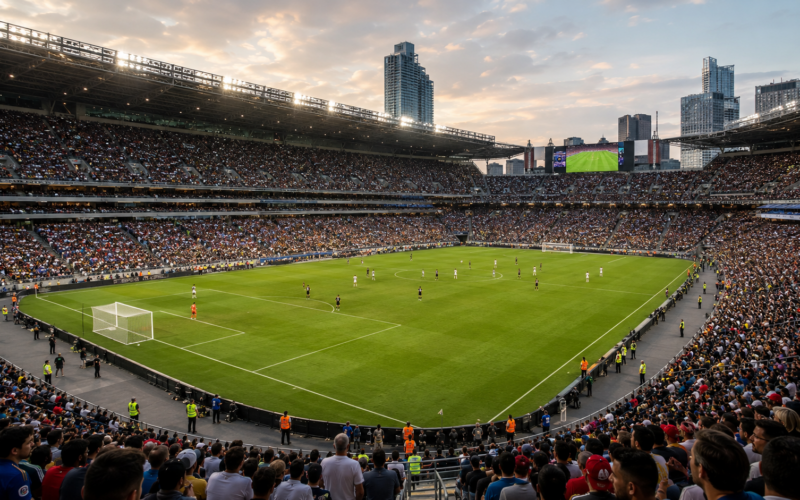
The United States defeated Australia 2-0 at Seattle Stadium on June 19, 2026, securing a place in the FIFA World Cup round of 32 with one Group D match remaining. An own goal by Australia defender Cameron Burgess opened the scoring in the 11th minute before Alex Freeman headed in the second goal in the 43rd minute following a video assistant referee review. The victory gave the United States six points from two matches and extended an encouraging start that began with a 4-1 win over Paraguay.
The United States reached the knockout stage despite playing without injured captain Christian Pulisic, giving head coach Mauricio Pochettino an important demonstration of the squad depth available to the co-hosts. Australia improved after making attacking substitutions at halftime but could not recover from a poor opening period, while the United States recorded its first clean sheet in nine matches.
The result was only the second occasion on which the United States had won two group-stage matches at the same men’s FIFA World Cup. The previous instance came at the inaugural tournament in 1930, when the United States defeated Belgium and Paraguay before reaching the semifinals.
How did the United States take control of the FIFA World Cup match against Australia?
The United States began with some early nervousness in front of a large home crowd in Seattle, but Mauricio Pochettino’s side soon established control through stronger midfield pressure and more purposeful movement in possession. Weston McKennie became particularly influential as the United States prevented Australia from building sustained attacks and repeatedly forced the Socceroos back towards their own penalty area.
The opening goal arrived in the 11th minute after Folarin Balogun accelerated down the left side and directed the ball towards Ricardo Pepi inside the area. Cameron Burgess attempted to intercept the delivery but diverted the ball beyond Australia goalkeeper Patrick Beach and into his own net.
The goal reflected the United States’ aggressive opening strategy. Rather than waiting for Australia to make a clear technical error, the United States created the danger through width, speed and pressure inside the penalty area. Cameron Burgess faced a difficult defensive decision because Ricardo Pepi was positioned to attack the cross if the defender allowed the ball to continue across goal.
Australia struggled to respond during the remainder of the first half. The Socceroos had difficulty advancing beyond the United States midfield, while their most promising moment before the interval came when Alex Freeman blocked a threatening delivery from Mathew Leckie.
The United States continued to dominate territory and was rewarded in the 43rd minute. A set-piece sequence reached Sergino Dest near the edge of the penalty area. Sergino Dest’s attempt was blocked and looped into the air while Patrick Beach was out of position, leaving Alex Freeman with an opportunity to head into an open goal.
The assistant referee initially disallowed the goal for offside. A video assistant referee review subsequently confirmed that Alex Freeman was in a legal position, giving the United States a two-goal lead shortly before halftime.
The review was the decisive turning point because it transformed a controlled but still competitive match into one that Australia needed to chase after the interval. Australia entered the second half requiring at least two goals against a United States team that could protect space, reduce risk and manage its physical resources.
Why was Alex Freeman’s goal the defining moment in the United States victory?
Alex Freeman’s goal carried significance beyond the immediate scoreline. The 21-year-old defender produced the finish after advancing for a set piece, demonstrating how the United States was receiving attacking contributions from positions outside its established forward line.
The goal also arrived during a period in which Australia was attempting to reach halftime only one goal behind. A narrow deficit would have allowed Australia head coach Tony Popovic to reorganise the team without abandoning the original tactical structure. The second goal required Australia to become more aggressive, creating additional space for the United States after the interval.
The video assistant referee decision also changed the emotional balance inside Seattle Stadium. The initial offside ruling briefly interrupted the celebration, but confirmation of the goal generated a stronger response from the United States bench and supporters. The decision reinforced the sense that the co-hosts had converted their first-half superiority into a result that was becoming difficult for Australia to reverse.
Alex Freeman’s wider performance added defensive value. The defender blocked Mathew Leckie’s dangerous first-half cross and remained part of a back line that denied Australia a goal despite increased second-half pressure.
For Mauricio Pochettino, the contribution illustrated the importance of receiving decisive moments from younger and less internationally established players. Tournament squads cannot depend exclusively on their most recognisable names, particularly when injuries, suspensions and physical fatigue accumulate during a seven-match route to the final.
Alex Freeman’s goal therefore supported two conclusions. The United States possessed enough attacking variety to score without Christian Pulisic, and the team’s younger players were capable of influencing a match carrying significant knockout-stage consequences.
How did the United States cope without injured captain Christian Pulisic?
Christian Pulisic missed the Australia match after training separately from the squad following the United States’ opening victory over Paraguay. Christian Pulisic had been withdrawn at halftime during the 4-1 win, leaving uncertainty over whether the United States would lose creativity and attacking leadership against a physically organised Australian team.
Ricardo Pepi replaced Christian Pulisic in the starting side, becoming the only change to the United States lineup. Ricardo Pepi operated as part of an attack that also included Folarin Balogun, while Weston McKennie, Tyler Adams and other midfielders assumed greater responsibility for controlling the match.
The replacement worked because the United States did not attempt to reproduce Christian Pulisic’s role through a single player. Folarin Balogun created the opening goal from the left, Ricardo Pepi occupied central defenders, Weston McKennie influenced the midfield and Alex Freeman supplied the second goal from defence.
This collective structure reduced the risk associated with Christian Pulisic’s absence. The United States remained dangerous without forcing one replacement player to carry the entire creative burden.
Mauricio Pochettino indicated after the match that Ricardo Pepi was continuing to improve and remained an important attacking option. The performance also supported Mauricio Pochettino’s argument that every player would need to contribute if the United States intended to compete deep into the tournament.
Christian Pulisic’s availability remains important because knockout matches are often decided by individual quality, particularly when opponents defend compactly and limit transition opportunities. However, the Australia result reduced the fear that an injury to Christian Pulisic would automatically undermine the United States’ tournament.
The immediate advantage is that the United States has already qualified for the round of 32. Mauricio Pochettino can assess Christian Pulisic carefully before the final Group D match against Turkey rather than rushing the captain back because qualification remains uncertain.
Why did Australia’s tactical changes fail to produce a second-half comeback?
Australia entered the match after an impressive 2-0 victory over Turkey, but Tony Popovic made two notable changes by leaving previous goalscorers Nestory Irankunda and Connor Metcalfe out of the starting lineup. Both players were introduced at halftime after Australia’s first-half approach failed to contain the United States or create meaningful attacking pressure.
The substitutions improved Australia’s urgency. Australia advanced more players, competed more aggressively for second balls and attempted to place the United States defence under sustained pressure.
However, the changes came after Australia had already conceded twice. The United States could defend with greater numerical security, slow the tempo and avoid committing unnecessary players into advanced positions.
Australia’s attacks also lacked precision in the final third. Harry Souttar received one of Australia’s clearest opportunities with approximately five minutes remaining but could not convert the chance. A goal at that stage could have created a tense conclusion, but the missed opportunity allowed the United States to preserve its clean sheet.
Tony Popovic acknowledged that Australia had appeared sluggish and heavy-legged during the first half. The assessment was significant because Australia’s principal problem was not simply tactical positioning. The Socceroos also struggled to match the intensity and speed of the United States during the period when the match was decided.
The physical nature of the contest was reflected in seven yellow cards, including three for the United States and four for Australia. As the second half progressed, the match became increasingly fragmented, reducing Australia’s ability to establish the consistent attacking rhythm required for a comeback.
Australia’s improved second half offered some encouragement before its final group match. However, the defeat demonstrated that a competitive response after halftime cannot fully compensate for conceding control, territory and two goals during the opening 45 minutes of a World Cup match.
What does the Australia result reveal about Mauricio Pochettino’s United States team?
The victory showed that the United States can win through different phases of a match. Mauricio Pochettino’s team attacked with intensity in the first half, created a two-goal advantage and then shifted towards controlled game management after the interval.
That flexibility matters because tournament football rarely allows a team to maintain attacking dominance for 90 minutes. Successful sides must recognise when to press, when to control possession, when to defend deeper and when to conserve energy.
The United States also demonstrated resilience under expectations associated with being a co-host. The opening 4-1 victory over Paraguay created enthusiasm, but it also increased pressure to confirm that the performance was not an isolated result. Defeating Australia provided that confirmation and secured qualification before the final group fixture.
The clean sheet represented another important development. The United States had conceded in eight consecutive matches before facing Australia, raising concerns about defensive reliability against stronger tournament opponents. Australia was unable to exploit those earlier weaknesses despite introducing more attacking players during the second half.
Weston McKennie’s midfield influence, Folarin Balogun’s direct running, Ricardo Pepi’s central movement and Alex Freeman’s decisive contribution all suggested that Mauricio Pochettino has multiple functional options. The team did not depend on one tactical route or one star player.
The remaining question is whether the United States can reproduce the same discipline against technically stronger opponents. Australia offered physical resistance but created limited high-quality attacking chances. Knockout-stage opponents may apply more sophisticated pressure and punish possession errors more efficiently.
The first two group matches nevertheless provide a credible foundation. The United States has scored six goals, collected six points and reached the knockout stage with one game remaining.
What does the 2-0 defeat mean for Australia’s FIFA World Cup qualification hopes?
Australia remained on three points following the defeat and retained a route into the round of 32. The expanded 48-team FIFA World Cup format sends the top two teams from each of the 12 groups into the knockout stage, together with the eight best third-placed teams.
Australia’s final Group D match against Paraguay in San Francisco will therefore carry direct qualification importance. A victory would place Australia in a strong position to advance, while a draw or defeat could leave the Socceroos dependent on the Turkey result and comparisons with third-placed teams from other groups.
Goal difference could also become important. Australia entered the United States match after a 2-0 win over Turkey but surrendered that positive margin with the 2-0 loss in Seattle. The Socceroos must now consider not only the result against Paraguay but also the value of every goal scored or conceded.
Tony Popovic must decide whether to restore Nestory Irankunda and Connor Metcalfe to the starting lineup. Their introduction improved Australia’s energy, but the coaching staff will also need to determine whether the pair can deliver the same impact from the opening whistle.
Australia’s defensive organisation remains another concern. Cameron Burgess’s own goal was unfortunate, but it followed a move in which Folarin Balogun reached a dangerous crossing position too easily. The second goal also emerged from an unsettled set-piece sequence in which Patrick Beach was unable to recover his position.
Australia is not eliminated, and its opening win remains valuable. However, the final match has become a test of whether the Socceroos can respond immediately to a performance in which they failed to compete effectively during the decisive first half.
What happens next for the United States after qualifying for the round of 32?
The United States will complete its Group D campaign against Turkey in Los Angeles. The match will determine the final group position and could influence the identity and difficulty of the United States’ first knockout opponent.
Finishing first in Group D would place the United States against an eligible third-placed team from another group. Finishing second would produce a different route and potentially a more difficult round-of-32 matchup.
Mauricio Pochettino must therefore balance two priorities. The United States has an incentive to win the group, but it also needs to manage injuries and fatigue before the knockout phase.
Christian Pulisic’s fitness will receive particular attention. Qualification gives Mauricio Pochettino the option of protecting Christian Pulisic if there is any risk that returning against Turkey could worsen the injury. Other players carrying physical concerns may also be rested or given reduced minutes.
The United States will also want to preserve momentum. Excessive rotation could disrupt the structure that produced two victories, while a strong performance against Turkey would reinforce confidence before elimination football begins.
The broader challenge is to prevent early success from becoming a source of complacency. The first expanded 48-team World Cup provides a longer knockout route, and reaching the round of 32 is only the beginning of the co-hosts’ campaign.
For the moment, the United States has achieved its first major objective. The team has qualified with a game to spare, won consecutive World Cup matches for the first time since 1930 and demonstrated that it can produce a decisive result without Christian Pulisic.
What are the key takeaways from the United States’ 2-0 World Cup win over Australia?
- The United States defeated Australia 2-0 at Seattle Stadium on June 19, 2026, collecting six points from two Group D matches and securing qualification for the FIFA World Cup round of 32.
- Australia defender Cameron Burgess scored an own goal in the 11th minute after Folarin Balogun delivered a dangerous ball towards Ricardo Pepi, giving the United States an early advantage.
- Alex Freeman scored the second goal in the 43rd minute after a set-piece sequence, with the goal confirmed following a video assistant referee review after initially being disallowed for offside.
- The United States won without injured captain Christian Pulisic, as Ricardo Pepi entered the starting lineup and the team distributed its attacking responsibilities across several players and positions.
- Australia improved after Tony Popovic introduced Nestory Irankunda and Connor Metcalfe at halftime, but the Socceroos could not overturn the damage caused by their sluggish first-half performance.
- The United States recorded its first clean sheet in nine matches and won two group-stage games at the same men’s FIFA World Cup for only the second time, following the 1930 tournament.
- Australia remains in contention for the knockout stage with three points, but its final Group D match against Paraguay in San Francisco has become critical to its qualification prospects.
- The United States will next face Turkey in Los Angeles, where Mauricio Pochettino must balance the opportunity to win Group D with the need to protect Christian Pulisic and manage the squad.
Share this:
Discover more from Business-News-Today.com
Subscribe to get the latest posts sent to your email.