






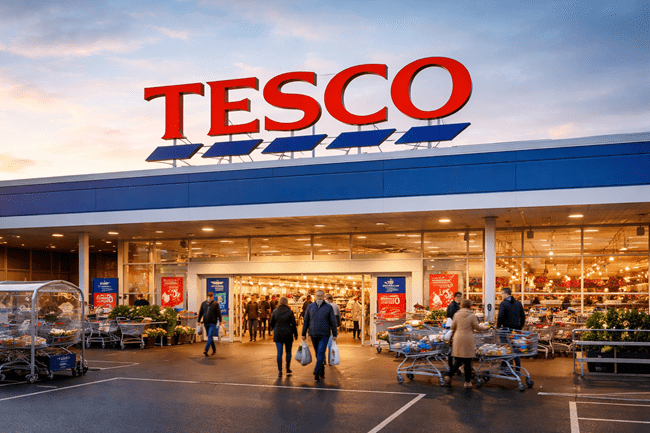
Tesco PLC (LSE: TSCO) has reported slower-than-expected first-quarter sales growth as pressure on household budgets and difficult prior-year comparisons affected Britain’s largest grocery retailer. Group sales excluding VAT and fuel reached £16.83 billion for the 13 weeks ended 30 May 2026, while UK like-for-like sales increased 1.8% and total group like-for-like sales rose 1.0%. The immediate strategic significance is that Tesco PLC must preserve market share and customer satisfaction without allowing price investment, operating inflation or weakness at Booker to erode margins. TSCO shares fell after the announcement as investors looked beyond strong online and premium-range growth and focused on whether the group can reach the upper end of its £3.0 billion to £3.3 billion profit guidance.
Why did Tesco shares fall even though full-year profit guidance was maintained?
The share-price decline reflects an expectations problem rather than evidence that Tesco PLC’s business has suddenly deteriorated. UK like-for-like sales rose 1.8%, but analysts had expected stronger growth. The result also represented a sharp slowdown from the growth delivered in previous quarters, creating concern that Tesco’s recent momentum may be normalising faster than investors anticipated.
The comparison period was unusually demanding. Tesco benefited from exceptionally favourable weather and disruption at competitors during the equivalent quarter last year. The company’s two-year UK like-for-like growth remained healthy at 6.9%, suggesting the underlying position is stronger than the single-quarter slowdown implies.
However, TSCO had entered the update with a relatively full valuation for a supermarket business. The shares had gained around 15% over the previous year and were trading well above their 52-week low. When a defensive retailer is already priced for steady execution, even a modest sales miss can prompt investors to lock in gains.
The market was also looking for evidence that Tesco could comfortably reach the upper end of its profit range. Management maintained guidance rather than narrowing or upgrading it. That was prudent given geopolitical and consumer uncertainty, but it provided no new earnings catalyst to offset the weaker sales figure.
How much of Tesco’s UK slowdown reflects weak demand rather than tough comparisons?
The first-quarter slowdown appears to reflect a combination of consumer caution and an unusually strong prior-year base. Tesco said the conflict in the Middle East had created uncertainty for households, particularly through its influence on energy prices and broader economic confidence.
Private-sector real wages have also been under pressure, leaving many consumers more selective about discretionary purchases. Grocery spending is essential, but customers can still trade down, reduce waste, switch brands or avoid higher-margin non-food products when household finances tighten.
Tesco’s food performance was nevertheless resilient. Food sales increased 2.6%, while fresh food rose 3.6%. These figures suggest the company continued to attract customer volumes in strategically important categories rather than relying entirely on price inflation.
Customer satisfaction also improved significantly. Tesco’s net promoter score increased six points year-on-year to 31, with better perceptions of value and range. This is an important counterweight to the weaker headline growth because it indicates customers are not abandoning the brand.
The two-year growth figure provides the clearest perspective. UK like-for-like sales were 6.9% higher than two years earlier. Tesco therefore remains structurally larger and stronger, even though the latest quarter did not deliver the acceleration investors wanted.
Why does Tesco’s 8.9% online growth matter for margins and customer retention?
Tesco’s UK online sales increased 8.9%, significantly outperforming its overall UK sales growth. This suggests digital grocery remains one of the group’s strongest expansion channels and is helping Tesco capture a greater share of customers’ weekly spending.
The company extended Whoosh rapid delivery into another 34 large stores and introduced Book for Later delivery slots. These changes make same-day delivery available across a wider product range and help Tesco compete with rapid-delivery specialists, Amazon and other supermarket platforms.
Online growth also supports customer retention. Customers who use delivery subscriptions, saved shopping lists and Clubcard-linked recommendations may be less likely to switch retailers regularly. The digital relationship gives Tesco more data on purchasing behaviour and more opportunities to personalise pricing and promotions.
However, online grocery can carry additional costs for picking, delivery, technology and fulfilment. The investment case depends on Tesco increasing order density, improving basket economics and using its extensive store network efficiently.
The company’s scale provides an advantage. Smaller competitors may struggle to match Tesco’s national coverage, product selection and fulfilment infrastructure. If online sales continue growing faster than the wider business, the channel could strengthen market share and customer loyalty, although investors will still require evidence that growth supports rather than dilutes margins.
What is going wrong at Booker and why does it matter to Tesco’s group valuation?
Booker was the clearest weak point in the update, with like-for-like sales falling 3.2% to £2.25 billion. Core retail sales declined 1.5%, core catering sales fell 3.3%, and tobacco sales dropped 9.7%.
Part of the decline was intentional. Tesco exited a lower-margin national account in August 2025, creating an approximately 200-basis-point drag on core retail sales. Removing low-return revenue can improve the quality of earnings even when headline sales decline.
Booker also faced difficult comparisons because favourable weather and a later Easter supported the prior-year period. Its two-year growth figures were more positive, with core retail sales up 3.2% and catering sales up 2.9%.
The strategic concern is that Booker has now delivered several quarters of weaker growth. The wholesale business supplies independent retailers, pubs, restaurants and catering customers, making it sensitive to high-street conditions and hospitality demand.
Booker remains profitable and strategically useful, but its weaker performance can dilute Tesco’s stronger supermarket and online trends. Investors will want the division to stabilise before concluding that the national-account exit has created a cleaner and more valuable revenue base.
The addition of 146 net new retailer partners during the quarter is encouraging. The key question is whether those relationships can translate into higher sales and stronger operating leverage over the remainder of the financial year.
Can Aldi Price Match and Clubcard personalisation defend Tesco’s market leadership?
Tesco extended Aldi Price Match to more than 2,000 Express stores during the quarter. This is strategically important because convenience stores generally carry higher prices than large supermarkets, making affordability a growing concern for customers who rely on local shopping.
The expansion allows Tesco to challenge the perception that convenience automatically means poor value. It may also protect Express traffic from discounters, neighbourhood retailers and rapidly expanding convenience formats operated by competitors.
Clubcard remains another major defensive advantage. Tesco’s personalised Your Clubcard Prices programme has delivered nearly 100 million tailored offers since launching in March. The system allows the company to target discounts more precisely instead of reducing prices across entire categories.
Personalisation can protect margins because promotions are directed toward customers most likely to respond. It can also improve customer engagement and help Tesco identify when shoppers are switching brands, reducing basket size or moving toward cheaper alternatives.
The risk is that competitors are also investing aggressively in loyalty pricing. Sainsbury’s Nectar Prices, Lidl Plus and other retailer programmes are creating a market where customers increasingly expect personalised discounts.
Tesco’s advantage lies in scale and data depth. Its leading market share, Clubcard membership, banking and insurance relationships, mobile customers and online platform create a broad customer-information ecosystem. The company must use that advantage carefully, delivering meaningful value without making pricing unnecessarily complex.
Why are Tesco Finest and new product launches important during a consumer squeeze?
Tesco Finest sales increased 9% during the quarter and 29% over two years. This is a notable result because premium products might be expected to struggle when household budgets are under pressure.
The performance suggests that consumers are trading down from restaurants and branded premium products rather than abandoning quality entirely. A customer may reduce spending outside the home while still purchasing higher-quality supermarket meals, deli products or drinks.
Tesco launched or improved more than 520 products during the quarter, including over 220 Finest lines. The company completed its largest-ever Finest deli transformation and expanded the Tesco High Protein range.
Innovation helps Tesco differentiate itself from discounters. Aldi and Lidl compete aggressively on price, but Tesco can use product development, convenience, online availability and premium own-label ranges to provide a broader proposition.
Own-brand products may also support margins because Tesco has greater control over sourcing, packaging, pricing and promotion. The balance is important. The retailer must offer enough affordable products to maintain its value credentials while using Finest and specialist ranges to increase basket value.
Why is the £750 million share buyback more important as organic growth moderates?
Tesco began a £750 million share-buyback programme in April 2026 and had already repurchased approximately £341 million of shares by the close of trading on 17 June. The remaining programme is expected to be completed by April 2027.
Buybacks reduce the number of shares in circulation and can support earnings per share even when underlying profit growth is modest. This becomes particularly valuable when organic sales growth slows and investors seek alternative sources of per-share value creation.
Tesco generated £1.96 billion of free cash flow in FY2025/26 and maintained medium-term free cash flow guidance of £1.5 billion to £2.0 billion. This cash generation supports dividends, buybacks and continued investment in stores, technology and online capacity.
The buyback also signals that management considers the balance sheet strong enough to return capital while navigating uncertain consumer conditions. It can provide technical support for the share price during periods of market weakness.
However, buybacks cannot permanently compensate for weak revenue or margin trends. Repurchasing shares creates the most value when the stock is undervalued and the underlying business remains capable of growing cash generation.
Investors will therefore assess the programme alongside operating performance. A buyback combined with stable profit and market-share gains can be powerful. A buyback used mainly to disguise deteriorating earnings is far less attractive.
How should investors read Tesco’s valuation after the post-update share-price fall?
Tesco shares traded around 447p to 449p after the Q1 update, leaving the stock below its February 2026 high of approximately 508p but still above the 52-week low near 393p. The market capitalisation remained close to £28.6 billion.
The shares trade at roughly 15 to 16 times trailing earnings and offer a dividend yield near 3.2%. This is not an extreme valuation, but it reflects expectations that Tesco can sustain market leadership, cash generation and disciplined capital returns.
The post-update decline may interest long-term investors who believe the sales slowdown is largely caused by comparisons and temporary consumer caution. Tesco’s scale, market share, property base, free cash flow and buyback provide substantial defensive qualities.
The opposing view is that the valuation still leaves limited room for disappointment. Booker is weak, competition remains intense, wage and operating costs are rising, and price investment could pressure margins.
TSCO is therefore being valued as a high-quality defensive retailer rather than a rapid-growth company. The next re-rating will depend less on headline sales and more on whether Tesco can protect absolute profit and free cash flow while continuing to invest in value.
What does Tesco’s update reveal about Britain’s wider grocery market in 2026?
The update confirms that the UK grocery market remains intensely competitive. Tesco is extending price matching, improving Clubcard rewards and launching hundreds of new products even though it already holds more than 28% of the market.
Discounters continue expanding, while Sainsbury’s, Lidl and other rivals are investing in pricing and convenience. Morrisons has also described the market as highly competitive, with its own sales growth slowing.
Consumer behaviour is becoming more fragmented. Customers want value, but they are also willing to pay for premium own-label products, rapid delivery and convenient store formats. Retailers must therefore compete across several dimensions at once.
Online grocery is again growing faster than the overall market. Tesco’s 8.9% UK online growth and 17.4% expansion in Central Europe show that digital shopping is becoming a more important part of the grocery mix.
The wider macroeconomic environment remains uncertain. Energy prices, real wages, employment conditions and food inflation can all influence shopping patterns. Tesco has the balance-sheet strength to respond, but smaller retailers and independent Booker customers may face greater pressure.
What should investors watch before Tesco reports interim results on 8 October 2026?
The first issue is UK like-for-like growth. Investors will want evidence that the first-quarter slowdown was temporary and that sales improve as comparisons become less demanding.
The second issue is Booker. Stabilisation in core retail and catering would reduce concern that wholesale weakness is becoming structural.
The third issue is margin protection. Tesco must demonstrate that price investment, wage inflation and online growth remain compatible with adjusted operating profit of £3.0 billion to £3.3 billion.
The fourth issue is market share. Continued share gains would support management’s strategy even if overall grocery growth remains modest.
The fifth issue is free cash flow. Maintaining the £1.5 billion to £2.0 billion range would protect the dividend, buyback and balance-sheet investment case.
The final issue is whether management narrows guidance. A move toward the upper end of the profit range would provide a meaningful catalyst. Continued wide guidance may suggest uncertainty remains too high for stronger earnings confidence.
Key takeaways on Tesco’s Q1 sales update, TSCO share price and UK grocery outlook
- Tesco PLC reported group sales excluding VAT and fuel of £16.83 billion for the 13 weeks ended 30 May 2026.
- Group like-for-like sales increased 1.0%, while UK like-for-like sales growth slowed to 1.8% and missed market expectations.
- The weaker UK figure was partly caused by difficult comparisons following favourable weather and competitor disruption in the prior year.
- UK online sales rose 8.9%, showing that digital grocery remains one of Tesco’s strongest growth channels.
- Tesco Finest sales increased 9% year-on-year and 29% over two years, supporting the company’s premium own-label strategy.
- Booker like-for-like sales declined 3.2%, making the wholesale division the clearest operational weakness in the quarter.
- Tesco maintained adjusted operating profit guidance of £3.0 billion to £3.3 billion and free cash flow guidance of £1.5 billion to £2.0 billion.
- The company had completed £341 million of its £750 million share-buyback programme by 17 June 2026.
- TSCO shares fell after the update because slower sales growth and unchanged guidance provided no immediate catalyst for a stock already priced for steady execution.
- The next major tests will be UK sales reacceleration, Booker stabilisation, margin protection and any narrowing of guidance at the October interim results.
Share this:
Discover more from Business-News-Today.com
Subscribe to get the latest posts sent to your email.
