





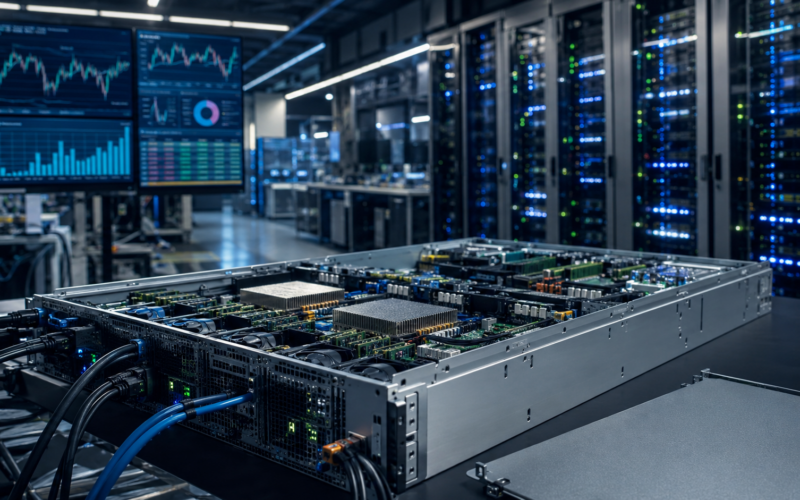
Super Micro Computer, Inc. (NASDAQ: SMCI) has priced a series of equity and equity-linked financing transactions that could raise up to $7.0 billion to fund components for a surge in artificial intelligence server orders. The company priced 45,454,545 common shares at $27.50 each and 75,000,000 depositary shares at $50 each, with the depositary shares tied to newly issued 7.0 percent series A mandatory convertible preferred stock. The financing is intended to support approximately $39 billion of recent advanced AI server orders from more than 20 customers, making the transaction one of the clearest signs yet that AI infrastructure demand is stretching supplier balance sheets. SMCI stock recently traded around $29.17, sharply below its 52-week high of $62.36 but still above its 52-week low of $19.48, after the financing announcement triggered a heavy selloff. The core investor question is whether Super Micro Computer is raising capital to capture a genuine AI growth window or issuing stock at a difficult moment because the business model needs more working capital than shareholders expected.
Why did Super Micro Computer stock fall despite the company’s $39bn AI server order backdrop?
Super Micro Computer’s selloff looks counterintuitive at first glance because a $39 billion order pipeline should normally be received as a sign of strong demand. The problem is that investors are not just looking at demand. They are looking at the funding structure required to serve that demand. When a company announces a large equity and equity-linked raise, shareholders immediately focus on dilution, conversion risk, ownership compression, and whether the company could have funded growth through internal cash generation instead.
The $7.0 billion potential raise tells investors that the AI server boom is not an easy asset-light story. Super Micro Computer sells into one of the hottest parts of the technology market, but high-growth AI server demand requires upfront purchases of graphics processing units, networking components, racks, power systems, cooling equipment, and other hardware. Those components are expensive, supply constrained, and often needed before revenue is fully collected. That creates a working-capital gap, and equity markets are being asked to help bridge it.
The stock reaction therefore reflects a more mature phase of the AI trade. Earlier in the cycle, markets rewarded almost any company exposed to Nvidia Corporation, data centers, or large language model infrastructure. Now investors are asking who absorbs the capital burden, how margins behave when order volumes accelerate, and whether suppliers can convert demand into cash flow rather than just revenue. Super Micro Computer is not being punished because AI demand is absent. It is being punished because AI demand is proving expensive to serve.
How does the $7bn financing structure change the risk profile for SMCI shareholders?
The structure of the financing matters because it combines immediate common stock dilution with future equity-linked conversion exposure. Super Micro Computer priced 45,454,545 common shares at $27.50 per share, which places new equity into the market at a level that existing shareholders will naturally compare with recent trading prices. The company also priced 75,000,000 depositary shares, each representing a 1/20th interest in series A mandatory convertible preferred stock.
The mandatory convertible preferred stock carries a 7.0 percent annual dividend rate and is expected to convert into common stock in 2029 unless converted earlier under specified terms. That means investors are not only evaluating today’s dilution. They also have to evaluate future share count expansion, dividend obligations, and the impact of conversion mechanics on earnings per share. In other words, the financing gives Super Micro Computer capital, but it also makes the equity story more complicated.

The at-the-market program adds another layer. Super Micro Computer may sell up to $1.25 billion of common stock over time, with sales not expected to begin until the third quarter of 2026. That gives the company flexibility, but it may also weigh on sentiment because investors know additional shares could enter the market if conditions permit. For a stock already volatile, the possibility of future issuance can cap rebounds unless operating results quickly justify the financing.
What does this transaction reveal about the economics of the AI server supply chain?
Super Micro Computer’s financing shows that the AI server supply chain is experiencing a rare combination of enormous demand and heavy capital strain. The company’s products sit close to the physical layer of the AI boom. It does not merely sell software subscriptions or digital services. It must assemble, configure, and deliver complex server systems that depend on advanced chips, power density, thermal design, storage, memory, networking, and customer-specific deployment requirements.
That makes scale a double-edged sword. A large order book can improve purchasing leverage, factory utilization, and customer relevance. However, it can also create pressure if component purchases must be made before cash is collected, if suppliers demand earlier payments, or if customers delay deployments. The larger the order intake, the larger the operating balance-sheet requirement can become. Growth looks wonderful until the invoice arrives before the customer payment. That is when the finance department stops smiling politely.
The transaction also highlights a broader industry shift. AI infrastructure suppliers may increasingly need capital-market access to keep pace with hyperscaler demand. The companies that can secure financing, inventory, supply relationships, and delivery capacity may win share. Those that cannot may miss orders even when demand is strong. Super Micro Computer’s raise is therefore not just a company-specific event. It is a signal that the AI server boom is becoming a working-capital race.
Why is Super Micro Computer’s margin profile central to the investment debate?
Super Micro Computer’s margin profile is now one of the most important variables for SMCI stock. Investors can tolerate dilution more easily if they believe the capital will generate high-return revenue with improving margins. They become less tolerant when the business requires large financing but operates on thinner hardware margins. AI server demand can scale quickly, but the profitability of that scale depends on pricing power, component costs, supply timing, customer mix, and operational execution.
The competitive landscape is intense. Dell Technologies Inc., Hewlett Packard Enterprise Company, Lenovo Group Limited, and other infrastructure providers are also targeting AI server and data-center opportunities. Customers are sophisticated and often large enough to negotiate aggressively. That makes it difficult for Super Micro Computer to assume that high demand automatically translates into high margins. If customers view AI servers as urgent but substitutable infrastructure, pricing power may be more limited than bulls hope.
The company’s advantage is speed and configuration flexibility. Super Micro Computer has built a reputation for moving quickly around new chip platforms and custom server architectures. That can matter in a market where deployment timing is critical. The risk is that speed alone may not protect returns if gross margins compress, if supply-chain costs rise, or if large customers demand favorable terms. The financing makes this margin question unavoidable.
How should investors read SMCI stock after the sharp post-financing selloff?
SMCI stock’s market reaction shows that investors are drawing a line between AI revenue excitement and shareholder return discipline. The shares recently traded around $29.17, compared with a 52-week range of $19.48 to $62.36. The stock had closed at $46.88 on June 1, showing how quickly sentiment shifted once the market began focusing on dilution, financing needs, and broader technology-sector weakness. That is not a small wobble. That is a reminder that AI hardware stocks can move like small-cap biotechs when confidence cracks.
The current price also shows why the investment case is divisive. Bulls may argue that SMCI stock now reflects excessive fear, especially if the $39 billion order pipeline converts into revenue and cash flow. Bears may argue that the stock deserves a discount because the company needs equity capital to fund growth, has a volatile operating history, and faces margin pressure in a competitive hardware market. Both sides can point to real facts.
The key sentiment issue is whether investors see the raise as offensive or defensive. An offensive raise would mean Super Micro Computer is opportunistically raising capital to capture a rare demand window. A defensive raise would mean the company needs external funding because its operating model cannot internally support the growth being advertised. The difference will be decided by execution over the next several quarters, not by the announcement itself.
What are the biggest execution risks behind Super Micro Computer’s AI order backlog?
The first risk is order conversion. Super Micro Computer has said the recent AI server orders are expected to be fulfilled in future quarters, but large infrastructure orders can face delays, cancellations, customer changes, financing conditions, and supply-chain constraints. Investors should not treat the full order figure as immediate revenue. It is a major demand signal, but demand still needs to move through procurement, production, shipping, installation, acceptance, and payment.
The second risk is component availability. AI servers depend heavily on advanced chips and related systems, with Nvidia Corporation remaining a central supplier across much of the high-performance AI infrastructure market. If critical components are delayed, reallocated, repriced, or constrained, Super Micro Computer’s delivery schedule and margins could be affected. Supply-chain execution is not background noise in this business. It is the business.
The third risk is cash conversion. Even if revenue grows, investors will watch whether Super Micro Computer can improve free cash flow and reduce reliance on repeated financing. If the company keeps converting large orders into large revenue but not enough cash, the stock may remain under pressure. A server business can look spectacular on revenue growth and still disappoint if working capital, inventory, receivables, and margins do not cooperate.
What does the Super Micro Computer raise mean for Nvidia and the wider AI ecosystem?
The transaction is an indirect reminder of Nvidia Corporation’s influence across the AI infrastructure value chain. Super Micro Computer’s need to fund component purchases underscores the scale of demand for advanced compute hardware and related server systems. Nvidia Corporation may not be the issuer in this financing, but the AI server buildout depends heavily on the chip platforms and accelerator ecosystems that Nvidia Corporation has helped define.
For the wider AI ecosystem, the lesson is that demand is not the only constraint. Capital, power, cooling, manufacturing, logistics, and customer financing are all becoming constraints. Companies building AI capacity are discovering that artificial intelligence is not just software in the cloud. It is metal, memory, racks, cables, liquid cooling, substations, debt, equity and a lot of paperwork. The technology may be futuristic, but the balance-sheet mechanics are wonderfully old-fashioned.
This is also why investors are becoming more selective across AI infrastructure stocks. The market is no longer giving every AI supplier the same valuation treatment. Software platforms, chip designers, cloud operators, data-center landlords, and server manufacturers all have different margin structures and capital needs. Super Micro Computer’s raise makes that distinction clearer. AI demand is real, but not every layer of the AI stack captures the same economics.
Could Super Micro Computer’s financing ultimately prove positive if the company executes well?
The financing could still prove strategically useful if Super Micro Computer uses the proceeds to secure components, deliver orders, protect customer relationships, and improve revenue visibility. In a fast-moving AI infrastructure market, companies that cannot fund inventory may lose business to competitors. From that perspective, the raise may be necessary rather than optional. If the company had failed to secure capital and then missed deliveries, the market could have punished the stock for a different reason.
The best-case scenario is straightforward. Super Micro Computer uses the financing to fulfill orders, scales production efficiently, improves gross margin through volume and configuration mix, collects cash on time, and demonstrates that the dilution was more than offset by growth. If that happens, the stock could recover because the market would reframe the transaction as a painful but value-creating capital raise.
The downside scenario is equally clear. If orders slip, margins disappoint, customers renegotiate, or additional capital is required, investors may conclude that Super Micro Computer is operating in a high-demand but low-return segment of the AI boom. That would be a tougher outcome for SMCI stock because the company would have diluted shareholders without proving that the new capital creates superior returns. The next few quarters will decide which version of the story wins.
Key takeaways on what Super Micro Computer’s $7bn financing means for SMCI stock and AI infrastructure
- Super Micro Computer’s $7.0 billion potential financing shows that AI server demand is strong, but it also highlights the heavy working-capital burden required to serve large infrastructure orders.
- The company’s approximately $39 billion AI server order backdrop is strategically significant, but investors are focused on whether those orders convert into cash flow rather than only revenue.
- SMCI stock sold off because the market viewed the common stock offering, mandatory convertible preferred structure, and future ATM capacity as potentially dilutive for existing shareholders.
- The 45,454,545 common-share offering at $27.50 per share places a clear reference point under the stock and may influence near-term trading sentiment.
- The 75,000,000 depositary-share offering tied to 7.0 percent mandatory convertible preferred stock adds future conversion complexity and dividend obligations to the equity story.
- Super Micro Computer’s margin profile is central to the investment case because AI server demand may not automatically translate into high-return growth in a competitive hardware market.
- The financing is indirectly positive for the AI infrastructure demand narrative, but it also shows why server suppliers may need constant access to capital as order volumes rise.
- Nvidia Corporation remains a key ecosystem reference point because advanced AI server demand depends heavily on accelerator supply, platform timing, and component availability.
- The biggest risk for Super Micro Computer is that orders, supply-chain execution, and customer payments do not move fast enough to justify the dilution and financing complexity.
- The clean investor question is whether this raise is an offensive move to capture a rare AI demand window or a warning that the AI server boom requires more capital than shareholders expected.
Share this:
Discover more from Business-News-Today.com
Subscribe to get the latest posts sent to your email.