





Avenira Limited (ASX:AEV) has released its Gold Coast Investment Showcase presentation, placing the Wonarah Phosphate Project in the Northern Territory at the centre of its near-term strategy. The update frames Wonarah as a Direct Shipping Ore phosphate opportunity designed to generate early revenue before larger beneficiation and yellow phosphorus pathways are advanced. The strategic relevance is immediate because Avenira Limited is trying to move ASX:AEV from long-dated project optionality toward a more visible production-readiness story. ASX:AEV recently traded around A$0.007, with a 52-week range of about A$0.006 to A$0.010 and a market capitalisation near A$29.8 million, showing that the market remains cautious despite the scale of the resource. For investors, the decisive question is whether Avenira Limited can convert a very large phosphate deposit into a fundable, executable and commercially contracted operation.
Why is Avenira Limited making Wonarah phosphate the centre of its ASX:AEV investment case?
Avenira Limited is putting Wonarah at the centre of the ASX:AEV story because the project gives the company a clearer near-term path than a typical exploration-stage resource asset. Wonarah is described by the company as one of Australia’s largest phosphate resources, with a total resource of 533 million tonnes using a 15 percent P2O5 cut-off grade. That scale gives Avenira Limited a strategic foundation, but the company’s latest pitch is not simply about size. It is about sequencing.
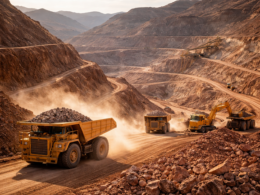
The sequencing matters because Avenira Limited is now emphasising a Direct Shipping Ore stage that could generate revenue before higher-capital downstream phases are fully developed. In practical terms, that means the company is trying to use a simpler open-cut, blast, dig, load, crush and transport model as the first commercial step. That is a more digestible proposition for investors than asking them to immediately underwrite a large integrated phosphate chemicals platform.
The market logic is also clear. ASX small-cap investors have become less tolerant of projects that remain permanently “strategic” but never cross into operating reality. Avenira Limited is therefore trying to show that Wonarah has moved beyond conceptual importance and into development readiness. The presentation highlights completed approvals, a mine management pathway, tenders in the market and a planned H2 CY26 pre-strip. Those are the types of milestones that can reduce the gap between resource ownership and cash generation, provided execution actually follows.
How does the Wonarah Phosphate Project’s infrastructure position improve the development argument?
Wonarah’s infrastructure setting is one of Avenira Limited’s strongest strategic arguments. The project is adjacent to the Barkly Highway, has access to the Darwin bulk commodity port, sits near rail capacity between Tennant Creek and Darwin, and is crossed by the Northern Gas Pipeline and fibre optic infrastructure. For a bulk commodity such as phosphate, logistics are not a supporting detail. They are often the economics.
This matters because phosphate rock must compete across price, quality, freight distance and reliability of supply. A deposit can look impressive in geological terms, but if the freight solution is expensive or operationally fragile, customers may not care how large the resource is. Avenira Limited’s ability to point to road, rail, port and gas infrastructure gives the company a more credible route to market than many remote resource projects.
The renewable energy angle adds another layer, although investors should treat it as a longer-term advantage rather than an immediate cash-flow driver. Avenira Limited has highlighted strong solar irradiation and wind conditions at Wonarah, which could become relevant if the project eventually moves into beneficiation or yellow phosphorus production. For now, the more important question is simpler: can the company mine, crush, transport and sell phosphate ore reliably enough to establish commercial traction?
Why does the Direct Shipping Ore strategy matter more than the larger downstream ambition?
The Direct Shipping Ore strategy matters because it is the bridge between Avenira Limited’s resource base and investor credibility. The downstream pathway into beneficiation and yellow phosphorus may offer higher-value optionality, especially because phosphate products are relevant to agriculture, industrial chemicals, energy storage and battery supply chains. However, those stages require more engineering, customer qualification, funding, approvals alignment and execution confidence.
By contrast, the Direct Shipping Ore stage is designed to be lower technical risk. Avenira Limited has presented it as a simple open-cut operation with minimal processing before transport and export. That does not mean it is easy. Bulk mining still requires working capital, contractor discipline, grade control, logistics scheduling, port access, product quality assurance and customer acceptance. But it is a more immediate test than building out the full downstream vision.
This is why H2 CY26 is important. Avenira Limited has indicated that pre-strip work at the Arruwurra orebody is scheduled for the second half of calendar 2026, exposing ore ahead of crushing, transport and export. If that timetable holds, ASX:AEV could begin to be assessed less as a dormant phosphate option and more as a company moving toward first commercial output. If the timetable slips, investors may become less forgiving because the company has now made execution timing central to the story.
How does Sichuan Hebang Biotechnology support change Avenira Limited’s funding and market position?
Sichuan Hebang Biotechnology Corporation Limited is important to the Avenira Limited story because it provides more than passive register support. The investor presentation refers to balance-sheet support, logistics capability and a panamax vessel fleet through Hebang Biotechnology, which matters because bulk commodity development often depends on supply-chain strength as much as resource quality. For a company of Avenira Limited’s size, that type of strategic shareholder backing can reduce perceived execution risk.
The support is particularly relevant because Avenira Limited’s cash balance at 31 March 2026 was A$2.03 million with no debt. A debt-free balance sheet is useful, but the cash balance by itself is not large relative to the work required to move Wonarah toward production. That makes shareholder support, financing flexibility, contractor terms and potential offtake arrangements critical components of the company’s development path.
There is also a commercial logic behind the relationship. If Avenira Limited can transition from a free-on-board Darwin model toward cost-and-freight delivery into Asian ports, it could gain more control over customer service, freight efficiency and pricing competitiveness. That would make Wonarah more than a mine-mouth project. It would become part of a regional supply-chain proposition. The risk is that every additional layer of logistics control brings its own execution burden.
What does ASX:AEV’s share price performance say about investor sentiment toward Avenira Limited?
ASX:AEV’s share price shows that investors are not yet paying heavily for the Wonarah development pathway. The stock recently traded around A$0.007, with market data showing a 52-week range around A$0.006 to A$0.010 and a market capitalisation close to A$29.8 million. TradingView data indicated no weekly move but a roughly 12.5 percent one-month decline, while other market snapshots showed the company still sitting well below its 52-week high.
That market behaviour is not surprising. Investors are recognising the project scale, but they are also discounting the practical difficulty of moving from presentation milestones to sales, cash flow and repeat shipments. In small-cap resources, a large resource can attract attention, but early revenue is what changes the conversation. Avenira Limited’s stock is therefore sitting in that awkward but familiar zone where the story is interesting, yet the proof is still pending.
The absence of broad institutional coverage also affects sentiment. Without consistent analyst modelling, ASX:AEV is likely to trade on announcements, shareholder updates, project timelines and retail investor interpretation. That can create sharp swings around milestones, but it also means the company must communicate clearly and avoid ambiguity. Investors do not need more adjectives. They need dates, contracts, costs and evidence that ore can move.
Why does the Jundee South Gold Project add optionality without replacing the Wonarah thesis?
Jundee South gives Avenira Limited a second line of market interest, but it should be seen as optionality rather than the main valuation anchor. The company has approved a A$2.6 million exploration budget for the Jundee South Gold Project in Western Australia, covering 16,200 metres of reverse circulation and aircore drilling and soil sampling. Field activities are planned to begin in Q3 CY26, giving ASX:AEV another potential catalyst window.
The project’s location in the Yandal Greenstone Belt is attractive because the broader Yandal and Wiluna gold province includes major historical production and established mining names. Avenira Limited’s ground package is large, covering more than 1,250 square kilometres across discrete tenure parcels, with targets near areas associated with Jundee, Bronzewing, Darlot, Agnew Lawlers, Thunderbox and Bellevue. That gives the exploration story enough geological context to be relevant.
The risk is focus. Avenira Limited is primarily asking investors to value a phosphate development pathway, yet it is also promoting a sizeable gold exploration program. That can be helpful if Jundee South produces strong results, but it can also blur the company’s identity if capital and management attention become spread too thin. The cleanest ASX:AEV rerating path still runs through Wonarah execution. Jundee South is a useful bonus, not the main course.
What are the biggest execution risks before Avenira Limited can prove the Wonarah pathway?
The first execution risk is offtake and customer qualification. Avenira Limited has referred to cornerstone offtake being in final negotiation and to plans for customer product qualification, but investors will want binding commercial evidence. Bulk commodity customers care about grade, consistency, impurities, delivery reliability and price. Avenira Limited must show that Wonarah ore is not only saleable, but saleable repeatedly into the target markets.
The second risk is logistics execution. Moving phosphate ore from inland Northern Territory to Darwin and then into Asian markets requires disciplined transport planning, port coordination and working capital management. Avenira Limited may have useful infrastructure access, but access is not the same as execution. The difference between a good mining plan and a profitable shipment can be a long train ride, a port bottleneck and a freight bill that refuses to behave.
The third risk is funding. The company’s market capitalisation is small relative to the ambition at Wonarah, and the longer-term beneficiation and yellow phosphorus pathways will require more capital and technical validation. If the Direct Shipping Ore stage works, it may help fund or de-risk later stages. If it slips, Avenira Limited could face the familiar small-cap problem of raising capital before the market has seen enough evidence to reward the strategy.
What happens next if Avenira Limited executes the H2 CY26 Wonarah plan successfully?
If Avenira Limited executes the H2 CY26 pre-strip and moves toward first shipments, the ASX:AEV story could become materially more investable. Investors would then be able to evaluate production readiness, product quality, customer traction and cash conversion rather than relying mainly on resource size and development timelines. That would be an important shift because revenue proof can reduce the valuation discount attached to long-dated project developers.
Successful execution would also strengthen the downstream case. A working Direct Shipping Ore operation could provide customer relationships, logistics data, operational credibility and potentially cash flow to support beneficiation studies. It would not automatically fund a larger phosphate chemicals platform, but it would make the next phase easier to discuss with financiers, strategic partners and customers.
If Avenira Limited misses the timetable or fails to secure commercial traction, the market may continue to treat ASX:AEV as a low-priced project-stage option rather than an emerging producer. That would not erase the scale of Wonarah, but it would delay the company’s credibility test. The company’s opportunity is meaningful because phosphate sits at the intersection of food security, industrial chemicals and energy storage supply chains. The market, however, is asking a very practical question: when does the big deposit become a real business?
What are the key takeaways from Avenira Limited’s Gold Coast Investment Showcase presentation?
- Avenira Limited is using the Gold Coast Investment Showcase to position Wonarah as an early revenue Direct Shipping Ore phosphate opportunity rather than only a long-dated downstream project.
- Wonarah’s 533 million tonne phosphate resource gives ASX:AEV strategic scale, but investor value now depends on whether the company can execute mining, logistics and sales.
- The H2 CY26 planned pre-strip at the Arruwurra orebody is the most important near-term milestone because it could move Avenira Limited toward first commercial activity.
- Existing infrastructure around Wonarah, including road, rail, port, gas pipeline and fibre access, improves the development argument but does not remove logistics or cost risk.
- Sichuan Hebang Biotechnology support gives Avenira Limited a stronger strategic shareholder and supply-chain angle, especially around logistics and potential Asian market access.
- ASX:AEV trading around A$0.007 shows that investors remain cautious and are not yet pricing in a major production rerating from the Wonarah pathway.
- The planned beneficiation and yellow phosphorus pathways could create higher-value optionality, but they depend on Direct Shipping Ore execution, funding and further technical validation.
- Jundee South adds gold exploration upside through a A$2.6 million drilling budget, although Wonarah remains the clearer near-term valuation driver for Avenira Limited.
- The main risks are offtake finalisation, product qualification, logistics costs, working capital pressure and the need to avoid timeline slippage before first revenue.
- The bull case for ASX:AEV depends on turning Wonarah into a real phosphate export platform, while the bear case is that execution delays keep the company trapped as a low-priced project developer.
Share this:
Discover more from Business-News-Today.com
Subscribe to get the latest posts sent to your email.