
The A-Nord HVDC underground power transmission project has become a critical test of Germany’s ability to match renewable power generation with industrial electricity demand. The project is being developed by Amprion GmbH as a 305km high-voltage direct current link from Emden in Lower Saxony to Osterath in North Rhine-Westphalia, with a planned transmission capacity of 2GW. Its strategic purpose is direct and highly consequential: to move electricity generated by wind farms in northwest Germany and the North Sea to consumption centres near the Rhine and Ruhr rivers in western Germany.
A-Nord matters in 2026 because Germany’s energy transition is no longer constrained only by how much renewable energy can be generated. It is increasingly constrained by whether enough transmission infrastructure can be approved, built and commissioned at the speed required by industry, households and policymakers. Amprion has said electricity is expected to be transmitted from Emden to North Rhine-Westphalia from late 2027, with enough wind energy to supply around two million people.
The project is also important because it is part of Corridor A, which combines A-Nord between Emden and Osterath with Ultranet between Osterath and Philippsburg. Together, the two projects are intended to create a long-distance wind power corridor from northern Germany into western and southern demand regions. That makes A-Nord more than a regional cable link. It is a backbone project in Germany’s wider attempt to make renewable generation useful at national grid scale.
Where is the A-Nord project located and what exactly is Amprion building?
The A-Nord project runs from Emden, close to Germany’s North Sea coast, to Osterath near Düsseldorf in North Rhine-Westphalia. It is being developed as an underground HVDC cable connection rather than an overhead transmission line. That underground model reflects the public acceptance and land-use challenges that have shaped Germany’s major power corridor projects over the past decade.
The route is physically significant because it crosses a wide range of agricultural, transport, river and conservation environments. Bundesnetzagentur has confirmed that the last approved section runs from the municipal boundary between Wietmarschen and Nordhorn to the border between Lower Saxony and North Rhine-Westphalia. The project also includes technically complex crossings, including an underwater crossing beneath the Rhine near Rees of about 2,150 metres.
A-Nord is being built as an extra-high voltage direct current system because HVDC technology is well suited for transmitting large quantities of electricity across long distances with lower losses than comparable alternating current systems. Converter stations are needed at the endpoints because wind power enters and exits the wider grid in alternating current form, while the long-distance corridor itself uses direct current transmission.
Who operates A-Nord and how is the ownership structure organised?
A-Nord is being developed and operated by Amprion GmbH, one of Germany’s transmission system operators. Unlike oil, gas, mining or LNG projects, A-Nord does not have an upstream-style ownership structure involving reserves, licences or production-sharing arrangements. It is a regulated power transmission asset that sits within Germany’s statutory grid expansion framework.
Amprion is the project developer and transmission system operator responsible for delivery, system integration and future operation. Bundesnetzagentur is the federal regulator responsible for planning approval procedures. The project is also embedded in Germany’s Federal Requirements Plan framework, where A-Nord forms part of the legally required grid expansion needed to move electricity from generation-heavy northern regions to consumption-heavy western and southern regions.
The commercial structure is therefore contractor-led rather than equity-led. Amprion remains the responsible grid operator, while specialist contractors supply the cable systems, civil works, converter infrastructure, foundations, engineering, logistics and installation services. That makes A-Nord a useful reference case for investors and contractors tracking Europe’s grid infrastructure bottleneck, especially in HVDC cable manufacturing, converter construction and underground transmission execution.
What is the capacity of A-Nord and how should its output profile be understood?
A-Nord has a planned transmission capacity of 2GW. Bundesnetzagentur has said that this is equivalent to the electricity demand of around two million people. The project should not be treated like a power plant because it does not generate electricity. Its value lies in transfer capacity, grid flexibility and renewable integration.
The capacity of A-Nord is strategically important because wind generation in northern Germany and the North Sea has limited value if it cannot be moved efficiently to demand centres. The 2GW line will help reduce the mismatch between where renewable electricity is produced and where it is consumed. This is especially important for North Rhine-Westphalia, one of Germany’s most industrially important regions.
The project’s capacity profile also depends on how effectively it connects with the wider Corridor A system. Amprion has said that A-Nord and Ultranet together create a wind power corridor of about 600km extending toward southern Germany. The company has also indicated that the combined corridor could reduce grid bottleneck costs by around €700m per year.
How is the A-Nord underground cable route being constructed across Germany?
A-Nord is being delivered in six planning and construction sections, with three in Lower Saxony and three in North Rhine-Westphalia. Amprion says the project has been under construction since 2024. The development process includes surveying, soil and groundwater investigations, preparatory construction measures, ordnance investigations, archaeological checks and other works required before cable installation can move ahead.
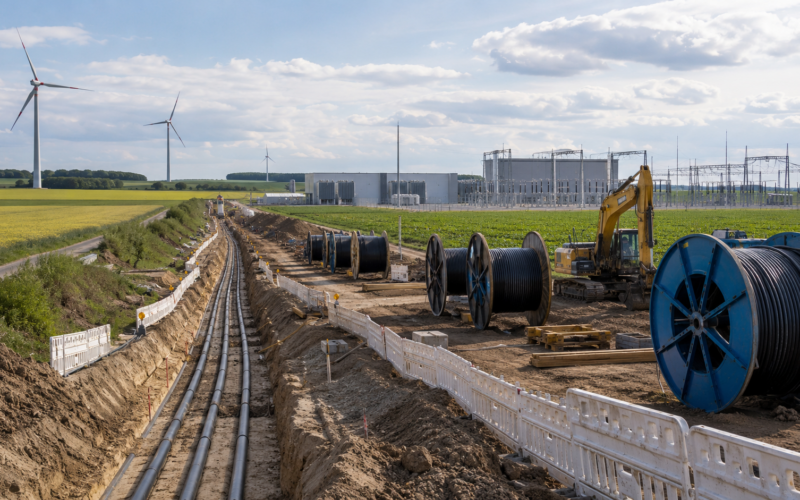
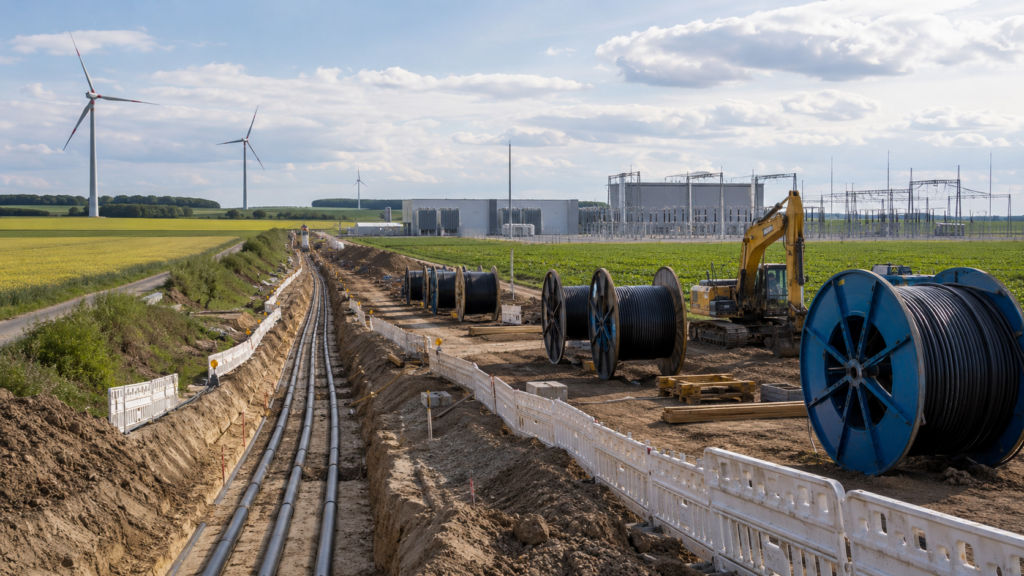
The underground route uses two cable systems, each consisting of high-voltage cables for the positive and negative poles as well as a return conductor. Amprion has said the cables are being laid in two separate trenches so that a fault in one system does not require the entire line to be switched off. This approach also helps construction teams work from a central access road between the trenches.
Open construction is used where conditions allow, while closed construction techniques are used for roads, rivers, railways, conservation areas and other sensitive crossings. This distinction matters because underground HVDC lines are often more publicly acceptable than new overhead corridors, but they require more complex civil engineering and more careful soil management. The A-Nord project therefore illustrates a core trade-off in Europe’s energy transition: underground lines can reduce visual impact, but they increase execution complexity.
Which companies won contracts for A-Nord and what work are they carrying out?
The A-Nord contract structure shows how Germany’s grid expansion depends on a small group of specialist HVDC cable and infrastructure suppliers. Prysmian won a contract worth more than €500m from Amprion in 2020 for a 1GW underground cable system along the northern route of Corridor A. Its scope covers design, manufacture, supply, laying, jointing, testing and commissioning of a ±525kV HVDC cable system. Prysmian said the cable system uses its P-Laser technology and includes accessories and monitoring systems.
Sumitomo Electric Industries also secured a major A-Nord contract from Amprion. In July 2025, the Japanese group said it had begun installation of its 525kV XLPE HVDC underground cable system for Corridor A-Nord on June 23, 2025. The company said its scope covers design, manufacturing, logistics, installation, jointing, commissioning and maintenance for about 300km of HVDC cable, with a contract value of more than €500m.
The converter infrastructure has also created major civil engineering work. PORR said in June 2024 that PORR Spezialtiefbau, working with Gebr. Neumann GmbH on behalf of Siemens Energy, was producing around 5,200 full displacement drilled piles for the deep foundations of the converter station at the starting point of the A-Nord route in Emden/Ost. PORR also said the Emden converter station would include converter halls around 18 metres high with floor areas of about 5,000 square metres.
These contracts matter because they show how A-Nord is not simply a cable installation project. It is a multi-layered infrastructure programme involving cable manufacturing, route engineering, civil works, foundation design, converter technology, grid integration and long-term maintenance planning.
How did A-Nord move from planning approval to active construction?
The A-Nord development timeline reflects Germany’s wider struggle to accelerate major power line approvals. Bundesnetzagentur completed the planning approval process for the last section of A-Nord on April 15, 2025. That decision completed a seven-year process of planning and approving all underground cabling sections of the project.
Construction had already begun on some sections before final route approval was completed. Bundesnetzagentur said work on the first two Lower Saxony sections between Emden Ost and the municipal boundary between Wietmarschen and Nordhorn began in the fourth quarter of 2023 after early construction approvals. The three sections between the North Rhine-Westphalia border and Osterath were approved in 2024 and the first quarter of 2025.
This staged approval and early-start model is important because it shows how German regulators and grid operators are trying to compress timelines for major transmission projects. A-Nord’s latest status therefore has broader significance beyond the project itself. It demonstrates how permitting reform, early works approvals and contractor mobilisation can help move grid expansion from policy ambition to physical construction.
What are the latest A-Nord project developments and operational updates in 2026?
The latest public update in 2026 is that construction of the A-Nord converter in Emden-Petkum is progressing rapidly. Amprion said on April 29, 2026, that key installation work had been completed, 13 transformers weighing around 300 tonnes each were already on site and installation of power electronics in the converter halls was under way.
The converter station is central to the project because it will convert alternating current into direct current for long-distance transmission and later convert electricity back into grid-compatible form. Amprion has also said the Emden facility will help regulate and stabilise grid voltage, which gives it a system support function beyond basic conversion. That role becomes increasingly important as Germany replaces conventional power plants with more variable renewable generation.
A-Nord’s route-level approval status is also clearer than it was in earlier project profiles. All underground cabling sections are now approved, construction is progressing and the latest Amprion timing points to transmission from late 2027. That is the cleaner 2026 position. Older references to commissioning in 2025 or mid-2027 should be treated as outdated or superseded by later project updates.
What regulatory and environmental factors shape the A-Nord project?
A-Nord is shaped by Germany’s formal grid expansion process, environmental permitting requirements and public consultation framework. Bundesnetzagentur has been central to the route approval process, while Amprion is responsible for implementation. The final approval in April 2025 allowed work to progress along the full length of the line.
Environmental and land-use issues are central because A-Nord is an underground corridor crossing agricultural land, waterways, transport infrastructure and conservation-sensitive areas. Amprion’s construction approach includes soil and groundwater investigations, ordnance checks, archaeological preliminary investigations and measures designed to protect soil during construction.
The project also illustrates the public acceptance challenge around grid expansion. Underground cabling can reduce the visual impact associated with overhead transmission lines, but it places heavier demands on route planning, construction logistics, restoration work and environmental management. For policymakers, A-Nord is therefore a reminder that the energy transition is not just a generation story. It is also a land, permitting and infrastructure delivery story.
How does A-Nord affect Amprion, Germany’s energy strategy and grid suppliers?
For Amprion, A-Nord is one of the projects that turns Germany’s grid expansion mandate into regulated infrastructure growth. The company’s role is not to generate electricity, but to provide the transmission backbone required for a more renewable and electrified economy. Amprion has described its network as extending around 11,000km and serving as a backbone of the German economy, transporting electricity for 29 million people.
For Germany, A-Nord supports energy security by improving the ability to move domestic renewable electricity from the north to industrial regions in the west and south. This matters for heavy industry, electrification, hydrogen development, data centres and broader industrial decarbonisation. A country can build offshore wind farms quickly, but if the grid cannot move that power, renewable growth can produce congestion rather than resilience.
For suppliers such as Prysmian, Sumitomo Electric Industries, Siemens Energy, PORR and other contractors, A-Nord is a reference project in the European HVDC build-out. It demonstrates the scale of demand for cable systems, converter infrastructure, foundation engineering and underground construction capabilities. It also highlights a supply-chain reality that investors are watching closely: Europe’s energy transition depends not only on developers and utilities, but also on cable factories, engineering capacity and skilled grid contractors.
Why will A-Nord remain strategically relevant after commissioning?
A-Nord’s long-term relevance will not end once the Emden to Osterath link enters service. The project is likely to remain important because it sits at the centre of Germany’s grid-balancing challenge: renewable electricity generation is expanding in the north, while a large share of industrial power demand remains concentrated in western and southern Germany. That makes A-Nord a structural transmission asset rather than a short-cycle infrastructure project.
The project’s strategic value will depend on how effectively it helps reduce grid congestion, integrate offshore and onshore wind generation, and support system stability as Germany relies more heavily on renewable electricity. The Emden converter is especially important in this context because converter stations are no longer passive grid interfaces. They increasingly play a role in voltage control and grid management, which becomes more important as conventional thermal generation declines.
A-Nord should also be viewed alongside Ultranet and other German HVDC corridors because the country’s energy transition depends on a connected network of long-distance electricity highways, not a single transmission line. If A-Nord enters service on schedule, it would strengthen confidence in Germany’s ability to deliver large underground HVDC infrastructure after a long permitting cycle. If delays or commissioning challenges emerge, the project would instead underline how difficult it remains to align renewable energy targets with grid construction timelines.
For contractors, cable suppliers and transmission investors, A-Nord will remain a reference project because it combines underground HVDC cable installation, major converter infrastructure, route approvals, land-use management and offshore wind integration. Its long-term importance therefore lies not only in its 2GW capacity, but in what it reveals about Germany’s ability to build the grid needed for a more electrified industrial economy.
What is the future outlook for the A-Nord HVDC underground power transmission project?
The outlook for A-Nord is positive but execution-sensitive. The strongest point in the project’s favour is that the full underground route has received planning approval, construction is under way, cable installation has started and the Emden converter station has reached an advanced installation phase. The remaining risks are not commodity-price risks or reserve risks, as in oil and gas projects. They are construction sequencing, cable logistics, converter integration, environmental compliance, grid commissioning and timetable discipline.
A-Nord’s future also depends on how quickly Germany’s wider grid expansion programme can keep pace with renewable capacity growth. The project will add 2GW of long-distance transfer capacity, but it will not solve Germany’s grid constraints on its own. Its real importance lies in being part of a larger portfolio of transmission corridors, offshore connections and converter stations required to make renewable energy available where it is most needed.
By late 2027, A-Nord is expected to become a working test of Germany’s ability to connect North Sea wind resources with industrial power demand in North Rhine-Westphalia and beyond. If the project performs as intended, it will strengthen the case for accelerated HVDC grid development across Europe. If it faces integration delays, it will become another signal that renewable energy targets must be matched by faster grid delivery. Either way, A-Nord has already become one of the most important reference projects in Germany’s energy transition infrastructure.
Discover more from Business-News-Today.com
Subscribe to get the latest posts sent to your email.