



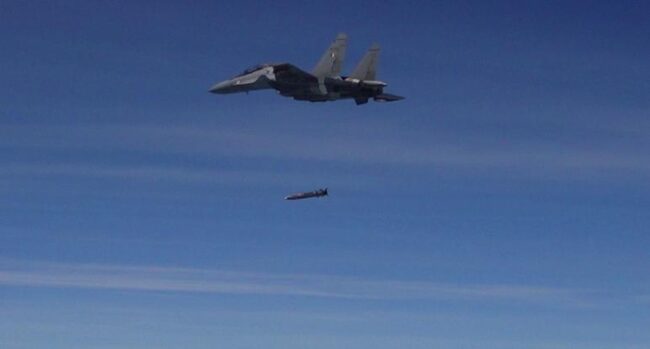
The Defence Research and Development Organisation and the Indian Air Force have successfully flight-tested the indigenous RudraM-II air-to-surface missile from an airborne platform, marking another step in India’s effort to deepen domestic precision-strike capability. The missile was tested from the Integrated Test Range at Chandipur and demonstrated accuracy against a predefined target under demanding release conditions. The development is strategically important because the Indian Air Force needs stand-off strike options that can suppress enemy air defences, hit high-value targets and reduce dependence on imported weapons. For India’s defence ecosystem, the RudraM-II test strengthens the broader Atmanirbhar Bharat narrative around missiles, sensors, propulsion, guidance and combat aircraft integration.
Why does India’s RudraM-II missile test matter for Indian Air Force strike planning?
India’s RudraM-II missile test matters because the Indian Air Force is operating in a security environment where precision, survivability and domestic control over weapons supply chains are becoming more important at the same time. Air-to-surface missiles allow fighter aircraft to strike from safer distances, reduce exposure to hostile air defence systems and increase the pressure on adversary command centres, radar sites, logistics nodes and fortified targets. In practical terms, a successful missile test is not merely about a projectile hitting a target. It is about building confidence that aircraft, weapons, sensors, software and launch procedures can work together under realistic combat conditions.
The RudraM-II programme also fits into India’s attempt to create a layered indigenous air-launched weapon portfolio. The Indian Air Force cannot rely only on imported precision weapons if it wants operational depth across prolonged conflict scenarios. Indigenous missiles give planners more control over inventory, upgrades, integration timelines and future variants. That matters because imported weapons may carry supply constraints, political conditions or integration dependencies that become uncomfortable during crisis periods.
The strategic message is therefore larger than one flight test. India is trying to move from selective indigenous development toward a more complete domestic strike ecosystem. RudraM-II adds to that effort by reinforcing the Defence Research and Development Organisation’s role in air-launched weapons and giving the Indian Air Force another potential tool for high-value target engagement. The test still needs to be followed by user evaluation, production scaling and operational integration, but the direction is clear.
How could RudraM-II strengthen India’s ability to suppress enemy air defences?
RudraM-II is important because India’s air campaign planning increasingly requires tools that can challenge enemy air defence networks before manned aircraft enter heavily contested zones. Suppression of enemy air defences is one of the most difficult missions in air warfare because pilots must locate, target and neutralise radar and missile systems that are designed to remain hidden, mobile and lethal. An air-launched missile designed for precision strike gives the Indian Air Force another way to reduce the risk posed by hostile radar and surface-to-air missile systems.
The value of such a missile rises when integrated with modern sensors and electronic warfare systems. If the Indian Air Force can pair RudraM-II with aircraft that detect, classify and engage enemy emitters or other high-value targets quickly, the missile becomes part of a wider kill chain rather than a standalone weapon. That is where the operational leverage sits. A missile is most valuable when it fits into a targeting architecture that can find threats before those threats can relocate or shut down.
There is also a deterrence effect. Adversaries must account for the possibility that Indian aircraft can engage air defence assets from stand-off ranges, forcing them to disperse, hide or operate more cautiously. That can create openings for other aircraft, drones and ground systems. The missile’s future value will depend on range, seeker performance, warhead options, integration depth and production reliability, but the strategic purpose is already visible: India wants more credible tools to open and sustain contested air operations.
Why is indigenous missile development becoming central to India’s defence industrial strategy?
Indigenous missile development is becoming central to India’s defence industrial strategy because missiles combine multiple high-value technology domains. Guidance systems, propulsion, seekers, materials, software, warheads and aircraft integration all require specialised capabilities. When India develops these systems domestically, it strengthens not only one weapon programme but a wider industrial base that can support future variants, exports and technology spillovers.
The RudraM-II test is especially relevant because air-launched weapons demand tight integration between missile and aircraft. It is not enough to develop a missile on paper or test it in isolation. The weapon must separate safely from the aircraft, perform under aerodynamic stress, follow the intended trajectory and execute its terminal mission accurately. That makes the test a strong signal about systems engineering rather than only missile design.
The industrial angle also matters because India wants defence manufacturing to move beyond licensed production. Domestic design and development give Indian institutions and companies more room to adapt systems to local requirements. Over time, that could support private-sector participation in components, electronics, testing infrastructure and production scaling. The Defence Research and Development Organisation remains central to the technology push, but the long-term economic opportunity depends on whether domestic industry can absorb and manufacture these capabilities at scale.
How does the RudraM-II test fit into India’s wider air-launched weapons roadmap?
The RudraM-II test fits into a wider roadmap in which the Indian Air Force is building a more diversified set of air-launched weapons for different mission profiles. India has been working across air-to-air missiles, anti-radiation weapons, precision-guided bombs, cruise missiles and drone-launched weapons. That spread reflects a basic operational reality: no single missile solves every battlefield problem. Fighter aircraft need multiple weapon options depending on target type, range, threat environment and rules of engagement.
For the Indian Air Force, the ability to field indigenous air-to-surface missiles can strengthen aircraft such as the Sukhoi Su-30MKI and future platforms that may carry domestic weapons. This is particularly important because India’s fighter fleet is diverse, with Russian, French, Indian and other systems operating together. Weapon integration across such a fleet is technically demanding, but success would give the Indian Air Force more flexibility in how it configures strike packages.
The roadmap also has a strategic export dimension. India has already shown ambition in missile exports through systems such as BrahMos. If future air-launched missile families demonstrate reliability, production scale and operational performance, India could eventually position select systems for friendly export markets. That will require regulatory clearance, quality consistency and competitive pricing, but the direction aligns with India’s broader aim of becoming a more serious defence exporter.
What does the test reveal about India’s evolving military posture toward China and Pakistan?
The RudraM-II test should be read against India’s two-front planning challenge, even though the missile itself is not tied to one theatre. India faces different operational requirements along the western front with Pakistan and the northern and eastern frontiers with China. Air power must be able to operate across varied terrain, target sets and escalation conditions. Precision air-to-surface missiles give India more options without immediately forcing deeper aircraft exposure into contested airspace.
Against Pakistan, stand-off and anti-radiation capabilities can support operations aimed at air defence suppression, infrastructure targeting and rapid escalation management. Against China, the challenge includes altitude, distance, hardened infrastructure and dense surveillance networks. In both cases, indigenous strike weapons allow India to build stockpiles and tailor systems to specific mission requirements without waiting on foreign suppliers.
The risk is that missile tests can sometimes be over-read as immediate operational transformation. A successful flight test is a necessary milestone, not the final destination. The Indian Air Force will still need user trials, integration validation, production planning and doctrine alignment. However, the strategic direction is significant because India is steadily improving the domestic toolkit available for precision air operations in high-pressure theatres.
Why will production scale and aircraft integration decide the real value of RudraM-II?
The real value of RudraM-II will be decided by whether India can move from successful testing to repeatable production and operational deployment. Defence programmes often clear technical milestones before facing the harder questions of manufacturing, quality control, supply-chain reliability and unit cost. For the Indian Air Force, a missile that performs well but is available in limited numbers has less battlefield value than a system that can be produced, stored, maintained and fired at scale.
Aircraft integration will be equally decisive. The missile must be compatible with launch aircraft, onboard mission computers, sensors and targeting workflows. It must also be maintainable by operational units and usable in realistic sortie planning. Integration delays can reduce the pace at which new weapons enter service, especially when the aircraft fleet involves multiple variants and upgrade standards.
This is where India’s defence ecosystem must prove maturity. Successful tests generate headlines, but sustainable capability comes from production engineering, quality assurance, logistics planning and training. RudraM-II’s operational future will depend on how quickly the Defence Research and Development Organisation, production partners and the Indian Air Force can move from trial success to deployable inventory. The missile has cleared an important gate, but the road beyond the gate is where capability becomes real.
Could RudraM-II improve India’s long-term defence export credibility?
RudraM-II could contribute to India’s defence export credibility if the missile evolves into a reliable, scalable and operationally proven system. Global demand for precision strike weapons is rising as countries reassess inventories after recent conflicts. Many armed forces want affordable air-launched weapons that can be integrated with existing aircraft and used for suppression, interdiction or stand-off strike missions. India could eventually have an opening if it can offer systems that combine credible capability with competitive pricing.
However, defence exports are not won through national ambition alone. Buyers will ask hard questions about operational performance, delivery timelines, sustainment support, training, integration costs and export approvals. They will also compare Indian systems with offerings from the United States, Israel, Europe, Russia, South Korea and Turkey. RudraM-II would need to show not only technical merit but a complete support ecosystem.
The broader reputational effect may be more immediate. Each successful indigenous missile test strengthens India’s image as a country moving up the defence technology chain. That can help Indian firms and public-sector entities in future partnerships, co-development talks and export conversations. RudraM-II is not yet an export story, but it is part of the cumulative credibility India needs if it wants to become more than a large defence buyer.
What are the key risks that could slow RudraM-II’s transition from test success to operational capability?
The first risk is development-to-production transition. India’s defence programmes have often shown strong technical ambition but faced delays when moving into volume production and induction. RudraM-II will need a disciplined pathway covering manufacturing partners, component availability, testing cadence, quality standards and delivery schedules. Without that, the missile could remain strategically promising but operationally limited.
The second risk is integration complexity. Air-launched missiles must work seamlessly with aircraft software, targeting systems and pilot workflows. If integration is restricted to a narrow set of aircraft or requires lengthy upgrades, the missile’s immediate operational flexibility could be constrained. The Indian Air Force will likely want a weapon that can be used across relevant platforms with minimal friction.
The third risk is battlefield relevance. Adversary air defence systems are also evolving, with mobile radars, decoys, electronic countermeasures and layered interceptors. RudraM-II must keep pace with that threat environment through seeker resilience, electronic protection, navigation robustness and potential future upgrades. In missile development, the target rarely waits politely for the weapon to mature. It evolves too.
Key takeaways on what the RudraM-II missile test means for India’s air power strategy
- The successful RudraM-II flight test strengthens India’s effort to develop indigenous air-to-surface missile capability for precision strike and suppression of enemy air defences.
- The test supports Indian Air Force planning by adding momentum to stand-off strike options that can reduce aircraft exposure in contested airspace.
- The missile’s value lies not only in target accuracy but in its potential integration with aircraft, sensors, mission computers and electronic warfare systems.
- The Defence Research and Development Organisation gains another validation point in India’s broader missile development roadmap, especially in air-launched weapons.
- India’s domestic defence industrial base could benefit if RudraM-II moves into production with meaningful participation from public and private-sector suppliers.
- The missile fits India’s two-front security planning challenge by improving options against air defence networks and high-value targets in different theatres.
- Production scale will be critical because a successful missile that cannot be manufactured in useful numbers will have limited operational effect.
- Aircraft integration will decide how quickly the Indian Air Force can convert test success into deployable capability across relevant platforms.
- The programme could support India’s long-term export credibility if RudraM-II demonstrates reliability, affordability, production depth and sustainment support.
- The main risks include production delays, integration complexity, evolving enemy countermeasures and the need for continued testing under realistic operational conditions.
Discover more from Business-News-Today.com
Subscribe to get the latest posts sent to your email.

