




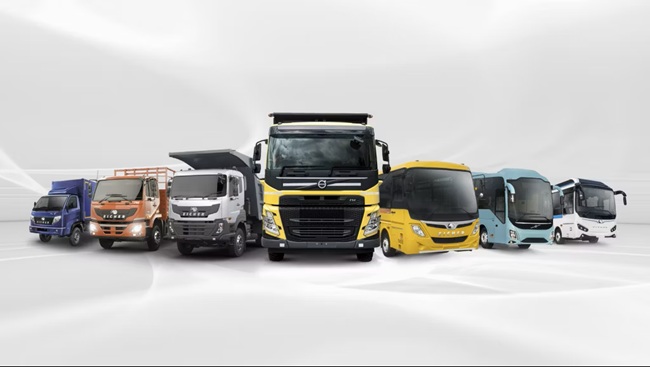
Eicher Motors Limited (NSE: EICHERMOT, BSE: 505200) and Volvo Financial Services are moving to create a 50:50 financial services joint venture in India, marking a deeper push into commercial vehicle financing, leasing and customer credit solutions. The proposed structure will see Eicher Motors Limited invest up to ₹750 crore in Volvo Financial Services India, subject to regulatory approvals, with the entity serving customers and dealers of Volvo Group, Eicher Motors Limited and VE Commercial Vehicles Limited. The development matters because India’s commercial vehicle market is not shaped only by product quality, fuel efficiency or dealer reach, but also by whether truck buyers and fleet operators can access structured financing at the right cost. Eicher Motors Limited shares were trading around ₹7,070 on June 5, 2026, below the stock’s 52-week high of ₹8,230 but well above the 52-week low of ₹5,219.50, suggesting that investors still see strength in the company’s broader auto platform while watching whether new capital allocation moves can support durable growth.
Why does the Eicher Motors and Volvo finance joint venture matter for India’s commercial vehicle market?
The proposed Eicher Motors Limited and Volvo Financial Services joint venture matters because vehicle finance is one of the most important but least glamorous parts of the commercial vehicle business. Trucks, buses and heavy vehicles are expensive working assets, and many buyers depend on credit availability to make fleet expansion viable. A manufacturer-linked finance platform can reduce friction between product sales, dealer conversion, repayment structures and customer retention.
For Eicher Motors Limited, the move extends the logic of its long partnership with Volvo Group through VE Commercial Vehicles Limited. The partnership has already connected Indian market reach with global commercial vehicle technology and process discipline. A dedicated finance arm adds another layer to that ecosystem by giving the group more influence over the ownership journey after a customer decides to buy a vehicle. That is important because the sale of a commercial vehicle is not the end of the relationship. It is where maintenance, uptime, resale value, working capital pressure and replacement cycles begin.
The strategic value is not only in loan disbursement. Captive finance can help companies understand customer behaviour, fleet renewal cycles, default risk, regional demand, dealer quality and asset utilisation. In a market where small fleet operators, logistics companies, bus operators and contractors face uneven credit access, the ability to offer finance and leasing solutions can influence purchase decisions. That gives Eicher Motors Limited and Volvo Group a potential commercial advantage, provided the joint venture manages credit risk with discipline.
How could captive vehicle finance strengthen Eicher Motors’ full-stack commercial vehicle strategy?
Captive finance can strengthen Eicher Motors Limited by turning vehicle sales into a more integrated business model. Instead of depending entirely on third-party lenders, the company can support customers through financing and leasing options tailored to commercial vehicle usage patterns. That can help dealers close sales faster, especially when buyers are creditworthy but underserved by conventional lending channels.
The model is especially relevant for fleet operators. Fleet buyers often evaluate total cost of ownership rather than only sticker price. Financing terms, down payment flexibility, residual value assumptions, repayment schedules and insurance-linked products can materially affect purchasing decisions. If the joint venture can package finance with vehicle acquisition, service support and lifecycle solutions, it may help Eicher Motors Limited compete more effectively against rivals in medium and heavy commercial vehicles.
The opportunity, however, comes with a balance-sheet warning label. Commercial vehicle finance is exposed to freight cycles, fuel prices, economic slowdowns, regional construction activity and customer cash flows. A captive finance entity can support sales, but it can also create credit exposure if underwriting weakens during growth phases. The best finance arms behave like disciplined lenders, not like sales teams wearing banking costumes. That distinction will matter if Eicher Motors Limited wants this joint venture to become a long-term asset rather than a risk amplifier.
Why does Volvo Financial Services’ role change the risk profile of the proposed India joint venture?
Volvo Financial Services brings global experience in financing, leasing and dealer support for commercial vehicles and equipment. That matters because commercial vehicle finance is not identical to consumer auto loans. Loan structures must account for vehicle utilisation, fleet revenue, maintenance cycles, route economics, resale values and sector-specific risk. The involvement of Volvo Financial Services can give the India joint venture a more mature framework for risk assessment and product design.
For Eicher Motors Limited, this reduces the need to build a financial services capability from scratch. The proposed joint venture can combine Volvo Financial Services’ financial services systems with Eicher Motors Limited’s dealer network, domestic market knowledge and customer relationships. That combination could be useful in India, where credit demand is large but borrower profiles vary widely across fleet sizes, geographies and business segments.
The regulatory aspect still matters. The proposed entity is expected to operate within India’s non-banking financial company framework, which means compliance, capital adequacy, governance and risk controls will be central to execution. Regulatory approval is not a box-ticking formality in this case. It will shape how quickly the joint venture can scale and how much flexibility it has in product design, funding structures and customer outreach.
What does the joint venture signal about competition in India’s truck and bus market?
The proposed Eicher Motors Limited and Volvo Group finance joint venture signals that competition in India’s commercial vehicle market is moving beyond product and price. Manufacturers are increasingly competing across financing, aftersales, uptime, connected services, resale support and lifecycle economics. This is a natural evolution in a market where fleet operators want lower operating risk, not just more horsepower and a better brochure.
Rivals such as Tata Motors Limited, Ashok Leyland Limited and Mahindra & Mahindra Limited already compete aggressively across commercial vehicle segments. Many of these companies have strong financing relationships, captive or associated finance arms, dealer networks and service ecosystems. Eicher Motors Limited therefore needs more than product strength if it wants to expand share in competitive fleet categories. Financing can become one of the levers that improves conversion, especially when customers compare the monthly economics of different vehicle brands.
The second-order impact could be sharper competition in customer acquisition. If finance-linked offerings become more sophisticated, commercial vehicle buyers may increasingly compare packages rather than vehicles alone. That could push the market toward bundled propositions involving finance, service contracts, telematics, insurance, maintenance and fleet management tools. Eicher Motors Limited and Volvo Group appear to be preparing for that direction, where the winner is not just the company that sells the truck, but the one that helps the customer keep the truck earning.
What does Eicher Motors’ current stock performance suggest about investor sentiment?
Eicher Motors Limited shares were trading around ₹7,070 on June 5, 2026, compared with a 52-week low of ₹5,219.50 and a 52-week high of ₹8,230. That places the stock meaningfully above its annual low but still below its peak, suggesting that investors continue to value the company’s brand strength and operating profile while remaining selective about future growth triggers. The company’s market capitalisation was around ₹1.95 lakh crore, which means even a ₹750 crore investment is strategically meaningful but not large enough on its own to transform the valuation base.
The market’s likely read-through is balanced. On one side, the joint venture can deepen Eicher Motors Limited’s commercial vehicle ecosystem and support sales conversion through better financing access. On the other side, investors may watch whether this move increases exposure to credit cycles and whether returns on invested capital justify the expansion into financial services. A strong auto company entering finance can create value, but only if the credit book is built cautiously.
The timing also matters because commercial vehicle demand is cyclical. If freight activity, infrastructure spending and replacement demand remain healthy, the finance joint venture could help Eicher Motors Limited capture more customers. If the cycle weakens, credit exposure could become more sensitive. For investors, this makes the joint venture a strategic positive with execution caveats, not a guaranteed rerating trigger.
How could this finance platform affect dealers, fleet operators and customer retention?
For dealers, the joint venture could improve lead conversion by reducing financing uncertainty at the point of sale. Dealers often lose potential buyers not because the customer dislikes the vehicle, but because financing terms, documentation requirements or lender approvals slow the process. A captive finance platform can make the purchase path smoother if underwriting and dealer coordination are handled efficiently.
For fleet operators, the impact could be more direct. Financing and leasing options can help operators preserve working capital, expand fleet size and align repayments with vehicle earnings. This is especially relevant for small and mid-sized fleet owners, who may face less favourable terms from traditional lenders compared with larger logistics companies. A dedicated vehicle finance arm can potentially design products around real operating patterns rather than generic loan templates.
Customer retention is the long game. If Eicher Motors Limited and Volvo Group can finance vehicles, support servicing, monitor lifecycle value and structure repeat purchases, they can build deeper customer relationships. That creates the possibility of stronger replacement demand and higher customer stickiness. The risk is that aggressive financing can pull forward sales but weaken portfolio quality later. The best outcome would be measured growth, not a sprint to build a book for the sake of headline scale.
What execution risks could decide whether the Eicher Motors Volvo finance venture creates durable value?
The first execution risk is underwriting discipline. Commercial vehicle loans depend on borrower cash flows, freight rates, utilisation and asset values. If the joint venture expands too quickly or prices risk too generously, it could face asset quality pressure during a downturn. Captive finance arms must resist the temptation to become sales accelerators at any cost.
The second risk is funding and capital efficiency. Financial services businesses need capital, risk systems and collections infrastructure. Eicher Motors Limited’s proposed investment of up to ₹750 crore gives the venture a base, but the long-term return depends on portfolio growth, net interest margins, credit costs and operating leverage. Investors will watch whether the financial services platform earns attractive returns or simply supports vehicle sales at modest profitability.
The third risk is integration. The finance joint venture must work smoothly with dealers, manufacturers, service centres and customers without creating confusion or channel conflict. If the platform can simplify purchase journeys and improve lifecycle support, it can add value. If it becomes bureaucratic or slow, customers may continue relying on external lenders. In vehicle finance, speed matters, but bad speed is just future stress with better lighting.
What are the key takeaways from the Eicher Motors and Volvo finance joint venture for investors and India’s commercial vehicle sector?
- Eicher Motors Limited and Volvo Financial Services are proposing a 50:50 financial services joint venture in India focused on financing, leasing and related customer solutions.
- Eicher Motors Limited is expected to invest up to ₹750 crore in Volvo Financial Services India, subject to regulatory approvals and completion conditions.
- The joint venture can support customers and dealers of Volvo Group, Eicher Motors Limited and VE Commercial Vehicles Limited across India’s commercial vehicle market.
- Captive finance could strengthen Eicher Motors Limited’s commercial vehicle ecosystem by linking product sales, dealer conversion, financing access and customer retention.
- The strategy is especially relevant for fleet operators that evaluate vehicles through total cost of ownership, repayment flexibility, uptime and lifecycle economics.
- Volvo Financial Services brings global commercial vehicle finance experience, while Eicher Motors Limited contributes domestic market reach, dealer relationships and customer knowledge.
- The main strategic opportunity is stronger sales conversion and deeper customer stickiness, but the main financial risk is credit exposure during weak freight or economic cycles.
- Eicher Motors Limited’s share price remains below its 52-week high, suggesting that investors are constructive but still looking for clear growth and return triggers.
- The joint venture could push competition in India’s truck and bus market beyond vehicles into bundled finance, service, leasing and lifecycle support models.
- A neutral reading suggests the finance joint venture is strategically sensible, but its long-term value will depend on underwriting discipline, regulatory execution, dealer integration and portfolio quality.
Discover more from Business-News-Today.com
Subscribe to get the latest posts sent to your email.


