

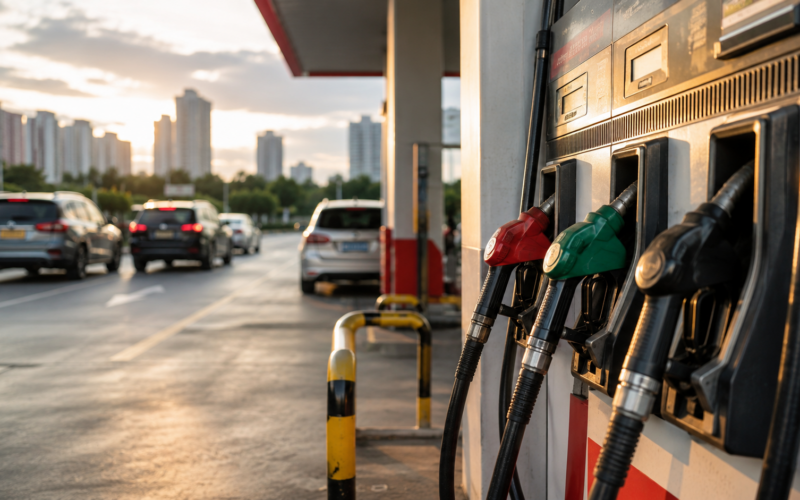
China will cut domestic retail ceiling prices for gasoline and diesel from June 5, giving consumers and transport operators some relief even as the global oil market remains distorted by Middle East supply disruption. The National Development and Reform Commission is reducing gasoline prices by 525 yuan per tonne and diesel prices by 505 yuan per tonne, marking another adjustment under China’s state-controlled fuel pricing system. The move matters because China is not simply passing through lower oil prices, but managing a more complicated mix of weak domestic fuel demand, refinery losses, electric vehicle substitution and crude-import caution. For energy markets, the bigger signal is that the world’s largest crude importer is still behaving defensively despite geopolitical tightness elsewhere.
Why does China’s latest gasoline and diesel price cut matter for global oil markets?
China’s latest fuel price cut matters because it reveals a demand problem hiding inside a supply-shock market. Global oil prices have been supported by Middle East disruption, shipping uncertainty and reduced confidence around Gulf energy flows, yet China’s domestic fuel system is showing enough weakness to justify a sizable retail price reduction. That is an awkward combination for oil bulls because it suggests the geopolitical premium is not being matched by equally strong end-user consumption in the world’s most important incremental energy market.
The immediate consumer effect is straightforward. Lower gasoline and diesel ceilings reduce costs for motorists, logistics operators, agricultural users and some industrial transport chains. Reuters reported that the gasoline cut would save around 20.5 yuan on a 50-litre tank, which is not a household windfall, but it is visible enough to matter in a price-sensitive consumer environment. In a large economy, small per-tank savings can still add up across millions of drivers and freight movements.
The market implication is more interesting. If China is lowering fuel prices while crude markets remain nervous, it suggests Beijing is trying to support domestic mobility and business activity without fully exposing consumers to volatile international oil costs. That does not mean China is insulated from global prices. It means the state is still actively managing the transmission mechanism between Brent-linked crude swings and domestic economic pressure.

How does weak Chinese fuel consumption change the oil-demand narrative in 2026?
Weak Chinese fuel consumption complicates the oil-demand narrative because China has historically been treated as the demand engine that could absorb supply shocks and support prices. That assumption is becoming less reliable. Reuters reported sharp year-on-year declines in fuel consumption during April and May, with high prices, weak activity and electric vehicle adoption all playing a role. If the pattern persists, China’s oil demand growth may look less like a straight road and more like Hyderabad traffic after rain, technically moving but not exactly smooth.
Gasoline demand is under particular pressure from electric vehicle penetration. China’s electric vehicle fleet has grown large enough to affect fuel consumption patterns in major cities and increasingly across intercity travel. That substitution does not eliminate gasoline demand overnight, but it reduces the traditional link between economic reopening, vehicle ownership and fuel consumption. In previous cycles, more mobility almost automatically meant more gasoline use. In China’s current market, more mobility can increasingly mean more electricity demand instead.
Diesel demand is also sending mixed signals. Summer harvest activity may support diesel use in June, but industrial activity, freight demand and weather disruption can all offset that seasonal boost. Reuters noted that El Niño-linked rainfall could affect diesel consumption, adding another variable to an already uneven fuel market. For crude exporters, the lesson is clear: China still matters enormously, but its demand profile is becoming harder to read from headline economic growth alone.
Why are Chinese refiners under pressure despite high global oil prices?
Chinese refiners are under pressure because domestic price controls and weak product demand can squeeze margins even when global oil prices look strong. Reuters reported that some independent refiners in Shandong were recently allowed to reduce output from June, after earlier requirements kept production elevated to protect fuel supply. That policy shift suggests Beijing is becoming more comfortable with domestic supply availability and less willing to force loss-making refiners to run hard.
The economics are painful for smaller refiners. Reuters reported that independent refiners were losing hundreds of yuan per tonne of crude refined, with losses worsening from April to May. When crude import costs are high but domestic fuel prices are capped or demand is weak, refining becomes an exercise in turning expensive inputs into underpriced outputs. That is not a business model. That is a spreadsheet asking for a nap.
This matters beyond refinery margins because China’s independent refiners have been important marginal buyers of crude. If they reduce runs, China’s crude import demand can weaken even during a period of global supply anxiety. That helps explain why China is reportedly drawing from inventories while seaborne imports soften. The global market can face geopolitical disruption and still see lower demand from a key buyer if refining economics break down.
How are electric vehicles changing China’s gasoline demand and pricing strategy?
Electric vehicles are becoming a structural force in China’s fuel market because they reduce gasoline demand in a way that is not easily reversed by lower pump prices. China has built the world’s largest electric vehicle ecosystem, supported by domestic manufacturers, charging infrastructure, battery supply chains and government policy. That means gasoline demand is now facing competition not only from price-sensitive consumers driving less, but from a technology shift that permanently changes the fuel base of the transport fleet.
The latest fuel price cut may help conventional vehicle owners, but it does not change the direction of travel. Electric vehicles continue to weaken the elasticity that oil producers once counted on. Lower gasoline prices may support some driving activity, yet they are unlikely to reverse the substitution trend among consumers who have already moved to electric vehicles or plug-in hybrids. The more China’s vehicle fleet electrifies, the less useful gasoline demand becomes as a clean proxy for mobility.
For Beijing, this creates a policy advantage. Electric vehicle adoption gives China a buffer against imported oil price shocks because a growing share of transport energy demand is supplied through electricity rather than crude-derived fuels. However, it also creates a new challenge for refiners and fuel distributors. A market designed around steady fuel consumption growth must now adjust to a future where gasoline demand may stagnate or decline even as car ownership remains high.
Why is China drawing on oil stockpiles instead of chasing more imports?
China appears to be drawing more heavily on crude stockpiles because it has built inventory buffers and now has less incentive to chase expensive imports during a disrupted market. Reuters reported that seaborne imports were heading toward their lowest level in a decade, while refiners were using commercial inventories accumulated earlier in the year. That strategy helps China avoid buying aggressively into high-risk international conditions.
This is a classic energy-security move. When imports are expensive, risky or logistically uncertain, large stockpiles give policymakers room to wait. China’s earlier procurement of discounted crude from suppliers such as Russia and Iran helped build inventories, and those inventories now provide optionality. The country can run down stocks while assessing whether global prices soften, shipping risks ease or domestic demand recovers.
The risk is that inventory drawdowns cannot last forever. If stocks fall too far or if demand rebounds faster than expected, China may need to return to the market more aggressively later. That could create a delayed demand wave and lift prices again. For now, however, stockpile use gives Beijing leverage. It can reduce imports, manage refinery runs and cut retail fuel prices without immediately intensifying pressure on its external crude supply chain.
What does Beijing’s fuel-price mechanism reveal about energy policy priorities?
China’s fuel-price mechanism reveals that Beijing is trying to balance three priorities: consumer protection, refinery stability and energy security. The National Development and Reform Commission adjusts fuel prices periodically based on international crude movements, but the system also gives policymakers room to smooth shocks. That matters in a volatile market because full pass-through of global crude spikes could hurt households, freight operators and manufacturing margins.
The June 5 cut shows that the mechanism can also transmit relief when conditions allow. However, the broader pattern since the Iran conflict began suggests the state has repeatedly moderated the impact of international prices rather than simply allowing domestic prices to move freely. That intervention protects consumers, but it can shift pain toward refiners if crude costs remain high and product prices are capped.
This policy trade-off is particularly important for inflation management. China is not facing the same fuel-price transmission problem as many import-dependent economies, partly because state controls can soften the consumer impact. But controlled prices can distort refinery incentives and complicate import decisions. Beijing’s challenge is to keep fuel affordable without forcing refiners into losses that undermine supply reliability.
How could China’s fuel-price cut affect Asian refining and product markets?
China’s fuel-price cut could affect Asian refining and product markets by reinforcing expectations of softer Chinese domestic demand and restrained exports. Reuters has reported that China’s refined fuel exports remain under restrictions as Beijing prioritises domestic supply security. If domestic demand remains weak but exports stay controlled, Chinese refiners may cut runs rather than flood regional markets with excess gasoline and diesel.
That matters for Asian product balances. In normal cycles, Chinese exports can strongly influence regional diesel, gasoline and jet fuel margins. When China restricts exports, Southeast Asian and Australian buyers may have less access to Chinese surplus barrels, even if China has comfortable domestic inventories. This can create a strange market where China has weak demand internally, but the wider region does not receive the full benefit through cheaper product flows.
For refiners outside China, the effect is mixed. Lower Chinese runs can support regional product margins if export supply remains limited. But weaker Chinese crude buying can also pressure crude demand expectations. The result is a split signal: product markets may stay tight in some regions, while crude markets lose confidence in Chinese import growth. Energy markets do enjoy making everyone uncomfortable at once.
What should oil producers and investors take from China’s latest fuel adjustment?
Oil producers should read China’s fuel cut as a warning against assuming that geopolitical disruption automatically guarantees strong demand. Supply risk can lift prices, but high prices can suppress consumption, weaken refinery economics and accelerate substitution. China’s latest adjustment shows that demand destruction and energy transition pressures are not theoretical. They are already visible in fuel data and refinery behaviour.
Investors should also separate crude-price movement from refining health. A high Brent price may look positive for upstream producers, but it can hurt refiners if domestic price controls or weak demand prevent margin recovery. In China, independent refiners are particularly exposed because they lack the same balance-sheet strength and policy positioning as larger state-owned players. That could drive further rationalisation or operational discipline in the sector.
The broader investment implication is that China’s oil demand is becoming more policy-managed, inventory-managed and technology-disrupted. That makes forecasting harder. A simple model based on gross domestic product growth, vehicle sales and crude imports is no longer enough. Investors need to track electric vehicle penetration, refinery margins, strategic inventory policy, export quotas, fuel price controls and weather-linked diesel demand. The easy oil-demand model has left the building.
Can China’s fuel-price cut signal a longer-term shift in global oil demand?
China’s fuel-price cut does not prove a permanent decline in oil demand, but it does highlight a structural transition already underway. China remains the world’s largest crude importer and will continue to influence global oil balances. Yet the composition of that influence is changing. The country can now absorb shocks through stockpiles, reduce fuel demand through electrification, adjust refinery runs through policy and control exports through quota systems.
That flexibility makes China more resilient, but it also makes global oil demand less predictable. Importers that build buffers and electrify transport reduce the automatic demand response that exporters once relied on. This is one reason oil markets can appear tight on supply headlines while still facing doubts about consumption growth. Both can be true at the same time, which is deeply annoying but analytically useful.
A neutral reading suggests that Beijing’s June fuel price cut is not just a consumer-relief measure. It is a signal that China is actively managing the oil shock from the demand side, the inventory side and the refining side. For global energy markets, that means China remains central, but not always in the way oil producers would prefer.
Key takeaways on China’s fuel price cut and what it means for oil markets
- China’s June 5 gasoline and diesel price cut shows that domestic fuel weakness is visible even during a period of global oil-market disruption.
- The National Development and Reform Commission will reduce gasoline by 525 yuan per tonne and diesel by 505 yuan per tonne, easing costs for consumers and transport users.
- The move reflects China’s state-managed fuel pricing system, which cushions domestic consumers from extreme international crude-price volatility.
- Weak gasoline demand is increasingly linked to electric vehicle adoption, making China’s transport fuel market structurally different from earlier oil cycles.
- Diesel demand remains mixed because harvest activity may support consumption, while weak industrial freight and heavy rainfall can offset that seasonal lift.
- Chinese independent refiners are under pressure from weak margins, high crude costs and controlled domestic product prices.
- Beijing’s reported allowance for some refiners to reduce output suggests policymakers are more confident about fuel supply and less willing to force uneconomic runs.
- China’s use of crude stockpiles gives it flexibility to avoid buying aggressively during expensive or disrupted global market conditions.
- Regional product markets may remain distorted if China keeps export restrictions in place while domestic demand remains soft.
- For oil producers and investors, the cut is a reminder that China’s demand outlook is now shaped by policy controls, inventories and electrification, not just economic growth.
Discover more from Business-News-Today.com
Subscribe to get the latest posts sent to your email.