

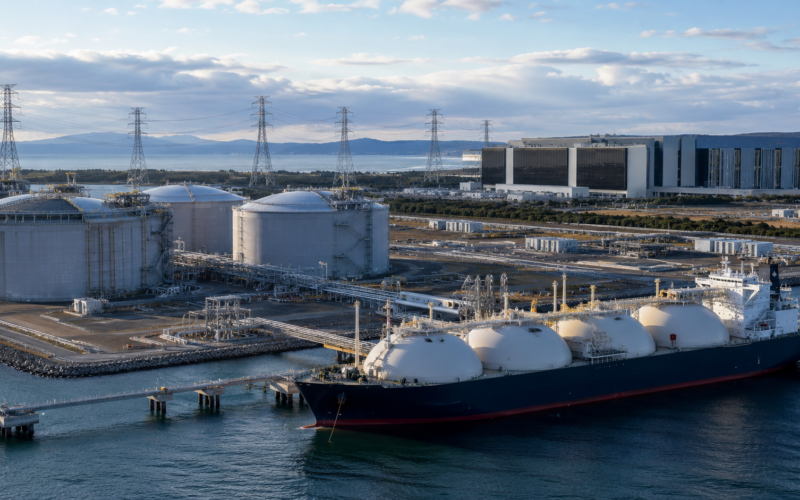
Mitsui & Co., Ltd. (TYO: 8031) is seeking new liquefied natural gas investments as the trading house positions itself for rising electricity demand from data centres and artificial intelligence infrastructure. The Japanese company is exploring LNG opportunities across the Middle East, the United States and Australia, including potential equity stakes and long-term supply agreements that could strengthen its energy supply chain exposure. The move matters because AI growth is no longer only a semiconductor, cloud computing or software story. It is becoming an energy procurement story, and Mitsui & Co., Ltd. is trying to place itself closer to the fuel flows that could keep digital infrastructure running.
Why is Mitsui & Co., Ltd. linking LNG investment strategy to artificial intelligence data centre demand?
Mitsui & Co., Ltd.’s LNG push reflects a major shift in how global energy companies and trading houses are interpreting artificial intelligence infrastructure. Data centres are no longer viewed as ordinary commercial power users. They are becoming strategic energy customers with rising, constant and highly reliability-sensitive electricity needs. That changes the value of gas supply, LNG logistics and long-term procurement in markets where grid capacity is already under pressure.
Artificial intelligence workloads can be power-intensive because large model training, inference, cooling systems and cloud availability require high-density computing capacity. Data centre operators are trying to secure electricity from renewables, nuclear power, batteries and grid connections, but gas-fired generation remains a practical balancing fuel in many markets. That is where LNG can become more valuable. It offers flexibility across regions, supports power plants that can respond to demand swings and provides import-dependent countries with a way to manage energy security.
For Mitsui & Co., Ltd., the opportunity is not simply selling LNG molecules. The larger strategy is to build a wider energy services position around data centre demand. If the company can connect LNG procurement, gas-fired power, infrastructure investment and digital solutions, it can move beyond commodity trading into a more integrated role. That could help Mitsui & Co., Ltd. defend margins in a business where pure trading can be cyclical and where energy security is becoming a boardroom issue.
The risk is that AI power demand forecasts can run ahead of actual grid buildout and commercial contracting. Data centres can be delayed by permitting, local opposition, transmission constraints and cooling requirements. Mitsui & Co., Ltd. needs to avoid locking itself into LNG exposure that assumes every AI campus will materialise on schedule. The opportunity is real, but the energy industry has met enough demand forecasts wearing expensive suits to know that not all of them show up on time.
How does Mitsui’s LNG strategy fit into Japan’s broader energy security challenge?
Mitsui & Co., Ltd.’s LNG investment strategy sits directly inside Japan’s energy security dilemma. Japan remains heavily dependent on imported energy, and LNG has long been one of the country’s most important fuel sources for electricity generation. The Middle East war, Strait of Hormuz disruption and wider concern over shipping risk have made that dependency more visible again.
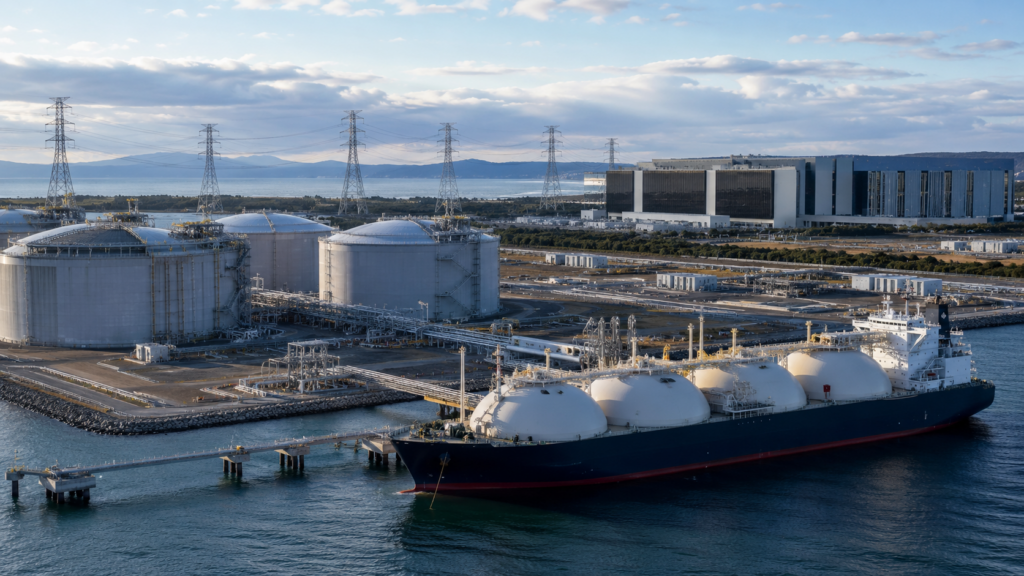
Japan’s challenge is that it needs stable energy supply while also navigating decarbonisation commitments, industrial competitiveness and the growth of electricity-intensive sectors. Data centres add another layer because digital infrastructure requires not just total electricity, but dependable electricity. Interruptions are costly, and power quality matters. LNG-backed generation can provide reliability when renewables are intermittent or when transmission upgrades lag demand.
Mitsui & Co., Ltd. is therefore not only pursuing a corporate growth angle. It is participating in a national energy security strategy. By seeking LNG investments in the Middle East, the United States and Australia, the company can help diversify supply origins and reduce overdependence on any single region. The United States offers expanding LNG export capacity. Australia provides geographic proximity and established LNG infrastructure. The Middle East remains a major energy hub, but geopolitical risk makes diversification essential.
The strategic question is whether Japan can balance LNG security with emissions reduction. LNG is cleaner than coal when used efficiently, but it is still a fossil fuel. If Japan leans too heavily on gas to support data centre growth, it could complicate climate targets. If it underinvests in reliable power, digital infrastructure and AI adoption could suffer. Mitsui & Co., Ltd.’s role is to navigate that awkward middle path where energy transition and energy security are both correct, and neither is convenient.
Why are Middle East, United States and Australia LNG assets strategically important for Mitsui?
The Middle East, United States and Australia each offer a different kind of LNG value for Mitsui & Co., Ltd. Middle East projects can provide scale, low-cost resource access and proximity to established Asian demand routes. Mitsui & Co., Ltd.’s existing exposure to Abu Dhabi National Oil Company’s Ruwais LNG project gives the company a foothold in a region where national oil companies are trying to expand LNG output and capture demand from Asia and Europe.
The United States offers a more market-driven opportunity. United States LNG projects are linked to large gas reserves, flexible commercial structures and growing export infrastructure. Mitsui & Co., Ltd.’s long-term supply agreement with Venture Global LNG for 1 million metric tons per year already positions the company inside the United States LNG growth story. That exposure can help Japan and other Asian buyers diversify away from traditional supply patterns while gaining access to Atlantic Basin flexibility.
Australia remains important because it is geographically close to Asian buyers and has a long track record as a major LNG exporter. Australian LNG can support Japan’s supply security, although project costs, regulatory issues and domestic gas politics can complicate new development. For Mitsui & Co., Ltd., maintaining optionality across all three regions reduces concentration risk and improves negotiating leverage.
The common thread is supply chain control. In an era of geopolitical disruption, a trading house with equity stakes, supply agreements and logistics relationships can offer more than spot-market purchasing. It can offer resilience. That is increasingly valuable to customers whose electricity demand is mission-critical, whether they are utilities, manufacturers or data centre operators.
What does Mitsui’s stock performance suggest about investor sentiment toward its LNG pivot?
Mitsui & Co., Ltd. shares recently traded around ¥5,300 to ¥5,336 in Tokyo, with a 52-week range of roughly ¥2,844 to ¥6,675. That places the stock well above its 52-week low but below its recent high, suggesting investors continue to value Mitsui & Co., Ltd.’s diversified trading house model while still applying discipline around commodity cyclicality, earnings visibility and capital allocation.
The LNG strategy could be sentiment-positive if investors believe Mitsui & Co., Ltd. is attaching itself to a durable growth driver. AI-linked data centre demand is attracting global capital, and energy suppliers that can support reliable power are likely to receive closer attention. LNG exposure may therefore be viewed not only as a traditional commodity bet, but as an infrastructure-enabling position tied to digital economy growth.
However, investors will also scrutinise the cost and structure of any new LNG commitments. Equity stakes in large LNG projects can require substantial capital, long development timelines and exposure to construction risk. Long-term supply agreements can provide security, but they can also create price and volume obligations if demand disappoints. Mitsui & Co., Ltd. has deep experience in resource investments, but the market will still expect evidence that AI demand is being converted into bankable contracts rather than broad strategic enthusiasm.
The stock’s valuation context also matters. Japanese trading houses have enjoyed significant investor attention, helped by stronger governance, shareholder returns and global investor interest in diversified cash-flow platforms. Mitsui & Co., Ltd. cannot assume that LNG growth alone will keep sentiment strong. Investors will want capital discipline, clear returns and a credible explanation of how new LNG investments fit alongside metals, chemicals, food, mobility and other business lines.
Could LNG become a core enabler of the global data centre boom?
LNG could become a core enabler of the data centre boom in regions where electricity demand is rising faster than renewable generation, transmission capacity or nuclear development can keep pace. Data centres need continuous power, and grid operators need flexibility. Gas-fired power plants supplied by LNG can provide reliability, especially in markets with growing renewables but insufficient storage or interconnection.
This does not mean LNG will be the preferred long-term solution for every data centre. Many technology companies want low-carbon power, and some are pursuing renewable power purchase agreements, advanced nuclear options, geothermal energy and battery-backed systems. Yet the near-term reality is that power demand is moving faster than the clean firm power buildout in many regions. LNG can fill part of that gap.
For Mitsui & Co., Ltd., the commercial opportunity is strongest where data centre demand overlaps with import-dependent power markets. Japan, South Korea, Taiwan, Singapore and parts of Southeast Asia all face versions of this issue. These markets need secure energy supply, limited land for renewables, high reliability and growing digital infrastructure. LNG is not a perfect answer, but it is a practical one.
The risk is that LNG becomes politically exposed if it is seen as enabling carbon-intensive AI growth. Data centre operators may face public criticism if energy use rises sharply while climate commitments remain ambitious. LNG suppliers and trading houses will need to position gas as part of a reliability bridge, not a substitute for decarbonisation. That distinction will matter for regulators, investors and customers.
How could Mitsui’s LNG expansion affect competition among Japanese trading houses?
Mitsui & Co., Ltd.’s LNG expansion could intensify competition among Japanese trading houses that are already active across energy, metals, infrastructure and industrial supply chains. Companies such as Mitsubishi Corporation, Itochu Corporation, Sumitomo Corporation and Marubeni Corporation are all reassessing growth opportunities tied to energy security, digital infrastructure and industrial transformation.
The competitive edge may come from integration. A trading house that can combine LNG procurement, power generation, project finance, logistics and customer relationships may be better positioned than one that only holds commodity exposure. Mitsui & Co., Ltd.’s ability to link energy supply with data centre power needs could therefore become a differentiator if it can build a credible customer-facing platform.
There is also a portfolio allocation question. Japanese trading houses have historically balanced resource exposure with non-resource businesses to reduce volatility. AI-linked energy demand could make LNG appear more strategic and less cyclical, but that assumption needs testing. If every trading house chases the same LNG theme, project valuations could rise and returns could compress.
For Japan’s trading houses, the broader question is whether they can become infrastructure orchestrators for the AI economy. That means connecting energy, land, logistics, digital solutions and financing. Mitsui & Co., Ltd.’s LNG push is one early example of that shift. The company is not merely asking where gas demand will grow. It is asking what kind of supply chain the digital economy needs around it.
What risks could challenge Mitsui’s LNG investment thesis?
Mitsui & Co., Ltd.’s LNG investment thesis faces several risks. The first is demand uncertainty. AI data centre electricity demand is rising, but the pace varies by region and depends on chips, grid access, permitting, cooling and customer economics. If AI workloads become more efficient or if data centre buildout slows, gas demand linked to digital infrastructure could undershoot expectations.
The second risk is project execution. LNG projects can face cost overruns, delays, regulatory opposition, environmental scrutiny and financing challenges. Equity stakes can deliver attractive returns, but they can also lock capital into long-duration assets before market conditions are fully visible. For a trading house, the difference between disciplined optionality and overcommitment can be expensive.
The third risk is geopolitical exposure. Middle Eastern projects may offer strong resource economics, but shipping through key chokepoints remains vulnerable. United States LNG may offer flexibility, but it can face political, regulatory and permitting risk. Australian LNG offers regional relevance, but project development can be affected by domestic gas policy and environmental approvals.
The fourth risk is climate policy. If governments tighten methane rules, carbon pricing or fossil fuel financing restrictions, LNG projects may face higher compliance costs. Customers may also demand lower-emission LNG, carbon capture, methane monitoring or bundled clean energy solutions. Mitsui & Co., Ltd. will need to show that its LNG strategy can survive both energy-security shocks and climate-policy pressure.
What should executives and investors watch as Mitsui pursues new LNG deals?
Executives and investors should watch whether Mitsui & Co., Ltd. moves from exploration to binding investment decisions. Announcements around equity stakes, offtake agreements, joint ventures or dedicated data centre energy platforms would indicate that the strategy is becoming more concrete. The most important detail will be whether these commitments are backed by long-term customers or depend mainly on market demand assumptions.
They should also monitor which regions Mitsui & Co., Ltd. prioritises. A stronger United States LNG push would suggest an emphasis on flexible supply and Atlantic Basin diversification. More Middle East exposure would signal confidence in large-scale resource projects despite geopolitical risk. Additional Australian exposure would point toward Asia-Pacific supply security and customer proximity.
Another key signal will be whether Mitsui & Co., Ltd. builds a consolidated energy supply chain entity for data centres. Such a move would suggest that the company sees data centre power as a strategic customer vertical, not just another LNG demand source. That could change how investors value the opportunity because integrated services may carry different margins and customer stickiness than commodity trading.
The final indicator is capital discipline. Mitsui & Co., Ltd. has the experience and balance sheet to pursue LNG growth, but investor support will depend on returns, risk sharing and clarity. AI may be the hottest demand story in the global economy, but buying into every energy asset with “data centre” in the pitch deck would be a very expensive way to prove one reads the news.
Key takeaways on what Mitsui’s LNG push means for data centre energy demand and Japan’s energy security
- Mitsui & Co., Ltd.’s LNG investment push shows that artificial intelligence data centre demand is becoming a major factor in global energy strategy, not just technology infrastructure planning.
- The company is exploring LNG opportunities across the Middle East, the United States and Australia to support power reliability and diversify supply exposure.
- Mitsui & Co., Ltd.’s existing links to Abu Dhabi National Oil Company’s Ruwais LNG project and Venture Global LNG give it a platform for further expansion.
- Japan’s dependence on imported energy makes LNG security strategically important, especially as electricity demand rises from data centres and digital infrastructure.
- LNG can support data centre growth by providing flexible power generation, but it must be balanced against decarbonisation commitments and methane-related scrutiny.
- Mitsui & Co., Ltd.’s stock remains well above its 52-week low, suggesting investors value its diversified platform while still monitoring commodity and capital allocation risks.
- The opportunity for Mitsui & Co., Ltd. is to become more than an LNG trader by linking fuel supply, power solutions and data centre customer demand.
- Japanese trading house competition could intensify as peers also pursue energy security, digital infrastructure and AI-linked investment themes.
- The main risks include overestimating AI power demand, committing capital to delayed LNG projects and underestimating geopolitical or climate-policy constraints.
- Investors should watch for binding offtake agreements, equity stakes, regional project choices and whether Mitsui & Co., Ltd. creates a dedicated energy platform for data centres.
Discover more from Business-News-Today.com
Subscribe to get the latest posts sent to your email.