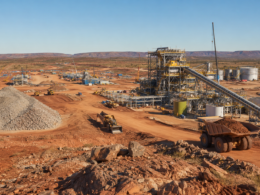





Ballymore Resources Limited (ASX:BMR) has reported further broad zones of massive sulphide mineralisation from the first two holes of its new 3,000-metre reverse circulation drilling campaign at the Torpy’s silver-lead-zinc-indium discovery within the Ruddygore Project in North Queensland. The company said the holes extended known mineralisation closer to surface and strengthened its view that Torpy’s may host multiple high-grade shoots across a broader mineralised system. The announcement matters because Ballymore Resources Limited is trying to convert a historically mined but underexplored Chillagoe district asset into a modern exploration growth story at a time when silver, lead, zinc and critical by-product metals are drawing renewed attention. Ballymore Resources Limited shares recently traded around A$0.13, close to their 52-week low, which means the next laboratory assays in June may carry more weight than the usual early-stage exploration update.
Why does the latest Torpy’s drilling matter for Ballymore Resources and ASX:BMR investors?
The immediate significance of the Torpy’s update is that Ballymore Resources Limited has not merely repeated historic excitement around an old mining area. The company has reported fresh visual evidence of sulphide mineralisation in newly drilled holes, with BTPRC010 intersecting a visually estimated 9 metres containing 7% galena and 5% sphalerite from 79 metres, including 3 metres at 16% galena and 10% sphalerite. BTPRC011 intersected a visually estimated 28 metres containing 4% galena and 3% sphalerite from 106 metres, including two higher-intensity sub-intervals. These are visual estimates, not assay grades, and Ballymore Resources Limited itself cautioned that visual mineral abundance should not be treated as a substitute for laboratory analysis. That caveat is important, because markets love shiny drill core almost as much as they love disappointment when assays fail to match the theatre.
What changes the investment read-through is the geological setting rather than the visual percentages alone. Both holes were designed to test up-dip extensions of known lenses, and both encountered massive to semi-massive sulphide mineralisation dominated by galena and sphalerite. Galena is the main ore mineral for lead and can be a key host for silver, while sphalerite is the main ore mineral for zinc. For an explorer, continuity is the difference between an isolated high-grade hit and the early outline of a system that can support follow-up drilling, resource definition and capital market interest.
The company’s prior Torpy’s drilling already produced notable assay intersections, including BTPRC005 with 23 metres at 215.6 grams per tonne silver, 8.55% lead and 1.99% zinc from 130 metres, including 7 metres at 650.7 grams per tonne silver, 25.37% lead and 3.01% zinc. That earlier result is the benchmark against which the market will judge the new campaign. The fresh holes are therefore not just “more drilling.” They are a test of whether Ballymore Resources Limited can demonstrate repeatability across multiple mineralised shoots, which is the point at which a discovery story starts to look less like luck and more like a system.
How could the Ruddygore Project become more than a single high-grade silver discovery?
The Ruddygore Project gives Ballymore Resources Limited a broader strategic canvas than Torpy’s alone. The project sits near Chillagoe, around 150 kilometres west of Cairns, and covers approximately 556 square kilometres. Ballymore Resources Limited describes the area as prospective for multiple deposit styles, including porphyry copper-gold, skarn-hosted copper-gold-lead-zinc, sediment-hosted massive sulphide lead-zinc-silver, tungsten-molybdenum greisen and intrusive-related gold systems. That matters because single-target explorers often struggle to sustain market attention once the first excitement fades. A corridor-scale project gives the company more ways to generate follow-up news, although it also raises the execution burden.
The company has highlighted a 32-kilometre mineralised corridor across Ruddygore, where a government-supported gravity survey is underway to generate additional drill targets. This is strategically relevant because gravity surveying can help identify denser sulphide or skarn-related bodies that may not be obvious from surface work alone. In plain English, Ballymore Resources Limited is trying to move from drilling where history already pointed to mineralisation toward building a pipeline of targets across a larger district. If that works, Ruddygore becomes a portfolio of prospects rather than one headline discovery.
The historical context adds another layer. The Torpy’s Crooked Creek mine was developed in the early 1900s, with production from 1904 to 1907 and again from 1912 to 1914. Historical production figures are incomplete, but Ballymore Resources Limited cites earlier geological work estimating 6,000 tons of ore yielding 84,000 ounces of silver and 920 tons of lead from the post-1912 period. That historical grade profile explains why the company is spending modern exploration dollars here, but it does not remove the usual risks around continuity, metallurgy, scale, permitting and funding. Old mines are useful clues, not free feasibility studies.
What does the 3,000-metre drilling campaign signal about Ballymore Resources’ exploration strategy?
The new 3,000-metre reverse circulation drilling campaign at Torpy’s is designed to test extensions of newly recognised high-grade shoots and additional structural targets generated from Ballymore Resources Limited’s evolving geological model. That phrasing is important because the company is not simply stepping out in a straight line. It is testing a structural interpretation in which mineralisation may be localised at intersections of northwest and north-northeast trending faults, with mineralised shoots plunging toward the south.
This matters for two reasons. First, structural controls can make discoveries more complex but also more repeatable if the model is correct. Second, the presence of Little Torpy’s around 600 metres south of the main Torpy’s mine gives Ballymore Resources Limited a nearby analogue within the same broader area. Previous drilling at Little Torpy’s returned 30 metres at 58.4 grams per tonne silver, 4.29% lead and 3.70% zinc from 22 metres, including a higher-grade interval of 1 metre at 293.0 grams per tonne silver, 19.96% lead and 9.36% zinc from 45 metres. That supports the idea that Torpy’s may not be a one-lens story.
The next inflection point will be assay confirmation. Visual sulphide intervals may help geologists steer rigs and maintain investor interest, but they do not answer the economic question. The market will want to see silver grades, lead and zinc grades, indium values, interval widths, depth, continuity and whether the mineralisation is improving or weakening as drilling progresses. For a small ASX explorer, assay timing can also shape funding flexibility. Strong assays can reopen the risk-capital window; weak or inconsistent assays can make every future metre drilled feel more expensive.
Why is market sentiment around Ballymore Resources still cautious despite the Torpy’s update?
Ballymore Resources Limited has delivered technically interesting exploration news, but ASX:BMR continues to trade near the lower end of its recent range. Public market data showed the stock around A$0.13, with the same level identified as its 52-week low on 7 May 2026. Recent ASX announcement tracking also indicated that the stock fell around 7.14% around the 22 May Torpy’s announcement window, after trading near A$0.14 before moving to A$0.13. That suggests investors are not yet pricing Torpy’s as a de-risked discovery.
There are several reasons for that caution. Ballymore Resources Limited remains an exploration and development company, not a producer generating free cash flow from Ruddygore. The company is also juggling multiple workstreams, including Torpy’s drilling, the Ruddygore gravity survey, Dittmer access development, a Stage 6 drill program, Dittmer bulk sample recovery and a planned maiden mineral resource estimate for Dittmer in the third quarter of 2026. That breadth can be attractive, but it also creates funding and prioritisation questions. Investors may like optionality, but they usually prefer optionality with enough cash to chase it.
The planned capital raise or rights issue is another sentiment factor. Ballymore Resources Limited listed June 2026 as the period to finalise its capital raise or rights issue, alongside completion of the Ruddygore gravity survey and Torpy’s reverse circulation drilling program. For shareholders, the equation is simple but unforgiving. Good exploration results can justify fresh funding if the funds accelerate value creation. Poor or merely ambiguous results can make dilution harder to digest. In small-cap resources, geology writes the plot, but the balance sheet edits the ending.
What are the main execution risks as Ballymore Resources advances Torpy’s and Ruddygore?
The first risk is assay risk. The latest Torpy’s announcement is built on visual sulphide estimates, and Ballymore Resources Limited explicitly warned that visual estimates should never be considered a proxy for laboratory analysis. That warning is not a formality. Sulphide abundance can be visually impressive while grade distribution, deleterious elements, metallurgical behaviour or economic continuity still disappoint. The June assays therefore matter not because they will finish the story, but because they will determine whether the next chapter deserves a larger budget.
The second risk is geological complexity. Ballymore Resources Limited’s structural interpretation points to multiple shoots controlled by fault intersections. That can create high-grade zones, but it can also produce discontinuity. A project can look exciting across a handful of holes and still require substantial drilling before a coherent mineral resource model emerges. The JORC checklist in the announcement also states that there are no Mineral Resources or Ore Reserves at Ruddygore and that drill spacing is currently insufficient to establish geological and grade continuity for Mineral Resource or Ore Reserve estimation. That is a sober reminder beneath the exciting headline.
The third risk is capital sequencing. Ballymore Resources Limited is advancing Ruddygore while also developing Dittmer, where the company is targeting access upgrades, drilling, bulk sample recovery and a maiden mineral resource estimate. That gives the company multiple potential catalysts, but it also means management must allocate capital with discipline. If Torpy’s assays are strong, Ruddygore may demand more attention. If Dittmer advances toward a clearer resource or development pathway, investor focus may swing back there. The opportunity is that Ballymore Resources Limited has more than one lever. The risk is that small companies can only pull so many levers before the machinery starts shaking.
What should investors watch next after Ballymore Resources’ Torpy’s drilling update?
The most important near-term catalyst is the June assay batch from the new Torpy’s drilling campaign. Investors should watch whether laboratory assays confirm meaningful silver, lead, zinc and indium grades across the visually logged intervals in BTPRC010 and BTPRC011. The headline grade will matter, but so will the relationship between width, depth and continuity. A narrow spectacular intercept can excite traders. A broader, repeatable mineralised zone can start to interest long-term resource investors.
The second catalyst is the gravity survey across the Ruddygore corridor. If the survey generates compelling new anomalies that align with known mineralised trends, Ballymore Resources Limited could extend the narrative from Torpy’s to district-scale targeting. That would be especially important if the company can link geophysical targets with historical workings, surface geochemistry and structural interpretation. The market does not need every target drilled immediately, but it does need evidence that the target pipeline is improving.
The third catalyst is funding clarity. The company’s June 2026 capital raise or rights issue timetable means investors will assess exploration results alongside dilution risk. A well-funded explorer with validated targets can move quickly. An underfunded explorer with good rocks can still stall. For Ballymore Resources Limited, the next few weeks may therefore determine whether Torpy’s remains a promising technical discovery or becomes the centrepiece of a broader ASX small-cap resources rerating story.
Key takeaways on what Ballymore Resources’ Torpy’s drilling means for ASX:BMR and Queensland base metals exploration
- Ballymore Resources Limited has extended known mineralisation at Torpy’s through the first two holes of its new 3,000-metre reverse circulation drilling campaign.
- The latest update is based on visual sulphide estimates, so June assays will be essential for confirming grade, thickness and economic relevance.
- BTPRC010 and BTPRC011 both intersected massive to semi-massive galena and sphalerite mineralisation, supporting the company’s view that multiple high-grade shoots may exist.
- Previous Torpy’s assays, including high-grade silver and lead in BTPRC005, provide a strong benchmark for judging the new campaign.
- The 32-kilometre Ruddygore mineralised corridor gives Ballymore Resources Limited a broader exploration story beyond the immediate Torpy’s prospect.
- A government-supported gravity survey could help generate new targets and strengthen the district-scale case for Ruddygore.
- ASX:BMR sentiment remains cautious, with the stock recently trading near its 52-week low despite the exploration update.
- The planned capital raise or rights issue in June 2026 makes assay quality and investor confidence especially important.
- The main risks are assay disappointment, structural complexity, funding dilution and the absence of a defined Mineral Resource at Ruddygore.
- If assays confirm strong grade continuity, Ballymore Resources Limited could have a stronger platform to reposition Torpy’s from a promising discovery into a more serious Queensland silver-base metals growth story.
Discover more from Business-News-Today.com
Subscribe to get the latest posts sent to your email.