

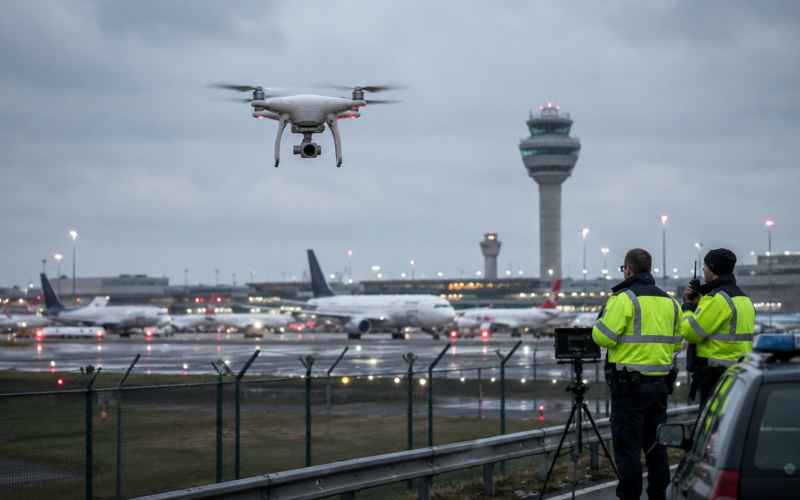
European defence officials, aviation security leaders, and industry analysts are warning that the continent remains structurally exposed to drone incursions, a vulnerability that has shut down major airports, breached NATO airspace dozens of times, and exposed a widening gap between the speed of the threat and the pace of Europe’s response. The European Commission has answered with the 2026 European Drone Defence Initiative, an Action Plan on Drone and Counter-Drone Security, and more than three billion euros in fresh defence-industrial funding, yet the central problem persists. A commercial quadcopter costing a few hundred euros can ground a hub handling tens of thousands of passengers, and the systems built to stop it cost orders of magnitude more. That asymmetry, not any single sighting, is what experts identify as Europe’s real exposure.
What is driving the warnings that Europe cannot defend its airspace against small drones?
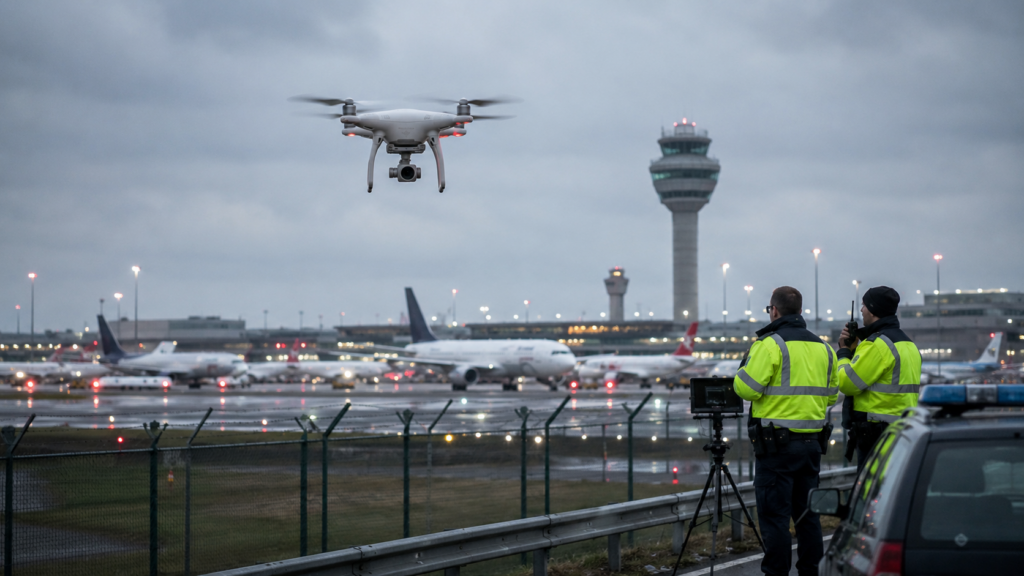
The warnings rest on a concrete record of disruption rather than hypothetical risk. Across a single month in late 2025, fifteen European airports closed or suspended operations because of drone incursions, with incidents spanning Germany, Denmark, Norway, Romania, the Netherlands, Poland, and Spain’s Canary Islands. Munich Airport, one of Europe’s largest hubs, was forced into multiple shutdowns, including one episode that grounded seventeen flights and diverted fifteen more. Brussels Zaventem closed its airspace, reopened, then closed again after a second sighting, with diverted flights sent to Liège, only for Liège to close in turn. Copenhagen shut for nearly four hours, Oslo for around three, and Berlin Brandenburg suspended operations for two hours after a single unidentified drone breached its airspace.
The competitive and strategic implication is that these were not isolated hobbyist mishaps. Danish Prime Minister Mette Frederiksen and other European leaders convened an emergency summit in Copenhagen specifically because the pattern suggested coordination, and multiple national authorities attributed responsibility, directly or by implication, to Russia. The second-order consequence is the one security officials find most alarming. Local police and federal agencies responding in Munich deployed helicopters and ground patrols but could not confirm the number or type of drones involved, an admission that detection and identification capability around civilian airports remains limited against small, low-flying unmanned aircraft. When a continent cannot reliably count the threats over its busiest runways, the defensive posture is reactive by definition.
How many times has Russia violated NATO airspace and what does the pattern signal?
European Parliament documentation records that Russia has violated NATO airspace at least thirty-seven times since 2022, and at least ten European countries have detected drones near airports and military sites. The provocations have not been limited to unmanned systems. Russian military aircraft violated the airspace of Poland, Romania, and Estonia in the weeks preceding the Copenhagen summit, and in September 2025 four Polish airports closed after Russian military drones entered Polish airspace, prompting Polish and NATO forces into what was described as the bloc’s first direct military engagement with Moscow over the incursions.
The strategic reading among European institutions is that this constitutes hybrid warfare, a sustained campaign of airspace violations, suspected sabotage, and provocation calibrated to sit below the threshold of open conflict. The competitive dimension is that Russia has paired these incursions with its own capability build-out, reportedly beginning to launch a low-earth-orbit satellite constellation to enable drone control without dependence on Starlink. The risk this signals is escalation through ambiguity. Each unattributed drone forces a binary choice between expensive interception and visible inaction, and an adversary that can manufacture that dilemma cheaply holds the initiative. Lithuania has faced a parallel version of the problem, suspending operations at Vilnius Airport after clusters of helium balloons believed launched from neighbouring Belarus drifted across the border, a reminder that the low-cost aerial threat is not confined to drones alone.
Why does the cost asymmetry of drone defence threaten European budgets?
The economics sit at the heart of the expert warnings. Analysis emerging from the XPONENTIAL Europe 2026 defence gathering framed the danger precisely. When an adversary deploys Shahed-type loitering munitions en masse, the objective is not only physical destruction but economic attrition, forcing defenders to expend multi-million-dollar interceptors against targets worth a fraction of that. The consensus reached in those sessions was blunt, that continuing to rely on legacy air-defence systems against massed cheap drones is fiscally ruinous and operationally unviable in any protracted conflict.
The competitive implication is that Europe is now racing to field cost-proportionate counter-unmanned systems that match the price of the effector to the price of the threat, a category that barely existed at scale a few years ago. Counter-drone specialists argue that the answer cannot be uniform. A bifurcated approach is required, with traditional air defence reserved for high-altitude military threats and a dedicated radio-frequency and cyber-based solution layered in for small drone incursions, integrating distinct systems for smaller Group 1 and 2 drones and larger Group 3 and above platforms at the command-and-control level. The risk, and the reason the warnings carry urgency, is that procurement cycles move in years while drone innovation moves in months. European officials concede that any early capability available in 2026 is likely limited to initial radar and sensor deployments, with a mature, fully interoperable shield realistically a 2030 proposition.
What is the European Drone Defence Initiative and can it close the gap in time?
The European Drone Defence Initiative, widely referred to as the Drone Wall, is the Commission’s flagship answer. It is conceived as a multi-layered, 360-degree shield of interoperable counter-drone systems for detection, tracking, and neutralisation, explicitly rejecting the notion of a static physical barrier in favour of a networked sensing and interception architecture. Proposed under the EU Defence Readiness Roadmap 2030, the initiative targets initial operational capability by the end of 2026 and full functionality across the 2027 to 2028 window, with the European Commission stating an objective of a fully functional system by the end of 2027. Complementing it is a proposed Drone Alliance with Ukraine, designed to fuse European technology with Ukrainian battlefield experience through joint ventures and to co-produce unmanned systems at scale.
The competitive logic is sound, but the execution risk is substantial. A genuinely interoperable Drone Wall requires aggregating and sharing target data across national borders to form a single Recognised Air Picture, and at present national forces operate distinct integrated air-and-missile-defence systems that do not natively talk to one another. The second-order consequence is political as much as technical. Cross-border data sharing, common procurement, and the surrender of some national control over airspace defence are precisely the areas where European cooperation has historically moved slowly. Analysts at the XPONENTIAL discussions identified this fragmentation, rather than any shortage of hardware, as the harder problem to solve.
How is the European Union funding the drone defence build-out?
The financial response has scaled rapidly. The European Defence Industry Programme, adopted on 8 December 2025, carries a 1.5 billion euro work programme for 2026 and 2027, of which more than 700 million euros is directed at increasing production of counter-drone systems, missiles, and ammunition. Within that, 260 million euros under the Ukraine Support Instrument is earmarked to rebuild and modernise Ukraine’s defence industrial base through joint projects. Alongside the European Defence Industry Programme, the Commission launched a 115 million euro pilot instrument called AGILE, aimed at start-ups and technology-driven small and medium enterprises, with the explicit goal of moving disruptive defence technology from laboratory to deployment in weeks rather than years. The 2026 European Defence Fund work programme adds a further 1 billion euros for collaborative research and development, including work on electronic warfare and swarms of small robots and drones for tactical awareness.
National commitments stack on top of the Brussels funding. France has announced an 8.5 billion euro investment to raise its drone and missile stocks by 400 percent before 2030, Germany has committed 10 billion euros to military drones, and Poland has launched a programme it describes as a drone revolution. The competitive implication is that Europe is finally committing capital at a scale that signals seriousness to both adversaries and its own defence industry. The risk, repeatedly flagged by analysts, is absorptive. Money committed in 2026 must pass through procurement processes, industrial ramp-up, and cross-border coordination before it becomes a drone neutralised over a runway, and the threat is not waiting. As one assessment of Europe’s parallel space-defence effort noted, Ukraine already uses hundreds of deep-strike drones every day, a tempo that exposes just how far European production must scale to be relevant.
What does this mean for airports, critical infrastructure, and the months ahead?
For airport operators, the warnings have already curdled into operational reality. Security leaders at the International Airport Summit in Berlin described a threat landscape where the pace of drone innovation is outstripping both airport preparedness and regulatory clarity, leaving operators exposed to disruption, financial loss, and a slow erosion of public confidence in air travel. Airlines for Europe has pressed for faster implementation of protocols to limit disruption across what it calls an overstretched and fragmented European airspace. Some national responses have been improvised. Germany approved legislation empowering police to shoot down drones, Munich Airport installed a laser to measure the distance between drones and the airfield, and Denmark and Poland called in Ukrainian soldiers experienced in shooting down drones over civilian areas to train their own forces.
The strategic implication is that civilian infrastructure has become the soft underbelly of European security, and the Commission’s Action Plan on Drone and Counter-Drone Security, published on 11 February 2026, explicitly targets that vulnerability through enhanced preparedness, better detection, coordinated response, and a Drone Security Package to improve identification and registration of civilian drones. The Action Plan also pushes for a self-sufficient European drone industry less dependent on non-EU suppliers, a clear acknowledgement that strategic autonomy in unmanned systems is now a security requirement, not an industrial preference. The risk that frames the next twelve to twenty-four months is one of timing. Europe has correctly diagnosed the threat, mobilised significant funding, and designed an ambitious architecture, but the gap between a drone in the sky and a system able to stop it cheaply, legally, and across borders remains open. Whether that gap narrows or widens through 2027 is the question on which Europe’s airspace security now turns.
What are the key takeaways on Europe’s drone defence gap and the EDDI Drone Wall timeline?
- Fifteen European airports closed or suspended operations in a single month in late 2025 due to drone incursions, spanning seven countries and affecting hundreds of flights, with Munich, Brussels, Copenhagen, Oslo, and Berlin among the hubs hit.
- European Parliament records show Russia has violated NATO airspace at least thirty-seven times since 2022, and at least ten European countries have detected drones near airports and military sites, a pattern widely read as coordinated hybrid warfare.
- The core vulnerability is cost asymmetry, where commercial drones costing a few hundred euros force defenders to expend multi-million-dollar interceptors, a dynamic defence analysts call fiscally ruinous against massed loitering munitions.
- Detection remains a critical weakness, with authorities in Munich unable to confirm the number or type of drones involved despite deploying helicopters and ground patrols.
- The European Drone Defence Initiative, or Drone Wall, targets initial capability by end-2026 and full functionality by end-2027, but a mature interoperable system is realistically a 2030 proposition.
- The hardest problem is not hardware but integration, specifically aggregating target data across national borders into a single Recognised Air Picture when national air-defence systems do not natively interoperate.
- The European Defence Industry Programme commits 1.5 billion euros for 2026 to 2027, with more than 700 million euros for counter-drone systems, missiles, and ammunition, plus a 115 million euro AGILE pilot for defence start-ups and a 1 billion euro 2026 European Defence Fund programme.
- France has pledged 8.5 billion euros to lift drone and missile stocks 400 percent by 2030, Germany 10 billion euros for military drones, and Poland a national drone programme, layering national money on top of Brussels funding.
- The European Commission’s Action Plan on Drone and Counter-Drone Security, published 11 February 2026, prioritises preparedness, detection, coordinated response, and a self-sufficient European drone industry less reliant on non-EU suppliers.
- The decisive variable for 2026 and 2027 is absorption speed, as committed funding must survive procurement, industrial ramp-up, and cross-border coordination before it translates into operational drone defence.
Discover more from Business-News-Today.com
Subscribe to get the latest posts sent to your email.