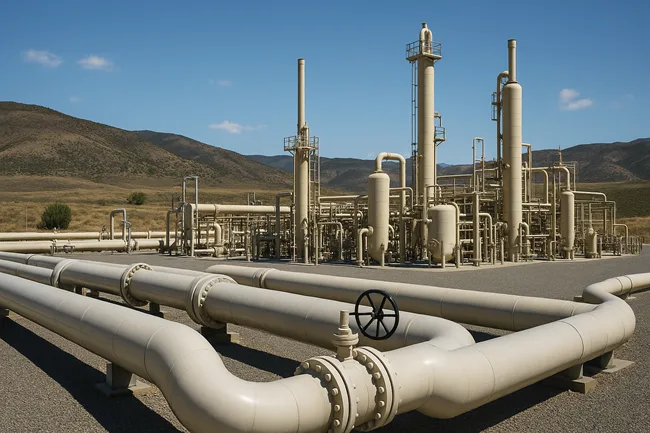


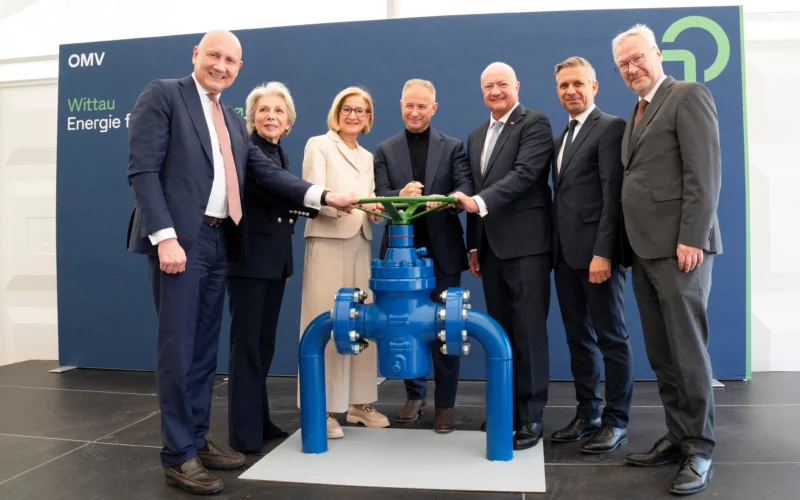
OMV Aktiengesellschaft (VIE: OMV) has commenced commercial gas extraction from its Wittau field in Lower Austria, marking the company’s most consequential domestic upstream milestone in decades and the formal payoff of a discovery first announced three years ago. The first development phase will recover approximately 11 terawatt-hours of gas, with total recoverable resources estimated at up to 48 TWh and first deliveries timed for the winter heating season of 2026 and 2027. OMV has committed roughly EUR 150 million to date across drilling and surface infrastructure, and Chairman and Chief Executive Alfred Stern has flagged up to EUR 500 million in further regional investment subject to market conditions. The announcement lands with OMV stock trading at EUR 64.27 on the Vienna Stock Exchange as of May 19, sitting at the very top of a 52-week range of EUR 42.76 to EUR 64.32 and within touching distance of the all-time high of EUR 62.10 recorded in late March, a price action that already reflects investor confidence in the company’s diversification narrative even before Wittau began contributing volumes.
What does the Wittau start-up actually change for OMV’s Austrian production base and gas supply mix?
The headline operational shift is straightforward in arithmetic but consequential in strategic weight. At full ramp-up, Wittau is expected to double OMV’s natural gas production inside Austria, transforming a domestic upstream business that had been in structural decline into a meaningful contributor to national supply once again. The 11 TWh first-phase volume is roughly equivalent to the heating demand of 100,000 households across a decade, and the upper-end recoverable estimate of 48 TWh, or approximately 4.2 billion standard cubic meters, places Wittau in a category of its own among Austrian onshore developments. For a country that historically sourced around 80 percent of its gas from Russia before 2022 and that saw Gazprom finally cut deliveries to OMV in November 2024, the marginal value of every domestic molecule has risen sharply. Wittau does not by itself resolve Austria’s import dependence, but it shifts the balance in favour of indigenous supply at precisely the moment when transit routes through Ukraine have ceased and European hub volatility remains structurally elevated.
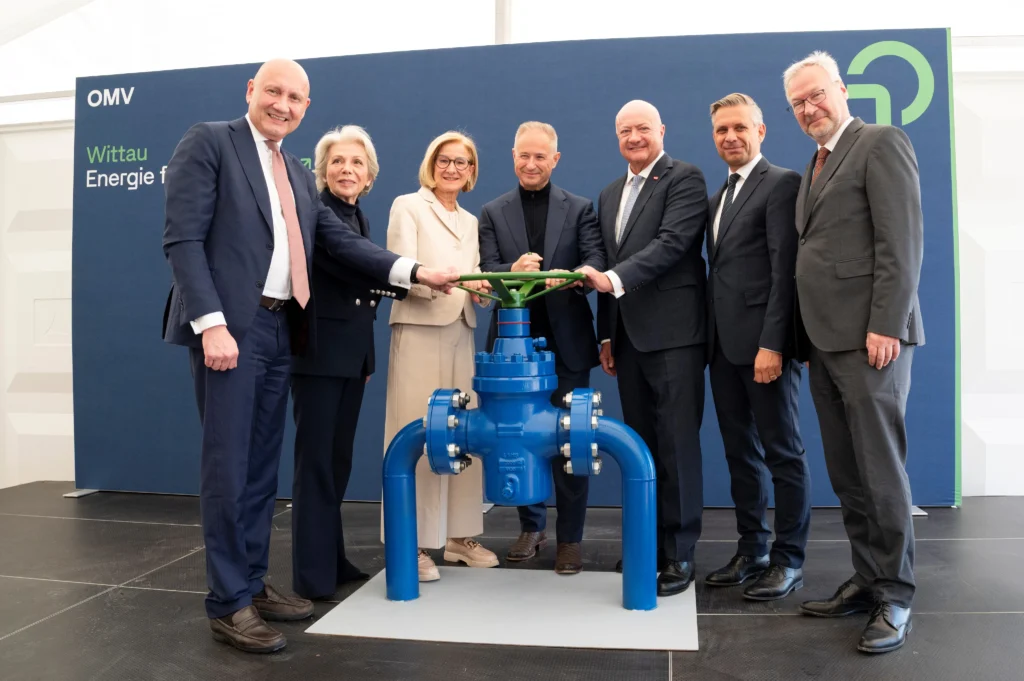
Why is OMV anchoring this announcement around the Chancellor and Federal Economy Minister rather than treating it as a routine upstream milestone?
The political staging of the Wittau launch, with Chancellor Christian Stocker, Federal Minister Wolfgang Hattmannsdorfer, and Lower Austria Governor Johanna Mikl-Leitner all in attendance, signals that this is not being framed as a corporate operational event. It is being positioned as a national security of supply moment. The Republic of Austria retains a significant ownership stake in OMV through ÖBAG, and the alignment between corporate strategy and federal energy policy has rarely been more visible. Stocker explicitly tied the project to resilience and crisis preparedness, language that would have sounded out of place at a gas field opening five years ago. For OMV, the political endorsement carries practical value beyond optics. Permitting timelines for follow-on exploration, regulatory treatment of the EUR 500 million pipeline of additional regional investment, and any future debate over windfall taxation all become easier to navigate when the federal government has publicly underwritten the project’s strategic significance. The cost of capital for further drilling in the basin should fall on the margin as a result.
How does the EUR 150 million Wittau outlay compare to OMV’s broader capital allocation discipline and what does the deal economics look like at current European gas prices?
OMV’s first-phase Wittau commitment splits into approximately EUR 70 million for drilling and EUR 80 million for surface infrastructure and equipment, a relatively modest cheque against a group that generated roughly EUR 5.3 billion in EBITDA on its most recent reported basis. The discipline lies in the staged nature of the spend. OMV took the formal investment decision in early 2025, moved to first gas inside eighteen months, and has retained optionality on the larger EUR 500 million regional follow-on programme rather than committing the full capital cycle upfront. At European TTF prices that have ranged broadly between EUR 25 and EUR 40 per megawatt-hour over the past year, the gross revenue potential from the 11 TWh first-phase resource alone runs into the high hundreds of millions of euros, with the full 48 TWh upside scenario pointing to gross revenue well above EUR 1.5 billion across the asset’s life. Operating costs for onshore Austrian production sit at the lower end of OMV’s global cost curve, and the project benefits from existing pipeline interconnection. The payback profile is therefore attractive in any reasonable price scenario, and even more so if European gas prices remain elevated through the late 2020s.
What does the Wittau ramp-up signal about OMV’s strategic direction under incoming Chief Executive Emma Delaney and the post-Stern era?
The Wittau commissioning is, in effect, the closing chapter of Alfred Stern’s tenure on the upstream front. OMV announced in April that Emma Delaney, currently of BP, will succeed Stern as Chairwoman of the Executive Board and Chief Executive, and the transition introduces a meaningful strategic question. Stern’s tenure was defined by the Borealis chemicals integration, the Russian exit, and a stated pivot towards a leaner, lower-carbon integrated model. Delaney inherits a company that is simultaneously trying to grow domestic and Norwegian gas production, divest non-core upstream positions, and accelerate its chemicals and circular polymer ambitions. Wittau fits neatly into the gas diversification leg of that strategy, but it also commits OMV to a longer onshore Austrian footprint at a time when peer European majors are pulling back from continental upstream work. How Delaney chooses to size the EUR 500 million follow-on opportunity, and whether she accelerates or moderates further domestic exploration, will be among the earliest signals of her strategic instincts. The market is unlikely to wait long for an answer.
How are OMV shares pricing the Wittau development and the broader diversification story?
OMV stock has had a strong run into the Wittau launch, with the shares up approximately 31 percent over the trailing twelve months and roughly 10 percent over the past month alone. The recent all-time high of EUR 62.10 set on March 26 has already been surpassed in intraday trading, and the current level of EUR 64.27 leaves the stock at the upper bound of analyst consensus, where price targets have clustered in a range of EUR 46 to EUR 70. The strong performance has come despite a difficult first quarter, in which OMV reported earnings per share of EUR 0.99 against consensus expectations of EUR 1.89, a substantial miss that reflected weak refining margins and softer chemicals contributions. That the stock has continued to rally through an earnings disappointment suggests that investors are looking past near-term cyclical pressure and rewarding the structural diversification story, of which Wittau is a tangible component. The risk for new buyers is straightforward. Much of the gas security premium may already be in the price, and any softening in European TTF benchmarks, any delay in the Wittau ramp profile, or any strategic reset under the incoming chief executive could trigger a correction from the current elevated levels. The asymmetry from here looks less favourable than it did six months ago.
What execution and second-order risks could undermine the Wittau thesis even after first gas?
First production is not the same as sustained commercial delivery, and the gap between the 11 TWh first-phase commitment and the 48 TWh upside scenario is where the operational risk concentrates. Reservoir performance over the first two to three years of extraction will determine whether the upper-end recoverable resource estimate holds. Onshore gas fields in mature European basins have historically shown decline curves steeper than initial geological estimates suggested, and any downward revision to the resource base would compress the project’s lifetime value. There is also a regulatory tail risk. Austrian and broader European policy on continued fossil fuel investment remains contested, and a future government with a different energy policy orientation could constrain the permitting environment for the EUR 500 million follow-on programme. Climate-aligned investor pressure on European integrated majors has not abated, and OMV’s decision to expand domestic gas production at this stage of the energy transition will continue to draw scrutiny from European sustainability-mandated capital pools. Finally, the economic case rests substantially on European gas prices remaining at current elevated levels. A meaningful normalisation of TTF benchmarks towards historical averages would not kill the project, but it would materially reduce the case for the EUR 500 million follow-on commitment.
Key takeaways on what the Wittau start-up means for OMV, its competitors, and the European gas sector
- OMV has converted a three-year-old discovery into a producing asset within an unusually tight timeline, validating its onshore execution capability and strengthening its credibility for any follow-on investment cases.
- The 11 TWh first-phase volume is modest in European terms but doubles OMV’s Austrian production at full ramp, restoring domestic upstream relevance after years of structural decline.
- The presence of the Chancellor, Federal Economy Minister, and Lower Austria Governor confirms that Wittau is being treated as national infrastructure rather than a corporate operational event, with implications for permitting and follow-on regulatory treatment.
- At European TTF prices of EUR 25 to EUR 40 per megawatt-hour, the 11 TWh first-phase resource alone supports a strong payback profile against the EUR 150 million committed capital base.
- The EUR 500 million follow-on regional opportunity creates strategic optionality but commits OMV to a longer Austrian onshore footprint at a time when European peers are reducing continental upstream exposure.
- Wittau is materially relevant for Austrian gas security but does not eliminate the country’s structural import dependence, leaving Norwegian gas and LNG access as continuing strategic priorities.
- OMV shares are trading at the top of their 52-week range and have rallied through a weak first quarter, suggesting much of the diversification premium is already priced in.
- The CEO transition from Alfred Stern to Emma Delaney later in 2026 introduces near-term strategic uncertainty around the pace and scale of further Austrian upstream investment.
- Reservoir performance risk over the first two to three years of production will determine whether the 48 TWh upside scenario holds, with direct implications for the follow-on investment case.
- Climate-aligned investor scrutiny on continued European fossil fuel investment remains a structural headwind for the OMV equity story even as security of supply considerations dominate the near-term narrative.
Share this:
Discover more from Business-News-Today.com
Subscribe to get the latest posts sent to your email.