




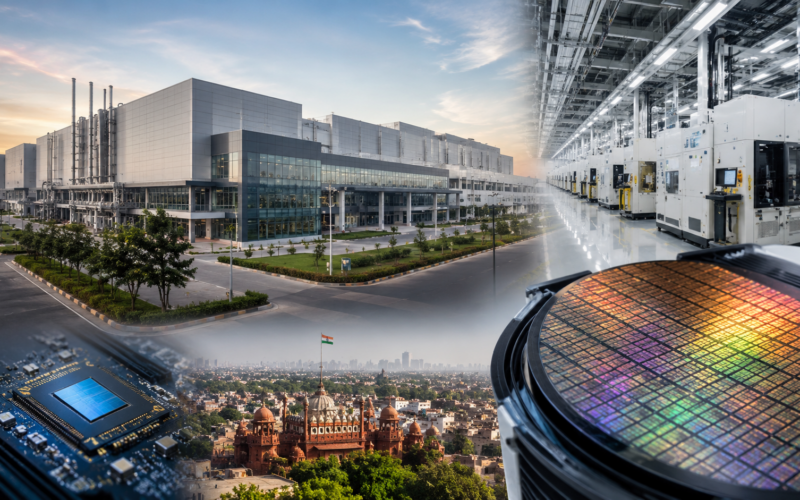
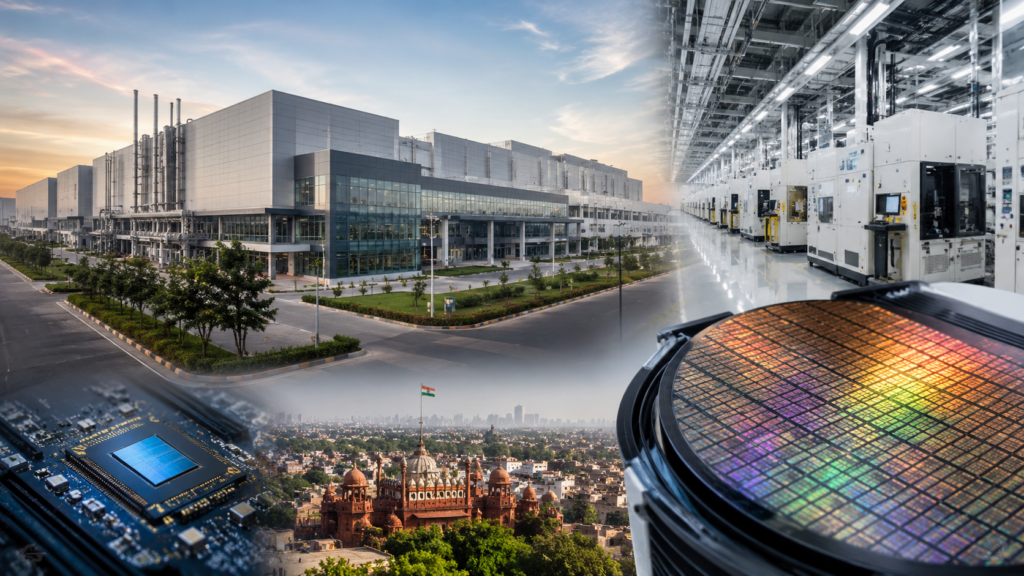
ASML Holding N.V. (NASDAQ: ASML) has signed a strategic partnership with Tata Electronics Private Limited to support the establishment and ramp-up of Tata Electronics’ planned US$11 billion semiconductor fabrication plant in Dholera, Gujarat. The agreement places ASML’s lithography tools, process support, talent development and supply-chain collaboration at the centre of India’s first commercial 300 mm semiconductor fab. For India, the pact gives its semiconductor manufacturing programme a more credible technology anchor at a stage when policy ambition must start converting into yield, customer qualification and repeatable production. For ASML Holding N.V., whose Nasdaq-listed shares recently traded at US$1,501.81, the deal adds another long-cycle growth geography at a time when chip equipment demand remains heavily tied to artificial intelligence, memory upgrades and geopolitical supply-chain reshoring.
Why does the ASML and Tata Electronics partnership matter for India’s semiconductor manufacturing strategy?
The ASML and Tata Electronics partnership matters because it shifts India’s semiconductor story from incentive-led project announcements toward the harder industrial question of whether the country can build a functioning fabrication ecosystem. Semiconductor fabs are not won on capital expenditure alone. They require tool availability, process discipline, trained operators, maintenance ecosystems, materials coordination, yield engineering and customer confidence, all of which take years to develop and even longer to prove at scale.
Tata Electronics is positioning the Dholera facility as India’s first commercial 300 mm semiconductor fab, with planned production across automotive, mobile devices, artificial intelligence and other application segments. That breadth is strategically useful because India does not need to start by competing directly with the most advanced nodes used for frontier artificial intelligence accelerators. Instead, the access to process technologies including 28 nm, 40 nm, 55 nm, 90 nm and 110 nm through Tata Electronics’ earlier partnership with Powerchip Semiconductor Manufacturing Corporation gives the project a more realistic entry path into mature and specialty chips where demand is broad, sticky and increasingly strategic.
The presence of ASML Holding N.V. in the Dholera project does not automatically guarantee success, but it materially improves the credibility of the execution stack. Lithography is one of the most complex and expensive steps in semiconductor manufacturing. A fab without deep lithography support is not really a fab strategy, it is a very expensive construction project waiting for physics to object. By tying ASML Holding N.V. into tool deployment, ramp-up support, training and R&D infrastructure, Tata Electronics is trying to avoid the classic emerging-market trap of building industrial capacity before building the operating ecosystem that makes the capacity bankable.
How could the Dholera semiconductor fab change India’s role in global chip supply chains?
The Dholera semiconductor fab could change India’s role in global chip supply chains by moving the country beyond assembly, outsourced services and electronics consumption into front-end manufacturing. India already has advantages in design talent, electronics demand, engineering services and geopolitical alignment with Western and Asian supply-chain diversification efforts. What India has lacked is commercial-scale wafer fabrication, which is the missing industrial layer between chip design and downstream electronics manufacturing.
If Tata Electronics can execute the Dholera fab successfully, India could begin to serve global customers looking for a more diversified chip manufacturing footprint outside Taiwan, South Korea, China and a small group of established semiconductor hubs. The early target markets also make strategic sense. Automotive chips, mobile device semiconductors and artificial intelligence-adjacent components do not all require bleeding-edge nodes, but they do require reliability, repeatability and trusted supply. That is where India could build relevance before trying to climb further up the complexity ladder.
The broader consequence is that India’s semiconductor policy may become less dependent on subsidy headlines and more dependent on ecosystem compounding. A fab draws equipment vendors, gas suppliers, chemicals providers, cleanroom contractors, maintenance specialists, engineering institutes and downstream packaging players. If Dholera works, Gujarat could become more than a single-project showcase. It could become an industrial clustering experiment for a country that wants semiconductor sovereignty without pretending that sovereignty can be built overnight.
What does ASML gain from supporting Tata Electronics’ India semiconductor ecosystem?
ASML Holding N.V. gains a strategically important customer relationship in a market that is still early, policy-backed and likely to remain politically protected for years. The company’s core growth remains tied to major chipmakers and foundries in established markets, but India offers a different opportunity. It is not only a unit-sales opportunity for lithography systems. It is a chance to embed ASML Holding N.V. into the training, process and support architecture of a new semiconductor manufacturing geography.
That matters because semiconductor equipment relationships are long-cycle and sticky. Once a fab operator builds around a supplier’s toolchain, switching costs become very high. Service teams, process recipes, training systems, maintenance routines and yield-improvement cycles all deepen the relationship. For ASML Holding N.V., early involvement in India could create a durable position as Tata Electronics and potentially other Indian fabs scale capacity over time.
There is also a geopolitical angle. Dutch semiconductor companies face a world where export controls, China exposure, U.S. pressure and industrial policy are now part of commercial planning. India offers ASML Holding N.V. a large market that is aligned with Western technology ecosystems while also pursuing its own strategic autonomy. That does not remove geopolitical risk, but it spreads it. In semiconductor equipment, diversification is not a slogan anymore. It is balance-sheet hygiene with more acronyms.
Why is lithography the strategic bottleneck in Tata Electronics’ Dholera chip fab?
Lithography is the strategic bottleneck because it determines how circuit patterns are transferred onto wafers, which in turn shapes chip performance, yield and production economics. A semiconductor fab can spend billions on buildings, utilities and cleanrooms, but without lithography precision, the production line cannot reliably create commercial-grade chips. That is why ASML Holding N.V.’s involvement matters more than a generic supplier agreement would.
The Dholera fab is expected to focus on mature and specialty nodes rather than the most advanced extreme ultraviolet-dependent logic nodes. Even so, deep ultraviolet lithography and related process control remain critical. Mature nodes are not simple nodes. Automotive, industrial and mobile applications demand reliability, quality certification and long product lifecycles. For customers, a chip made on a mature node still has to work every time, often for years, sometimes in brutally unforgiving operating environments.
For Tata Electronics, the lithography partnership also reduces execution risk during ramp-up. The most dangerous phase of any fab is not the ribbon cutting. It is the period when installed tools must be converted into stable production, acceptable yields and customer-qualified output. ASML Holding N.V.’s support in training, process alignment and R&D infrastructure could help Tata Electronics shorten the learning curve. The real test will be whether that support translates into high-volume manufacturing discipline, not just well-lit photos of cleanroom corridors.
How does the ASML Tata Electronics deal fit into India Netherlands technology diplomacy?
The ASML Tata Electronics deal fits neatly into a broader India Netherlands technology relationship that is becoming more strategic because semiconductors sit at the intersection of trade, national security, industrial policy and digital infrastructure. The agreement was signed during high-level engagement between India and the Netherlands, with semiconductor cooperation framed alongside other critical sectors such as renewable energy, digital technologies and healthcare.
For India, Dutch participation brings credibility because the Netherlands is home to one of the most strategically important semiconductor equipment companies in the world. For the Netherlands, India offers market access, geopolitical relevance and a diversification channel at a time when Europe is reassessing dependence on concentrated technology supply chains. This is not traditional bilateral trade in goods. It is technology diplomacy through industrial infrastructure.
The free trade context also matters. India and the European Union have long discussed deeper trade cooperation, but semiconductors add urgency because both sides are trying to reduce supply-chain vulnerability without severing global interdependence. The Tata Electronics and ASML Holding N.V. pact gives that policy conversation a tangible industrial project. If Dholera progresses well, it could become a reference point for future India Europe cooperation in semiconductor equipment, materials, skills and advanced manufacturing.
What are the main execution risks for Tata Electronics at the US$11bn Dholera fab?
The main execution risk is that semiconductor fabs are unforgiving capital projects where delays, low yields and skill gaps can quickly turn national ambition into expensive underutilisation. Tata Electronics has the advantage of Tata Group’s balance-sheet reputation and project discipline, but semiconductor manufacturing is a different league from conventional industrial expansion. The sector punishes overconfidence with mathematical elegance, usually measured in defective wafers and painful depreciation.
The first risk is talent. India has strong chip design and software capabilities, but front-end semiconductor manufacturing requires a deep workforce of process engineers, equipment technicians, yield specialists and operations leaders with hands-on fab experience. ASML Holding N.V.’s training role helps, but local talent depth will take time to develop. The second risk is supply chain. Chemicals, gases, ultrapure water systems, spare parts, cleanroom components and qualified vendors must be available with reliability, not merely listed in a policy document.
The third risk is customer qualification. Global customers will not shift chip orders to a new fab simply because the project is strategically important to India. They will demand consistency, cost competitiveness, quality certification and delivery reliability. Tata Electronics must therefore convert the ASML partnership and Powerchip Semiconductor Manufacturing Corporation technology access into proven output. Until then, the market will treat the Dholera fab as a promising industrial buildout rather than a fully validated semiconductor supplier.
How is ASML stock sentiment shaped by India expansion and global chip equipment demand?
ASML Holding N.V. shares recently traded at US$1,501.81 on Nasdaq, down 5.22% in the latest session, with a 52-week range of US$683.48 to US$1,603.49. MarketWatch data showed the stock down 4.09% over five days but up 1.71% over one month, while the broader one-year performance remained sharply positive. That market setup is important because the Tata Electronics pact arrives when investors already value ASML Holding N.V. as a core beneficiary of global semiconductor capital expenditure, not as a speculative India story.
The near-term market reaction should therefore be interpreted carefully. A single partnership in India is unlikely to move the needle immediately for a company with a market capitalisation around US$590 billion and entrenched relationships with the world’s largest chipmakers. The strategic value is longer term. India could become an incremental demand pool for lithography tools, service revenue and ecosystem support if the country’s fab programme scales beyond one or two flagship projects.
Investor sentiment toward ASML Holding N.V. remains tied to bigger variables, including artificial intelligence-driven chip demand, memory investment cycles, foundry spending, export controls and the pace of advanced-node capacity expansion. The Tata Electronics deal adds a diversification signal, not an earnings reset. Still, for a stock trading near the upper end of its 52-week range, even small proof points around future geographic demand can support the long-term premium investors assign to ASML Holding N.V.’s near-irreplaceable role in chipmaking.
What happens next if Tata Electronics and ASML make the Dholera fab work?
If Tata Electronics and ASML Holding N.V. make the Dholera fab work, India’s semiconductor programme could shift from credibility-building to capacity-building. That would change how global customers, equipment makers and policymakers assess India’s role in electronics manufacturing. A successful ramp would also strengthen Tata Electronics’ claim to be a full-stack electronics and semiconductor player rather than only a contract manufacturing and assembly platform.
The next phase will likely be judged on construction progress, equipment installation, hiring, technology transfer, pilot production, yield improvement and customer qualification. Each stage will matter more than the announcement itself. Semiconductor manufacturing is a sequence of gates, and none of them care about political enthusiasm. If Tata Electronics clears those gates, Dholera could become the anchor asset around which India builds a more serious fab ecosystem.
If the project struggles, the consequences would also be significant. India’s semiconductor policy would still continue, but investor confidence in large-scale front-end manufacturing could weaken. Equipment vendors may remain cautious, customers may hesitate, and future projects may tilt more heavily toward assembly, testing and packaging rather than wafer fabrication. That is why the ASML Holding N.V. partnership is strategically important. It increases the probability of execution, but it does not remove the need for disciplined delivery.
Key takeaways on what the ASML and Tata Electronics semiconductor partnership means for India and global chip manufacturing
- ASML Holding N.V.’s partnership with Tata Electronics gives India’s US$11 billion Dholera fab a stronger lithography and ramp-up foundation.
- Tata Electronics is moving India’s semiconductor strategy from policy intent toward front-end manufacturing execution.
- The 300 mm Dholera fab could serve automotive, mobile, artificial intelligence and specialty chip markets where mature nodes remain commercially important.
- ASML Holding N.V. gains early positioning in an emerging semiconductor geography that could become a long-term equipment and services market.
- The deal strengthens India Netherlands technology cooperation at a time when semiconductor supply chains are being reshaped by geopolitics.
- The biggest risk for Tata Electronics is not funding alone, but yield, talent, supplier depth and customer qualification.
- India’s chip ambitions will be judged by production reliability, not announcement size.
- ASML stock sentiment remains driven mainly by global chip equipment cycles, but India adds a useful long-term diversification signal.
- A successful Dholera ramp could attract more ecosystem partners into Gujarat and strengthen India’s broader electronics manufacturing base.
- A weak ramp would not end India’s semiconductor push, but it would slow confidence in large-scale wafer fabrication.
Share this:
Discover more from Business-News-Today.com
Subscribe to get the latest posts sent to your email.