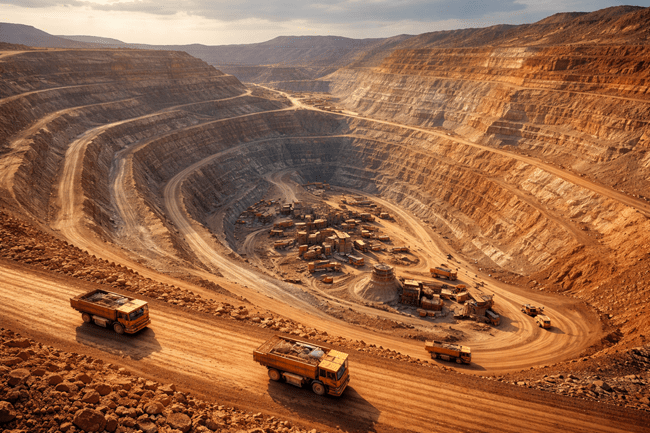
Sunrise Energy Metals climbed 5.60 per cent to A$13.19 on Tuesday, placing the scandium developer third on the ASX 200 leaderboard during a broad-based resources rally that lifted gold, lithium, aluminium and rare earth names. The move extends a year-long re-rating that has taken the stock from below A$1 to a current market capitalisation north of A$1.8 billion. Behind the price action sits a single high-conviction setup: Sunrise Energy Metals is months away from a final investment decision on the Syerston Scandium Project in central New South Wales, a deposit the company describes as the world’s largest and highest-grade source of mineable scandium. Retail investors are positioning ahead of that decision, with the Lockheed Martin offtake option, the US Export-Import Bank financing letter, and China’s standing export controls on scandium all stacking the thesis on the same side of the table.
What does Sunrise Energy Metals actually own and why is the Syerston scandium deposit so strategically rare?
Sunrise Energy Metals, formerly Clean TeQ Holdings, is an ASX-listed developer based in Melbourne with a single producing-stage asset in central-west New South Wales. The Syerston project sits about 450 kilometres west of Sydney on a granted mining lease and a freehold land package, with secured water rights covering 3.2 gigalitres a year. The deposit hosts roughly 46 million measured and indicated tonnes grading 414 parts per million scandium, equating to around 19,000 tonnes of contained scandium metal. By every benchmark the company and independent analysts cite, this is the largest and highest-grade scandium resource on a permitted mining lease anywhere in the world.
Scandium itself is the part of the story most retail investors miss. It is classified by the US Geological Survey as a critical mineral, used to strengthen aluminium alloys for aerospace and defence applications, in solid oxide fuel cells powering AI data centres, and as a dopant in wireless communications semiconductors. The global market is tiny, around 50 to 60 tonnes a year, and China currently produces between 80 and 85 per cent of that supply. There has been no primary scandium production in the United States for decades. The combination of a strategic end-use profile, a vanishingly thin Western supply base, and a single low-cost deposit large enough to reshape the market is what gives Sunrise Energy Metals its current investment narrative.
Sunrise Energy Metals also owns the Sunrise Nickel-Cobalt Project on the same tenement, one of the most cobalt-rich nickel laterite deposits globally. Management has effectively deprioritised the battery metals leg in favour of scandium for now, though the optionality remains on the balance sheet.
How did China’s April 2025 rare earth export controls reshape the investment case for ASX-listed scandium developers?
The structural shift in the scandium market did not come from a price spike or a demand surge. It came from a regulatory decision in Beijing. On 4 April 2025, China’s Ministry of Commerce issued Announcement No. 18, adding seven medium and heavy rare earth elements, including scandium, to the country’s dual-use export control list. The measure does not ban exports outright. It requires both Chinese exporters and foreign purchasers to obtain case-by-case licences, with a process that runs roughly four months and carries no guarantee of approval.
These controls have not been suspended. A separate set of October 2025 measures was paused in November 2025 until 10 November 2026 as part of broader US-China trade de-escalation, but the April 2025 scandium controls remain fully in force. Chinese bulk scandium quotes now sit at around US$5,000 per kilogram, while Western retail prices have moved to roughly double that level. Verified market trackers describe the retail scandium metal market as thin, with frequent stockouts and wide spreads by purity and form.
For an ASX-listed developer with a permitted, financed, low-cost scandium project, this is the kind of macro backdrop that does not show up in spreadsheets but rewrites the investment thesis. Western aerospace, defence and AI infrastructure buyers are now actively scouting non-Chinese primary scandium supply, and Sunrise Energy Metals is one of a handful of credible names on that list.
What does the March 2026 Syerston feasibility study tell retail investors about the economics of the project?
The Syerston feasibility study, prepared by GR Engineering Services and released on 3 March 2026, gave the market the first hard set of numbers to value the project against. Development capital comes in at US$120 million, life-of-mine site-level cash operating costs at US$534 per kilogram of scandium oxide, and steady-state production at 60 tonnes per annum of 99.9 per cent purity scandium oxide. The proposed mine life runs 32 years, with first commissioning targeted for the first half of 2028 and site works expected to begin in the back half of 2026.
The capital intensity is the headline. At US$120 million, Syerston is one of the most capital-efficient critical minerals projects on the ASX development pipeline. Sunrise Energy Metals is also evaluating a second processing train that would add another 120 tonnes per annum of capacity, which would position the company to supply roughly three times current global scandium consumption from a single site. For context, an annual run rate of 60 tonnes alone represents around 100 per cent of current global market size, raising both an opportunity and a risk that the analytical layer below catches.
The stock dropped 3.6 per cent on the day the feasibility study was released, closing at A$7.69 after trading resumed from suspension. That softness reflected three things rather than disappointment with the economics: a sell-side note that maintained a Hold and an A$10.00 price target, a separate analyst with a Sell rating at A$7.50, and a market digesting the gap between feasibility study delivery and actual final investment decision.
Why are retail investors on HotCopper and Twitter/X watching the SRL final investment decision in late 2026?
The final investment decision is the central catalyst now. Sunrise Energy Metals has guided to a board decision in the second half of 2026, with on-site construction targeted to begin shortly after. Between now and then, retail investors on HotCopper, Strawman, X and broader ASX-focused forums are tracking three sub-catalysts that determine whether the FID actually lands.
The first is the conversion of the Lockheed Martin offtake option into a binding agreement. In October 2025, Sunrise Energy Metals signed a non-binding arrangement under which Lockheed Martin secured an option to purchase the first 15 tonnes per annum of scandium oxide for five years, totalling up to 75 tonnes. A binding offtake from a US defence prime carries weight beyond the headline volume, because it functions as the customer reference point for further offtake and for bank underwriting on the project debt.
The second is the formal Ex-Im Bank application. The Letter of Interest for up to US$67 million in debt financing, covering roughly half of project capital, is preliminary. Sunrise Energy Metals would still need to file a formal application, meet underwriting criteria, and finalise terms before a lending commitment is issued. The repayment term of up to 15 years and the Supply Chain Resiliency Initiative pathway are unusually attractive, but execution is not done.
The third is the closing equity gap. Sunrise Energy Metals raised A$45.6 million via a November 2025 placement at A$4.25 a share, followed by a further A$18.8 million December 2025 placement at A$4.90. Combined with the Ex-Im Bank facility, this gets the company close to the US$120 million capital figure but not all the way. A final equity top-up or revised financing structure is highly likely between now and FID, and the market is already pricing it in.
How does Robert Friedland’s involvement change how the market values Sunrise Energy Metals shares?
Robert Friedland is co-chair of Sunrise Energy Metals, and his presence on the board is not a passive endorsement. Robert Friedland has a track record of taking deposits from concept to large-scale production, most notably with Ivanhoe Mines and the Kamoa-Kakula copper project in the Democratic Republic of Congo. For retail investors, Robert Friedland’s involvement reduces a specific kind of execution risk: the risk that a junior developer with a great deposit fails to assemble the customer base, the financing syndicate, and the operating capability to actually build the mine.
That said, Robert Friedland’s name does not eliminate price risk on the stock. Sunrise Energy Metals has traded as low as 40 cents in the past 12 months and as high as A$12.49. The share price has been driven primarily by news flow rather than fundamentals, because there are no current earnings to model against. Investors paying north of A$13 a share today are paying for a successful FID, a successful Ex-Im draw, a successful Lockheed Martin binding offtake, and a successful 2028 commissioning. Any slip in that chain has the potential to compress the valuation materially, and the lessons of Sunrise Energy Metals’ earlier life as Clean TeQ Holdings, when a previous A$1.77 billion battery metals capex plan stalled out, are written into the long-tenured shareholder base.
What execution risks should retail investors weigh against the SRL bull case before adding exposure?
The scandium market itself is the most underrated risk. Global demand sits at around 50 to 60 tonnes a year, and Sunrise Energy Metals’ base case adds 60 tonnes from a single project, with potential to add another 120 tonnes from a second train. Demand has to grow into that supply for the project to monetise its full reserve. The bull case rests on solid oxide fuel cells in AI data centres, aerospace alloys, and defence procurement scaling demand toward 200 tonnes a year by the late 2020s. The bear case is that scandium remains a niche specialty metal, prices normalise once Chinese licensing settles into a routine, and Sunrise Energy Metals ends up with a long-life mine whose product the world only partly wants.
Construction execution is the second risk. The 2028 commissioning timeline assumes a clean run from FID through equipment delivery, water and power connection, and process commissioning, which is rarely how greenfield mines proceed. Cost overruns on a US$120 million project would be absorbed by the equity holder, given the fixed Ex-Im facility ceiling.
Geopolitical reversal is the third. If the US-China trade dynamic shifts and China lifts the April 2025 controls, the urgency premium currently embedded in scandium prices unwinds, and the strategic premium attached to Western supply weakens. The reverse scenario, where the November 2026 expiry of the October 2025 suspension brings additional restrictions, is the bull case but not the base case.
What is the key takeaways summary of the Sunrise Energy Metals retail investor roadmap?
- Sunrise Energy Metals trades on the ASX as SRL and gained 5.60 per cent to A$13.19 on Tuesday, ranking third on the ASX 200 leaderboard during a broad-based resources rally.
- The Syerston Scandium Project in central New South Wales hosts approximately 19,000 tonnes of contained scandium at an average grade of 414 parts per million, described as the world’s largest and highest-grade scandium deposit on a permitted mining lease.
- The March 2026 feasibility study confirmed development capital of US$120 million, cash operating costs of US$534 per kilogram of scandium oxide, annual production of 60 tonnes, and a 32-year mine life with potential to expand.
- The investment thesis rests on China’s April 2025 export controls on scandium, which remain in force and have created an active Western search for non-Chinese supply for aerospace, defence and AI infrastructure applications.
- The final investment decision is targeted for the second half of 2026, with sub-catalysts including binding Lockheed Martin offtake conversion, formal Ex-Im Bank application drawdown, and any final equity raise to close the funding gap.
- Co-chair Robert Friedland’s track record reduces execution risk but does not eliminate price risk, given the stock has run from below A$1 to north of A$12 in 12 months on news flow rather than earnings.
- Key risks include the thin global scandium market absorbing new supply, construction and commissioning execution into 2028, and any reversal in US-China critical minerals policy.
Discover more from Business-News-Today.com
Subscribe to get the latest posts sent to your email.