


U.S. households are facing one of the clearest domestic consequences of the continuing Iran war: higher gasoline prices that are now reshaping travel plans, household budgets, food spending and political pressure in an economy already sensitive to inflation. The national average price for regular gasoline stood at $4.530 per gallon, compared with $4.166 a month earlier and $3.146 a year earlier, while diesel averaged $5.650 per gallon.
The latest pump-price pressure is not only a consumer inconvenience. It is the retail end of a wider energy shock linked to disrupted Middle East oil flows, lower U.S. crude and gasoline inventories, record demand for U.S. refined fuel exports, and uncertainty over whether the Strait of Hormuz can fully reopen to stable commercial shipping. The United States Energy Information Administration has assessed that disrupted Middle East crude production rose sharply after the conflict began and projected global inventory draws in the second quarter of 2026.
The Iran war has therefore moved from foreign policy headlines into everyday U.S. household economics. Drivers are paying more to commute, families are reconsidering road trips, gig workers are absorbing higher operating costs, and restaurants are already reporting pressure as consumers redirect income toward fuel. Reuters reported that several U.S. restaurant chains, including Wingstop Inc. and Domino’s Pizza Inc., cited gasoline prices as a factor behind weaker sales momentum.
Why are U.S. gasoline prices rising while the Iran war keeps disrupting global oil supply routes?
Gasoline prices in the United States are rising because the Iran war has tightened the global crude oil market at the same time that U.S. fuel inventories have declined. The Strait of Hormuz remains central to this pressure because the waterway normally handles about one-fifth of the world’s oil supply. Reuters reported that Tehran has largely blocked non-Iranian shipping through the strait since the war began, keeping energy markets exposed to supply risk even during periods of relative calm.
The pressure is visible in official U.S. stockpile data. U.S. crude inventories fell by 2.3 million barrels to 457.2 million barrels in the week ended May 1, while gasoline stocks dropped by 2.5 million barrels to 219.8 million barrels. Distillate stockpiles, which include diesel and heating oil, fell to 102.3 million barrels, their lowest level since 2005.
That combination matters because gasoline prices are shaped by more than domestic production. The United States is a major oil and fuel producer, but U.S. pump prices still reflect global crude pricing, refinery availability, export demand, shipping disruption and regional distribution constraints. When Middle East supply routes are disrupted, crude becomes more expensive globally. When gasoline inventories fall at the same time, the domestic buffer weakens.
The Energy Information Administration’s Short-Term Energy Outlook described disrupted Middle East crude production as having increased significantly from its prior forecast. It assessed that production shut-ins averaged 7.5 million barrels per day in March and expected them to peak at 9.1 million barrels per day in April before gradually easing. That scale of disruption helps explain why gasoline prices have not behaved like a normal seasonal increase.
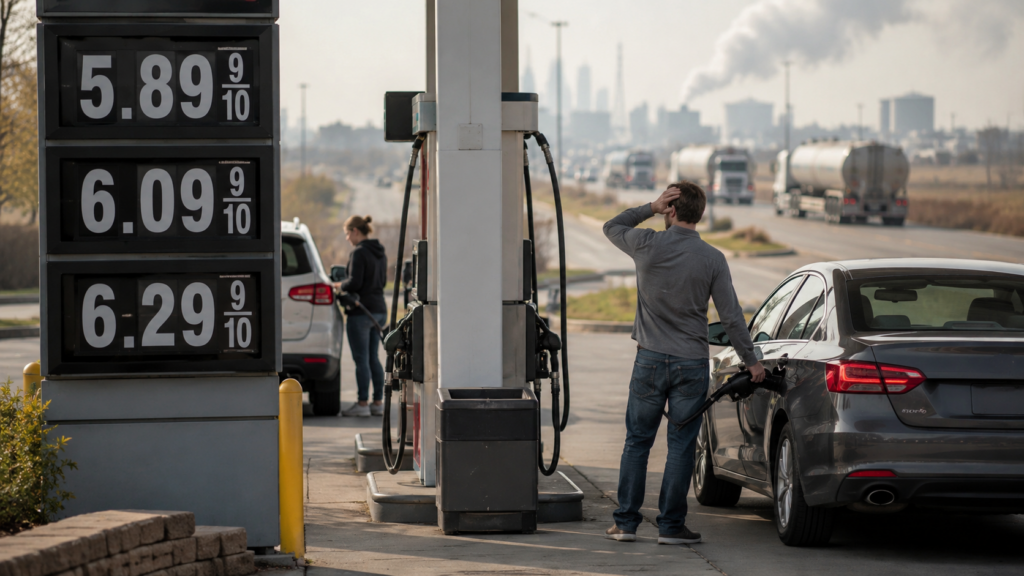
How is the Iran war turning fuel prices into a household budget problem across the United States?
The clearest impact for U.S. consumers is the sudden increase in the cost of routine mobility. AAA data showed regular gasoline at $4.530 per gallon nationally, with mid-grade at $5.022, premium at $5.394 and diesel at $5.650. The year-on-year difference is especially sharp because regular gasoline averaged $3.146 one year earlier.
That increase affects households unevenly. Suburban and rural households with longer commutes feel the rise faster than urban households with access to public transit. Workers who rely on cars for shift work, delivery jobs, rideshare driving or small-business operations have less flexibility to cut fuel use. Families planning summer travel face a different problem: the trip itself becomes more expensive before hotels, food and entertainment are even counted.
The pressure also extends beyond gasoline. Diesel prices affect trucking, distribution and delivery costs, which can feed into retail and food prices. The decline in distillate inventories is therefore important because diesel is not just a fuel for private vehicles. It is a backbone fuel for freight, agriculture, construction and industrial logistics.
For many households, high gasoline prices function like an unofficial tax. The money goes first to essential travel and leaves less for restaurants, retail, entertainment and discretionary services. That is why the consumer effect is already appearing in corporate results and commentary from restaurant chains. Reuters reported that gasoline costs were pressuring U.S. restaurant sales as consumers reduced spending elsewhere.
Why does the Strait of Hormuz matter so much for U.S. drivers despite domestic oil production?
The Strait of Hormuz matters because gasoline is priced through a global energy system, not only through U.S. production. Even when the United States produces large volumes of crude oil and refined products, international supply disruption raises benchmark prices and changes trade flows. The result can still reach U.S. drivers through higher crude input costs, tighter refining margins and stronger export demand for U.S. petroleum products.
Reuters reported that a relative calm prevailed around the Strait of Hormuz on May 9 after sporadic flare-ups, but the United States was still waiting for Iran’s response to proposals aimed at ending more than two months of fighting. That uncertainty alone is enough to keep a geopolitical risk premium in oil prices.
The shipping picture also remains politically sensitive. A Qatari liquefied natural gas tanker was sailing toward the strait in what Reuters described as a confidence-building move involving Qatar and Pakistan, both mediators in the conflict. If completed, it would mark the first transit of a Qatari liquefied natural gas vessel through the strait since the conflict started.
For U.S. consumers, the key issue is not whether every tanker is blocked every day. The issue is whether energy traders, refiners, governments and shipping insurers believe flows are reliable. When reliability falls, prices rise before shortages appear at retail pumps. That is what makes the Iran war a domestic economic issue for the United States, even for drivers thousands of miles from the Persian Gulf.
How are U.S. fuel inventories and exports adding pressure to gasoline and diesel markets?
The United States is helping supply other regions facing Middle East disruptions, and that is tightening domestic inventories. Reuters reported that fuel inventories declined as U.S. petroleum product exports rose to their highest level on record. Distillate fuel oil exports reached 1.9 million barrels per day, up from 1.6 million barrels per day the previous week.
This is a critical detail because it shows that the pressure is not purely a domestic demand story. Total product supplied, a proxy for U.S. demand, fell to 19.48 million barrels per day, and gasoline consumption declined to 8.81 million barrels per day. Yet inventories still tightened.
That means U.S. consumers are being affected by the country’s role as a supplier in a stressed global market. When other regions need fuel because Middle East flows are disrupted, U.S. barrels become more valuable abroad. Higher exports can support U.S. refiners and energy exporters, but they also reduce domestic inventory cushions.
This explains why calls for policy intervention are emerging. A legislative proposal was introduced to keep domestic crude and refined oil products inside the United States during the Iran war, with the stated goal of holding down pump prices.
What does the gasoline price shock mean for U.S. consumer spending and the wider economy?
The gasoline price shock is becoming a test of U.S. consumer resilience. Higher fuel costs tend to hit lower and middle-income households hardest because transportation consumes a larger share of their monthly budgets. When fuel expenses rise quickly, consumers often respond by delaying discretionary purchases rather than eliminating essential travel.
Restaurants are one of the first sectors to feel that shift. Reuters reported that U.S. restaurant sales softened as gasoline prices climbed, with chains turning to discounts to keep customers engaged. The report also said analysts and LSEG data showed roughly $40 billion in market value had been erased from affected restaurant chains.
The broader economic risk is that gasoline prices can revive inflation anxiety even when other parts of the economy remain stable. Fuel prices are highly visible, updated daily and unavoidable for many households. That makes them politically powerful and psychologically important. Consumers may not track global crude inventories, but they see pump prices every time they refuel.
The current situation also complicates monetary and fiscal policy messaging. If gasoline prices remain elevated because of geopolitical disruption rather than domestic demand strength, the policy response becomes harder. Central banks cannot reopen shipping lanes, while fiscal relief can be costly and may only partly offset the pressure.
What could change U.S. gasoline prices if diplomacy, shipping flows or oil inventories shift?
Gasoline prices could ease if the Strait of Hormuz reopens more reliably, Middle East production shut-ins decline, U.S. inventories rebuild or crude prices retreat. The Energy Information Administration projected that disruptions would gradually ease over coming months, but it also expected a long adjustment period after flows through the strait resume.
Diplomacy therefore matters directly to consumers. Reuters reported that the United States was seeking Iran’s response to a proposal that would formally end the war before talks on more contentious issues, including Iran’s nuclear program. The same report noted that recent flare-ups around the strait had tested the ceasefire and kept shipping uncertainty elevated.
There is also a refinery and inventory dimension. Even if crude prices fall, gasoline prices may not immediately return to pre-war levels if inventories remain thin or refining disruptions persist. Diesel prices may be especially important because low distillate stocks can influence freight, farming and commercial transport costs.
For U.S. households, the practical takeaway is that pump prices are now tied to three moving variables: the course of the Iran war, the reliability of Persian Gulf shipping, and the pace at which U.S. fuel inventories can be rebuilt. Until those variables improve together, gasoline prices are likely to remain a central domestic strain from a conflict that began far from American roads.
What are the key takeaways from the Iran war’s impact on U.S. gasoline prices?
- The U.S. national average price for regular gasoline stood at $4.530 per gallon, up from $4.166 a month earlier and $3.146 a year earlier.
- U.S. crude inventories fell by 2.3 million barrels in the week ended May 1, while gasoline stocks fell by 2.5 million barrels.
- Distillate inventories, including diesel and heating oil, fell to their lowest level since 2005.
- The Strait of Hormuz remains central to the energy shock because about one-fifth of global oil supply normally passes through the waterway.
- U.S. restaurant chains have reported weaker sales momentum as high gasoline prices pressure consumer spending.
Share this:
Discover more from Business-News-Today.com
Subscribe to get the latest posts sent to your email.