The hantavirus outbreak that began aboard the Dutch-flagged expedition cruise vessel MV Hondius widened on 8 May 2026 with two new suspected cases reported in geographically distant locations, one in the southeastern Spanish province of Alicante and the other on the British overseas territory of Tristan da Cunha in the remote South Atlantic Ocean. The fresh cases emerged as the World Health Organization, Spanish authorities and the United Kingdom Health Security Agency raced to finalise disembarkation protocols ahead of the ship’s expected arrival at the port of Granadilla on the island of Tenerife in the early hours of 10 May 2026.
The suspected case in Spain involves a 32-year-old woman in Alicante province who developed mild respiratory symptoms after she sat two rows behind a Dutch passenger who had earlier disembarked the MV Hondius. The Dutch passenger, who later died at a hospital in Johannesburg, had felt unwell aboard a KLM flight on 25 April 2026 and was removed from the aircraft before take-off. Spanish Secretary of State for Health Javier Padilla confirmed at a press briefing that Valencia regional health authorities had begun tracing contacts of the Alicante woman, while noting that her exposure had been brief because the index passenger was on the aircraft for only a short duration. Test results for the Spanish woman were expected within twenty-four to forty-eight hours of sampling, according to a statement issued by the regional health department.
The second new suspected case involves a British national on Tristan da Cunha. The United Kingdom Health Security Agency, the Department of Health and Social Care, and the Foreign, Commonwealth and Development Office issued a joint statement disclosing that the agency was assessing the suspected infection. Officials confirmed the individual had been a passenger aboard the MV Hondius when the vessel called at Tristan da Cunha between 13 and 15 April 2026 during its South Atlantic itinerary. No further details were released regarding the individual’s clinical status or how exposure was likely to have occurred. The United Kingdom Health Security Agency simultaneously confirmed two laboratory-verified British infections linked to the same outbreak.
How did the MV Hondius hantavirus outbreak originate and which patients have been identified so far?
The cluster aboard the MV Hondius was first notified to the World Health Organization on 2 May 2026 by the National International Health Regulations Focal Point of the United Kingdom of Great Britain and Northern Ireland. Laboratory testing conducted in South Africa confirmed hantavirus infection on the same date in one critically ill patient. The vessel had departed Ushuaia, Argentina, on 1 April 2026 and followed an itinerary across the South Atlantic that included stops in mainland Antarctica, South Georgia, Nightingale Island, Tristan da Cunha, Saint Helena, Ascension Island, and Cabo Verde. Onset of illness among passengers and crew occurred between 6 and 28 April 2026, with clinical presentations marked by fever, gastrointestinal symptoms, rapid progression to pneumonia, acute respiratory distress syndrome, and shock.
Three deaths have been recorded so far: a Dutch couple and a German national. The wife of the first deceased patient travelled to Saint Helena on 24 April 2026 with gastrointestinal symptoms and subsequently deteriorated during a flight to Johannesburg, dying upon arrival at the emergency department on 26 April 2026. Polymerase chain reaction confirmation of hantavirus infection in her case followed on 4 May 2026. Four further confirmed infections involve two British nationals, one Dutch national and one Swiss national, who are receiving hospital treatment in the Netherlands, South Africa and Switzerland. The Swiss patient was confirmed in Zurich on 6 May 2026.
What does the confirmation of the Andes hantavirus strain mean for the public health risk assessment?
World Health Organization scientists have confirmed that the strain involved in the MV Hondius cluster is the Andes virus, the only hantavirus species recognised by the World Health Organization as capable of limited transmission between humans. Such transmission has historically required prolonged and very close contact with a symptomatic individual. The Andes virus is endemic to parts of South America, particularly Argentina and Chile, where outbreaks have been documented in Patagonia. The case fatality rate among infected individuals in the United States has been estimated by the World Health Organization at up to 50 per cent, although these figures derive primarily from Sin Nombre virus rather than Andes virus surveillance.
The United States Centers for Disease Control and Prevention has classified the outbreak as a level 3 emergency response, the lowest level of formal emergency activation under its incident management framework. Independent epidemiologists and the World Health Organization have stressed that the probability of widespread community transmission remains low. Hantaviruses are typically acquired through contact with the urine, faeces or saliva of infected rodents, and human-to-human transmission events involving the Andes strain have been documented historically only in clusters with sustained close contact.
Why has the Canary Islands president opposed the docking of the MV Hondius and how did Spain respond?
The decision to direct the MV Hondius to the Spanish island of Tenerife generated political friction. Fernando Clavijo, President of the Canary Islands, publicly opposed the vessel’s arrival, stating he could not allow the ship to enter the archipelago. Fernando Clavijo cited concerns that the docking would endanger residents, a position that drew sympathy from segments of the local population still scarred by the COVID-19 pandemic. The Spanish anti-establishment group Iustitia Europa, which gained visibility during pandemic-era legal challenges, called for the vessel to be barred from Spanish shores.
The Spanish central government overruled the regional objection. Spain’s Health Ministry stated that the disembarkation plan was consistent with international law and humanitarian obligations. The World Health Organization separately stated that Spain had a moral and legal obligation to assist those on board, several of whom hold Spanish citizenship. The vessel left Praia, Cabo Verde, on 6 May 2026 and was expected to anchor off Tenerife in the early hours of 10 May 2026. Three patients were evacuated from the ship at Cabo Verde for medical treatment in the Netherlands. Four medical specialists, including epidemiologists from Italy and the Netherlands and clinicians from Amsterdam University Medical Center and Central Military Hospital in Utrecht, embarked the vessel before its departure to investigate the scope of the outbreak and provide onboard care.
How will the disembarkation operation at the port of Granadilla in Tenerife be conducted?
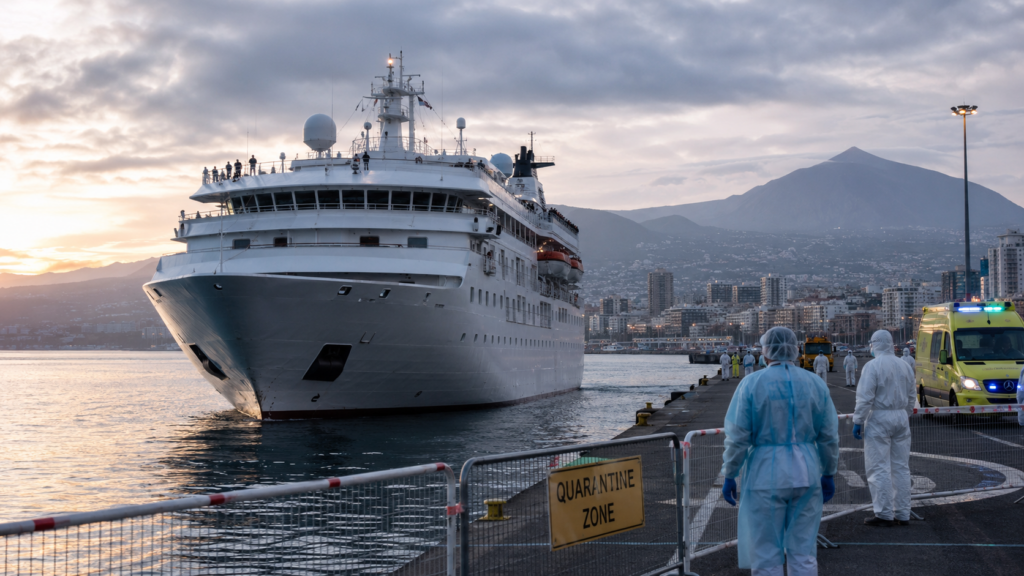
Spanish authorities have designed an isolation-led disembarkation operation at the port of Granadilla on Tenerife. Virginia Barcones, head of Spain’s emergency services, stated that passengers would be moved to a completely isolated, cordoned-off area upon disembarkation. The vessel will remain anchored offshore, with passengers transferred by small boats to designated buses. Repatriation flights are being readied in advance, and passengers will be taken from the disembarkation point directly to the airport runway with no contact with island residents.
Repatriation arrangements have been organised by Germany, France, Belgium, Ireland and the Netherlands, according to Spain’s Interior Minister Fernando Grande-Marlaska. The European Union is dispatching two additional aircraft for remaining European citizens. The United States Centers for Disease Control and Prevention is sending a government-provided aircraft to evacuate the seventeen United States citizens on board, who will be transferred to the National Quarantine Center at the University of Nebraska in Omaha. The United Kingdom Foreign, Commonwealth and Development Office is chartering a dedicated repatriation flight for British passengers and crew at no cost to those evacuated, supported by a Rapid Deployment Team from the United Kingdom Health Security Agency. The Irish government is finalising a separate evacuation plan for two Irish citizens aboard. Dutch passengers will be repatriated by the Dutch government in coordination with Spanish authorities and Oceanwide Expeditions, the Dutch tour operator that owns the vessel, with asymptomatic individuals required to enter home quarantine for six weeks under monitoring by local health services.
What is the role of WHO Director-General Tedros Adhanom Ghebreyesus in coordinating the Tenerife operation?
Tedros Adhanom Ghebreyesus, Director-General of the World Health Organization, arrived in Spain on 9 May 2026 to oversee the disembarkation. According to the office of Spanish Prime Minister Pedro Sánchez, Tedros Adhanom Ghebreyesus was scheduled to meet the Prime Minister before travelling to Tenerife alongside Spanish Health Minister Mónica García and Interior Minister Fernando Grande-Marlaska. The trio will operate from a command post on the island to ensure coordination between administrations, oversee health control measures, and apply the planned surveillance and response protocols.
In a public letter addressed to the people of Tenerife, Tedros Adhanom Ghebreyesus directly acknowledged the COVID-era anxieties of Canary Islanders and stated that the hantavirus situation was not comparable to the coronavirus pandemic. The World Health Organization Director-General reiterated that the public health risk from hantavirus remained low and that none of the 147 individuals currently aboard the vessel, including 60 crew members, were displaying symptoms at the time of the statement. Mónica García confirmed at a Madrid press briefing that all non-Spanish citizens disembarking healthy in Tenerife would be repatriated to their countries of origin.
How does the Tristan da Cunha geography complicate the public health response and contact tracing operation?
Tristan da Cunha, a British overseas territory of approximately 200 residents administered as part of Saint Helena, Ascension and Tristan da Cunha, sits roughly midway between South Africa and South America. Tristan da Cunha is recognised as the world’s most remote inhabited island, lying more than 1,500 miles from Saint Helena, its nearest inhabited neighbour, and accessible only by a six-day boat journey. The territory has no intensive care unit and no ventilator capacity, a constraint flagged repeatedly by local administrators during the COVID-19 period. The island successfully avoided any recorded coronavirus infection during the pandemic by requiring approaching vessels to turn back if anyone aboard was suspected of being infected.
The geographic isolation of Tristan da Cunha imposes severe logistical constraints on any potential medical evacuation. Any patient requiring escalation beyond the small medical centre on the island would need transfer by a passing fishing or research vessel to Cape Town in South Africa. The United Kingdom Health Security Agency has not disclosed whether the suspected British case on the island is symptomatic or how clinical management is being arranged. Health authorities across four continents are tracking and monitoring more than two dozen passengers who left the MV Hondius before the outbreak was first detected on 2 May 2026, and they are simultaneously seeking to trace secondary contacts. The geographically scattered pattern of suspected and confirmed cases across South Africa, Switzerland, the Netherlands, the United Kingdom, Spain and Tristan da Cunha reflects the global mobility of the original passenger cohort and the contact-tracing complexity arising from a multi-stop expedition itinerary.
What are the key takeaways from the Spain and Tristan da Cunha hantavirus suspected cases linked to MV Hondius?
- A 32-year-old woman in Alicante province in Spain has been recorded as a suspected hantavirus case after sitting two rows behind a Dutch MV Hondius passenger who later died in Johannesburg, with test results expected within twenty-four to forty-eight hours.
- The United Kingdom Health Security Agency is assessing a suspected hantavirus infection in a British national on Tristan da Cunha, where the MV Hondius called between 13 and 15 April 2026.
- The MV Hondius outbreak has been confirmed as the Andes hantavirus strain, the only hantavirus species recognised by the World Health Organization as capable of limited human-to-human transmission, and has so far been linked to three deaths and multiple confirmed infections.
- Spain’s central government has approved the docking of the MV Hondius at the port of Granadilla in Tenerife despite opposition from Canary Islands President Fernando Clavijo, with disembarkation scheduled in the early hours of 10 May 2026 under a fully isolated protocol.
- World Health Organization Director-General Tedros Adhanom Ghebreyesus has travelled to Spain to oversee the operation alongside Spanish Health Minister Mónica García and Interior Minister Fernando Grande-Marlaska, with repatriation flights organised by the United States, the United Kingdom, Germany, France, Belgium, Ireland, the Netherlands and the European Union.
Discover more from Business-News-Today.com
Subscribe to get the latest posts sent to your email.