Gallantt Ispat Limited (NSE: GALLANTT, BSE: 532726) has reported a 20.8 percent rise in FY26 profit after tax to ₹484.3 crore, even as softer steel realisations limited revenue growth to 2.9 percent for the year. The Uttar Pradesh and Gujarat focused integrated steelmaker delivered FY26 revenue from operations of ₹4,418.9 crore, EBITDA of ₹776.0 crore, and an EBITDA margin of 17.6 percent, positioning its cost structure as the real story behind the numbers. The company is also pushing ahead with a ₹3,000 crore capital expenditure programme covering finished steel capacity expansion, mine development, and renewable energy, while remaining a net cash, zero term-debt business. For investors, the sharper question is whether Gallantt Ispat Limited can convert this margin resilience into a larger, more defensible steel platform after a strong share-price rally.
The stock context matters because Gallantt Ispat Limited has already attracted significant market attention. Recent market data showed the stock trading around ₹843.50 to ₹877.15 in early May 2026, with a 52-week range of ₹400 to ₹948, indicating that investors have already priced in a fair amount of optimism around the company’s integrated steel model, capex visibility, and earnings momentum. NSE data placed the 52-week high at ₹948 and the 52-week low at ₹400, while third-party market platforms showed market capitalisation around ₹20,000 crore.
Why did Gallantt Ispat Limited’s FY26 results stand out despite weaker steel realisations?
Gallantt Ispat Limited’s FY26 results stood out because the company expanded profitability faster than revenue, which is usually the detail investors care about most in a cyclical steel business. Revenue from operations increased only 2.9 percent year-on-year to ₹4,418.9 crore, but profit after tax rose 20.8 percent to ₹484.3 crore. That gap signals that the earnings improvement was not merely a function of stronger selling prices or a broad commodity upswing. It was driven by cost absorption, higher operating leverage, and the benefits of backward integration.
The company’s EBITDA per tonne rose to ₹8,784.7 in FY26 from ₹8,308.2 in FY25, despite the company itself noting that steel realisations remained soft through the year. That is the cleanest indicator in the release because it separates operational performance from market price noise. In plain English, Gallantt Ispat Limited made more operating profit per tonne even though the steel pricing environment was not particularly friendly. That is not a small detail for a company operating in a sector where input volatility can quickly punish loosely integrated players.
Quarterly numbers reinforced the same pattern. In Q4 FY26, revenue from operations rose 12.4 percent year-on-year to ₹1,204.8 crore, while EBITDA increased 7.3 percent to ₹208.9 crore and profit after tax rose 5.6 percent to ₹122.8 crore. The Q4 EBITDA margin of 17.3 percent was lower than the 18.2 percent recorded in Q4 FY25, but it improved from 15.7 percent in Q3 FY26. That sequential recovery matters because it suggests the company entered the new financial year with stronger operating momentum than the full-year revenue growth rate alone would imply.
How is Gallantt Ispat Limited using backward integration to defend steel margins?
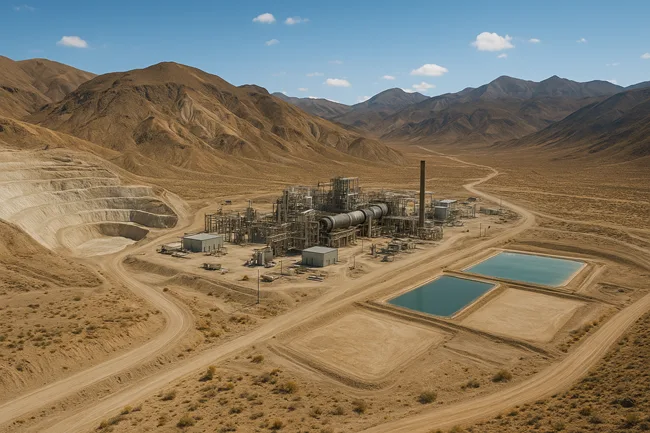
The core of Gallantt Ispat Limited’s investment case is not just steel demand in Uttar Pradesh or Gujarat. It is the extent to which the company can control more of its production chain. The company operates integrated manufacturing units at Gorakhpur in Uttar Pradesh and Kutch in Gujarat, with 1.0 million tonnes per annum of finished steel capacity, 129 megawatts of captive power, pellet manufacturing capacity, and secured iron ore mine blocks in Uttar Pradesh and Rajasthan.
This matters because regional steel producers often live or die by raw material access, power costs, freight economics, and working capital discipline. Gallantt Ispat Limited’s strategy is designed to reduce exposure to external input shocks by internalising more of the value chain. Pellet production rose 37 percent in FY26 to 819 kilotonnes, while sponge iron production increased 21 percent to 915 kilotonnes. At the same time, pellet sales fell 42 percent and sponge iron sales rose sharply from a low base, showing a shifting internal mix as the company channels more upstream output into finished steel production.
That shift is strategically important because selling semi-finished material can support near-term revenue, but consuming it internally can strengthen margin capture across the chain. Gallantt Ispat Limited is effectively trying to turn upstream capacity into a structural cost advantage rather than a standalone sales line. If the company executes this correctly, it can create a more resilient earnings base than a rolling mill dependent on external supplies. If execution slips, however, the same integration model can become capital intensive, operationally complex, and harder to flex during downturns. Steel never gives free lunches, only invoices with better formatting.
Can the ₹3,000 crore capex programme change Gallantt Ispat Limited’s growth profile?
Gallantt Ispat Limited’s ₹3,000 crore capex programme is the biggest forward-looking element in the FY26 update because it moves the company from margin defence to capacity-led growth. The company said the programme spans capacity expansion, mine development, and renewable energy, and is being funded through strong internal cash generation, with flexibility to use external capital if required. That funding structure is central to the story because the company remains net cash and zero term-debt at a time when many industrial expansion stories become less attractive once leverage enters the room.
The company plans to expand finished steel capacity from 1.00 million tonnes per annum to 1.29 million tonnes per annum, with commissioning expected in the second half of FY2027. Management also indicated that the expansion of finished steel capacity by roughly 29 percent to 30 percent would be commissioned progressively through the first half of FY2027, with volume impact expected in the second half of FY2027. This creates a clear earnings bridge, but not an automatic one. The next two years will test whether demand in its addressable markets can absorb higher output without pressuring pricing or working capital.
The iron ore mine development adds another layer. Management indicated that captive iron ore blocks in Rajasthan and Uttar Pradesh, once operational, are expected to improve raw material security and potentially deliver an EBITDA improvement of about ₹2,000 per tonne. That is a powerful claim in economic terms, but investors should treat it as an execution milestone rather than a guaranteed valuation input. Mine operationalisation, regulatory approvals, logistics readiness, grade consistency, and ramp-up timing will all decide whether the theoretical margin uplift converts into reported EBITDA.
What does Gallantt Ispat Limited’s FY26 performance signal about regional steel demand in India?
Gallantt Ispat Limited’s operating performance points to continued demand support from infrastructure and housing, especially in Uttar Pradesh and Gujarat. TMT bar production rose 3 percent in FY26 to 788 kilotonnes, while TMT bar sales increased 2 percent to 766 kilotonnes. These are not explosive numbers, but they show stability in the company’s core finished steel category. For a rebar-heavy business, stability in TMT volumes during a softer realisation environment is more useful than a flashy sales jump followed by margin erosion.
The company’s regional positioning is also important. Gallantt Ispat Limited describes itself as the largest rebar producer in Uttar Pradesh, with a 25 percent market share in its addressable geographies. That gives the company a demand base linked to construction, real estate, public infrastructure, and regional industrial activity. It also means future growth will partly depend on how effectively the company can deepen distribution, maintain brand pull in commodity-adjacent steel products, and prevent capacity additions from turning into price competition.
The risk is that steel markets rarely reward capacity expansion alone. If broader steel prices remain weak, or if regional competitors expand aggressively, Gallantt Ispat Limited will need to rely even more heavily on cost leadership. That makes the integration strategy sensible, but it also raises the bar for operational discipline. The company is not merely expanding output. It is betting that its cost curve will stay attractive enough to protect returns through the cycle.
Is Gallantt Ispat Limited stock sentiment running ahead of fundamentals after the rally?
Gallantt Ispat Limited’s share-price performance suggests the market has already discovered the story. The stock’s 52-week move from ₹400 to as high as ₹948 shows a major re-rating, while recent prices around the mid-₹800 range still place the stock much closer to its high than its low. Market platforms showed a one-month rise of nearly 50 percent in early May data, and media coverage in April noted a sharp rally after the stock hit fresh highs.
That does not automatically mean the stock is overvalued, but it does change the burden of proof. When a stock has already rallied hard, investors usually stop rewarding promises and start demanding delivery. Gallantt Ispat Limited now has to show that FY26 margin resilience was not a one-year sweet spot, that the ₹3,000 crore capex remains disciplined, and that the capacity expansion does not dilute returns. The company’s zero term-debt position gives it room to manoeuvre, but valuation comfort will depend on how much of the future EBITDA uplift is already embedded in the share price.
Sentiment therefore looks constructive but increasingly execution-sensitive. The bull case rests on three pillars: higher finished steel capacity, stronger captive raw material security, and continued regional demand from infrastructure and housing. The bear case is just as simple: steel pricing remains weak, capex timelines stretch, and the market decides the stock ran too far before the earnings catch-up. In that sense, Gallantt Ispat Limited has moved from being a turnaround or margin-resilience story to a delivery story.
What should investors watch next as Gallantt Ispat Limited moves from FY26 resilience to FY27 execution?
The next phase for Gallantt Ispat Limited will be judged less by headline revenue and more by quality of growth. Investors should track whether EBITDA per tonne remains firm as volumes rise, whether captive raw material projects stay on schedule, and whether the company can maintain its net cash positioning while funding a large expansion. A company can look conservative before capex peaks and still become stretched if commissioning, working capital, or demand timing moves against it.
FY27 will also reveal whether Gallantt Ispat Limited’s integrated model can scale without losing efficiency. Higher capacity should improve operating leverage, but only if utilisation follows. Management said utilisation improved to 82.9 percent in FY2025-26 from 80.5 percent in FY2024-25, which provides a reasonable base for expansion. The real signal will come when new finished steel capacity begins contributing in the second half of FY2027.
The broader steel cycle remains the external swing factor. Gallantt Ispat Limited has shown that integration can soften the blow from weaker realisations, but no steel company is immune to price cycles. The company’s advantage is that its balance sheet gives it patience, and its regional franchise gives it demand visibility. The challenge is that the market has now placed a brighter spotlight on execution. For investors, that means the story is attractive, but no longer undiscovered.
Key takeaways on what Gallantt Ispat Limited’s FY26 results mean for investors and India’s steel sector
- Gallantt Ispat Limited’s FY26 results show that margin resilience, rather than revenue acceleration, is the central investment story behind the company.
- The 20.8 percent rise in profit after tax outpaced the 2.9 percent revenue growth, indicating that cost structure and integration benefits did more heavy lifting than steel price momentum.
- The company’s EBITDA per tonne improvement is important because it suggests operational gains were achieved despite softer steel realisations.
- The ₹3,000 crore capex programme could materially expand Gallantt Ispat Limited’s growth runway, but it also shifts the market focus toward execution risk.
- The planned expansion from 1.00 million tonnes per annum to 1.29 million tonnes per annum gives the company a visible volume-growth trigger for FY2027.
- Captive iron ore blocks in Uttar Pradesh and Rajasthan could strengthen raw material security, but investors should wait for operational milestones before fully pricing in the expected EBITDA uplift.
- The zero term-debt and net cash position are major positives because they reduce balance-sheet stress during an expansion-heavy phase.
- The stock’s sharp rally means sentiment is already optimistic, making future returns more dependent on delivery than discovery.
- Regional demand from infrastructure and housing in Uttar Pradesh and Gujarat remains supportive, but steel pricing and competitor behaviour remain key risks.
- Gallantt Ispat Limited’s next valuation test will be whether higher capacity, better integration, and stronger raw material control can translate into durable free cash flow.
Discover more from Business-News-Today.com
Subscribe to get the latest posts sent to your email.