




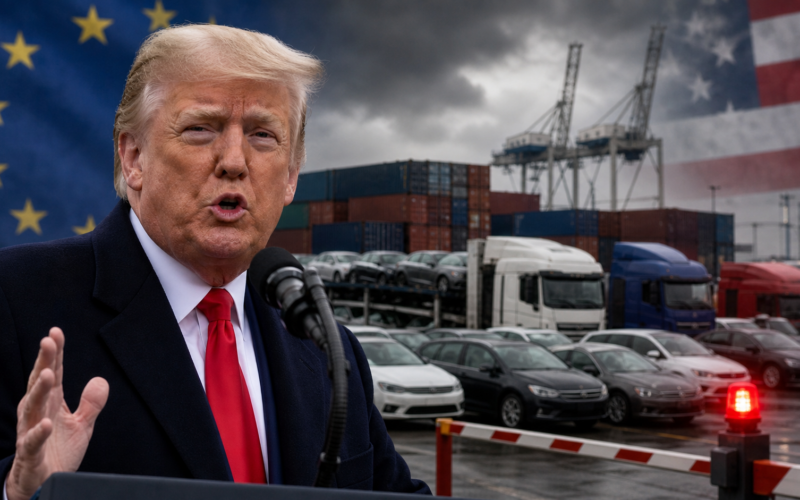
The Turnberry Agreement matters this week because Donald Trump has just announced a 25 per cent tariff on European Union cars and trucks from May 2026, accusing Brussels of failing to comply with the framework signed less than ten months ago. For exporters, automakers, energy traders, and corporate strategists with transatlantic exposure, the question is no longer whether the agreement will deliver the predictability it promised. The question is whether the deal survives at all, and what replaces it if the 15 per cent tariff ceiling that anchors the entire framework collapses. The Turnberry Agreement is the single most important trade instrument shaping European Union exports to the United States in 2026, and its operational status now changes the cost base for hundreds of billions of euros of commerce.
What is the Turnberry Agreement and where was it signed between the United States and European Union?
The Turnberry Agreement is a bilateral political framework on tariffs, market access, energy purchases, investment, and regulatory coordination, agreed between the United States and the European Union on July 27, 2025 at Trump Turnberry, Donald Trump’s golf resort on the west coast of Scotland. The deal was formalised on August 21, 2025 through a Joint Statement on a Framework for an Agreement between the European Union and the United States of America on Reciprocal, Fair and Balanced Trade. Its formal title is the Agreement on Reciprocal, Fair, and Balanced Trade, but the colloquial name Turnberry Agreement, drawn from the venue, has stuck across European and American policy circles, regulatory filings, and trade publications.
The agreement is legally non-binding in its current form. It has not been concluded under Article 218 of the Treaty on the Functioning of the European Union, which is the procedure required for binding international trade agreements involving the Council of the European Union and the European Parliament. The Joint Statement format places it in the category of political commitments that depend on subsequent legislative implementation on the European Union side and on executive orders on the United States side. As of May 2026, the European Parliament has approved its negotiating position with safeguards attached, but final adoption between the European Parliament and the Council of the European Union remains pending.
Who negotiated and now governs the implementation of the Turnberry Agreement on both sides?
The Turnberry Agreement was negotiated and announced jointly by Donald Trump, President of the United States, and Ursula von der Leyen, President of the European Commission. The political authority on the European side rests with the European Commission, with operational lead from European Commissioner for Trade and Economic Security Maroš Šefčovič. The legislative leg of implementation moves through the European Parliament’s Committee on International Trade, chaired by German Member of the European Parliament Bernd Lange, and through the Council of the European Union representing the twenty-seven member state governments.
On the United States side, implementation has been led by the Office of the United States Trade Representative under Jamieson Greer, with executive orders from Donald Trump providing the operational tariff adjustments. The United States Ambassador to the European Union, Andrew Puzder, has been the principal interlocutor with Brussels on day-to-day implementation issues, particularly around energy commitments. Authority shifts since 2022 are material here: the agreement was negotiated under Donald Trump’s second term, replacing the prior Transatlantic Trade and Investment Partnership effort, which had effectively been dormant since 2016, and reflecting a fundamental shift in United States trade policy posture from multilateralism to bilateral framework deals.
What does the Turnberry Agreement actually deliver in terms of tariffs, energy purchases, and investment commitments?
The core of the Turnberry Agreement is a 15 per cent tariff ceiling on most European Union exports to the United States. Under the deal, the United States committed to apply the higher of either its Most Favoured Nation tariff rate or a tariff rate of 15 per cent on most goods from the European Union, which represents a reduction from the 30 per cent rate Donald Trump had initially threatened in the spring of 2025. The 15 per cent ceiling applies to cars and car parts, and is intended to apply to any potential future tariffs on pharmaceuticals, semiconductors, and lumber, including duties imposed under Section 232 of the United States Trade Expansion Act of 1962. Specific carveouts retain pre-April 2025 Most Favoured Nation rates for unavailable natural resources including cork, all aircraft and aircraft parts, generic pharmaceuticals, and certain chemical precursors.
In exchange, the European Union agreed to eliminate tariffs on all United States industrial goods and provide preferential market access for a range of United States agricultural and fishery products, including dairy, meat, vegetables, fruit, soya oil, plant seeds, cereals, nuts, processed foods, and lobster. The asymmetry between the 15 per cent United States rate and the zero per cent European Union rate is the most contested element of the deal, and was openly criticised by then French Prime Minister François Bayrou, who described it as an act of submission, and by German Chancellor Friedrich Merz, who said it would significantly damage Germany’s finances.
Beyond tariffs, the Turnberry Agreement contains substantial European Union procurement and investment commitments. The European Union committed to purchase 750 billion United States dollars of United States energy products, primarily liquefied natural gas, oil, and civilian nuclear technology, through the end of 2028, structured as approximately 250 billion United States dollars in annual installments. The European Union also committed to 600 billion United States dollars in additional investment in the United States by 2028 or 2029, drawn from the aggregated investment intentions of European companies rather than from binding member state allocations. A further 40 billion United States dollars commitment covers purchases of United States artificial intelligence chips for European computing centres, and the deal includes a non-quantified commitment to increased European Union procurement of United States military equipment. The European Commission has confirmed only the energy purchase figure; the other numbers remain disputed between the two sides.
How does the Turnberry Agreement compare to the Transatlantic Trade and Investment Partnership and other major trade frameworks?
The Turnberry Agreement is structurally different from the Transatlantic Trade and Investment Partnership, the proposed European Union and United States free trade agreement that was abandoned in 2016. The Transatlantic Trade and Investment Partnership aimed at deep regulatory harmonisation and a comprehensive elimination of tariffs and non-tariff barriers under a treaty-grade architecture, governed by World Trade Organisation principles. The Turnberry Agreement, by contrast, is asymmetric, non-binding, narrowly tariff-focused at its core, and explicitly bilateral rather than multilateral. United States Trade Representative Jamieson Greer has publicly described the deal as the beginning of a Turnberry System designed to replace the post-Second World War Bretton Woods order, with bilateral arrangements and strong rules of origin substituting for World Trade Organisation commitments.
The 15 per cent ceiling Brussels accepted under the Turnberry Agreement is broadly aligned with the rates the United States has imposed on Japan and South Korea under similar bilateral frameworks. It is notably less favourable than the pre-2025 World Trade Organisation Most Favoured Nation regime, under which both sides enjoyed low or zero tariffs on most goods, and the European Union has lost tariff symmetry it previously held with Canada under the Comprehensive Economic and Trade Agreement and with the United Kingdom under the European Union and United Kingdom Trade and Cooperation Agreement. The market dynamics have been clear: the 15 per cent United States rate is now a baseline for European exporters to one of their two largest markets, and European Union companies have been adjusting pricing, supply chains, and investment plans accordingly.
What is the history and legacy arc that produced the Turnberry Agreement at Donald Trump’s Scottish golf resort?
The Turnberry Agreement emerged from an escalating tariff dispute that began in spring 2025 after Donald Trump returned to office in January 2025 and began using tariff threats to address what his administration described as a structural trade deficit with the European Union. The United States moved to impose 25 per cent Section 232 tariffs on foreign autos in March 2025, a 10 per cent global reciprocal tariff in April 2025, and threatened tariffs of up to 30 per cent on most European Union goods through the summer. The European Union prepared a counter-tariff package and considered deployment of its anti-coercion instrument, but Ursula von der Leyen postponed countermeasures until August 1, 2025 to allow negotiations to continue. The July 14, 2025 meeting of European Union trade ministers set the stage for the final negotiation, and Ursula von der Leyen flew to Scotland on July 27, 2025 to conclude the framework directly with Donald Trump after approximately three hours of talks at Trump Turnberry. The choice of Trump Turnberry as the venue, a Trump-owned property, was itself politically charged in European capitals and has shaped how the agreement is remembered.
What practical exposure do exporters, energy traders, and investors have under the Turnberry Agreement framework?
For European exporters, the practical reality of the Turnberry Agreement is a 15 per cent United States entry tariff on cars, machinery, chemicals, electronics, consumer goods, and most industrial categories, with an effective floor that as of May 2026 is being challenged by the new 25 per cent auto threat. Volkswagen Group, BMW Group, Mercedes-Benz Group, Stellantis, Airbus, ASML, LVMH and other major European exporters have all adjusted pricing, margin guidance, and capital allocation to reflect the 15 per cent baseline. Specific practical effects already reported include Mercedes-Benz revising its 2026 margin targets downward by 150 to 200 basis points, Volkswagen reporting a 1.1 billion euro loss attributed in part to tariff headwinds, and LVMH reporting a 25 per cent profit decline in its wines and spirits division as duties on Cognac and Champagne hit United States consumer prices.
For energy traders and utilities, the 750 billion United States dollar commitment translates into a roughly tripling of European Union energy imports from the United States compared to the 2024 baseline of approximately 80 billion United States dollars in oil, liquefied natural gas, liquefied petroleum gas, and coal purchases. Industry analysts have flagged the headline figure as unlikely to be fully met given United States production capacity, terminal throughput, and European Union refining capacity, although the directional shift toward United States supply is consistent with the European Union’s plan to phase out remaining Russian liquefied natural gas and pipeline gas imports by 2028. The Iran war, ongoing since the United States and Israel strikes at the end of February 2026, has tightened the global liquefied natural gas market and increased Europe’s exposure to United States supply, which Ambassador Andrew Puzder has explicitly cited in pressing Brussels to ratify the deal without weakening amendments.
For investors and corporate strategists, the safeguard mechanism added by the European Parliament is now the most consequential implementation detail. The Parliament’s position adopted on March 26, 2026 with 417 votes in favour, 154 against, and 71 abstentions, includes a sunset clause under which the deal expires in March 2028 unless both sides agree to extend, a sunrise clause making European Union tariff preferences conditional on United States compliance, and an explicit suspension trigger if the United States exceeds the 15 per cent ceiling, discriminates against European Union member states, threatens territorial integrity, or engages in economic coercion. These conditions were partly driven by the Greenland crisis and by Donald Trump’s threats against several European Union and North Atlantic Treaty Organization members in retaliation for participation in Operation Arctic Endurance.
What latest developments have occurred in 2025 and 2026 that have changed the operating environment of the Turnberry Agreement?
The most consequential development since signing has been the United States Supreme Court ruling in February 2026, which struck down the legal authority Donald Trump had used under the International Emergency Economic Powers Act to declare an economic emergency and impose tariffs on European Union goods. The ruling forced the Trump administration to identify alternative legal authorities, leading to a 10 per cent blanket global tariff under Section 122 of the Trade Act of 1974 and an expanded reliance on Section 232 of the Trade Expansion Act of 1962 for sector-specific duties. The European Parliament temporarily froze legislative work on the Turnberry implementing legislation in February 2026 in response to the legal uncertainty, before resuming work and adopting its position on March 26, 2026.
A second major development was the announcement in late February 2026 of the withdrawal of 5,000 United States troops from Germany and Donald Trump’s renewed criticism of German Chancellor Friedrich Merz on April 30, 2026 over Iran policy, both of which raised the political temperature ahead of the May 1, 2026 announcement of a 25 per cent tariff on European Union cars and trucks. Bernd Lange, chairing the European Parliament’s trade committee, characterised the auto tariff escalation as showing clear unreliability on the United States side. A third development is the parallel United States investigation under Section 301 into European Union digital trade and high-technology goods, which sits outside the Turnberry framework but creates pressure on European semiconductor equipment manufacturers including ASML.
What is the outlook for the Turnberry Agreement over the next two to three years and what would replace it if it fails?
The Turnberry Agreement enters May 2026 in a fragile state. The European Parliament has approved its position but trilogue negotiations between the European Parliament, the Council of the European Union, and the European Commission have not concluded. The new 25 per cent auto tariff announcement, if implemented under Section 232, would breach the 15 per cent ceiling at the heart of the framework and would likely trigger the suspension clause built into the European Union implementing legislation. Most observers in trade policy circles expect that even if the framework formally survives, its credibility as a stable tariff ceiling has already been undermined by repeated United States adjustments under different legal authorities.
The one-year health check scheduled for July 2026 will be the critical inflection point. If the Trump administration does not provide a legal carve-out for European Union goods from the 10 per cent universal tariff and from new Section 232 escalations, the European Parliament is unlikely to complete final ratification, and the framework would lapse into a contested political agreement rather than a functioning trade rule. The most realistic alternative if Turnberry fails is a return to the pre-Turnberry tariff posture, with sector-specific Section 232 tariffs of 25 per cent or higher on autos, steel, and aluminium, European Union retaliatory duties under the anti-coercion instrument, and a long period of trade uncertainty. The 750 billion United States dollar energy commitment is unlikely to be formally enforced if the trade framework collapses, although the underlying commercial logic of European Union liquefied natural gas purchases from United States suppliers, driven by the Russian gas phase-out and the Strait of Hormuz disruption, will continue to operate independently. Over a two to three year horizon, the Turnberry Agreement’s most enduring legacy may be the precedent it sets: that the United States is willing to use bilateral asymmetric frameworks rather than World Trade Organisation rules as the primary instrument of trade governance, regardless of whether this particular agreement survives.
Discover more from Business-News-Today.com
Subscribe to get the latest posts sent to your email.