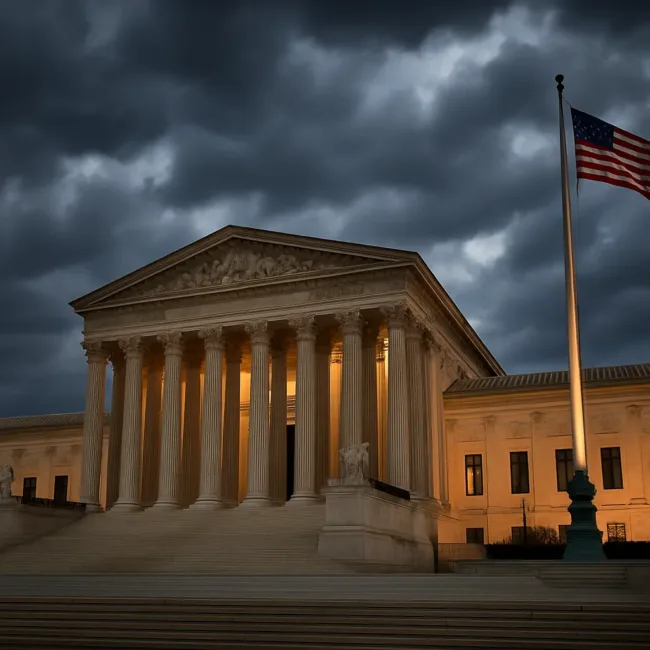


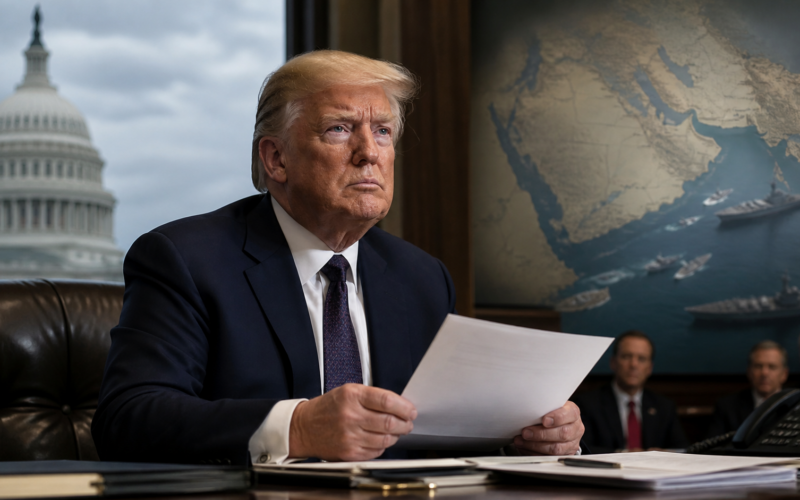
United States President Donald Trump informed Congressional leaders on Friday that hostilities with Iran have formally terminated, an assertion he used to argue that he is no longer required to seek lawmaker authorisation for the ongoing American military campaign in the Persian Gulf. The declaration, delivered in nearly identical letters to House Speaker Mike Johnson and Senate President pro tempore Senator Chuck Grassley, was timed to coincide with the sixty-day deadline established under the War Powers Resolution of 1973. That deadline had already become the most contentious legal flashpoint of Operation Epic Fury, the Pentagon designation for the United States and Israeli military campaign that began on February 28, 2026.
In the letters, Donald Trump wrote that there has been no exchange of fire between United States Forces and Iran since April 7, 2026, when a two-week ceasefire took effect and was subsequently extended. The hostilities that began on February 28, 2026, have terminated, the President wrote. He added that despite the success of United States operations against the Iranian regime and continued efforts to secure a lasting peace, the threat posed by Iran to the United States and its Armed Forces remains significant. The President pledged to keep Congressional leaders updated on further developments. Speaking to reporters at the White House before departing for Florida, Donald Trump described the War Powers Resolution as something every other president considered totally unconstitutional, and said his administration agrees with that view. He claimed that no previous president had sought Congressional authorisation under the statute, a claim that does not align with the historical record on the 1991 Gulf War or the 2002 Iraq authorisation.
How does the Trump administration justify ignoring the War Powers Resolution sixty-day deadline on the Iran war?
The legal architecture being deployed by the White House rests on a single contested premise: that a ceasefire halts the statutory clock established under the 1973 War Powers Resolution. United States Defense Secretary Pete Hegseth advanced this interpretation during testimony before the Senate Armed Services Committee on Thursday, telling lawmakers that the administration’s understanding is that the sixty-day clock pauses or stops in a ceasefire. Pete Hegseth said he would defer to the White House and White House counsel on the final legal determination, but his testimony established the administration’s working position less than twenty-four hours before the deadline expired.
The War Powers Resolution requires the President to notify Congress within forty-eight hours of introducing United States Armed Forces into hostilities and to terminate the use of force within sixty days unless Congress declares war or passes a specific authorisation for the use of military force. A single thirty-day extension is permitted, but only to facilitate the safe withdrawal of forces, not to continue combat. Donald Trump notified Congress of Operation Epic Fury on March 2, 2026, which set the sixty-day deadline at May 1. Senator Tim Kaine of Virginia, who has led the Democratic effort to force votes on war powers resolutions, rejected the ceasefire-pause interpretation outright during the same Senate hearing, telling Pete Hegseth that he did not believe the statute would support that reading. Senator Tim Kaine said the deadline would arrive on Friday and would pose a serious legal question for the administration. Constitutional scholars have echoed his concern. Michael Glennon, a professor of constitutional and international law at the Fletcher School at Tufts University and a former legal counsel to the State Department, told NBC News that the administration’s argument is a stretch and that the hostilities are continuing as a consequence of the administration’s enforcement of the blockade.
Why are Senate Democrats and a small group of Republicans rejecting the White House interpretation of the Iran ceasefire?
The Senate vote on the night of April 30 produced the most significant Republican defection on the war to date. Senator Susan Collins of Maine voted in favour of the Democratic war powers resolution for the first time, joining Senator Rand Paul of Kentucky as the only two Republicans to support the measure, which still failed by a margin of fifty to forty-seven. Senator John Fetterman of Pennsylvania remained the lone Democrat to vote against it. Senator Susan Collins issued a written statement saying that the Constitution gives Congress an essential role in decisions of war and peace, and that the War Powers Act establishes a clear sixty-day deadline for Congress to either authorise or end United States involvement in foreign hostilities. Senator Susan Collins said the deadline is not a suggestion, but a requirement, and that any further military action against Iran must have a clear mission, achievable goals, and a defined strategy for ending the conflict.
Senate Minority Leader Chuck Schumer rejected the President’s claim outright in a post on X, calling the war illegal and accusing Republicans of complicity in allowing it to continue. Senator Richard Blumenthal of Connecticut wrote on social media that there is no pause button in the Constitution or the War Powers Act. Within the Republican conference, Senator Lisa Murkowski of Alaska is preparing to introduce a formal Authorisation for the Use of Military Force, or AUMF, when the Senate returns from recess the week of May 11 if the administration has not presented a wind-down plan. Senator Lisa Murkowski has said she stands firmly behind the troops but believes Congress must fulfil its constitutional role of declaring war and providing oversight. Senator Josh Hawley of Missouri described the moment as an inflection point, noting that the administration could request the statutory thirty-day extension if it certifies a draw-down. Senator Kevin Cramer of North Dakota said he would vote for an authorisation if Donald Trump requested one, but questioned whether the Vietnam-era resolution itself is constitutional. Senator Todd Young of Indiana said in a statement that lawmakers must ensure the people, through their elected representatives, weigh in on whether to send the United States military into combat.
What does the United States naval blockade of Iranian ports mean for the claim that hostilities have ended?
The most concrete contradiction to the administration’s position is unfolding in the Persian Gulf and the Strait of Hormuz. The United States imposed a naval blockade on Iran on April 13, 2026, after the Islamabad Talks between Iranian and American negotiators on April 11 and 12 collapsed without an agreement. United States Central Command, or CENTCOM, has reported that the blockade is being enforced by more than ten thousand United States personnel, two carrier strike groups, more than one hundred fighter and surveillance aircraft, and over a dozen warships. CENTCOM has stated that the blockade applies impartially to vessels of all nations entering or departing Iranian ports and coastal areas, including all Iranian ports on the Arabian Gulf and Gulf of Oman.
By April 18, CENTCOM had reported that twenty-three vessels had been intercepted under the blockade, although Lloyd’s List reported that at least twenty-six ships had bypassed the blockade line in either direction by April 20. A United States Navy destroyer fired on and seized the Iranian-flagged container ship Touska on April 20, and Iranian forces subsequently seized two foreign commercial vessels in the days that followed. Under customary international law, a naval blockade is generally classified as an act of war, a designation that legal experts have used to argue that hostilities have not in fact ceased. Senator Adam Schiff of California has argued that ceasing to use some forces while continuing to use others does not stop the clock under the War Powers Resolution. Katherine Yon Ebright, an attorney at the Brennan Center for Justice’s Liberty and National Security Program, told CBS News that the War Powers Resolution does not by its text or design accommodate the interpretation that a ceasefire stops the sixty-day clock and that a resumption of hostilities resets it. Pete Hegseth, in a separate Pentagon briefing, said the United States military is locked and loaded on Iran’s critical dual-use infrastructure, remaining power generation, and energy industry, and that strikes could resume at the push of a button.
How has Iran responded to the United States ceasefire claim and the continuing naval blockade of the Strait of Hormuz?
Iranian President Masoud Pezeshkian condemned the United States naval blockade in a statement marking Persian Gulf National Day on April 30. Masoud Pezeshkian described the blockade as illegal, intolerable, and doomed to fail, and said the responsibility for any insecurity in the waterway lies with the United States and Israel. Masoud Pezeshkian argued that Gulf security depends on collective cooperation and respect for the sovereignty of coastal countries, not unilateral foreign intervention. Iran’s Foreign Minister Abbas Araghchi has previously stated that the Strait of Hormuz is open to all shipping except vessels associated with the United States, Israel, and their allies. Iran briefly announced on April 17 that the strait was open to all commercial traffic, prompting an eleven percent drop in oil prices, before reclosing it on April 18 in response to the United States refusal to lift the naval blockade. The Iranian Revolutionary Guard Corps has issued statements warning that the strait will not be opened to enemies of Iran through what it called the ridiculous spectacle of the United States President.
The diplomatic deadlock has hardened around two unresolved questions: the future of Iran’s nuclear enrichment programme and the terms under which the Strait of Hormuz will be reopened. Iran has offered to reopen the strait in exchange for the lifting of the United States blockade, but has sought to defer nuclear talks to a later stage. The White House has rejected that sequencing. Donald Trump told reporters on Friday that he was not satisfied with Iran’s latest offer to end the war. The conflict, which began on February 28 with joint United States and Israeli strikes that killed Iran’s then-Supreme Leader Ali Khamenei and senior commanders, has produced cascading economic and diplomatic effects. German Chancellor Friedrich Merz publicly criticised the United States administration this week for lacking a convincing strategy, telling a student forum that Iran has proven stronger than expected. The United Arab Emirates announced its withdrawal from the Organization of the Petroleum Exporting Countries amid the Gulf turmoil, and Bahrain has convened a high-level meeting at the United Nations demanding that Iran reopen the strait, although the Bahraini-sponsored statement notably did not mention the United States blockade.
What legal and political precedents will shape the next phase of the War Powers Resolution standoff over Iran?
The administration’s position draws on a thirty-year history of executive branch lawyers reinterpreting the War Powers Resolution to extend operations beyond sixty days. In 2011, the Barack Obama administration argued that air strikes on Libya did not constitute hostilities within the meaning of the statute because they did not involve sustained fighting, active exchanges of fire, or American ground troops. In 1993, the Bill Clinton administration argued during operations in Somalia that the engagements were not sustained, and in 1999, the Bill Clinton administration continued the Kosovo bombing campaign past the sixty-day mark by arguing that Congressional approval of funding constituted authorisation. Donald Trump himself vetoed a bipartisan resolution in 2019 that sought to end United States military involvement in Yemen.
Matt Waxman, a Columbia Law School professor who served in senior positions at the State Department, the Pentagon, and the National Security Council during the George W. Bush administration, told NBC News that while a ceasefire could be a relevant consideration under the War Powers Resolution, the question of whether it stops the clock entirely remains contested. Federal courts have historically declined to adjudicate War Powers Resolution disputes brought by members of Congress, treating them as political questions. Congressional Democrats are now considering whether to file suit if operations continue beyond the sixty-day mark. The political path forward is equally uncertain. Senator Lisa Murkowski’s draft AUMF could provide a vehicle for retroactive authorisation, but its prospects depend on whether Republican leadership is willing to schedule a vote during what most members view as a politically unpopular conflict. Polling has shown the war to be unpopular with the American public, a factor that has shaped the calculations of senators facing re-election cycles. Senate Majority Leader John Thune of South Dakota has previously said the administration needs a plan for how to wind this down, although he has not committed to scheduling an authorisation vote.
The constitutional question now joins a series of unresolved issues that include the legality of the naval blockade under international law, the future of Iran’s nuclear programme, the status of Hezbollah disarmament negotiations in Lebanon, and the broader trajectory of United States military posture in the Persian Gulf. With more than fifty thousand United States service members currently deployed across the Middle East, and with Pete Hegseth confirming that strikes could resume at any moment, the practical effect of the President’s letter on May 1 is to defer rather than resolve the underlying constitutional dispute. The next test is likely to come the week of May 11, when the Senate returns from recess and Senator Lisa Murkowski has indicated she will move forward with her AUMF draft if no wind-down plan has been presented. Whether Donald Trump will engage with that legislative track, or continue to assert that the War Powers Resolution does not apply, will determine whether the May 1 deadline becomes a footnote or the opening move in a sustained constitutional confrontation.
What are the key takeaways from the May 1 War Powers Resolution deadline on the United States war with Iran?
- Donald Trump told House Speaker Mike Johnson and Senator Chuck Grassley in letters dated May 1, 2026, that hostilities with Iran that began on February 28, 2026 have terminated, citing the absence of fire exchange since the April 7 ceasefire.
- Defense Secretary Pete Hegseth testified to the Senate Armed Services Committee on April 30 that the administration interprets the sixty-day War Powers Resolution clock as paused or stopped during a ceasefire, an interpretation rejected by Senator Tim Kaine and constitutional law scholars.
- The Senate voted fifty to forty-seven on April 30 to reject a Democratic-led war powers resolution, with Senator Susan Collins becoming the first Maine Republican to vote against the war and joining Senator Rand Paul as the only Republican defectors.
- The United States naval blockade of Iranian ports, imposed on April 13 after the failed Islamabad Talks, continues with more than ten thousand personnel, two carrier strike groups, and over a dozen warships, a posture that legal experts argue contradicts the claim that hostilities have ended.
- Senator Lisa Murkowski of Alaska has indicated she will introduce a formal Authorisation for the Use of Military Force when the Senate returns from recess the week of May 11 if the Trump administration does not present a plan to wind down Operation Epic Fury.
Share this:
Discover more from Business-News-Today.com
Subscribe to get the latest posts sent to your email.