



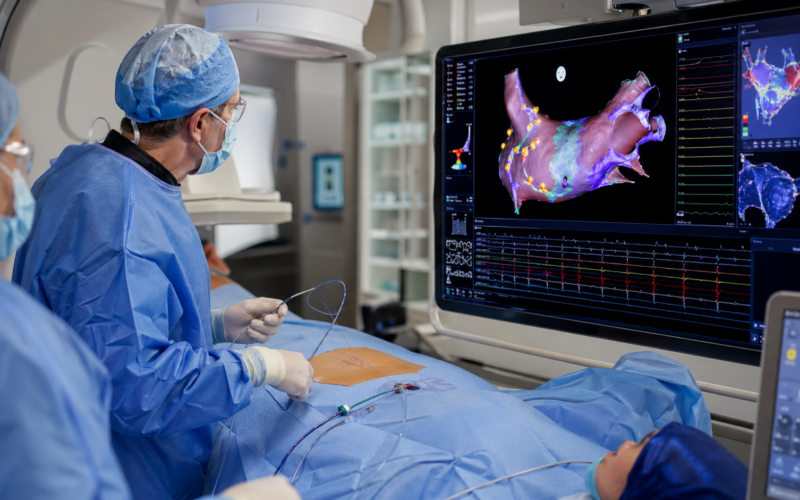
Medtronic plc (NYSE: MDT) has announced new clinical and regulatory milestones for its Affera cardiac ablation portfolio, including interim ventricular tachycardia data for the Sphere-9 catheter, FDA Breakthrough Device Designation for Sphere-9 in ventricular tachycardia, and new durability data for the Sphere-360 catheter in atrial fibrillation procedures. The update, presented around the Heart Rhythm Society Annual Meeting, matters because Medtronic plc is attempting to position Affera as more than another atrial fibrillation ablation platform. The company is trying to build a broader electrophysiology ecosystem across mapping, pulsed field ablation, radiofrequency ablation and multiple arrhythmia types. For investors watching Medtronic plc stock, the announcement adds a product pipeline narrative to a company trading below its 52-week high while still defending one of the most strategically important franchises in medical technology.
Why does Medtronic plc’s Affera update matter for the global cardiac ablation market?
The latest Affera update matters because cardiac ablation is no longer a narrow procedural technology story. It is becoming a platform competition in which large medtech companies are fighting for physician workflow, procedural efficiency, lesion durability, safety profile and regulatory breadth. Medtronic plc is using the Affera mapping and ablation system to challenge the idea that one catheter or one energy source is enough for an increasingly complex arrhythmia market.
The most strategically important part of the announcement is not simply that Medtronic plc reported 65.5 percent freedom from ventricular tachycardia recurrence at six months in an early feasibility study. The more important signal is that the company is testing whether its Sphere-9 catheter can move beyond atrial fibrillation and into ventricular tachycardia, a harder and often more clinically serious arrhythmia category. That would expand the commercial logic of Affera from a competitive atrial fibrillation tool into a more versatile electrophysiology platform.
This is also a timing story. Pulsed field ablation has rapidly become one of the hottest areas in cardiac electrophysiology because it offers the possibility of more selective tissue ablation compared with traditional thermal approaches. The sector has been moving quickly, and companies that can combine clinical evidence, regulatory progress and physician adoption may be better placed to defend premium positioning. Medtronic plc’s message is clear enough: Affera is not being positioned as a single-product launch, but as a long-duration platform bet.

How could Sphere-9 change Medtronic plc’s position in ventricular tachycardia treatment?
Sphere-9 is significant because ventricular tachycardia remains a demanding treatment area where procedural outcomes can be difficult and recurrence risk remains a major concern. Ventricular tachycardia patients often have structural heart disease, may depend on implantable defibrillators, and can face repeated shocks or therapies when the arrhythmia recurs. That makes ablation improvement not just a device innovation story, but a quality-of-life and health-system burden story.
Medtronic plc reported interim six-month outcomes from an early feasibility study of the Affera mapping and ablation system with the Sphere-9 catheter in patients with recurrent sustained monomorphic ventricular tachycardia after heart attack. The reported 65.5 percent freedom from ventricular tachycardia recurrence at six months is encouraging, but it should be treated carefully because the technology is still moving through the clinical evidence pathway for this indication. The Sphere-9 catheter is not approved for ventricular tachycardia in any geography, which means the commercial opportunity remains conditional on pivotal trial execution and regulatory review.
The FDA Breakthrough Device Designation is nevertheless an important regulatory signal. It does not guarantee approval, and investors should not treat it as a commercial green light. What it does indicate is that regulators see enough potential unmet need and technological relevance to allow a more focused development pathway. For Medtronic plc, that creates a clearer route to test Sphere-9 in a broader ventricular tachycardia population, including the planned U.S. pivotal trial.
Why is Medtronic plc combining pulsed field ablation and radiofrequency energy in one catheter?
The dual-energy nature of Sphere-9 may become one of the more important strategic features of the Affera system. The catheter combines pulsed field and radiofrequency ablation with high-definition mapping, giving physicians more procedural flexibility within one integrated system. That matters because arrhythmia cases are not all the same, and electrophysiologists often need to adapt based on anatomy, tissue characteristics and lesion targets.
Pulsed field ablation has attracted attention because it may reduce collateral tissue injury risk compared with conventional thermal ablation in certain contexts. However, radiofrequency ablation remains deeply embedded in electrophysiology practice, and many physicians are highly familiar with its procedural behavior. A system that integrates both energy types may appeal to operators who want the promise of pulsed field ablation without surrendering the control and familiarity of radiofrequency tools.
The commercial implication is also important. If Medtronic plc can make Affera feel like a workflow upgrade rather than just a catheter swap, it may increase switching appeal among hospitals and electrophysiology labs. Device companies rarely win durable share by offering isolated product features alone. They win when the technology fits naturally into clinical decision-making, procedural economics and staff training.
What does Sphere-360 durability reveal about Medtronic plc’s atrial fibrillation strategy?
Sphere-360 speaks to a different but equally important part of Medtronic plc’s ablation strategy: repeatable durability in atrial fibrillation procedures. The new sub-analysis from the Sphere-360 European study showed 100 percent lesion durability in patients with left common pulmonary veins, a challenging anatomical variation. That matters because pulmonary vein isolation remains central to atrial fibrillation ablation, and durability of isolation remains a key determinant of long-term procedural confidence.
The company had previously reported durability of 98 percent per vein and 93 percent per patient through invasive remapping at 75 days after ablation. These numbers support Medtronic plc’s effort to position Sphere-360 as a consistent single-shot pulsed field ablation catheter across varied anatomies. The emphasis on anatomical consistency is commercially useful because electrophysiologists do not only ask whether a catheter works in ideal cases. They ask whether it performs predictably in the messy middle of real-world anatomy.
Sphere-360 also broadens the Affera narrative in Europe, where the catheter has received CE Mark approval. In the United States, Sphere-360 remains investigational, with the Horizon 360 IDE trial underway. That split creates a familiar medtech dynamic: European adoption can generate commercial and clinical experience while the U.S. evidence pathway progresses more slowly. For Medtronic plc, global sequencing matters because early physician experience can influence later competitive positioning.
How does the Conquer-AF trial expand the commercial logic of Medtronic plc’s Affera system?
The first patient enrollment in the Conquer-AF trial adds another layer to the Affera strategy. The trial is designed to evaluate the Sphere-9 catheter in patients with recurrent paroxysmal or persistent atrial fibrillation who have already undergone an ablation procedure. That is an important population because repeat atrial fibrillation procedures are a persistent reality in electrophysiology.
Repeat ablation patients are commercially and clinically meaningful because they test whether a platform can handle complex, previously treated anatomy. A catheter may perform well in first-line procedures but face a harder test in patients with scar tissue, incomplete prior lesions or more advanced arrhythmia substrate. By targeting this population, Medtronic plc is pushing Sphere-9 into a use case that could strengthen Affera’s credibility among high-volume operators.
The trial also suggests that Medtronic plc is not building Affera around a single indication expansion. Instead, the company appears to be creating a layered evidence base across persistent atrial fibrillation, paroxysmal atrial fibrillation, repeat ablation and ventricular tachycardia. That is the right playbook if the goal is to make Affera a platform that can support multiple revenue streams rather than a narrow product cycle.
What does this mean for Medtronic plc stock and investor sentiment around the cardiac portfolio?
Medtronic plc stock recently traded around $83.32, with a market capitalization of roughly $107.44 billion. The shares remain well below the 52-week high of about $106.33, while the 52-week range also shows a low around $79.93. That market setup matters because investors are not currently pricing Medtronic plc as a high-momentum growth story, even though the company retains major global scale in medical devices.
The Affera update may not trigger an immediate stock rerating on its own because clinical and regulatory milestones rarely move large-cap medtech valuations unless they change near-term revenue expectations. However, the announcement does help strengthen the medium-term growth narrative in a business where product cycles and physician adoption can compound gradually. For Medtronic plc, electrophysiology is one of the areas where differentiated technology can still support pricing power, share gains and recurring procedural demand.
Investor sentiment is likely to remain cautiously constructive rather than euphoric. The positive side is that Medtronic plc is showing regulatory traction, expanding clinical evidence and building a broader ablation ecosystem. The caution is that the ventricular tachycardia indication remains investigational, Sphere-360 is still investigational in the United States, and competitors are not exactly taking a nap in the electrophysiology market. In medtech, even good science has to survive regulatory timelines, hospital purchasing committees and physician habit. That last one can be tougher than a pivotal trial, and far less polite.
What competitive pressure could Medtronic plc create for electrophysiology rivals?
The broader competitive implication is that Medtronic plc is trying to make Affera a full-stack electrophysiology platform rather than a product sitting at the edge of a procedure room. That matters for rivals because hospitals often prefer systems that integrate mapping, navigation, ablation and data capture into a smoother workflow. A company that controls more of the procedure may also have stronger leverage in training, service contracts and account relationships.
If Sphere-9 progresses successfully in ventricular tachycardia, Medtronic plc could differentiate Affera in a category that is less crowded than atrial fibrillation but clinically more complex. That would give the company a way to compete beyond the increasingly busy pulsed field ablation market for atrial fibrillation. It would also give electrophysiology centers a reason to evaluate Affera not only for volume procedures, but also for difficult cases where mapping and ablation flexibility are especially valuable.
The risk for competitors is not that one clinical update suddenly changes market share. The risk is that Medtronic plc gradually builds enough evidence across indications to make Affera harder to exclude from large electrophysiology programs. For hospital systems standardizing cardiac ablation equipment, a platform with expanding indications can become more attractive over time.
What are the main execution risks for Medtronic plc after the Affera milestones?
The first risk is clinical durability across larger and more diverse patient populations. Early feasibility data are useful, but pivotal trials carry higher evidentiary weight and often introduce more variability. Ventricular tachycardia patients can be clinically complex, and outcomes may depend on substrate, operator technique, patient selection and follow-up rigor.
The second risk is regulatory timing. Breakthrough Device Designation can support a faster and more interactive pathway, but it does not erase the need for convincing safety and effectiveness data. Medtronic plc still needs to show that Sphere-9 can deliver a strong enough benefit-risk profile in ventricular tachycardia to justify expanded approval. In the United States, Sphere-360 also remains under investigation, which means U.S. commercial upside depends on trial progress and regulatory review.
The third risk is competitive intensity. Pulsed field ablation has attracted aggressive investment from major medtech companies, and the sector will not reward technology that is merely interesting. Medtronic plc must prove that Affera can offer meaningful advantages in workflow, consistency, safety, durability and economic value. In other words, the platform has to win in the lab, the trial, the procurement office and the physician’s muscle memory.
Why could Medtronic plc’s Affera roadmap become a broader medtech platform story?
The Affera roadmap could become a broader medtech platform story because it sits at the intersection of clinical need, procedural efficiency and recurring device utilization. Cardiac arrhythmias are common, ablation volumes are growing, and healthcare systems continue to seek treatments that reduce recurrence, repeat interventions and long-term disease burden. A successful multi-indication ablation platform can therefore influence both revenue growth and strategic positioning.
Medtronic plc is also showing a familiar but effective medtech strategy: build evidence in one indication, expand into adjacent clinical populations, secure regulatory milestones, and turn physician confidence into platform adoption. Sphere-9, Sphere-360, Horizon 360 and Conquer-AF together suggest that Medtronic plc is trying to create a connected evidence ladder rather than chase disconnected product launches.
The real test will be whether the company can translate clinical momentum into durable commercial adoption. If Affera becomes a trusted platform across atrial fibrillation and ventricular tachycardia, Medtronic plc could strengthen one of its most strategically relevant cardiovascular businesses. If trial results disappoint or adoption slows, the announcement will look more like a promising update than a turning point. For now, the direction is clear: Medtronic plc is placing Affera at the center of its next cardiac ablation push.
Key takeaways on what Medtronic plc’s Affera milestones mean for cardiac ablation, investors and competitors
- Medtronic plc is positioning Affera as a broader cardiac arrhythmia platform rather than a single atrial fibrillation ablation product.
- The Sphere-9 catheter’s ventricular tachycardia pathway could open a more complex and differentiated growth opportunity if pivotal data support approval.
- The reported 65.5 percent freedom from ventricular tachycardia recurrence at six months is encouraging, but it remains interim early feasibility evidence.
- FDA Breakthrough Device Designation improves the regulatory pathway for Sphere-9 in ventricular tachycardia but does not guarantee approval.
- Sphere-360 durability data strengthen Medtronic plc’s atrial fibrillation narrative, especially in patients with varied pulmonary vein anatomies.
- The Conquer-AF trial expands the Affera evidence base into repeat atrial fibrillation procedures, a clinically important and commercially meaningful segment.
- Medtronic plc stock remains below its 52-week high, so investors may view Affera as a medium-term growth catalyst rather than an immediate valuation reset.
- The main execution risks include pivotal trial performance, U.S. regulatory timelines, physician adoption and competitive pressure in pulsed field ablation.
- If Affera succeeds across multiple indications, Medtronic plc could improve its competitive position in one of the most important medtech growth categories.
Discover more from Business-News-Today.com
Subscribe to get the latest posts sent to your email.