

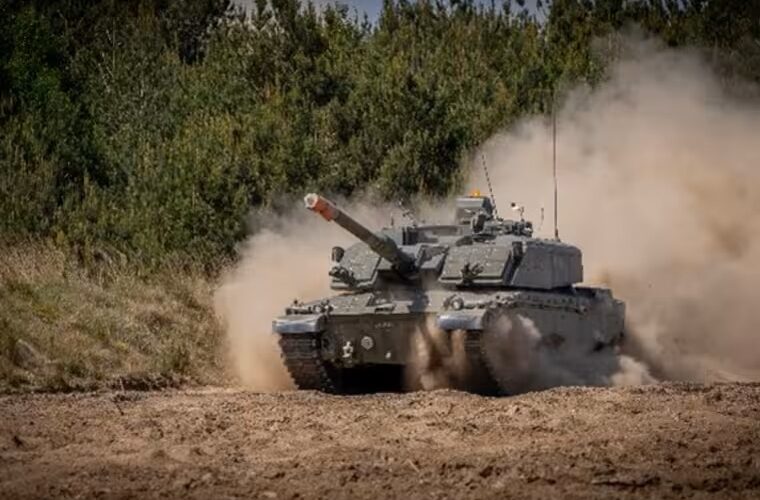
The Challenger 3 main battle tank is the British Army’s most significant armoured vehicle programme in a generation, representing a comprehensive modernisation of the existing Challenger 2 fleet through a deeply upgraded turret, a new NATO-standard smoothbore gun, advanced active protection, and digitised battlefield systems. Developed and manufactured by Rheinmetall BAE Systems Land, a joint venture between Germany’s Rheinmetall and the United Kingdom’s BAE Systems, the programme marks a structural shift in how British heavy armour will operate, fight, and survive on a contested battlefield through at least 2040. Under a contract valued at £800 million, signed with the Ministry of Defence in May 2021, a total of 148 Challenger 2 tanks are to be upgraded to the Challenger 3 standard. The programme sits at the centre of the British Army’s declared ambition to double its warfighting capability by 2030 and reestablish credible heavy armour as a cornerstone of its NATO contribution.
What is the strategic importance of the Challenger 3 main battle tank for the British Army in 2026?
The Challenger 3 programme addresses a capability gap that had been widening for years. The Challenger 2, which entered British Army service in 1994, had served without loss to enemy fire in the former Yugoslavia and Iraq, but its rifled 120mm gun used a proprietary two-piece ammunition system incompatible with NATO-standard smoothbore rounds used by every other major Western ally. The replacement of the L30A1 rifled gun with the Rheinmetall L55A1 120mm smoothbore cannon not only improves muzzle velocity and armour penetration, but opens access to the full spectrum of NATO-standard ammunition, including kinetic energy penetrators used by Germany, the United States, and most European allies. That interoperability deficit, which had persisted for decades, is the single most consequential change the Challenger 3 delivers at the alliance level.
Beyond ammunition compatibility, the programme addresses sensor obsolescence, survivability against modern anti-tank threats including loitering munitions, and the integration of digital command and control architecture consistent with the British Army’s wider modernisation direction. The Challenger 3 integrates Rafael’s Trophy active protection system, a digitised turret with day and night targeting sights, and a new modular armour system, collectively repositioning what was an ageing but structurally sound hull into a platform credible against near-peer adversaries.
The UK Army holds an inventory of 288 Challenger 2 vehicles but has no plans to upgrade more than 148 to the Challenger 3 standard. That force-size decision, driven by budgetary constraints rather than operational logic, reduces the armoured order of battle from three regiments to two regiments’ strength. The strategic trade-off is quality over quantity, a choice whose adequacy will be tested by the pace at which Russian armoured doctrine and production continues to evolve following the Ukraine conflict.
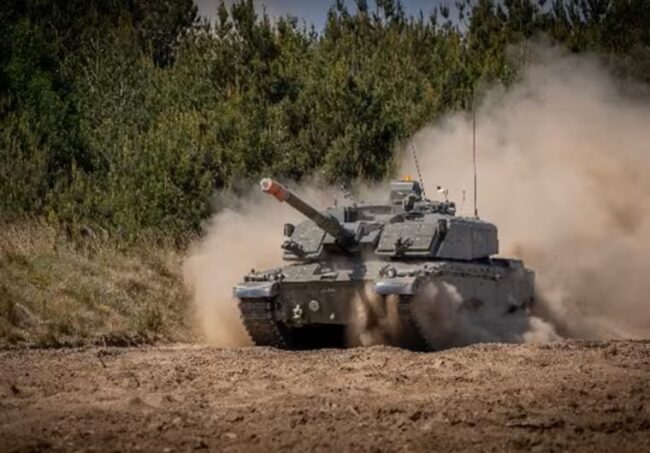
Who manufactures the Challenger 3 and what is the ownership structure of RBSL?
Rheinmetall BAE Systems Land came into existence in 2019 when Rheinmetall acquired BAE Systems’ UK land vehicle division, effectively merging the two competing bidders for the Challenger 2 Life Extension Programme into a single joint venture and leaving Rheinmetall’s upgrade proposal as the only viable option without replacing the fleet entirely with a foreign-designed platform. The joint venture structure means that while the vehicle is manufactured in the United Kingdom, the technical architecture and core systems, particularly the gun, turret, and fire control, are substantially German in origin.
Production is led from RBSL’s Telford manufacturing facility in the West Midlands, with engineering support from heavy armour specialists at RBSL sites in Washington in the North East and in Bristol. The programme is governed through the Ministry of Defence’s Defence Equipment and Support directorate, which acts as the procurement authority and has driven the trial sequencing from Critical Design Review through to the current pre-production phase.
A £40 million inward investment has been directed into RBSL’s Telford facility, including a Turret Test Rig that will enable Battlefield Mission simulations and reliability growth trials from 2026 onward. Rheinmetall separately announced in May 2025 the construction of a new barrel manufacturing facility in Telford, deepening the in-country production footprint and reducing dependency on German supply lines for the L55A1 gun. Approximately 60 percent of the Challenger 3 supply chain by value is provided by UK-based suppliers, a figure the Ministry of Defence has cited as evidence of the programme’s industrial and regional economic contribution.
What is the production schedule for Challenger 3 and when will it achieve full operational capability?
The initial entry into service for Challenger 3 has been brought forward to 2025 from the original 2027 timeline, with full operational capability expected by 2030. The programme is working through a structured pre-production trial phase involving eight prototype vehicles, produced in two sequential batches of four. By April 2025, four prototypes had been delivered to the British Army for field trials, with a further four in build.
The trial sequence is designed to progressively validate every major system before the System Qualification Review locks down the final manufacturing standard for the remaining 140 production vehicles. The first mobility trials covered nearly 800 kilometres across road and cross-country terrain, assessing noise, vibration, crew interface, and the structural behaviour of onboard ammunition under sustained movement. Live firing followed in stages, beginning with remote operation of the L55A1 gun before progressing to fully crewed firing.
The System Qualification Review is forecast to be reached during 2026, at which point the manufacturing standard for the full production run will be formally agreed. Delivery of all 148 vehicles is targeted for completion by 2030. Supply chain pressures prompted a parliamentary intervention in May 2025, when Defence Procurement Minister Maria Eagle confirmed that additional resources had been directed toward securing materials required to meet the delivery schedule. The reference was brief but the signal was clear: the programme is under schedule pressure that warrants active monitoring.
What capabilities does the Challenger 3 bring over the Challenger 2 platform?
The capability differential between the Challenger 2 and the Challenger 3 is substantial rather than incremental. The most operationally visible change is the smoothbore gun. The L55A1 fires single-piece ammunition and carries 31 rounds, compared to 49 in the Challenger 2, but in return provides access to NATO-standard kinetic energy penetrators including the DM63 and DM73 armour-piercing fin-stabilised discarding sabot rounds, and potentially the US-made M829A4 with a depleted uranium penetrator. The reduction in stowage reflects the physical constraints imposed by transitioning from two-piece to single-piece ammunition, a trade-off the British Army has accepted in exchange for the logistical and alliance benefits of NATO commonality.
Mobility improvements are delivered through the Heavy Armour Automotive Improvement Programme, which fits the platform with an improved Perkins CV12-8A V12 diesel engine rated at 1,500 horsepower, a third-generation hydro-gas suspension, and an enhanced cooling system. The upgrades push on-road speed to 60 kilometres per hour and extend the maximum operational range to 500 kilometres. The gross vehicle weight rises to 66 tonnes, one tonne above the Challenger 2.
The survivability package represents the most forward-looking element of the upgrade. Rafael Advanced Defence Systems has developed a modification to the Trophy system enabling it to reliably intercept drone threats including those approaching from overhead, addressing one of the most pressing lessons from the Ukraine conflict. Combined with the new modular armour package developed in partnership with the Defence Science and Technology Laboratory, the Challenger 3’s protection architecture is substantially more relevant to the contemporary threat environment than anything available on the existing Challenger 2 fleet.
Which contracts have been awarded for the Challenger 3 programme and who are the key suppliers?
The Challenger 3 supply chain spans the United Kingdom, Germany, Israel, and the United States, with primary contract accountability resting with RBSL as the design authority and prime contractor. The Trophy active protection system is supplied by Israel’s Rafael Advanced Defence Systems under an initial £20 million contract covering procurement, countermeasures, and test equipment for the demonstration phase, with testing conducted both at Rafael’s facility in Israel and at UK test ranges.
Elbit Systems UK is supplying the Elbit Laser Warning System, while Curtiss-Wright is providing the aiming and stabilisation system under an approximate $25 million contract covering the turret drive stabilisation architecture. Additional contracts in the published record include a multi-million-pound deal with TT Electronics for electric cable harness assemblies enabling power and communication capability; an £8 million subcontract for hull contactor panels and power distribution components; a £4.1 million contract for a custom variant of the Embedded Image Periscope; a £2 million contract for 148 vehicle crew seating sets comprising 444 individual seats; and approximately £1.39 million for internal LED lighting manufactured at a Cumbria facility. Horstman, owned by Germany’s RENK Group, holds a contract to refurbish and upgrade the hydrogas suspension to third-generation standard, while the Trailblazer Driver Vision System is being supplied alongside the Warrior and Boxer platforms in British service.
What are the regulatory, geopolitical, and procurement considerations shaping the Challenger 3 programme?
The Challenger 3 programme operates within a defence procurement environment defined by austerity-era decisions, an accelerating European rearmament cycle, and the operational lessons of the Ukraine conflict. The decision to upgrade only 148 of 288 Challenger 2 vehicles reflects a force-sizing choice made during the 2021 Integrated Review, when the British Army accepted a reduction in armoured scale in exchange for investment in quality and digital capability. That assumption is now under pressure as European NATO members expand rather than contract their armoured inventories.
The programme’s dual nationality, a German-British joint venture with an Israeli active protection system and American ammunition compatibility ambitions, reflects the reality that no single Western nation can now develop a credible main battle tank purely from domestic industrial resources. Against the German Leopard 2A8, the Challenger 3 shares the same L55A1 gun and offers a similarly modernised turret design, but differentiates through its bespoke British hydrogas suspension and proven modular armour lineage, while the Leopard 2 benefits from a larger production base and Pan-European logistics depth.
The geopolitical context shaping programme urgency has shifted significantly since the contract was signed in 2021. The Russian invasion of Ukraine demonstrated that main battle tanks remain relevant on a contested European battlefield provided they operate with adequate combined arms support, drone detection, and active protection. The Ukrainian deployment of British-supplied Challenger 2 tanks, which saw at least two vehicles destroyed under combat conditions, generated observable tactical and survivability data that is now informing Challenger 3’s developmental priorities, particularly the anti-drone integration of the Trophy system.
What is the latest status of Challenger 3 development and trials in 2026?
In January 2026, Rheinmetall BAE Systems Land completed the first crewed live firing of Challenger 3 on UK soil, a milestone described as the first crewed firing of a newly developed main battle tank in the United Kingdom in more than 30 years. The trial followed a phased sequence beginning with remote operation of the L55A1 gun before RBSL personnel fired the weapon from within the crewed turret. The firing took place at an undisclosed Ministry of Defence range in the United Kingdom.
The programme now moves into its next phase, with additional crewed firing activity and initial reliability growth trials planned through 2026 as Challenger 3 progresses toward full operational capability. Data gathered from the January crewed firing trials will be used to programme the Turret Test Rig at Telford for ongoing Battlefield Mission simulations supporting reliability growth work.
At the Defence and Security Equipment International exhibition in London in September 2025, RBSL publicly displayed the near-final configuration of the Challenger 3 for the first time, featuring a completely redesigned armour package across the turret and hull incorporating next-generation composite protection. The DSEI 2025 appearance was the platform’s most prominent public exposure to date and served as an implicit signal to potential export customers of the programme’s maturity and commitment.
What is the long-term outlook for Challenger 3 and what could change its trajectory?
The Challenger 3’s long-term relevance will be shaped by three variables: the pace of threat evolution on the European battlefield, the British Army’s structural willingness to fund and sustain a heavy armour capability, and the programme’s ability to deliver 148 vehicles on schedule by 2030 without further cost escalation. On the first count, the programme’s designers have built in meaningful adaptability, with the modular armour system capable of receiving future upgrades and the Trophy integration providing a drone interception pathway that is more future-proof than passive armour alone.
RBSL has stated that it is technically possible to manufacture new-build Challenger 3 vehicles if required, which opens a pathway to either British Army fleet expansion above 148 vehicles or export sales, the latter representing a long-term commercial objective that the programme’s developers have made no secret of. The DSEI 2025 display and the ongoing investment in the Telford facility suggest that export marketing is an active consideration even if no firm international customers have been announced.
The programme’s single most material risk is the gap between the 148 vehicles on contract and the broader Challenger 2 fleet. The 140 vehicles not selected for upgrade will progressively age out of relevance as spare parts availability narrows and the capability differential with Challenger 3 widens. Whether a future defence review revisits that force-size decision will depend on the evolution of the UK’s strategic risk assessment, its NATO burden-sharing obligations, and the fiscal constraints that have defined British defence procurement for the past fifteen years. What is not in doubt is that the Challenger 3, when it enters service in quantity, will represent the most capable armoured fighting vehicle the British Army has ever fielded.
Discover more from Business-News-Today.com
Subscribe to get the latest posts sent to your email.