




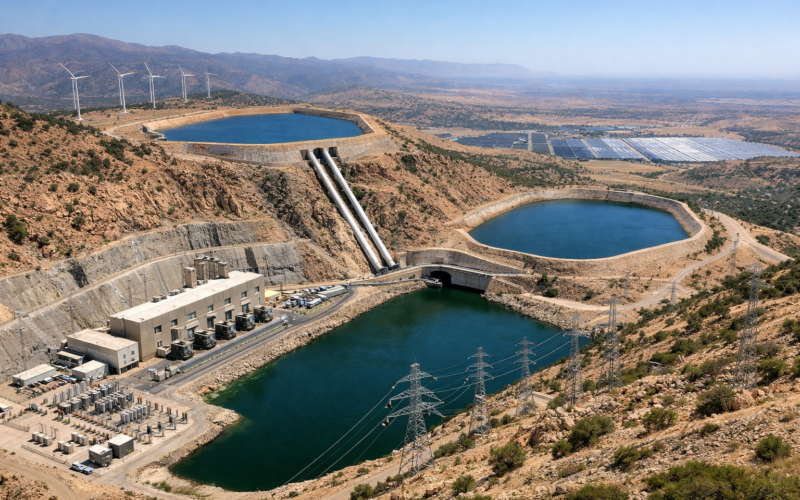
Morocco’s electricity system is undergoing one of the most ambitious transformations in the Middle East and North Africa, and the Abdelmoumen pumped-storage power plant sits at the operational heart of that shift. Developed and operated by the National Office of Electricity and Drinking Water, known by its French acronym ONEE, the plant is located approximately 70 kilometres east of Agadir in the Taroudant Province and functions as the country’s primary grid-scale energy storage asset. With an installed capacity of 350 megawatts, the facility can deliver electricity almost instantly and can cycle up to 20 times per day, making it the most operationally flexible power infrastructure Morocco has commissioned to date. Its completion marks a structural turning point in the country’s energy strategy, enabling a higher penetration of wind and solar generation without sacrificing grid stability.
What is the strategic importance of the Abdelmoumen pumped-storage power plant for Morocco?
Morocco imports the overwhelming majority of its energy needs in the form of hydrocarbons, a dependence that places significant pressure on public finances and constrains long-term economic planning. The government has responded with a multi-decade renewable energy programme targeting a 52 percent share of renewables in the national electricity mix by 2030, up from roughly 45 percent at the end of 2025. The challenge inherent in that trajectory is not generation capacity alone but dispatchability — the ability to supply power reliably when wind drops or the sun sets. The intermittent nature of solar and wind energy requires careful management to ensure the stability of the national grid, and the Abdelmoumen pumped-storage power plant plays a strategic role in maintaining that stability by helping meet demand during peak consumption periods while compensating for inevitable drops in solar and wind generation.
The Souss-Massa region where the plant is located is also a hub of industrial and agricultural activity, with cement producers, food processors, and export-oriented agribusinesses reliant on an uninterrupted electricity supply. For energy-intensive industrial operators such as Ciments du Maroc, a subsidiary of Heidelberg Materials, the reliability of the electricity grid is critical to maintaining industrial performance and safeguarding jobs. The Abdelmoumen pumped-storage power plant therefore fulfils a dual mandate: stabilising a grid increasingly dominated by variable renewables while underpinning the competitiveness of Morocco’s industrial base.
Who owns and operates the Abdelmoumen pumped-storage power plant?
State-owned national electric utility ONEE is the owner and developer of the project. ONEE holds exclusive responsibility for operating the facility across its working life, with no private equity participation in the asset itself. The plant was developed under a publicly funded model supported by multilateral financing rather than through an independent power producer or private finance initiative structure. The project received €179 million in financing from the African Development Bank Group as part of the Integrated Wind, Hydropower and Rural Electrification Programme, known as PIEHER. The European Investment Bank also contributed financing, making Abdelmoumen a project in which multilateral development institutions played a decisive role in enabling what would otherwise have been a capital-intensive undertaking for a utility operating within a developing economy.
The ownership structure has remained stable since the project’s inception, with no divestments, farm-ins, or joint venture restructuring reported. ONEE retains full operational control and the asset is integrated into the national transmission system it manages.
What is the installed capacity and production profile of the Abdelmoumen pumped-storage power plant?
The plant is designed to generate 616 gigawatt-hours of electricity per year and will provide reliable and cost-efficient electricity supply to the Souss-Massa region. The facility operates across a net hydraulic head of approximately 555 metres, one of the highest head values for any pumped-storage facility in North Africa, which directly enables its high output density relative to its physical footprint. When needed, the facility can adjust its output from 90 megawatts to 350 megawatts to stabilise the grid during peak demand.
The commissioning of the project in 2024 increased by 20 percent the installed hydropower capacity of Morocco, reinforcing that of the 460 megawatt Afourer pumped-storage plant which has been in operation since 2004. The Abdelmoumen pumped-storage station was commissioned in October 2024 and produced 135 gigawatt-hours in its first operational months. That early output figure reflects partial-year operation and is expected to increase as dispatch frequency rises in line with growing renewable penetration across the Moroccan grid.
How does the Abdelmoumen pumped-storage power plant work technically?
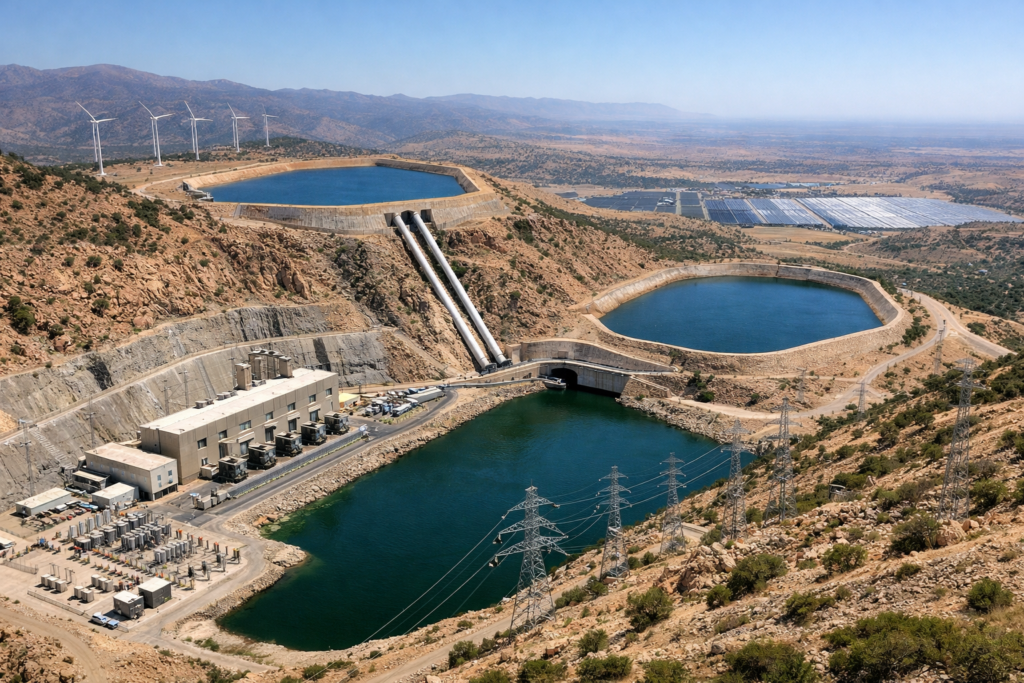
The system relies on two water reservoirs: one located at a lower level and another positioned approximately 600 metres higher, connected by pipelines and underground tunnels and supplied by the Abdelmoumen dam located next to the site. Water stored at the higher elevation functions as potential hydropower energy. When electricity demand rises or renewable output falls short of grid requirements, water is released downward through the waterway, passing through reversible pump-turbines to generate power. When renewable generation exceeds grid demand, the process reverses and surplus electricity is used to pump water back to the upper reservoir, effectively converting electrical energy into stored gravitational potential energy.
Each of the two reservoir basins holds 1.3 million cubic metres of active storage volume. The waterway connecting them is approximately 3 kilometres long and consists of a 2 kilometre penstock, more than 700 metres of tunnels with internal diameters of between 3.5 and 5 metres, and three shafts up to 60 metres high. The underground powerhouse is embedded in the hillside and houses two reversible Francis turbine-generator units. Operating under a net head of about 555 metres, the designs assure the two pump-turbines meet both high efficiency and reliability requirements for years to come.
What infrastructure and transmission connections serve the Abdelmoumen pumped-storage power plant?
The power generated at the plant is evacuated via an on-site substation through four transmission lines. One line connects with the 225 kilovolt substation in Agadir, two lines connect to Chichaoua, and a further line runs to Glacha. This four-direction transmission configuration gives the plant meaningful reach across the southern Moroccan grid, enabling it to dispatch power efficiently to different load centres depending on where demand is concentrated at any given moment.
The scheme is equipped with a 225 kilovolt substation including two group arrivals and four line departures, along with a pumping station supplying water from the existing Abdelmoumen reservoir. During construction, approximately 20 kilometres of access roads were created or rehabilitated to serve the site, infrastructure that now supports both operational logistics and the broader connectivity of the Taroudant Province.
What is the development history and investment timeline of the Abdelmoumen pumped-storage power plant?
The project emerged from Morocco’s broader national energy strategy, which identified pumped-storage hydropower as the most practical and economically viable solution for balancing a grid increasingly fed by intermittent wind and solar resources. Site selection favoured the Issen River valley in Taroudant Province because of its topographic suitability and proximity to the existing Abdelmoumen dam, which underpins the water supply for both reservoirs.
The estimated investment for the project was $317 million. The Vinci Construction and ANDRITZ Hydro consortium was selected in 2018 in a two-stage international tender, with prequalification followed by a detailed evaluation of technical and commercial offers assessing compliance with prequalification criteria, ability to meet technical requirements, and competitiveness of the commercial offer. Construction commenced in early 2018 with an initial target of completing the 48-month build programme by the first half of 2022.
The project encountered a sequence of challenges that extended that timeline by more than two years. Real-world pressures included tough specifications, tricky geology, resource constraints, the COVID-19 pandemic, exceptional drought, and global inflation. The pandemic disrupted labour availability and global supply chains during a critical phase of equipment procurement and underground excavation, while an exceptional regional drought complicated water management during the initial filling of the reservoirs. Global inflation from 2021 onwards added further pressure to an already complex budget environment. Despite these headwinds, the consortium delivered the project without any reported fundamental redesign of the core facility, with successful commissioning achieved in mid-2024.
Which companies won contracts for the Abdelmoumen pumped-storage power plant?
Vinci Construction, as part of a consortium with ANDRITZ Hydro, was awarded a €284 million contract to construct the 350 megawatt pumped-storage facility in January 2018. The contract was structured as a full turnkey engineering, procurement, and construction assignment, encompassing design, civil works, equipment supply, assembly, testing, and commissioning. Vinci Construction handled the civil engineering scope, while ANDRITZ Hydro was responsible for the electromechanical package.
ANDRITZ Hydro’s scope of supply comprised design, manufacturing, delivery, installation, supervision, and commissioning of the reversible pump-turbines, motor-generators, and electrical power systems. The full water-to-wire package covered two 175 megawatt reversible pump-turbines and motor-generators, transformers, electrical balance of plant equipment, and automation systems.
Artelia assisted the Vinci-ANDRITZ consortium for design review and study of alternatives during the EPC proposal preparation. Chryso, a construction chemistry specialist, supplied admixture products for the concrete works used in building the two reservoir basins. The project also generated a significant local employment effect during its execution phase, creating more than 1,400 jobs during construction, most of which were filled by workers from local communities.
One notable technical achievement during execution involved an on-site manufacturing improvisation. The last penstock section was fabricated in a temporary on-site workshop, a development that symbolised the completion of very complex work and the joint effort around high-level technical expertise. This was necessitated by logistical constraints during the final stages of the penstock installation programme.
What regulatory and environmental considerations affect the Abdelmoumen pumped-storage power plant?
The project operates under Moroccan energy and environmental law, with ONEE accountable to the national regulator and the Ministry of Energy Transition and Sustainable Development. As a public utility asset financed partly by multilateral development banks, the project was subject to the environmental and social safeguard frameworks of both the African Development Bank Group and the European Investment Bank, which require rigorous environmental impact assessment, community consultation, and labour standards compliance.
The plant operates as a reversible system, which means excess energy is stored in the form of potential energy of water rather than through chemical or thermal means, minimising the environmental footprint relative to alternative storage technologies. The closed-loop design, which circulates water between the two reservoirs rather than drawing continuously from the river system, further reduces hydrological impact. Operating in closed circuit, Abdelmoumen minimises its impact on water resources, combining energy performance, flexibility, and environmental responsibility while contributing to supply security.
How does the Abdelmoumen pumped-storage power plant affect Morocco’s national energy strategy?
Total renewable capacity in Morocco reached 5,439 megawatts by the end of 2024, covering 45 percent of the country’s electricity mix, with wind leading at 44 percent, followed by hydro at 24 percent, solar at 17 percent, and pumped-storage facilities at 15 percent. The Abdelmoumen pumped-storage power plant’s contribution to that pumped-storage share is decisive, as it more than doubled Morocco’s dispatchable hydropower storage relative to the Afourer facility alone.
The plant also positions Morocco as a credible platform for future cross-border electricity trade. As North African grid interconnection matures and the potential for Europe-to-Africa clean power flows gains political and commercial attention, Morocco’s ability to offer flexible, dispatchable capacity becomes a tangible economic asset rather than a purely domestic operational consideration.
Latest operational updates for the Abdelmoumen pumped-storage power plant in 2025
Wind power generation in Morocco surged to 9,363 gigawatt-hours in 2024, a 43 percent increase from 2023, accounting for 21 percent of total national electricity production and 80 percent of renewable output. This rapid expansion in variable generation has increased the operational value of the Abdelmoumen pumped-storage power plant, which is now being dispatched regularly to smooth the output of wind farms concentrated in southern Morocco. By the end of 2025, renewables made up around 45 percent of Morocco’s energy mix, one of the highest shares in the Middle East and North Africa, with ONEE confirming that Abdelmoumen stabilises the grid and makes it possible to increase the share of wind and solar in a sustainable way.
The African Development Bank Group published a detailed success story on the plant in April 2025, affirming its operational status and highlighting its contribution to industrial energy reliability across the Souss-Massa region. No operational outages, performance shortfalls, or material disputes with the EPC consortium have been publicly reported since commissioning.
Future outlook and long-term relevance of the Abdelmoumen pumped-storage power plant
Morocco’s commitment to 52 percent renewable electricity by 2030 will require a continued expansion of flexible storage capacity to manage increasingly high renewable penetration. The Abdelmoumen pumped-storage power plant provides the country with its most sophisticated grid balancing tool to date, and its operational track record since October 2024 is expected to inform the design and financing of future storage projects across the MENA region.
The plant’s successful delivery — despite the compounding disruptions of COVID-19, drought, and inflation — has demonstrated that a country at Morocco’s level of infrastructure development can finance, build, and operate a high-head pumped-storage facility to international technical standards. That validation is significant for the African Development Bank Group’s energy storage pipeline across the continent, where similar terrain-and-storage combinations exist in countries with far less developed energy infrastructure.
For Morocco, the Abdelmoumen pumped-storage power plant symbolises energy independence and regional leadership. As North African grids interconnect and cross-border flows grow, flexible assets like Abdelmoumen will stabilise systems far beyond the Atlas foothills. The combination of a 350 megawatt generation capacity, a 616 gigawatt-hour annual output target, and the ability to cycle up to 20 times daily gives the plant a durability and operational range that will remain relevant well into the 2040s, irrespective of how Morocco’s generation mix continues to evolve.
Discover more from Business-News-Today.com
Subscribe to get the latest posts sent to your email.