


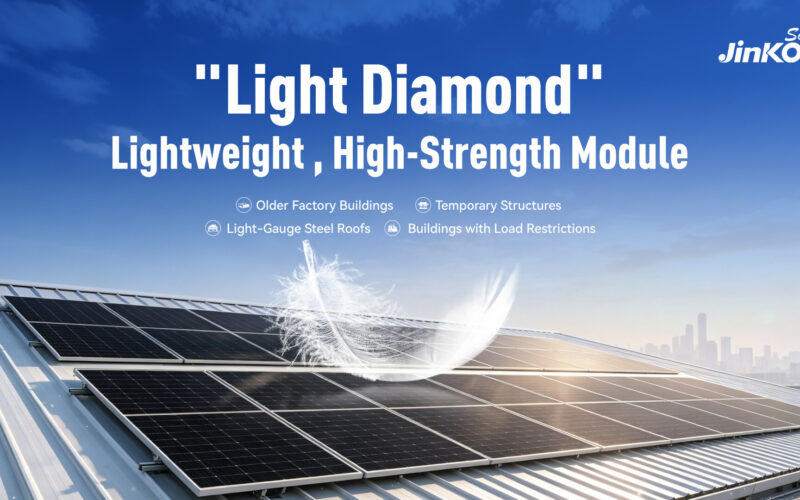
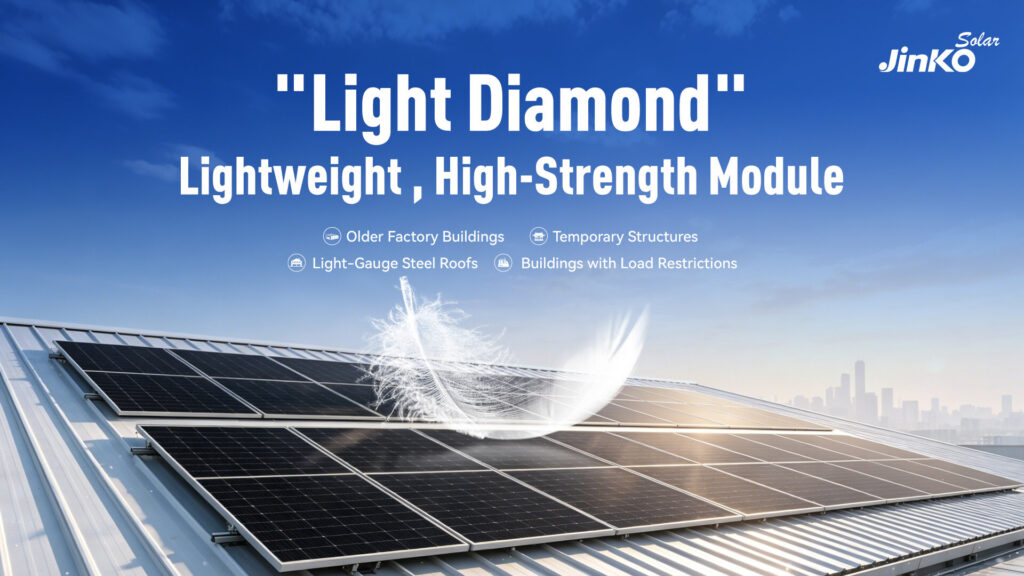
JinkoSolar Holding Co., Ltd. (NYSE: JKS) has launched a new lightweight solar module called Light Diamond, designed for roofs that cannot easily support conventional double-glass systems. The product arrives with a maximum output of 560 watts, claimed module efficiency of 24.94%, and a weight density of 7 kg per square meter, positioning it for older industrial buildings, light-gauge steel roofs, temporary structures, and other load-restricted sites. That is strategically relevant because it shifts the conversation from simply selling more modules to opening up project locations that were previously uneconomic or structurally off limits. It also comes at an important moment for JinkoSolar Holding Co., Ltd., which has just reported difficult 2025 financial results even as it maintained leadership in global module shipments.
The real significance of the launch is not that JinkoSolar Holding Co., Ltd. has made a solar panel lighter. The significance is that the company is trying to convert a physical installation constraint into a commercial category. A large part of the distributed solar market, especially in China’s commercial and industrial segment, has long been limited not by demand for electricity savings, but by roof integrity, permitting complexity, retrofit costs, and the operational disruption caused by reinforcement work. If a module can materially reduce those barriers while still delivering mainstream power density, that changes the economics of adoption more than a modest cell-efficiency improvement ever could.
JinkoSolar Holding Co., Ltd. is effectively arguing that the next wave of rooftop photovoltaic growth may come not from greenfield industrial sites, but from structurally compromised or previously excluded buildings. That is a more interesting thesis than the typical launch-day marketing language, because it implies the company is trying to grow through addressable-market expansion rather than through simple price competition in an oversupplied module industry. Solar has not exactly suffered from a shortage of panels. It has suffered from too many similar panels chasing the same projects.
Why does JinkoSolar Holding Co., Ltd.’s Light Diamond launch matter for China’s commercial rooftop solar market now?
Timing matters here. JinkoSolar Holding Co., Ltd. reported that full-year 2025 module shipments reached 86 GW, still enough to rank first globally, but the company also faced a much harsher operating environment marked by structural oversupply, pricing pressure, and rising costs. In that context, product differentiation becomes less of a branding exercise and more of a survival tactic.
The Chinese distributed solar market has matured to the point where the easy rooftops are no longer the only story. Many remaining commercial rooftops sit on older factories, industrial sheds, warehouses, agricultural structures, and light steel buildings that were never designed with photovoltaic loading in mind. Conventional module deployment in such settings often requires engineering review, reinforcement expense, downtime, and in some cases outright abandonment of the project. Light Diamond is aimed directly at that friction point.
That matters because the module is being sold not only on weight savings, but on project simplification. JinkoSolar Holding Co., Ltd. is framing the product around lower reinforcement costs, shorter construction timelines, and the ability to keep operating facilities running during installation. For commercial customers, especially manufacturers and logistics operators, the difference between a workable rooftop solar project and a shelved one is often less about module efficiency than about whether the business needs to stop production or re-engineer the roof. A factory owner does not care about photovoltaic elegance if the roof turns into an expensive civil works comedy.
This positioning also reflects a broader shift in solar competition. When module prices are compressed across the sector, the winner is often the supplier that can reduce total installed system friction, not just the supplier with the best nameplate economics on paper. In that sense, JinkoSolar Holding Co., Ltd. is trying to move the sales discussion from cents per watt to project viability, internal rate of return, and execution simplicity.
Can lightweight modules help JinkoSolar Holding Co., Ltd. defend margins in an oversupplied solar industry?
The margin question is where the story gets more interesting. Lightweight modules are not automatically lucrative. In fact, specialty products can become margin traps if they remain too niche, require complex manufacturing adaptation, or end up being commoditized as soon as demand becomes visible. So the strategic value of Light Diamond depends on whether JinkoSolar Holding Co., Ltd. can make this segment large enough and differentiated enough to resist the industry’s habitual race to the bottom.
The company has given itself a better chance than many lightweight competitors by claiming that Light Diamond does not force a major trade-off between reduced weight and usable output. That is important because many low-weight solutions have historically sacrificed power density, durability, or warranty appeal. If JinkoSolar Holding Co., Ltd. can combine lightweight deployment with power levels that remain credible for serious commercial projects, it has a better shot at pricing the product as a system-enabler rather than a compromise solution.
The load and durability claims also matter for bankability. The company says the module supports front-side load of 3,600 Pa, back-side load of 2,400 Pa, and a 30-year power warranty. Those numbers are central because roof-restricted projects are already viewed as harder installations. Developers, financiers, and EPC firms will not want a lightweight product that solves one engineering problem by introducing a long-term reliability question. The market will judge Light Diamond less by launch-day specifications and more by whether JinkoSolar Holding Co., Ltd. can convince installers and asset owners that lighter does not mean weaker.
There is also a portfolio logic here. JinkoSolar Holding Co., Ltd. has recently been showcasing Tiger Neo 3.0 as a broader technology platform and has used product segmentation to address distinct use cases, including anti-glare and data-center-related offerings. That suggests the company is trying to build commercial defensibility through application-specific product families rather than one-size-fits-all module selling. In a market where standardized products are punished by oversupply, segmentation is not a luxury. It is often the only way to avoid becoming your own low-cost competitor.
What does JinkoSolar Holding Co., Ltd.’s latest product launch signal about its post-2025 strategic reset?
This launch signals that JinkoSolar Holding Co., Ltd. is trying to do more than wait for industry conditions to improve. It is looking for product categories where system-level value can still be monetized even when mainstream utility-scale competition remains brutal. That is a sensible strategic adjustment after a year in which shipment leadership did not translate into easy financial comfort.
It also suggests the company sees China’s retrofit market as strategically important. Much of the global rooftop solar conversation focuses on new commercial buildings, policy incentives, or energy storage pairing. Yet there is a less glamorous but potentially large opportunity in retrofitting buildings that are already there, already consuming power, and already constrained by structural realities. Unlocking those rooftops could create a more stable demand pool than chasing purely price-led utility procurements.
For competitors, the launch is a warning that product innovation in photovoltaics is increasingly moving beyond cell efficiency headlines. The next battlefield may involve roof loading, fire safety, anti-glare performance, weather resilience, integration ease, and installation speed. In other words, solar module competition is becoming more like industrial systems competition. That tends to favor manufacturers with scale, engineering depth, and a broad channel footprint.
For project developers and EPC firms, the product could expand the menu of financeable projects, but only if field adoption validates the claimed cost and time savings. Commercial buyers are likely to test whether the promised reduction in reinforcement needs actually shortens approval cycles and lowers soft costs. If that happens, JinkoSolar Holding Co., Ltd. may have found a way to capture business that was not previously part of the active pipeline at all.
How are investors reading JinkoSolar Holding Co., Ltd. (NYSE: JKS) after the Light Diamond launch and recent earnings?
The stock context shows why investors are likely to view this product launch with cautious interest rather than automatic enthusiasm. JinkoSolar Holding Co., Ltd. closed at $21.36 on April 17, 2026, according to the company’s investor relations page, with a 52-week range of $15.55 to $31.88. Historical pricing also indicates the stock has fallen from about $25.17 on March 16, 2026, to $21.36 on April 17, 2026, a drop of roughly 15% over a month.
That price action suggests the market is still anchoring more heavily to sector oversupply, pricing pressure, and earnings fragility than to new product announcements. This is understandable. Investors generally reward solar manufacturers for launches only when they believe those launches can either widen margins, materially lift addressable demand, or strengthen competitive insulation. A clever module is nice. A clever module that changes the earnings debate is nicer.
At the same time, the Light Diamond launch does give JinkoSolar Holding Co., Ltd. a more defensible strategic narrative. Instead of competing purely on volume or commodity pricing, the company can tell investors it is pursuing installation-constrained niches where the value proposition is clearer and competition may be less immediately destructive. That does not erase sector risk, but it does offer a more coherent path to selective profitability than simply shipping more conventional modules into a weak pricing environment.
Investors will now look for evidence in three places. First, whether lightweight products begin contributing meaningfully to commercial rooftop orders. Second, whether the company can sustain or improve gross margin through differentiated offerings. Third, whether this category can travel beyond a domestic China retrofit story into other geographies with aging commercial building stock and rooftop load limitations. If the answer to all three is yes, Light Diamond becomes more than a press release. It becomes part of a plausible operating reset.
Key takeaways on what JinkoSolar Holding Co., Ltd.’s Light Diamond launch means for solar markets and competitors
- JinkoSolar Holding Co., Ltd. is targeting a part of the rooftop solar market that has often been excluded by structural load constraints, not by lack of demand.
- The launch matters because it reframes lightweight modules as a project-enablement tool rather than a niche engineering curiosity.
- If the company’s performance and durability claims hold up in the field, Light Diamond could expand the commercial retrofit pipeline for older industrial buildings.
- The strategic logic is stronger than a normal product refresh because it aims to create new addressable market rather than fight only on module price.
- JinkoSolar Holding Co., Ltd. is pursuing differentiation at a time when shipment leadership alone has not insulated solar manufacturers from earnings pressure.
- The product fits a wider industry shift in which system-level deployment advantages may matter as much as cell-level efficiency gains.
- Competitors may now be pushed to develop more application-specific module portfolios for weak roofs, glare-sensitive locations, or other constrained use cases.
- Investors are likely to stay cautious until there is evidence that specialty products can translate into better margins or higher-quality order growth.
- The one-month decline in JinkoSolar Holding Co., Ltd.’s share price suggests the market still sees sector oversupply as the bigger story for now.
- If Light Diamond wins real commercial adoption, it could become an important test case for how module makers escape commodity-style competition.
Discover more from Business-News-Today.com
Subscribe to get the latest posts sent to your email.
