



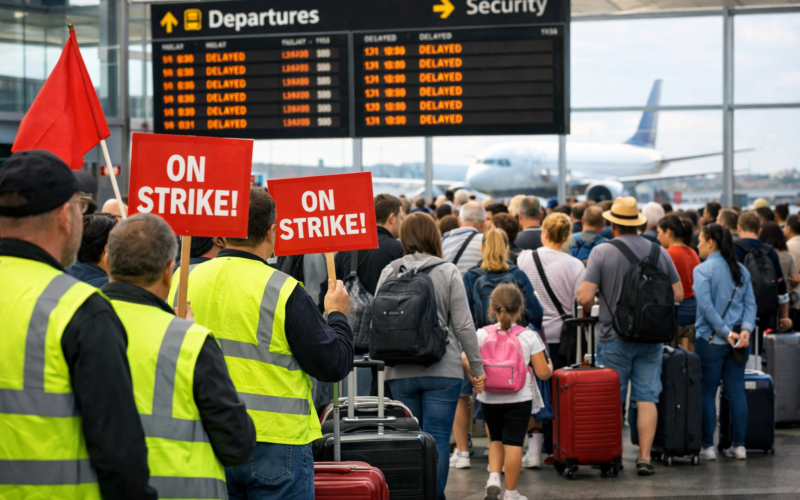
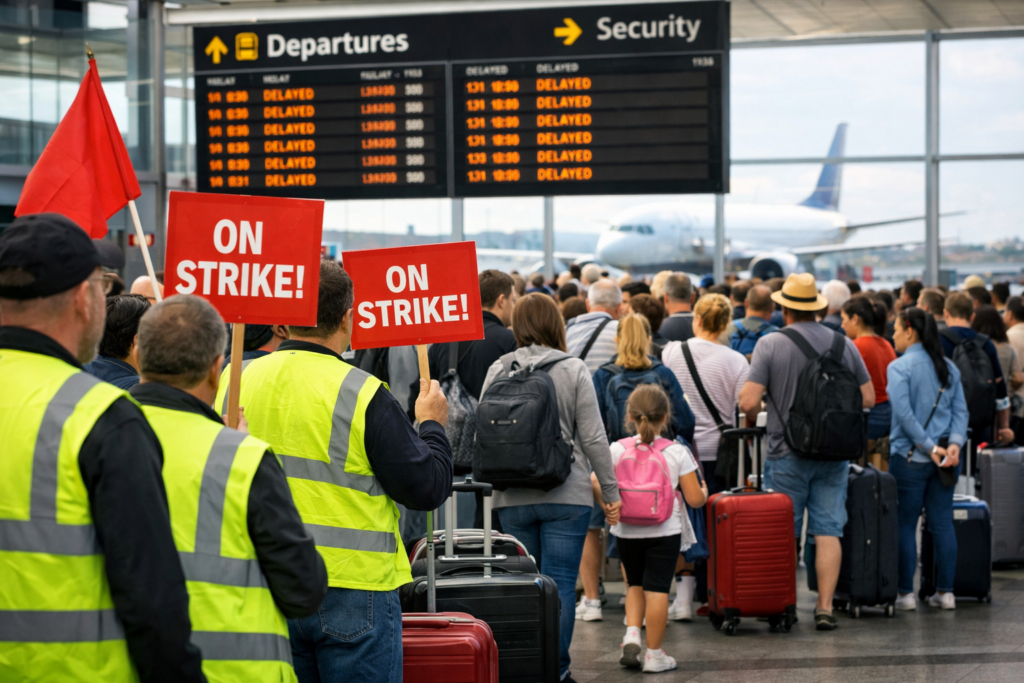
More than 100 workers employed by facility management company ABM at London Stansted Airport have voted for strike action in a dispute over pay, with the Unite trade union warning the walkout will cause flight delays for passengers travelling through the airport next week. Strikes are scheduled to take place from 17 to 20 April 2026, a period that coincides with one of the busiest leisure travel windows of the year as schools across England and Wales break for Easter and demand to Mediterranean destinations and European city break routes rises sharply.
ABM special assistance staff at London Stansted Airport vote to strike over pay offer Unite calls a real-terms pay cut
The Unite members involved in the dispute provide persons with reduced mobility services at London Stansted Airport, a category of airport operation commonly referred to as PRM services. The work involves helping passengers with disabilities to board aircraft, move between check-in counters and departure gates, and disembark on arrival. ABM provides this service under contract to the Manchester Airport Group, which owns and operates London Stansted Airport. Unite has confirmed that the strikes will result in flight delays because additional time will be required to board travellers who depend on the service, and that airlines using London Stansted may miss their scheduled departure slots during the period of industrial action.
The dispute centres on a pay offer from ABM that Unite members rejected. ABM offered workers an additional one pence per hour on their hourly rates in the first year of the proposed agreement, rising to a further two or three pence per hour in the second year. Unite characterised the offer as so minimal that workers would need to work an entire week to afford one extra tin of beans.
Unite general secretary Sharon Graham described the offer as among the worst conceivable pay rises and said ABM’s conduct was beyond contempt. Graham said the dedicated workers covered by the agreement would have to work for an entire week simply to purchase a tin of beans, and stated it was unacceptable that a profitable company such as ABM was choosing to place profit above its employees while exposing them to a real-terms pay cut. Graham confirmed that Unite would fully support its members at ABM throughout the dispute.
Why ABM workers at London Stansted Airport say the pay offer fails to reflect rising costs and growing workload pressure
Many ABM staff at London Stansted Airport are currently paid below the London Living Wage of £14.80 per hour, placing them among the lowest paid workers at the airport. Unite noted that pay increases received by ABM employees in recent years have largely resulted from government-mandated national minimum wage increases rather than from employer-led decisions, leaving workers’ real earnings falling behind the broader cost of living. ABM employees at Stansted have also pointed to growing workload pressure as London Stansted Airport has expanded its flight operations, stating they believe they deserve pay increases that reflect the greater responsibility placed on them.
How a strike by persons with reduced mobility staff at Stansted could trigger flight delays across Easter schedules
PRM services are tightly integrated into airport departure sequences. Airlines are required to ensure that passengers needing special assistance are safely boarded before aircraft doors can close and pushback can begin. A reduction in staffing levels for this service forces airlines to extend their gate time, generating delays that can cascade across subsequent rotations. London Stansted Airport is the primary United Kingdom base for Ryanair and a significant operating hub for Wizz Air and easyJet, all carriers running tight-turnaround schedules with limited tolerance for additional ground time. The April strike period falls during the airport’s highest-demand weeks of the first half of the year.
The ballot returned a 97 per cent vote in favour of industrial action across the Unite members at ABM involved in the dispute. Unite had previously secured a 12.4 per cent pay increase for ABM Aviation special assistance staff at London Stansted, alongside the introduction of company sick pay and higher overtime rates, making the outcome of the current ballot a signal that conditions have since deteriorated relative to rising living costs.
ABM responds to strike notice with contingency plans and defence of its pay proposal
ABM is a global facility management company that reported revenue of $2.2 billion in March 2026, an increase of 6.1 per cent on the prior year. Unite regional officer Steve Edwards attributed responsibility for any disruption to ABM, stating that any strike action and resulting inconvenience was entirely the fault of ABM for placing profit above people, and that the company had the ability to avoid the disruption by returning with a realistic pay offer that reflected the hard work of its employees at Stansted.
ABM responded by stating it was disappointed that industrial action was being taken given its ongoing engagement with Unite, and described its pay proposal as a structured, staged increase rather than a minimal rise. ABM said it was continuing to negotiate in good faith toward an agreement that was fair for its team members, clients, and stakeholders. The company said its immediate priority was to limit disruption to passengers with special assistance requirements who use its service at London Stansted every day, adding that it had put comprehensive contingency plans in place to maintain safety, operational resilience, and service continuity throughout the strike period.
Talks between ABM and Unite are understood to be ongoing ahead of the 17 April start date.
What the ABM strike at London Stansted means for passengers, airlines, and airport operations
- More than 100 Unite members employed by ABM at London Stansted Airport have voted 97 per cent in favour of strike action over a pay offer Unite described as delivering a real-terms pay cut, with walkouts confirmed for 17 to 20 April 2026.
- The striking workers provide persons with reduced mobility services at London Stansted, and Unite has warned that their absence will cause flight delays as airlines require additional time to board passengers who depend on these services.
- ABM, which reported $2.2 billion in revenue in March 2026, described its pay proposal as a structured staged increase and said it is continuing to negotiate in good faith with Unite while implementing contingency plans to maintain service continuity during the strike.
- Many ABM employees at London Stansted are paid below the London Living Wage of £14.80 per hour, and Unite has stated that recent pay increases at the company have been driven primarily by government minimum wage changes rather than employer decisions.
- The strike coincides with the Easter school holiday travel peak at London Stansted, which serves as a primary hub for Ryanair, Wizz Air, and easyJet, raising the risk of cascading schedule disruption across multiple routes during one of the airport’s busiest periods.
Discover more from Business-News-Today.com
Subscribe to get the latest posts sent to your email.