

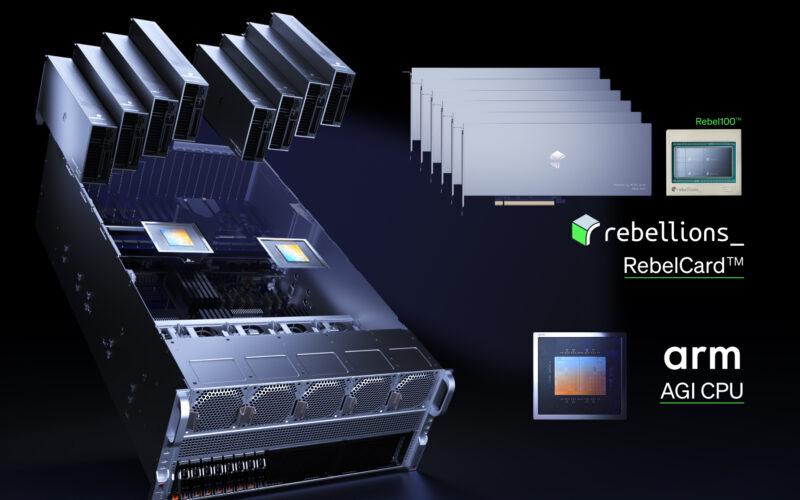
Rebellions has teamed up with Arm Holdings plc and SK Telecom Co., Ltd. to build and validate AI inference servers aimed at sovereign AI and telecom-focused data center deployments, with testing set to take place in SK Telecom Co., Ltd.’s live AI data center environment. The partnership combines Arm’s new Arm AGI CPU with Rebellions’ RebelCard accelerator and links the hardware story to SK Telecom Co., Ltd.’s broader sovereign AI stack, including its A.X K1 model strategy. That matters because the market conversation around AI infrastructure is slowly widening beyond training clusters and premium graphics processing unit scarcity toward a less glamorous but increasingly commercial question: who will control inference capacity for governments, telecom operators, and regulated industries that do not want to outsource their intelligence layer to foreign hyperscalers. Arm Holdings plc shares closed around $148.93 on the latest available U.S. quote, while SK Telecom Co., Ltd. ADRs traded at $36.41, near the top of their reported 52-week range, suggesting investors are already paying closer attention to how AI infrastructure narratives are feeding into each company’s valuation story.
The strategic logic is fairly straightforward. Rebellions gets what young chip companies usually need most but rarely secure at the right moment: credible distribution logic, a systems partner with global architecture influence, and a real deployment venue rather than a lab demo. Arm Holdings plc gets another proof point for its push to make central processing units more central to AI server design, particularly as the company tries to expand from an intellectual property licensor into a more visible force in data center compute. SK Telecom Co., Ltd. gets to move its sovereign AI ambitions one layer deeper, from model rhetoric and ecosystem positioning into the harder infrastructure question of what runs those models efficiently at scale.
Why are telecom operators suddenly becoming important buyers and validators of sovereign AI infrastructure?
Telecom operators have spent years trying to convince investors that their data centers, network assets, and enterprise relationships can be turned into something more exciting than utility-like connectivity. AI gives them a second chance, but only if they can prove they are not just resellers of somebody else’s compute. That is why this deal matters more than the average memorandum of understanding. SK Telecom Co., Ltd. is not merely attaching its name to a chip press release. It is positioning its AI data center footprint, its sovereign AI package strategy, and its proprietary A.X K1 model as pieces of a vertically integrated offer for customers that care about national control, localization, and operational predictability.
That framing also explains why the alliance is targeting telecom infrastructure specifically. Telecom operators sit in a useful middle ground between governments and hyperscalers. They already manage regulated infrastructure, operate national-scale networks, and have local enterprise trust that cloud giants do not always enjoy. In a sovereign AI market, that trust can matter almost as much as chip performance. Plenty of countries want AI capability. Fewer want strategic dependence dressed up as convenience. This is where telecom-backed AI infrastructure starts to look less like a side project and more like industrial policy with a revenue model.
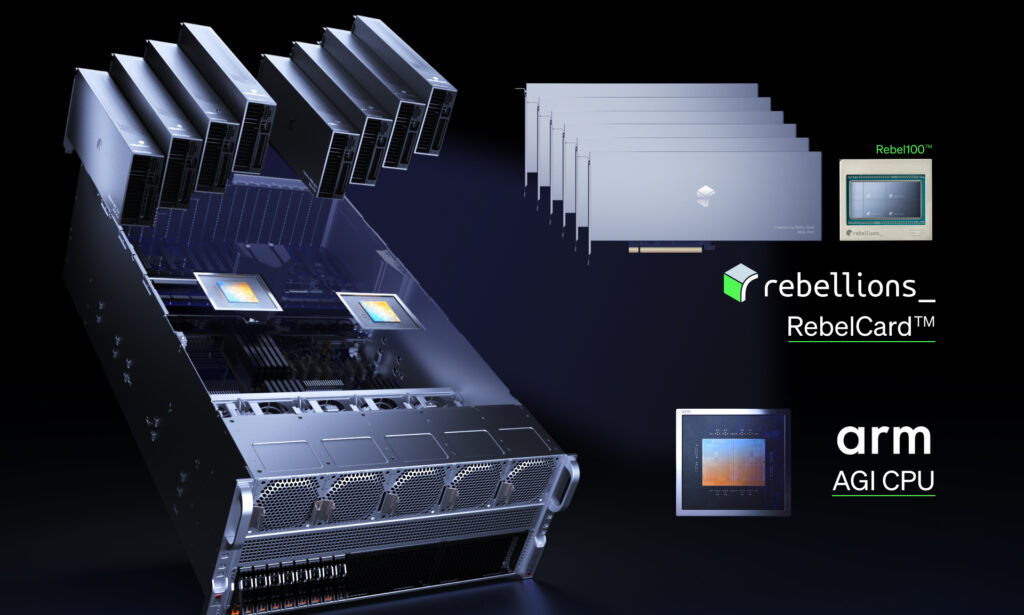
Can Rebellions’ RebelCard and Arm’s AGI CPU create a viable alternative to graphics processing unit-heavy AI servers?
The commercial case for the Arm-Rebellions architecture rests on a familiar promise: better power efficiency, air-cooled deployment, and lower-cost inference compared with more traditional graphics processing unit-heavy systems. Rebellions says RebelCard is built around its Rebel 100 chip and uses high bandwidth memory to support large multimodal and mixture-of-experts workloads, while Arm’s side of the stack brings the new Arm AGI CPU built on Arm Neoverse CSS V3 into the server design. On paper, that creates a cleaner story for inference-oriented deployments than simply throwing expensive training hardware at every workload and hoping the economics sort themselves out later.
Still, paper is polite. Real deployment is rude. The actual question is whether this stack can handle telco-grade reliability, orchestration complexity, and model-serving economics in production. That is why SK Telecom Co., Ltd.’s validation role matters so much. If the platform performs well in a live telecom AI data center, Rebellions gains something far more valuable than a benchmark chart. It gains a reference architecture. If it struggles, the industry will file this under the growing cabinet of “interesting non-graphics processing unit alternatives that were always one software layer away from greatness.” That cabinet, by the way, is getting crowded.
Arm Holdings plc has separate reasons to care. Its February shareholder letter said third-quarter fiscal 2026 revenue rose 26% year over year to $1.24 billion, with royalty revenue up 27% to $737 million, supported by demand across AI and general-purpose data centers, smartphones, physical AI, and edge AI. The company also said it would report fourth-quarter fiscal 2026 results on May 6, 2026. In other words, Arm is already monetizing AI exposure through licensing and royalties, but the deeper prize is proving that Arm-based server infrastructure can become standard in more AI deployments, not just adjacent to them.
How does this alliance fit into South Korea’s broader effort to build a sovereign AI stack at home?
This is not an isolated partnership. It sits neatly inside South Korea’s broader sovereign AI push, where policy ambition, telecom infrastructure, domestic model development, and semiconductor capability are increasingly being stitched together into the same narrative. SK Telecom Co., Ltd. unveiled A.X K1 in late 2025 as a 519 billion-parameter model and later said the consortium had advanced to Phase 2 of the government-backed sovereign AI foundation model project. The company has also been marketing a “Sovereign AI Package” that combines infrastructure, proprietary models, and industry services. That makes the Rebellions-Arm server tie-up less of a one-off hardware announcement and more of a missing infrastructure layer being slotted into a national strategy.
For Rebellions, that positioning could be especially valuable in Asia, where governments and telecom groups are increasingly interested in AI autonomy but may not want to wait for domestic champions to build every component alone. A partnership model lets local infrastructure buyers claim strategic independence without pretending they can decouple from global compute ecosystems entirely. Arm’s inclusion makes the stack globally legible. SK Telecom Co., Ltd.’s role makes it regionally credible. Rebellions provides the national-champion energy. It is an elegant political and commercial compromise, which is usually the kind of compromise that gets funded.
What are the biggest commercial and execution risks facing the Rebellions, Arm, and SK Telecom Co., Ltd. partnership?
The first risk is that sovereign AI is still a seductive phrase with uneven purchasing behavior behind it. Governments and public-sector entities may say they want independent AI infrastructure, but procurement cycles are slow, budgets are political, and local capability goals often collide with cost reality. The second risk is software. Hardware alliances are easy to announce and hard to operationalize. The companies say they will co-develop the full software stack, including firmware. That is exactly the right ambition, and exactly the part that tends to separate serious infrastructure plays from expensive science projects.
The third risk is competitive gravity. Nvidia still dominates the mental map of AI infrastructure buyers, and even where inference becomes more specialized, challengers must overcome not just performance comparisons but developer familiarity, toolchain maturity, and procurement inertia. Meanwhile, Arm Holdings plc itself is navigating a period of heightened investor debate. Recent coverage noted that Morgan Stanley downgraded the stock to equal weight even while acknowledging the strategic rationale of Arm’s move deeper into chip and data center opportunity, arguing that near-term execution and commercialization risks could cap upside. That does not invalidate the Rebellions deal, but it does underline a broader point: the market is no longer rewarding AI adjacency alone. It wants evidence that the revenue path is real.
SK Telecom Co., Ltd. faces a different version of the same question. Its ADR has traded near the top of its reported 52-week range, which suggests optimism about its artificial intelligence strategy is already being reflected to some degree. That raises the bar. Investors will want to see that sovereign AI package language translates into monetizable infrastructure demand, not just conference-stage vocabulary.
What should investors and enterprise buyers watch next after the Rebellions and Arm partnership announcement?
The next useful milestone is not another partnership headline. It is validation detail. Investors and enterprise buyers should watch for evidence on three fronts: whether SK Telecom Co., Ltd. actually runs A.X K1 or related workloads on the new server design, whether the companies publish performance or efficiency data that can be compared credibly with incumbent alternatives, and whether any telecom or public-sector customers beyond South Korea move from interest to procurement. If those signals emerge, Rebellions starts to look less like a promising domestic chip story and more like a serious inference infrastructure vendor with export potential.
The broader industry implication is that the AI infrastructure market is fragmenting in a commercially rational way. Training remains one contest. Sovereign inference, telecom AI, and regulated deployment environments are becoming another. That is good news for challengers because it creates room for architectures optimized around efficiency, serviceability, and local control rather than raw training prestige. It is also good news for Arm Holdings plc, whose architecture strengths become more relevant as AI compute spreads into more deployment types. And it may be the best possible stage for SK Telecom Co., Ltd. to argue that telecom operators can be infrastructure orchestrators in the AI era rather than just bandwidth landlords with nice slide decks.
What are the key takeaways on what the Rebellions, Arm, and SK Telecom Co., Ltd. alliance means for sovereign AI infrastructure?
- Rebellions has moved beyond startup signaling and secured a partnership structure that gives it architecture credibility, deployment access, and a clearer route to commercial validation.
- SK Telecom Co., Ltd. is trying to turn sovereign AI from a model-development narrative into a full-stack infrastructure business.
- Arm Holdings plc gains another real-world path to deepen its relevance in AI servers, especially for inference-oriented and power-sensitive deployments.
- The alliance targets a market segment that cares about localization, regulatory comfort, and national control as much as benchmark performance.
- Telecom operators could emerge as important sovereign AI intermediaries because they combine infrastructure ownership, enterprise relationships, and regulatory familiarity.
- The live validation environment at SK Telecom Co., Ltd.’s AI data center is more important than the announcement itself because it will determine whether the stack is commercially believable.
- Rebellions’ long-term challenge is not just chip performance but software maturity, workload compatibility, and procurement trust.
- For Arm Holdings plc investors, the partnership supports the company’s AI infrastructure expansion story but does not remove execution risk around monetization and competitive positioning.
- For SK Telecom Co., Ltd. investors, the market will eventually demand revenue evidence, not just sovereign AI branding.
- The bigger industry signal is that AI infrastructure is splitting into multiple profit pools, and sovereign inference may become one of the most strategically contested.
Share this:
Discover more from Business-News-Today.com
Subscribe to get the latest posts sent to your email.