


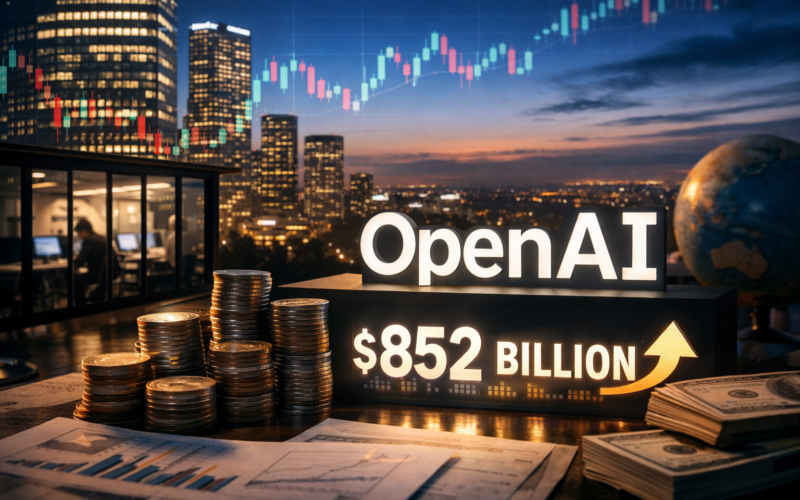
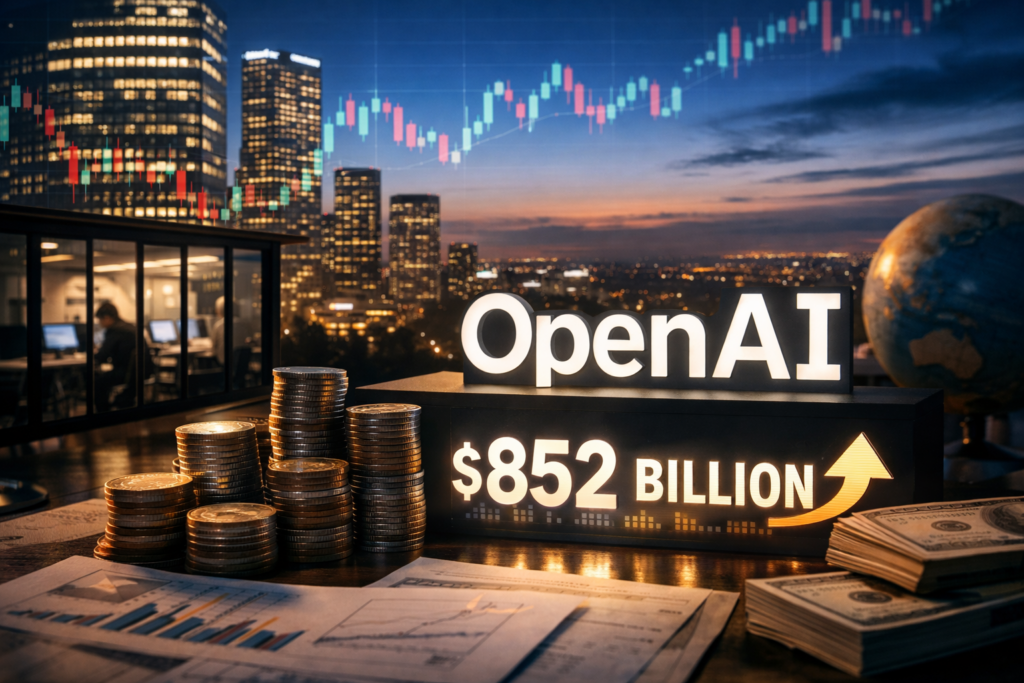
OpenAI Group PBC has closed its largest funding round to date, raising $122 billion in committed capital at a post-money valuation of $852 billion, a figure that surpasses the GDP of most nations and eclipses any prior venture financing deal on record. The round was anchored by Amazon.com Inc. ($50 billion), Nvidia Corp. ($30 billion), and SoftBank Group Corp. ($30 billion), with continued participation from Microsoft Corp. and a broad coalition of institutional and sovereign wealth investors. For the first time in its history, OpenAI extended access to individual retail investors through bank channels, raising more than $3 billion from that segment alone. The announcement arrives as OpenAI reports monthly revenues of $2 billion and actively constructs the narrative for what is widely expected to be one of the most consequential IPOs in technology history.
Why did OpenAI raise $122 billion and what does the $852 billion valuation actually reflect about its business model?
The headline numbers demand context. OpenAI’s $852 billion valuation is not simply a reflection of current earnings, though those earnings are themselves remarkable. The company reported $13.1 billion in revenue for 2025 and is now generating $2 billion per month, a trajectory it claims is four times faster than Alphabet Inc. and Meta Platforms Inc. achieved at equivalent commercial stages. That comparison is aggressive but not entirely without basis: ChatGPT reached 100 million users faster than any prior consumer platform, and the transition from consumer novelty to enterprise infrastructure has occurred with unusual speed.
What the valuation reflects, however, is less a present-tense earnings multiple and more a thesis about infrastructure ownership. OpenAI’s own framing positions the company as the foundational intelligence layer for the global economy, analogous to electricity grids or internet backbone providers. At that level of abstraction, $852 billion does not look like a richly priced software company. It looks like the early pricing of a category that does not yet have a comparable historical reference point. Whether that thesis proves correct over a five-to-ten-year horizon is a separate question from whether investors are willing to pay for it today, and clearly they are.
The capital itself has a clear operational purpose. OpenAI has been spending at scale on GPU clusters, data centre construction, and talent acquisition. Chief Executive Officer Sam Altman previously indicated total infrastructure investment targets north of $1 trillion; more recent guidance from the company has revised that figure to approximately $600 billion by 2030. Even the lower figure requires sustained capital deployment well beyond what existing revenue streams could support organically. The $122 billion round, supplemented by a revolving credit facility expanded to $4.7 billion and supported by JPMorgan Chase, Goldman Sachs, Morgan Stanley, and seven other major banks, provides the runway to continue at that pace without compromising operational flexibility.
How is Amazon’s contingent $35 billion investment in OpenAI structured around AGI milestones and an IPO?
The most structurally interesting element of the funding round is the conditionality embedded in Amazon’s commitment. Of Amazon’s $50 billion total, $35 billion is contingent on OpenAI either completing an initial public offering or achieving a technological milestone defined as artificial general intelligence. This is not a standard venture condition. AGI remains an undefined term even within the AI research community, and tying $35 billion of capital to its attainment creates an unusual governance and disclosure obligation for a company about to enter public markets.
From Amazon’s perspective, the conditionality is commercially rational. Amazon Web Services is a cloud infrastructure partner and a direct beneficiary of OpenAI’s compute spending. Structuring part of the investment around an IPO trigger allows Amazon to maintain optionality: if OpenAI’s public market debut delivers the expected valuation uplift, the $35 billion deployment accelerates returns; if the IPO is delayed or the valuation disappoints, Amazon retains capital. The AGI trigger is less easily legible, but it signals Amazon’s confidence that OpenAI will define that milestone in ways consistent with commercial milestones, not purely academic ones.
What does OpenAI’s retail investor tranche and ARK Invest ETF inclusion signal about its IPO timeline?
Raising $3 billion from individual investors via bank channels is not a financing necessity for a company with $122 billion in total commitments. It is a distribution exercise. By onboarding retail capital into the pre-IPO structure and simultaneously announcing inclusion in exchange-traded funds managed by ARK Investment Management LLC, OpenAI is manufacturing the demand architecture that typically precedes a public listing. Chief Financial Officer Sarah Friar described the financing as blowing out of the water even the largest IPO that has ever been done, a statement that simultaneously sets expectations and signals sequencing.
Market participants tracking the IPO timeline have placed a Q4 2026 target as the most probable window. The ARK ETF inclusion is particularly deliberate: it gives retail investors indirect exposure to OpenAI’s equity before the shares are listed, building a shareholder base that is already familiar with the story and theoretically willing to support the offering. It also generates sustained media coverage at a moment when OpenAI wants its commercial momentum narrativised to institutional allocators who will anchor the book.
How does OpenAI’s compute infrastructure strategy across Nvidia, AMD, and its own Broadcom chip reduce dependency risk?
One of the more consequential disclosures in OpenAI’s funding announcement is the explicit articulation of a multi-vendor compute strategy. The company confirmed that while Nvidia Corp. remains the foundation of its training infrastructure and the majority of its inference stack, it is actively building a broader portfolio spanning AMD Inc. processors, AWS Trainium chips, Cerebras Systems silicon, and a proprietary chip developed in partnership with Broadcom Inc. Cloud infrastructure similarly spans Microsoft Azure, Oracle Corp., Amazon Web Services, CoreWeave Inc., and Google Cloud.
This diversification reflects a genuine strategic calculation rather than simple supply chain hedging. Different workloads have materially different cost and latency profiles on different hardware architectures, and OpenAI’s product mix, which spans training frontier models, serving high-volume inference, and running real-time agentic workflows, is heterogeneous enough that no single chip family can optimise across all of them efficiently. The Broadcom co-designed chip, in particular, positions OpenAI to reduce per-token costs on specific inference workloads where the model architecture and the hardware can be co-optimised, a margin lever that compounds at the volume OpenAI is now running.
For Nvidia, which counts OpenAI as one of its most prominent strategic partners and participated in the funding round with $30 billion, the multi-vendor posture is a credible long-term risk, even if Nvidia’s near-term revenue exposure remains limited. The market will watch whether OpenAI’s Broadcom chip transitions from a disclosed partnership to a material component of its training infrastructure, which would be the threshold at which Nvidia’s relationship with its largest AI customer begins to genuinely change in character.
Can OpenAI sustain $2 billion in monthly revenue growth while remaining unprofitable ahead of an anticipated IPO?
OpenAI’s revenue trajectory is impressive by almost any benchmark. Moving from $1 billion per quarter to $2 billion per month in roughly twelve months represents a revenue velocity that very few enterprise software companies have achieved at comparable scale. The consumer side of the business continues to carry significant weight: ChatGPT reports more than 900 million weekly active users, over 50 million paid subscribers, and an advertising pilot that reached $100 million in annualised recurring revenue within six weeks of launch.
The profitability question is less easily answered. OpenAI remains cash-negative, burning capital against infrastructure investment and model development at a rate that current revenues do not cover. The company is betting that the cost-per-token will continue to decline as algorithmic efficiency and hardware improvements compound, while the revenue-per-token increases as enterprise adoption deepens and agentic workflows unlock higher-value use cases. That is a coherent thesis, but it is also one that requires executing on multiple technical and commercial fronts simultaneously over a period of years.
The decision to shut down Sora, OpenAI’s short-form video generation application, is illustrative of the tightening strategic discipline. Sora attracted significant attention at launch but failed to generate the engagement or monetisation that justified continued investment, particularly after a licensing arrangement with Walt Disney Co. reportedly dissolved. Chief Financial Officer Friar’s repeated reference to practical adoption as the 2026 strategic priority reflects a company that is now optimising for revenue quality and margin path rather than product surface area. That is the right posture for a company approaching public markets, even if it comes at the cost of some of the experimental momentum that defined OpenAI’s earlier identity.
How does the OpenAI superapp strategy affect Anthropic, Google DeepMind, and Microsoft Copilot in the enterprise AI market?
OpenAI’s announcement of a unified AI superapp, combining ChatGPT, Codex, browsing, and agentic capabilities into a single agent-first interface, is the clearest signal yet that the company intends to own the primary interaction layer between enterprise users and AI infrastructure. The strategic logic is sound: as model capabilities converge across frontier providers, differentiation increasingly accrues to distribution and workflow integration, not raw benchmark performance. A superapp that handles scheduling, coding, search, and complex multi-step tasks within one session creates switching costs that are qualitatively different from those of an API provider.
For Anthropic PBC, which has built its enterprise positioning on the reliability and safety profile of its Claude model family, the superapp announcement raises the competitive intensity of a market where it already lacks OpenAI’s consumer distribution advantage. Anthropic’s revenue model is more heavily API-dependent, and a superapp that absorbs enterprise workflows directly would reduce the addressable market for standalone model API providers. Google DeepMind faces a different version of the same problem: Gemini has technical parity with GPT-5.4 on many benchmarks, but Google’s inability to consolidate its consumer and enterprise AI surfaces into a single coherent product has been a persistent weakness that OpenAI is now explicitly exploiting.
Microsoft Corp. occupies an ambiguous position. As a long-term investor and cloud partner, Microsoft benefits from OpenAI’s commercial success. As a competing enterprise software vendor, however, the superapp ambition puts OpenAI on a collision course with Microsoft Copilot, which is embedded across the Microsoft 365 suite and targets the same workflow integration use cases. The OpenAI-Microsoft relationship has always contained this latent tension; the superapp announcement makes it structural rather than hypothetical.
What are the risks that could prevent OpenAI from justifying its $852 billion valuation over the next three to five years?
At $852 billion, OpenAI is being priced as if it will dominate the infrastructure layer of the AI economy in the way that Amazon Web Services dominated cloud infrastructure or that Apple Inc. dominated mobile. That analogy is flattering but not automatic. Several structural risks deserve honest treatment. First, the cost structure. OpenAI’s compute spending is not simply a scaling investment; it is also a competitive necessity, because any slowdown in training and infrastructure investment creates an opening for Anthropic, Google, Meta, and a deepening Chinese competitive tier that includes DeepSeek and Zhipu AI. Sustaining that spend while closing the path to profitability is a genuine tension.
Second, regulatory risk. The European Union’s AI Act introduces compliance obligations that disproportionately affect frontier model providers, and US regulatory posture, while currently permissive, could shift if AI-related job displacement becomes a political flashpoint. Third, talent concentration. OpenAI’s competitive position depends on retaining a small number of researchers and engineers for whom competing offers from Anthropic, Google DeepMind, and well-funded startups are constant. At $852 billion, the equity compensation upside that once anchored loyalty looks different than it did at a $30 billion valuation.
None of these risks are fatal, and none of them alter the core thesis that OpenAI is operating at a scale and with a commercial momentum that no other AI company currently matches. But at this valuation, the margin for strategic error is narrower than the headline numbers suggest, and investors entering at $852 billion are pricing in a degree of execution perfection that technology history rarely accommodates.
Key takeaways: What OpenAI’s $122 billion funding round means for the AI industry, enterprise technology, and global capital markets
- OpenAI has closed the largest private funding round in Silicon Valley history at $122 billion and an $852 billion post-money valuation, surpassing its February commitment of $110 billion.
- The three anchor investors are Amazon ($50 billion), Nvidia ($30 billion), and SoftBank ($30 billion), with Amazon’s $35 billion contingent on either an IPO or an AGI milestone.
- Revenue has accelerated from $1 billion per quarter at end-2024 to $2 billion per month, with OpenAI claiming growth four times faster than Alphabet and Meta at equivalent commercial stages.
- The retail investor tranche ($3 billion via bank channels) and ARK Invest ETF inclusion are pre-IPO demand-building mechanisms pointing to a probable Q4 2026 public listing.
- OpenAI’s multi-vendor compute strategy across Nvidia, AMD, AWS Trainium, Cerebras, and a Broadcom co-designed chip positions it to structurally reduce per-token inference costs as volume scales.
- The unified AI superapp strategy puts OpenAI in direct competition with Microsoft Copilot and represents the clearest challenge to date to enterprise AI platforms built on standalone model APIs.
- Sora’s shutdown signals a deliberate retreat from experimental consumer products and a sharpening focus on revenue-generating enterprise and coding tools ahead of public market scrutiny.
- Enterprise revenue now accounts for more than 40% of total revenue, up from roughly 30% a year ago, and is projected to reach parity with consumer by end of 2026.
- Anthropic and Google DeepMind face structurally disadvantaged distribution positions as OpenAI consolidates consumer reach and enterprise workflow integration within a single product surface.
- OpenAI remains unprofitable and is betting on declining compute costs and deepening enterprise monetisation to close the gap, a thesis that is coherent but requires multi-year execution discipline at enormous capital intensity.
Share this:
Discover more from Business-News-Today.com
Subscribe to get the latest posts sent to your email.