Unilever (NYSE: UL) has signed an agreement to acquire Grüns, a three-year-old U.S. vitamins, minerals, and supplements company that has built one of the fastest-rising positions in the American greens supplement category. The deal, announced on 9 April 2026, adds a digitally native, gummy-format brand to Unilever’s growing Wellbeing portfolio at a point when the consumer goods giant is simultaneously shedding its food business through the landmark McCormick merger. Financial terms were not disclosed, though Grüns was valued at approximately $500 million following a Series B round in 2025. The acquisition sharpens Unilever’s strategic pivot toward premium health and beauty categories in its most important growth market.
Why is Unilever doubling down on U.S. wellness acquisitions in 2026?
The Grüns transaction does not arrive in isolation. Over the past several years, Unilever has systematically assembled a wellness and supplement portfolio that now includes Liquid I.V., Nutrafol, Olly Nutrition, SmartyPants Vitamins, and Welly. Grüns slots into this architecture as its first meaningful greens supplement brand, filling a product gap that the others do not cover. The timing matters: Unilever announced in late March 2026 that it would merge its Foods division with McCormick in a deal valuing the combined entity at $65 billion, with Unilever retaining a 65% stake. That transaction, when it closes, will fundamentally shift Unilever’s revenue mix toward Beauty and Wellbeing. Adding Grüns now is consistent with building out the division that will carry the most strategic weight in the post-Foods portfolio.
Unilever’s Beauty and Wellbeing segment generated 6.5% underlying sales growth in 2024, outpacing the broader group, and Wellbeing specifically has been the fastest-growing pocket within that division. The U.S. greens supplement category has expanded sharply as consumers increasingly seek convenient, multi-functional nutrition formats that replace the friction of powders and pill regimens. Grüns positioned itself directly against that friction point from the outset.
What makes Grüns different from the greens supplement brands Unilever already competes against?
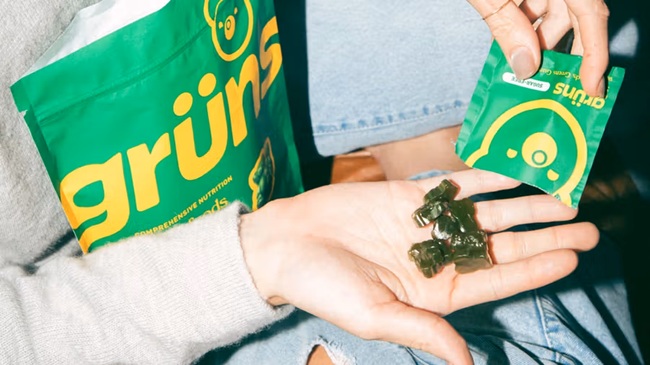
Chad Janis founded Grüns in 2023 on a specific consumer insight: awareness of the supplement category was not the barrier to adoption. Adherence was. Most greens supplement products require mixing powders into water, tolerating earthy or grassy flavors, and maintaining a daily discipline that a large proportion of buyers abandon within weeks. Grüns reformulated the delivery mechanism entirely, compressing more than 60 ingredients including 30-plus organic fruits and vegetables, 21 vitamins and minerals, and six grams of prebiotic fiber into a daily gummy format that is designed to taste good enough to become a genuine habit rather than a chore.
The product architecture is multifunctional in a way that competitors rarely match at the same serving size. A single daily portion covers the nutritional ground of a traditional greens powder and a standard multivitamin simultaneously, which simplifies the supplement routine for consumers managing multiple daily products. Whether the clinical efficacy of the formulation fully supports the marketing positioning is a question Unilever’s science and regulatory teams will now have to validate at scale, but the commercial data to date suggests the format resonates: Grüns reports more than one million customers, over 95,000 five-star reviews, and approximately 10 million gummies shipped every day.
Distribution has moved well beyond direct-to-consumer. Grüns is currently stocked at Target, Walmart, Costco, Sam’s Club, and Sprouts, a retail footprint that took the brand less than three years to establish. Holding the number one position on Amazon in the greens supplement category is commercially meaningful but also a function of the category’s relative youth as a mass-market product. The more defensible signal is the club and mass channel presence, which implies repeat purchase behavior at the household rather than trial-purchase level.
How does the Grüns acquisition fit within Unilever’s broader portfolio transformation strategy?
Unilever under chief executive Fernando Fernandez has described the company’s direction as a transition toward being a simpler, more focused business. The Foods divestiture to McCormick is the clearest structural expression of that intent. The Grüns acquisition reinforces the other side of the same logic: capital and organizational attention are being redirected toward categories where Unilever sees sustainable premium pricing power and where the U.S. consumer is actively growing spend.
The greens supplement market is one of those categories. It is fragmented, relatively young as a mainstream consumer product, and expanding through a combination of social media virality, celebrity wellness culture, and genuine functional demand from aging millennial consumers who grew up with dietary supplements but want more convenient formats. Unilever’s distribution muscle, retail relationships, and marketing infrastructure are advantages that a three-year-old digitally native brand cannot replicate on its own within any realistic timeframe.
The risk in this type of acquisition is not execution at scale but brand authenticity. Grüns built a following through a culture-driven identity that positioned it as a challenger to the established supplement industry. Consumers who chose Grüns over legacy brands because it felt independent and community-native may respond differently once a $100-billion parent company is visibly attached to the logo. Unilever has navigated this tension with varying success across its wellness portfolio. Liquid I.V. has retained meaningful brand equity post-acquisition. Dollar Shave Club, acquired by Unilever in 2016 and sold in 2023 at a steep loss, is a cautionary example of how aggressively scaled challenger brands can lose their identity, and their consumer base, when corporate integration is handled poorly.
Can Grüns sustain category leadership as competition intensifies in the greens supplement space?
The greens supplement category is attracting capital at pace. Brands including AG1 (Athletic Greens), Bloom Nutrition, and a growing list of private-label entrants are competing for the same consumer and the same shelf positions. AG1, in particular, occupies a premium subscription-led position that has been commercially resilient. Bloom has replicated some of Grüns’ social media playbook with significant traction among younger demographics.
Within this environment, Grüns has differentiated primarily through format, flavoring, and retail accessibility rather than through clinical differentiation that would be difficult for competitors to copy. The gummy format is distinctive but not proprietary. If the category migrates toward gummies more broadly, which seems likely given consumer preference trends, Grüns’ current format advantage narrows. Unilever’s task is to find and sustain a more durable moat, whether through proprietary formulation development, retailer exclusivity arrangements, or brand investment that converts category-trial consumers into long-term loyalists.
Grüns has also moved into adjacencies quickly. The product line now includes Grüns Kids, Nütrops for cognitive support, Immün for immune health, and Jüced for energy. Portfolio breadth at this stage of brand development is a double-edged consideration. It signals ambition and reduces reliance on a single SKU, but it also dilutes brand focus and creates execution complexity for a three-year-old organization. Under Unilever, those adjacencies will benefit from professional regulatory, supply chain, and marketing infrastructure, but the brand strategy will need to be sharpened to avoid the Wellbeing portfolio becoming internally cannibalistic.
How has the Unilever stock responded and what does the market signal about the deal’s strategic reception?
Unilever shares edged slightly higher on the day of the announcement, a muted but positive reaction that stands in contrast to the sharper movement triggered by the McCormick Foods deal, which pulled the stock down approximately 7% when it was announced on 31 March 2026. The Grüns acquisition is categorically smaller and does not restructure the balance sheet in the way the Foods transaction does, which explains the more subdued market response.
On the NYSE, Unilever ADR (UL) last traded at approximately $55.70 as of 8 April 2026, near the lower end of its 52-week range of $54.95 to $74.97. The stock is trading well below its 52-week high, which reflects broader market pressure as much as company-specific concerns, but the gap between current price and the average analyst price target of approximately $65.55 suggests a market that sees Unilever’s portfolio repositioning as credible but not yet fully de-risked. DZ Bank upgraded Unilever to a Buy rating on 8 April, and Barclays maintained a Buy call earlier in the month, signaling that institutional sentiment has not materially soured on the company’s strategic direction despite the complexity of executing simultaneous large transactions.
The Grüns deal does not move the needle on near-term earnings, but it is additive to the narrative Unilever is building around premium health and wellbeing as its structural growth engine. The valuation at approximately $500 million for a three-year-old brand is aggressive by historical consumer goods acquisition standards, but is broadly consistent with what the market has been pricing into high-growth supplement brands with this level of retail penetration and consumer traction.
Key takeaways on what the Unilever acquisition of Grüns means for the company, its competitors, and the wellness industry
- Unilever (NYSE: UL) is acquiring Grüns for an undisclosed sum, with the brand last valued at approximately $500 million, as it accelerates its pivot away from Foods toward Beauty and Wellbeing.
- The deal fills a specific gap in Unilever Wellbeing’s portfolio: Grüns is its first dedicated greens supplement brand, complementing Liquid I.V., Nutrafol, Olly, and SmartyPants.
- Grüns’ core differentiation is format, not formulation: the gummy delivery mechanism addresses the adherence problem that has historically limited greens supplement penetration among mainstream consumers.
- Commercial traction is strong for a three-year-old brand: over one million customers, 10 million gummies shipped daily, and retail placement across Target, Walmart, Costco, Sam’s Club, and Sprouts.
- Unilever’s distribution infrastructure and retailer relationships should accelerate Grüns’ U.S. footprint, but international expansion is a longer-term optionality that the deal does not immediately unlock.
- The primary execution risk is brand authenticity: digitally native challenger brands acquired by large FMCG companies face documented consumer loyalty risks when corporate parentage becomes visible.
- Competition in the greens category is intensifying, with AG1 and Bloom Nutrition among the established rivals; Grüns’ gummy format is distinctive but not structurally protected against imitation.
- Unilever’s simultaneous execution of the McCormick Foods merger and the Grüns acquisition signals a company willing to manage portfolio complexity in both directions at pace, which adds integration risk even if individual deal rationale is sound.
- Unilever UL shares remain near the lower end of their 52-week range at around $55.70, with institutional coverage maintaining Buy positions and a consensus price target in the mid-$60s suggesting recovery upside as portfolio clarity improves.
- The acquisition is a further indicator that the U.S. greens supplement category, previously fragmented and digitally concentrated, is entering a consolidation phase as large-cap FMCG players move to own the dominant positions before category growth fully matures.
Share this:
Discover more from Business-News-Today.com
Subscribe to get the latest posts sent to your email.