



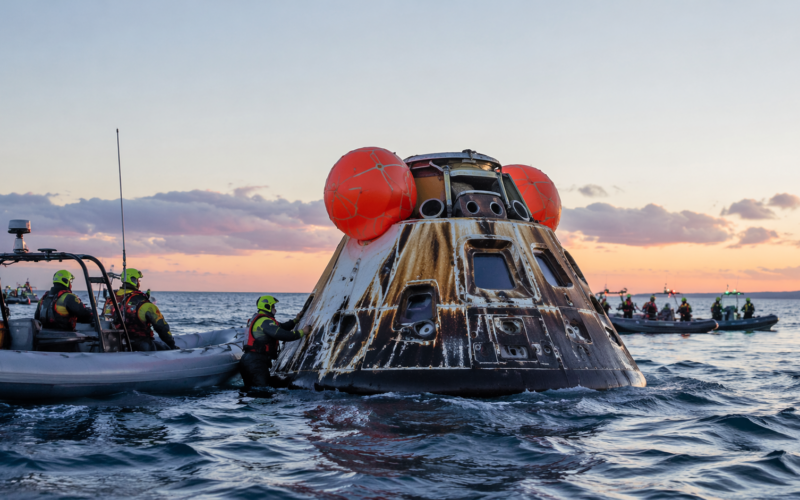
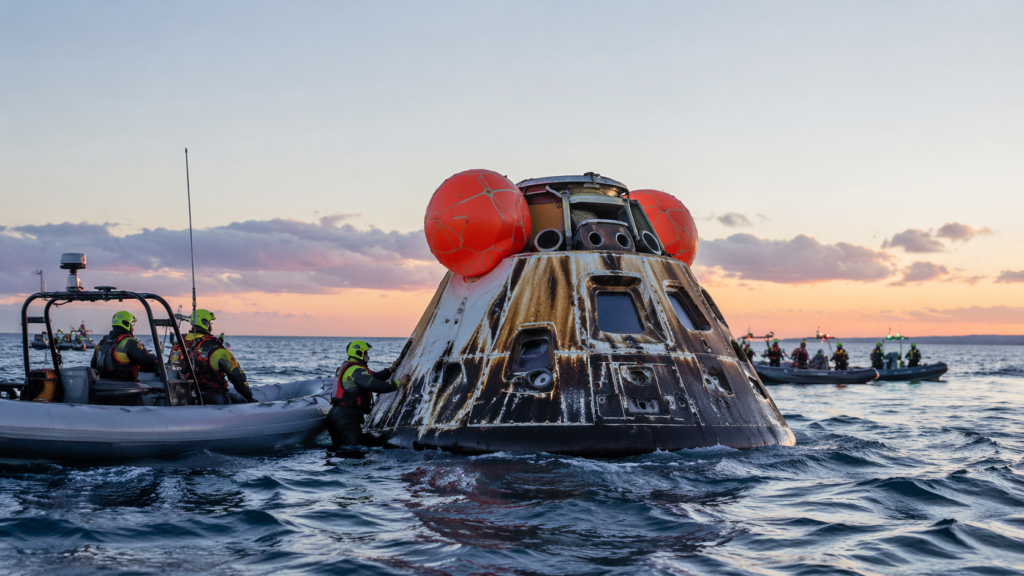
NASA’s Orion spacecraft Integrity splashed down in the Pacific Ocean off the coast of San Diego, California, on April 10, 2026, at 8:07 p.m. Eastern Daylight Time, bringing the Artemis II crew home after a 10-day mission that marked humanity’s return to the vicinity of the Moon for the first time in more than 50 years. NASA’s Mission Control Center described the landing as a perfect bullseye splashdown. Mission Control commentator Rob Navias called it a perfect descent. Commander Reid Wiseman radioed from inside the capsule to confirm all four crew members were in excellent condition.
The Artemis II crew consisted of NASA astronauts Reid Wiseman, serving as mission commander, Victor Glover as pilot, and Christina Koch as mission specialist, alongside Canadian Space Agency astronaut Jeremy Hansen as mission specialist. The crew lifted off on April 1, 2026, at 6:35 p.m. Eastern Daylight Time from Launch Pad 39B at NASA’s Kennedy Space Center in Florida aboard the Space Launch System rocket. The 10-day mission covered a total journey of approximately 694,481 miles from launch to splashdown.
Orion entered Earth’s upper atmosphere at 400,000 feet altitude while traveling at nearly 35 times the speed of sound, with the crew experiencing gravitational forces of up to 3.9 times their body weight during re-entry. A planned six-minute communications blackout occurred as plasma formed around the capsule. Drogue parachutes deployed at approximately 22,000 feet to stabilize the capsule, followed by three main parachutes at around 6,000 feet, reducing Orion’s speed to under 136 miles per hour before touchdown in the water at approximately 20 miles per hour. Recovery teams from NASA and the United States Navy transferred crew members by helicopter to the USS John P. Murtha, the amphibious ship leading the recovery operation, for post-mission medical evaluation before onward transport to NASA’s Johnson Space Center in Houston, Texas.
Why did NASA modify the Artemis II re-entry profile and what were the concerns over the Orion heat shield?
Re-entry had been the subject of sustained pre-mission scrutiny due to known design issues with the Orion heat shield. The heat shield on the Artemis II capsule was nearly identical to the shield flown on the Artemis I uncrewed test flight in 2022, which returned to Earth with unexpected and extensive pockmarking across its surface. To reduce risk, NASA replaced the originally planned skip re-entry trajectory with a steeper and faster descent, limiting the capsule’s exposure to peak heating. Howard Hu, the Orion program manager, stated before the mission that some degree of heat shield cracking was anticipated and that engineering analyses had confirmed the capsule’s underlying structure would remain intact under conditions exceeding those expected during re-entry. NASA Administrator Jared Isaacman said in January 2026 that he supported proceeding with the mission using the existing heat shield after reviewing the agency’s analysis and meeting with engineers and outside experts. Some engineers who had previously raised concerns indicated that additional data had addressed their questions, while others continued to object to flying without a redesigned heat shield. NASA has stated that design changes addressing AVCOAT permeability are planned for the heat shield intended for Artemis III.
How did the Artemis II lunar flyby on April 6, 2026, break the 56-year Apollo 13 distance record for human spaceflight?
The Artemis II mission’s central objective was the first crewed lunar flyby since the Apollo 17 mission in December 1972, which had been the last time humans had traveled to the Moon. On April 6, 2026, the crew completed that flyby, passing within approximately 4,067 miles of the lunar surface at closest approach. Orion then passed behind the Moon, resulting in a planned communications blackout lasting approximately 40 minutes, among the longest communication interruptions in the history of human spaceflight. At its farthest point during the flyby, Orion reached approximately 252,756 miles from Earth, surpassing the previous human spaceflight distance record of 248,655 miles that had been held by the Apollo 13 crew since April 1970. The Artemis II crew exceeded that mark by more than 4,000 miles under fully planned mission conditions.
The Apollo 13 distance record had stood for 56 years and had been set under emergency circumstances. Apollo 13, launched in April 1970, never completed its intended lunar landing due to an oxygen tank rupture shortly after departure. The crew reached their extreme distance from Earth as a consequence of using the free-return trajectory to loop around the Moon and return safely to Earth. Artemis II surpassed that mark deliberately, as part of a fully planned scientific flyby mission.
What scientific observations and crew firsts were recorded during the Artemis II lunar flyby in April 2026?
Multiple historic crew firsts were recorded during the Artemis II mission. Christina Koch became the first woman to complete a lunar flyby. Victor Glover became the first person of colour to travel around the Moon. Jeremy Hansen became the first non-American to fly beyond low Earth orbit.
During the flyby observation period, the Moon aligned between Orion and the Sun, creating an approximately one-hour solar eclipse as observed from the spacecraft. The crew used the eclipse to observe the solar corona and reported witnessing at least four meteoroid impact flashes on the lunar surface. The crew captured an estimated 10,000 photographs during the flyby and became the first humans to observe portions of the Moon’s far side with direct human vision. NASA scientists had identified approximately 35 geological features for the crew to observe and document. Among them was the Orientale Basin, a 600-mile-wide impact crater that straddles the boundary between the Moon’s near and far sides and had never before been seen in sunlight by human observers.
The crew proposed provisional names for two newly identified lunar craters during the observation period. One was named Integrity, in honor of the Orion spacecraft. The second was named Carroll, a tribute to Commander Reid Wiseman’s late wife, who died of cancer in 2020. Mission specialist Jeremy Hansen announced the Carroll dedication during a space-to-ground press conference, with fellow crew members visibly moved by the tribute. Wiseman described the moment as the most deeply profound of the entire mission.
What is the significance of the Artemis II mission for future NASA crewed lunar landing plans under the Artemis program?
Artemis II is the second flight of NASA’s Space Launch System and the first crewed flight of the Orion spacecraft. The mission was designed as a test flight to evaluate Orion’s life-support, propulsion, power, thermal, and navigation systems in the deep-space environment, with crew members performing manual spacecraft operations, proximity operations tests, and participating in science activities including lunar surface observations and human health studies.
The Artemis program was formally established in 2017 and has been structured around a phased return to human lunar presence: Artemis I as an uncrewed validation flight in 2022, Artemis II as a crewed deep-space test flight in 2026, and Artemis III as the planned crewed surface landing. Artemis III is intended to return astronauts to the Moon’s surface for the first time since Apollo 17 in December 1972. Operational and technical data gathered during Artemis II, covering crew performance, spacecraft systems behavior, deep-space communications, and heat shield performance during re-entry, will directly inform final preparations for Artemis III.
NASA Administrator Jared Isaacman, present at the splashdown site aboard a United States Navy vessel, described the successful landing as evidence that NASA was back in the business of sending astronauts to the Moon and returning them safely. Isaacman said the Artemis II mission was intended to be the beginning of a sustained program rather than a singular historic event. NASA Associate Administrator Amit Kshatriya, speaking the day before splashdown, paid tribute to the engineering and technical teams that had supported the mission.
The Artemis II splashdown also marked the first time since Apollo 17 in 1972 that NASA and the United States Department of Defense had jointly coordinated the recovery of a crewed spacecraft returning from the vicinity of the Moon. The USS John P. Murtha, supported by United States Navy helicopter assets from Helicopter Sea Combat Squadron 23, led the maritime recovery operation in the Pacific Ocean off the coast of San Diego.
Key takeaways on what the Artemis II splashdown means for NASA, the Artemis program, and human spaceflight
- The Artemis II Orion spacecraft splashed down at 8:07 p.m. Eastern Daylight Time on April 10, 2026, in the Pacific Ocean off the coast of San Diego, completing a 10-day mission and marking the first time humans had returned from the vicinity of the Moon since Apollo 17 in 1972.
- The Artemis II crew set a new record for the farthest distance traveled from Earth by a human crew, reaching approximately 252,756 miles, surpassing the Apollo 13 record of 248,655 miles that had stood since 1970.
- The mission recorded multiple individual firsts: Christina Koch became the first woman to complete a lunar flyby, Victor Glover became the first person of colour to travel around the Moon, and Jeremy Hansen became the first non-American to fly beyond low Earth orbit.
- NASA modified the Orion re-entry profile from a skip re-entry to a steeper descent following heat shield erosion observed during Artemis I, with design changes to address AVCOAT permeability planned for the Artemis III heat shield.
- NASA Administrator Jared Isaacman described the Artemis II splashdown as the beginning of a sustained return to crewed lunar operations, stating that NASA is back in the business of sending astronauts to the Moon and returning them safely.
Discover more from Business-News-Today.com
Subscribe to get the latest posts sent to your email.