


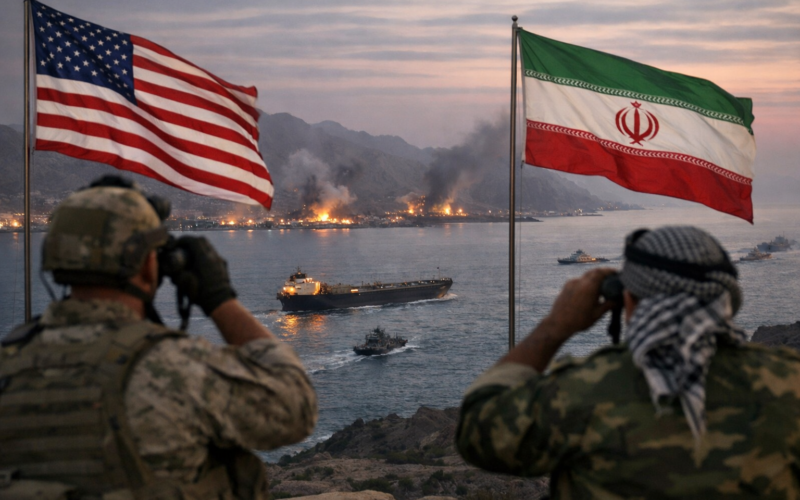
The United States and Iran reached a two-week ceasefire on the night of 7 April 2026, just hours before a deadline set by President Donald Trump for Iran to reopen the Strait of Hormuz or face large-scale military strikes. The agreement, brokered by Pakistan following overnight negotiations involving Pakistani Army Chief Asim Munir, United States Vice President JD Vance, United States Special Envoy Steve Witkoff, and Iranian Foreign Minister Abbas Araghchi, made the suspension of United States strikes conditional on Iran reopening the Strait of Hormuz to commercial traffic. Within hours of the announcement, both the status of the ceasefire and the operational status of the strait were in open and public dispute.
The conflict that the ceasefire was intended to pause had begun on 28 February 2026, when the United States and Israel launched air operations against Iran. In retaliation, Iran’s Islamic Revolutionary Guard Corps closed the Strait of Hormuz to international commercial shipping, initiating what energy analysts have described as the largest single oil supply shock on record. Before the war, approximately 120 to 150 commercial vessels transited the strait daily, moving roughly 20 percent of the world’s daily oil supply and approximately one quarter of global liquefied natural gas trade. During the 40 days of the conflict, that traffic had fallen to near zero. The International Energy Agency characterised the combined disruption to regional energy infrastructure as comparable in severity to the oil crises of the 1970s and the 2022 gas shock combined.
How did the Strait of Hormuz ceasefire agreement between the United States and Iran break down within hours of being announced?
President Trump announced the agreement on his Truth Social platform, stating that the United States had received a ten-point proposal from Iran and considered it a workable basis for negotiation. Trump stated that the ceasefire required the Strait of Hormuz to be reopened immediately and without limitation, including tolls. Iran’s Supreme National Security Council confirmed the ceasefire, stating that safe passage through the strait would be available for two weeks provided that vessels coordinated with Iran’s armed forces. The two governments publicly announced contradictory versions of what the same agreement required within hours of its announcement.
Iran’s Islamic Revolutionary Guard Corps stated that oil tanker traffic through the Strait of Hormuz had been halted in response to Israeli military strikes in Lebanon, which Tehran characterised as a direct violation of the ceasefire framework. White House Press Secretary Karoline Leavitt told reporters that reports of the strait’s closure were false and that Trump’s position was that the strait must be reopened immediately, without limitation. Iranian state media simultaneously published charts indicating active mine fields in the strait’s internationally established shipping lanes, a disclosure that directly contradicted the White House’s position that the waterway was functional.
Iranian Parliament Speaker Mohammad Bagher Ghalibaf stated publicly that three clauses of the ceasefire framework had been violated before the scheduled talks in Islamabad had even begun. Ghalibaf stated that on this basis, a bilateral ceasefire or negotiations was unreasonable. Iranian media reported that Iran’s Supreme National Security Council was considering withdrawing from the agreement.
Why is Israel’s continued military campaign in Lebanon threatening the Iran ceasefire deal?
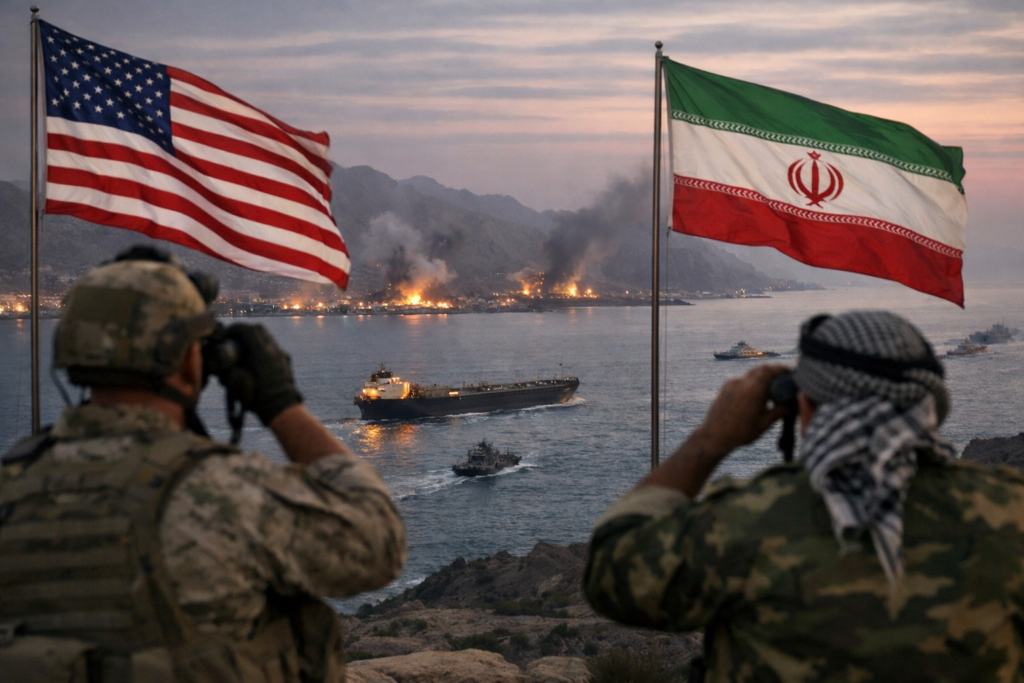
The ceasefire came under immediate pressure from continued Israeli military operations in Lebanon. Israeli Prime Minister Benjamin Netanyahu stated that the ceasefire agreement did not extend to Lebanon, where Israeli forces continued operations targeting Hezbollah. Pakistani Prime Minister Shehbaz Sharif had announced on social media that the ceasefire applied everywhere, including Lebanon, and cited that as the basis of his government’s mediation. The Trump administration and Netanyahu’s government subsequently rejected that interpretation.
Lebanon’s health ministry reported that at least 254 people were killed in Israeli strikes on 8 April 2026, which Israel said were directed at Hezbollah. Hezbollah stated it had launched rockets in response and would continue operations until Israeli and United States military activity ceased. Iran’s foreign minister, Abbas Araghchi, stated publicly that the United States must choose between upholding the ceasefire and allowing Israel to continue its operations in Lebanon. An Israeli source familiar with the negotiations said Israel had worked overnight with the United States to ensure Lebanon was excluded from the ceasefire agreement.
An Israeli source confirmed to media that Israel had actively worked with the United States to exclude Lebanon from the scope of the ceasefire. Pakistan’s Prime Minister Sharif had explicitly referenced Lebanon in his invitation to both parties to attend the Islamabad talks, a position that former Pakistani Ambassador to China Masood Khalid told Al Jazeera had been discussed with Washington prior to the announcement. The public contradiction between Pakistan’s statement and the subsequent positions of both Washington and Tel Aviv created a significant trust deficit ahead of the scheduled Islamabad talks.
What evidence exists that Iranian sea mines in the Strait of Hormuz remain a threat to global oil shipping?
Iran’s decision to mine the Strait of Hormuz added a physical obstacle to the waterway that the ceasefire announcement alone cannot quickly remove. United States officials confirmed that Iran had placed at least a dozen sea mines, identified as Iranian-manufactured Maham 3 and Maham 7 limpet mines, in the strait’s established shipping lanes. The International Institute for Strategic Studies assessed Iran’s total mine inventory at between 5,000 and 6,000 units, of which approximately 12 had been confirmed deployed in the strait.
On 9 April 2026, Iran’s Islamic Revolutionary Guard Corps published a formal navigational chart marking the internationally established shipping lanes in the Strait of Hormuz as a danger zone. The chart redirected all commercial traffic to a five-nautical-mile corridor near Larak Island, controlled by the Islamic Revolutionary Guard Corps. The corps issued a statement warning that ships transiting without authorisation would be targeted. The chart’s publication on the same day that Iran’s diplomatic delegation travelled to Islamabad represented a formal assertion by Iran that its physical control over access to the strait was a standing feature of any post-war arrangement, not a temporary wartime measure.
The IRGC-controlled corridor was described in regional reporting as requiring vessels to submit crew manifests, pay transit fees, and await authorisation from an IRGC naval pilot before proceeding. Shipping industry executives cited a near-total absence of operational clarity. A senior executive from a shipping company with vessels in the Persian Gulf told reporters that the company had received no information on how to transit the strait during the ceasefire and that safety guarantees for crew were the overriding concern before any transit attempt would be made.
Ship-tracking service MarineTraffic confirmed that two vessels, the Greek-owned bulk carrier NJ Earth and the Liberia-flagged Daytona Beach, had transited the strait following the ceasefire announcement. Both were dry cargo carriers, not oil tankers. Commercial tanker traffic had not resumed at scale. Before the conflict, between 100 and 120 commercial vessels, the majority of them oil tankers, transited the Strait of Hormuz daily.
What are the terms and risks of the United States and Iran talks scheduled in Islamabad, Pakistan?
The Islamabad negotiations represent the highest-level direct engagement between the United States and Iran since the 1979 Islamic Revolution. Pakistan confirmed that a first round of negotiations would take place in Islamabad on the morning of 11 April 2026. The United States delegation would be led by Vice President Vance and include Special Envoy Witkoff and presidential adviser Jared Kushner. Iranian state media reported that Iranian Parliament Speaker Ghalibaf and Foreign Minister Araghchi were expected to lead the Iranian delegation. Pakistan and Egypt were designated as guarantors of the temporary ceasefire framework. The two-week ceasefire was scheduled to expire on 22 April 2026.
Earlier rounds of indirect talks had taken place in Muscat, Oman, in February 2026, mediated by Oman’s foreign ministry, and in Geneva in late February 2026. Those rounds had not produced an agreement. Pakistan’s emergence as primary mediator reflected both the country’s working relationships with Washington and Tehran and President Trump’s publicly expressed confidence in Pakistani Army Chief Asim Munir, whom Trump had referred to favourably in prior public statements. Pakistan had its own material reasons to seek a resolution. The country imports a substantial share of its oil and gas from the Middle East and had signed a mutual defense agreement with Saudi Arabia the previous year. Pakistan’s close partnership with China, which Islamabad describes as an all-weather relationship, also provided it with additional standing in Tehran, as China had maintained commercial and diplomatic ties with Iran throughout the conflict.
Key substantive gaps between the two governments remained unresolved ahead of the talks. The United States position, as stated by Leavitt, was that Iran’s uranium enrichment programme was a red line that would not be conceded. Iran’s publicly released version of the ten-point ceasefire framework stated that the United States had accepted Iran’s right to continue enriching uranium. Vice President Vance stated in Budapest on 8 April 2026 that there had been three separate Iranian proposals during the negotiating process, the first of which had been immediately rejected, and that the final agreed text differed from the version Iran had released publicly. The public discrepancy on the enrichment question, alongside the Lebanon dispute, constituted the most significant substantive obstacles ahead of the Islamabad meeting.
How is the Iran ceasefire and Strait of Hormuz disruption affecting global oil markets and energy supply?
Oil prices moved sharply in both directions following the ceasefire announcement and its subsequent complications. United States West Texas Intermediate crude prices fell more than 16 percent on 8 April 2026, the day the ceasefire was announced. By 9 April 2026, West Texas Intermediate futures had recovered to approximately 96 to 97 dollars per barrel as uncertainty over the ceasefire’s durability returned. Brent crude futures also rose on 9 April. Asian equity markets, which had rallied strongly on the ceasefire announcement, gave back significant portions of those gains. Hong Kong’s Hang Seng index, China’s Shanghai Composite index, South Korea’s Kospi, and Japan’s Nikkei 225 all declined on 9 April 2026.
Analysts at BCA Research noted that global energy prices would likely remain on a structurally elevated floor regardless of the ceasefire outcome, as governments continued to hoard and restock energy supplies in anticipation of potential renewed conflict. The International Air Transport Association director general stated that jet fuel supply and pricing normalisation would take months regardless of how quickly the strait reopened, given the extent of damage to refining infrastructure across the Middle East. Eight members of the OPEC+ production group, comprising Saudi Arabia, Russia, Iraq, the United Arab Emirates, Kuwait, Kazakhstan, Algeria, and Oman, had agreed to increase production by 206,000 barrels per day in May 2026, though the disruption to regional export infrastructure and the continued uncertainty over Strait of Hormuz access complicated the practical impact of that decision.
Trump directed all United States ships, aircraft, and military personnel to remain positioned in the region pending full compliance with the agreement. He stated that if the ceasefire terms were not met, military operations would resume at a scale larger than anything previously seen. Vice President Vance characterised the ceasefire publicly as a fragile truce. The International Maritime Organization’s Maritime Safety Division stated that its immediate priority was the safe evacuation of approximately 20,000 seafarers who had remained on vessels in the Persian Gulf throughout the duration of the conflict, and that it was working to establish an appropriate transit mechanism for the strait in coordination with relevant parties.
What are the key takeaways from the United States and Iran ceasefire breakdown and Islamabad talks ahead of the Strait of Hormuz standoff?
- The United States and Iran agreed to a two-week ceasefire on 7 April 2026, brokered by Pakistan, requiring Iran to reopen the Strait of Hormuz in exchange for a suspension of United States strikes. The ceasefire was scheduled to expire on 22 April 2026.
- Iran’s Islamic Revolutionary Guard Corps moved to restrict Strait of Hormuz access after Israel’s continued military operations in Lebanon, which Iran characterised as a ceasefire violation. Washington rejected that characterisation. Commercial oil tanker traffic had not resumed at scale as of 9 April 2026.
- Iran’s Islamic Revolutionary Guard Corps published a navigational chart on 9 April 2026 formally designating the strait’s international shipping lanes as a danger zone and redirecting vessels to an Iranian Revolutionary Guard Corps-controlled corridor near Larak Island, citing sea mines remaining in the main shipping lane.
- The United States delegation led by Vice President Vance, alongside Special Envoy Witkoff and Jared Kushner, was scheduled to meet Iran’s delegation in Islamabad, Pakistan on 11 April 2026, representing the highest-level direct contact between the two governments since 1979. Egypt and Pakistan were named as ceasefire guarantors.
- The two sides held publicly contradictory positions on the ceasefire’s core terms, including on Iran’s uranium enrichment programme and the geographic scope of the agreement. Analysts cited a structural trust deficit as the primary obstacle to a durable resolution.
Discover more from Business-News-Today.com
Subscribe to get the latest posts sent to your email.