




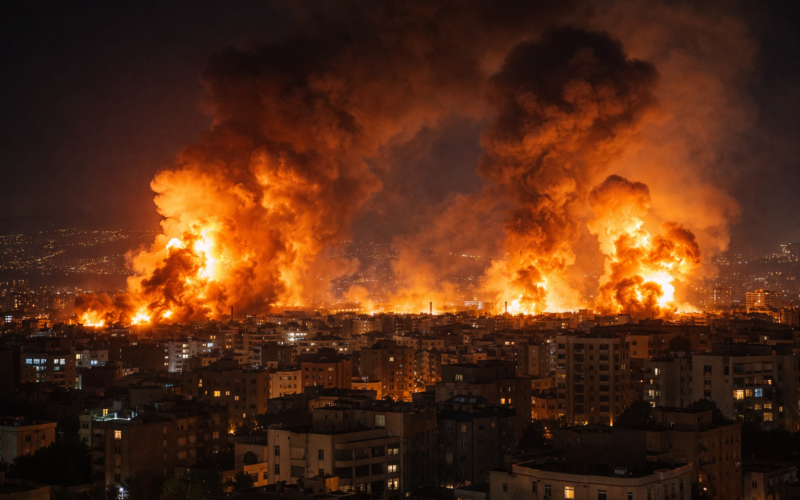
Israel’s military announced early Friday that it had executed a wide-scale wave of strikes targeting infrastructure of the Iranian government in the heart of Tehran, marking one of the most significant escalations in the ongoing conflict that began on 28 February 2026. The Israeli army confirmed it had launched a second round of attacks on the same day, hours after the first wave. Correspondents in Tehran reported explosions across the city, including in northern neighbourhoods and the city centre, with Al Jazeera’s correspondent describing the scale and volume of the blasts as unprecedented, particularly on the eastern side of the capital.
The escalation on the ground coincided with a significant diplomatic development in Washington. President Trump announced on Thursday that he was extending the deadline for Iran to fully reopen the Strait of Hormuz to April 6, 2026, stating via his Truth Social platform: “As per Iranian Government request, I am pausing the period of Energy Plant destruction by 10 Days to Monday, April 6, 2026, at 8 P.M., Eastern Time.” It was the second extension Trump had granted within the same week, following a five-day pause announced on Monday that had been set to expire on Friday.
Why did Trump extend the Strait of Hormuz deadline a second time to April 6?
Trump originally threatened on 21 March to obliterate Iran’s power plants if Tehran did not fully reopen the Strait of Hormuz within 48 hours. He then extended that deadline to Friday 27 March, citing what he described as productive conversations with Iran. On Thursday he announced a further 10-day extension to April 6, writing on Truth Social that Iran had requested the additional time and that talks were going “very well.” He revealed at a Cabinet meeting that Iran had allowed 10 oil tankers, possibly Pakistani-flagged, to pass through the strait as a gesture of goodwill, which he said demonstrated the seriousness of the Iranian negotiating team. “I said, I guess we’re dealing with the right people,” Trump told reporters.
White House Special Envoy to the Middle East Steve Witkoff briefed Trump during the Cabinet meeting on the status of a 15-point ceasefire proposal the U.S. had submitted to Iran through intermediaries including Pakistan, Egypt, and Turkey. Witkoff said Iran was showing “strong signs” of readiness to negotiate and was “looking for an offramp.” However, Witkoff acknowledged separately that Iran had “repeatedly rebuffed on everything we asked for” in formal negotiations.

Is Iran actually negotiating with the United States to end the 2026 war?
The question of whether substantive talks are underway remains sharply contested. Trump has insisted Iran is actively seeking a deal, describing Iranian negotiators as “begging” to reach an agreement. Iran’s Foreign Ministry issued a flat denial, stating that there was no dialogue between Tehran and Washington. Iran’s Parliament Speaker described Trump’s talk of negotiations as “fake news” designed to manipulate oil markets. Senior security officials in Tehran said Iran had formally rejected the U.S. 15-point proposal, calling it “one-sided and unfair,” and had submitted five counter-conditions of its own through intermediaries.
Iran’s counter-conditions, as summarised by its embassy, called for an end to U.S. and Israeli aggression, concrete guarantees preventing recurrence of war, payment of war reparations, a comprehensive ceasefire across all fronts including for Hezbollah and other allied groups, and recognition of Iran’s sovereignty over the Strait of Hormuz. The conditions were regarded by analysts as far beyond anything contained in the U.S. proposal, which reportedly sought dismantlement of Iran’s nuclear facilities, limits on its ballistic missile programme, and an end to support for regional proxy forces.
What is the humanitarian toll of the Israel-Iran-Lebanon conflict so far?
The human cost of the conflict, now in its 27th day, has been substantial and continues to rise. Preliminary figures from Al Jazeera’s conflict tracker show at least 1,937 people killed in Iran. The Iranian Red Crescent Society reported by 7 March that more than 6,668 civilian units had been targeted by joint U.S.-Israeli strikes, including 5,535 residential units, 1,041 commercial units, 14 medical centres, and 65 schools. An estimated 15 percent of the total casualties in Iran were under the age of 18, according to Human Rights Activists in Iran.
In Israel, 19 people have been killed, including three soldiers. The largest single casualty event on the Israeli side occurred on 1 March, when an Iranian missile struck a residential neighbourhood in Beit Shemesh, killing nine civilians in a communal shelter. In Lebanon, where Israeli ground forces crossed the border with the stated objective of establishing a security zone south of the Litani River, approximately 32 kilometres from the Israeli border, hostilities have displaced millions. The U.S. military has confirmed 13 fatalities from Iranian attacks across the region, with a further six crew members killed when a U.S. refuelling aircraft crashed in western Iraq on 13 March. At least 25 people have been killed in Gulf states, including a Moroccan civilian contractor in Bahrain.
How has the conflict escalated in Lebanon and what are Israel’s military objectives there?
Israeli Defence Minister Israel Katz authorised a ground incursion into Lebanon on 3 March, with forces from the 91st Division crossing the border to establish what the Israeli military described as a “security layer” protecting northern Israeli settlements from Hezbollah. The stated target area is the terrain south of the Litani River, a zone that has been the subject of longstanding international expectations under United Nations Security Council Resolution 1701. The Lebanese government reported that Israeli operations reached the villages of Kfarkela and Qouzah, prompting the Lebanese army to redeploy from newly established border posts.
Israel also reported the killing of Daoud Alizadeh, the commander of the Quds Force’s Lebanon branch, in a strike in Tehran. Earlier in the week, Israel’s Defence Minister announced the killing of the Iranian Revolutionary Guard Corps naval commander Ali Reza Tangsiri, who was described as directly responsible for the mining and blockade operations that have choked shipping through the Strait of Hormuz. Hezbollah began firing missiles and drones at northern Israel on 2 March, two days after the war’s opening strikes.
What happened to the Thai cargo ship Mayuree Naree in the Strait of Hormuz?
The Thai-flagged bulk carrier Mayuree Naree, operated by Bangkok-based Precious Shipping Plc, was struck by two Iranian projectiles on 11 March 2026 while transiting the Strait of Hormuz. The vessel had departed Khalifa Port in the United Arab Emirates and was en route to Kandla Port in Gujarat, India, sailing in ballast without cargo. The Royal Thai Navy said the attack occurred at approximately 11:10 a.m. Thailand time, 11 nautical miles north of Oman. Both projectiles struck above the waterline, damaging the stern and engine room and igniting a fire on board.
Twenty of the 23 Thai crew aboard abandoned ship in liferafts and were rescued by the Royal Navy of Oman, subsequently returning to Thailand by 16 March. Three crew members working in the engine compartment at the time of the attack remained unaccounted for. Iran’s Islamic Revolutionary Guard Corps said the vessel had been fired upon after “disregarding warnings and insistently attempting to illegally pass through the Strait of Hormuz.” The drifting, powerless vessel eventually ran aground near the village of Ramchah on Iran’s Qeshm Island, confirmed by Iran’s Tasnim news agency on 27 March. Iranian and Omani authorities conducted a joint operation to reach the vessel on 24 March, but the fate of the three missing crew remained unknown at the time of publication.
The Mayuree Naree incident is one of more than 20 shipping incidents recorded in and around the Persian Gulf, Strait of Hormuz, and Gulf of Oman since hostilities began on 28 February, according to the UK Maritime Trade Operations. Iran has effectively blockaded the waterway to vessels from countries it regards as hostile or non-neutral, while selectively allowing ships from Pakistan, India, China, and other states it classifies as “non-hostile” to pass, in some cases after payment of what shipping sources have described as a transit levy.
How is the Strait of Hormuz blockade affecting global oil prices and market sentiment?
The disruption to shipping through the Strait of Hormuz, through which approximately one-fifth of the world’s traded oil and natural gas passes in normal conditions, has sent energy markets into significant volatility. Brent crude rose 4.8 percent on Thursday to settle at 101.89 U.S. dollars a barrel, up from roughly 70 dollars before the war began. U.S. benchmark crude rose 4.6 percent to 94.48 U.S. dollars per barrel. The S&P 500 fell 1.7 percent on Thursday for its worst day since January, with the Nasdaq composite dropping 2.4 percent into correction territory. Stock markets across Asia and Europe similarly declined.
Iran has announced plans to formalise fees for vessels transiting the strait, with its Parliament moving to codify a toll system. Some shipping sources have characterised the arrangement as a state-operated toll mechanism, with certain tankers reportedly paying millions of dollars for permission to pass through IRGC-controlled portions of the waterway. The International Energy Agency agreed on 11 March to release 400 million barrels of oil from member state strategic reserves to help stabilise global supply.
What is New Zealand’s four-phase National Fuel Plan and what triggers a higher alert level?
New Zealand Finance Minister Nicola Willis unveiled the updated National Fuel Plan on Friday 27 March 2026, detailing a four-phase escalation framework designed to manage disruptions to the country’s fuel supply caused by the Middle East conflict. New Zealand currently sits at Phase 1, described as a monitoring and coordination phase during which fuel flows normally. Willis confirmed there were no current restrictions on fuel purchasing or use and that the government had a forward order book of supply through to May.
Phase 2 would involve more active coordination between government and the fuel industry to shore up supply and encourage voluntary demand reduction. Phase 3 would see fuel prioritised for life-preserving services, with purchasing limits applied to others. Phase 4 represents the most severe tier, with strict intervention in fuel distribution and supply directed only to critical customers at designated points. Willis said the government’s explicit goal was to avoid ever reaching Phases 3 or 4 through early action in the earlier stages.
The Fuel Security Ministerial Oversight Group would determine transitions between phases based on six criteria: export restrictions imposed by New Zealand’s source refineries, changes in domestic fuel stock levels of more than three days’ cover, a fuel company advising that it cannot fill future orders, a breach of minimum storage obligations, significant policy changes by Australia or the International Energy Agency, and broader changes in global supply chain conditions. Prime Minister Christopher Luxon acknowledged that “things could get worse before they get better” and said officials had been tasked to plan for eight to 12 weeks of potential disruption.
New Zealand sources most of its refined fuel from South Korea and Singapore, both of which depend heavily on crude oil routed through the Strait of Hormuz. Willis separately confirmed a support payment of 50 New Zealand dollars per week for approximately 143,000 lower-income working households affected by fuel cost increases, with petrol prices having risen approximately 35 percent and diesel approximately 80 percent since the war began.
What are the key takeaways from Israel’s strikes on Tehran and the Strait of Hormuz crisis?
- Israel launched a wide-scale wave of airstrikes on Tehran’s infrastructure early Friday, 27 March 2026.
- President Trump extended the Strait of Hormuz deadline to April 6, citing a request from the Iranian government.
- Iran has publicly denied engaging in negotiations, though it issued five counter-conditions to a U.S. 15-point ceasefire proposal.
- The conflict has killed at least 1,937 people in Iran, 19 in Israel, 13 U.S. military personnel, and dozens across Gulf states.
- Israeli ground forces crossed into Lebanon, aiming to establish a security zone south of the Litani River.
- Thai cargo vessel Mayuree Naree ran aground on Iran’s Qeshm Island after being struck by Iranian projectiles on 11 March; three crew remain missing.
- New Zealand unveiled a four-phase National Fuel Plan, with Finance Minister Nicola Willis confirming no current restrictions but outlining escalating intervention tiers.
Discover more from Business-News-Today.com
Subscribe to get the latest posts sent to your email.

