

Glenmark Pharmaceuticals Ltd (BSE: 532296 | NSE: GLENMARK) entered India’s newly opened generic semaglutide market on March 21, 2026, launching GLIPIQ, a GLP-1 receptor agonist, for the management of Type 2 Diabetes Mellitus at a weekly treatment cost starting at Rs 325. The launch lands on the precise day Novo Nordisk’s last remaining Indian patent on semaglutide expired, triggering a simultaneous multi-company entry into what analysts project will become a Rs 1,000 to 2,000 crore incremental revenue opportunity in India’s branded formulations segment. GLIPIQ is available in vial and pre-filled pen formats, with both presentations carrying Central Drugs Standard Control Organisation approval backed by a Phase III clinical study conducted in Indian patients. Glenmark Pharmaceuticals shares were trading around Rs 2,097 to Rs 2,124 in the days immediately preceding the launch, against a 52-week range of Rs 1,276 to Rs 2,298, placing the stock in the upper half of its annual range as investor sentiment around GLP-1 positioned domestic names trended positive.
The India GLP-1 landscape underwent a structural shift overnight. With Novo Nordisk’s patent expiry on March 20, 2026, generic semaglutide became legally manufacturable by any CDSCO-cleared Indian drugmaker, and at least 12 large manufacturers including Sun Pharmaceutical Industries, Dr. Reddy’s Laboratories, Lupin, Zydus Lifesciences, and Natco Pharma have filed or announced products under more than 50 brand names expected to hit shelves through 2026. Against that crowded backdrop, Glenmark’s pricing strategy, delivery format choices, and patient support infrastructure collectively define its competitive positioning within a therapy category where the molecule itself is no longer a differentiator.
Why did Glenmark Pharmaceuticals price GLIPIQ semaglutide at Rs 325 per week and what does it mean for GLP-1 market access in India?
The Rs 325 to Rs 440 weekly price band for GLIPIQ vials represents a monthly treatment cost of roughly Rs 1,300 to Rs 1,760, positioning Glenmark Pharmaceuticals at the more accessible end of the emerging generic semaglutide pricing spectrum. Natco Pharma, whose vial product under the Semanat and Semafull brands launched simultaneously, opened at Rs 1,290 per month for lower strengths. Other market entrants are expected to price starting doses between Rs 3,000 and Rs 5,000 per month. By comparison, Novo Nordisk’s branded Wegovy pen was priced around Rs 10,480 per month in India before the patent fell, following a 37% preemptive price cut in November 2025. The branded originator’s full monthly cost ranged from Rs 10,850 to Rs 16,400 depending on dose strength.
The strategic logic behind vial-first pricing is well understood in the Indian pharma context. Vials require physician-guided dosing and purpose-built syringes, which constrains self-administration relative to a pre-filled pen but substantially lowers manufacturing cost and therefore retail price. Glenmark Pharmaceuticals is pairing the vial format with dose-specific syringes and a patient support program called Sankalp to address the administration complexity. Physician-mediated initiation is not a weakness in the Indian healthcare setting; the country’s specialist diabetes consultants already manage injectable insulin initiation via vials across a broad patient base, and the clinical familiarity with that model works in favour of a vial-led GLP-1 entry at this price point.
India presents a uniquely addressable need. Approximately 89.8 million adults were living with diabetes in India in 2024, making the country the second-most affected globally after China, with that figure projected to reach 156.7 million by 2050 according to the International Diabetes Federation’s Diabetes Atlas 11th Edition published in April 2025. Despite this scale, GLP-1 therapies have been largely inaccessible due to price. The branded monthly cost of Rs 10,000 to Rs 16,000 was equivalent to roughly 40 to 60 percent of the median Indian monthly income, creating a market that was structurally underpenetrated despite existing demand. At Rs 1,300 to Rs 1,760 per month, Glenmark Pharmaceuticals and other early generic entrants are targeting a meaningfully different patient population.

How does Glenmark’s GLIPIQ vial and pen dual-format strategy differentiate it from the wave of generic semaglutide competitors in India?
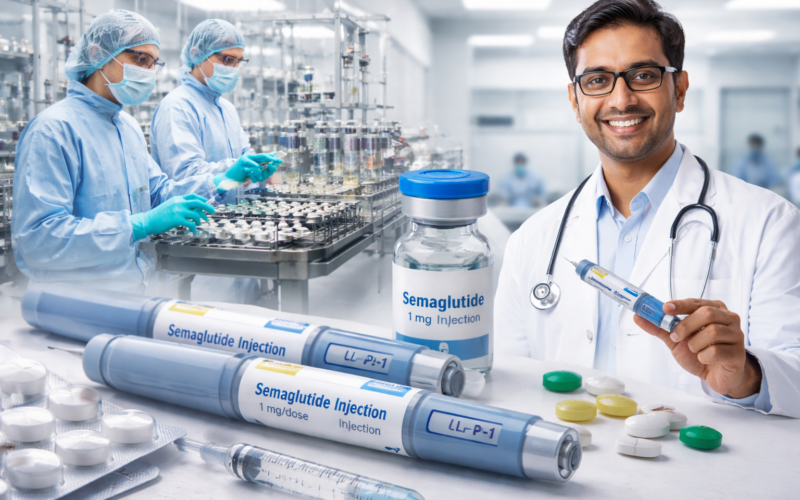
Glenmark Pharmaceuticals is launching GLIPIQ in both vial and pre-filled pen formats from day one, in strengths of 2 mg per 1.5 mL, 4 mg per 3 mL, and 8 mg per 3 mL. The dual-format approach is deliberate. It positions the vial as the affordability and initiation vehicle, where cost-sensitive patients and physicians unfamiliar with GLP-1 titration can begin therapy with direct medical oversight. The pen format then becomes the long-term adherence pathway for patients who have been stabilised and wish to self-dose. This structured treatment pathway mirrors the clinical design of insulin management in India, where vial-based initiation followed by device migration is an established clinical norm.
Not every competitor is launching both formats simultaneously. Natco Pharma, for instance, opened its market position with vials and has scheduled its pen device for April 2026. The market is likely to split between a price-driven tier anchored on vials and a convenience-driven segment for pre-filled pens at higher price points. Glenmark’s simultaneous dual-format launch reduces the risk of patients migrating to competitors’ pen products once they are ready to transition off vials. Industry observers have noted that delivery system familiarity creates switching friction once a patient has been established on a particular brand’s device, making early pen format ownership commercially important for long-term therapy revenue.
The Sankalp patient support program adds a third layer to the commercial strategy. Injectable therapy initiation consistently faces the challenge of patient hesitancy around self-administration, non-adherence during the early dose-titration period when side effects are most prominent, and early discontinuation when patients do not immediately see symptomatic improvement. Glenmark Pharmaceuticals’ decision to invest in structured patient support alongside the product launch reflects an understanding that the real competitive battleground in a commodity molecule market is not the molecule itself but the adherence infrastructure around it. The company already operates in the GLP-1 category with Lirafit, a liraglutide product, providing an existing prescriber relationship base from which to introduce GLIPIQ.
What competitive risks does Glenmark face as more than 40 manufacturers enter India’s generic semaglutide market in 2026?
The scale of competitive entry into Indian generic semaglutide is without recent precedent for a single molecule in this therapy class. Approximately 42 manufacturers are expected to launch products under more than 50 brand names through 2026, according to Pharmarack market data. The entrants include companies with substantially larger India formulation businesses than Glenmark Pharmaceuticals, including Sun Pharmaceutical Industries and Lupin. Dr. Reddy’s Laboratories has announced an obesity centre of excellence model that pairs its generic semaglutide with clinical infrastructure, creating a differentiated commercial offer rather than competing purely on price. Zydus Lifesciences has launched a reusable pen device designed to reduce the friction of long-term adherence while keeping monthly costs lower than single-use competitors.
The market entry volume creates both pricing and distribution challenges. With more than 50 branded products targeting the same molecule and similar patient populations, price pressure will be sustained and margins on the vial format are likely to compress over the next 12 to 24 months as competition matures. Glenmark Pharmaceuticals’ existing India formulations business and its established GLP-1 prescriber network through Lirafit provide a baseline commercial advantage, but the company will need to defend its position in a crowded field where brand differentiation on a commodity molecule rests heavily on trust, field force execution, device quality, and patient support depth. Alok Malik, President and Business Head for India Formulations at Glenmark Pharmaceuticals, framed the launch around the Sankalp program and the company’s existing GLP-1 experience, pointing to physician relationship continuity as a core asset in the competitive strategy.
One structural dynamic that benefits Glenmark Pharmaceuticals and other early movers is the geographic distribution opportunity. Novo Nordisk’s branded semaglutide was concentrated in urban specialist centres where premium pricing was sustainable, leaving smaller cities and towns largely unserved. The generic market opens addressable patient populations in tier 2 and tier 3 urban centres where diabetes prevalence is high but GLP-1 penetration is near zero. Companies with established field forces across semi-urban India, where Glenmark Pharmaceuticals has historically maintained a commercial presence through its India formulations business, are better positioned to capture this newly accessible patient pool than brands whose physician engagement has been primarily urban-focused.
What are the clinical and regulatory underpinnings of GLIPIQ approval and what does semaglutide’s cardiometabolic profile mean for India’s diabetes burden?
GLIPIQ received CDSCO approval following a multicentre, randomised, comparative, active-controlled, open-label Phase III clinical study conducted specifically in Indian patients with Type 2 diabetes, demonstrating favourable efficacy and safety outcomes. This India-specific clinical data set is commercially relevant in a prescriber environment where physicians are increasingly attentive to whether trial populations reflect their patient demographics. Semaglutide is a GLP-1 receptor agonist with a benefit profile that extends well beyond glycaemic control. Evidence from global trials has established its efficacy in patients with comorbidities including obesity, established atherosclerotic cardiovascular disease, heart failure with preserved ejection fraction, and chronic kidney disease, making it clinically relevant for the high proportion of Indian Type 2 diabetes patients who present with multiple cardiometabolic risk factors.
The cardiometabolic burden profile of Indian diabetes patients creates a structural case for GLP-1 therapy that goes beyond blood sugar management. India has one of the highest rates of cardiovascular disease comorbidity in its diabetes population, and established cardiovascular outcome data supporting semaglutide makes it a clinically compelling option for physicians managing complex cases. At prices above Rs 10,000 per month, that clinical logic was inaccessible for most patients outside of private tertiary care. At Rs 1,300 to Rs 1,760 per month, the therapy enters a cost range where specialist endocrinologists, diabetologists, and cardiologists in secondary and tertiary care settings can realistically initiate and sustain it for a much larger share of their patient panels. Whether India’s healthcare system infrastructure can support the prescribing volume and patient monitoring required for broad GLP-1 adoption remains an open question that the commercial success of this launch wave will depend on.
How does Glenmark Pharmaceuticals’ GLIPIQ launch fit into the company’s broader India strategy and its revenue growth trajectory in FY26?
Glenmark Pharmaceuticals reported December 2025 quarter net sales of Rs 3,900.6 crore, up 15.1 percent year on year, with net profit rising 15.9 percent to Rs 403.2 crore and EBITDA growing 44.8 percent to Rs 914.2 crore. The company has guided for EBITDA margins of 23 percent by FY27 and has stated an objective of reaching a debt-free balance sheet by March 2026. Against that backdrop, the GLIPIQ launch is strategically important not because it will move near-term revenue materially in the first quarter, but because it stakes a credible early claim in a therapy category whose Indian market Jefferies has estimated at roughly $500 million, potentially rising to $1 billion with appropriate pricing, physician adoption, and government support.
The India formulations business is one of Glenmark’s core operating segments, and its GLP-1 commercial experience through liraglutide provides what most new generic semaglutide entrants lack: category-trained field personnel, existing physician relationships in the diabetes and endocrinology segments, and clinical understanding of how to manage injectable GLP-1 therapy initiation in an Indian patient population. That accumulated capability represents a real but narrow advantage in a market where 40-plus manufacturers are entering simultaneously with comparable product quality claims. The market will likely reach initial consolidation within 18 to 24 months as smaller entrants struggle to establish distribution and physician mindshare, leaving a core group of well-resourced companies competing on brand, device, and adherence support.
The stock’s recent positioning, trading around Rs 2,097 to Rs 2,124 and holding above its 52-week midpoint, reflects market acknowledgment of Glenmark Pharmaceuticals’ improving fundamentals and the broadly positive sentiment toward domestically listed companies with exposure to the generic semaglutide launch window. The 52-week range of Rs 1,276 to Rs 2,298 captures the re-rating that has occurred as the company’s operational and financial metrics improved and the GLP-1 opportunity moved from speculative to concrete. Whether the GLIPIQ launch translates into a durable revenue contribution or gets competed to margin compression within a crowded generics market will depend on commercial execution discipline that is difficult to assess from a single-day product launch announcement.
Key takeaways: What Glenmark Pharmaceuticals’ GLIPIQ semaglutide launch means for investors, competitors, and India’s diabetes treatment market
- Glenmark Pharmaceuticals has launched GLIPIQ, its branded generic semaglutide, on the precise day of Novo Nordisk’s Indian patent expiry, establishing an early-mover position in a market where speed of launch and prescriber relationship capture are initial differentiators.
- The weekly treatment price of Rs 325 to Rs 440 via vials positions GLIPIQ at the accessible end of the generic spectrum, targeting the large underpenetrated patient population for whom Rs 10,000-plus monthly costs were prohibitive.
- Dual-format availability from day one, offering both vials and pre-filled pens, reduces the risk of pen-seeking patients migrating to competitor brands once ready to transition from physician-guided initiation to self-dosing.
- The Sankalp patient support program is the structural differentiator in a commodity molecule market, where long-term adherence infrastructure is the primary commercial moat once price parity is established across competitors.
- Glenmark’s existing GLP-1 commercial presence through Lirafit, its liraglutide product, provides a trained prescriber base that new-to-category entrants cannot replicate quickly.
- India’s competitive entry is historically unprecedented in scale: more than 40 manufacturers targeting more than 50 brand names creates margin pressure that will likely intensify through late 2026 and into 2027.
- Novo Nordisk’s decision to hold the brand line rather than match generic pricing preserves its premium positioning but cedes the mass-market volume opportunity to domestic players who can operate at lower cost structures.
- The cardiometabolic evidence base for semaglutide across cardiovascular disease, heart failure, and chronic kidney disease comorbidities creates a clinically compelling case for specialist prescribers in India’s secondary and tertiary care centres.
- India’s semaglutide market is not on the National List of Essential Medicines and remains fully out-of-pocket, meaning lower generic prices are necessary but not sufficient for mass adoption without physician outreach and patient education investment.
- For Glenmark Pharmaceuticals, the GLP-1 launch adds a high-potential growth vector to an India formulations business already reporting 15 percent revenue growth and accelerating EBITDA expansion, though near-term revenue contribution will be measured by prescriber uptake speed rather than pricing alone.
Discover more from Business-News-Today.com
Subscribe to get the latest posts sent to your email.