



United States President Donald Trump has renewed calls for other countries to assume shared responsibility for securing the Strait of Hormuz, framing maritime protection of the strategic waterway as a collective obligation rather than a unilateral United States commitment, as the Iran war enters its fifteenth day with commercial shipping through the corridor at a near-total standstill.
In a series of posts on his Truth Social platform on 15 March 2026, Trump stated that nations that depend on oil transiting through the Strait of Hormuz must take an active role in keeping the passage open. He confirmed the United States would assist, adding that Washington would coordinate with contributing countries so that the effort proceeds smoothly. Trump described the arrangement as a team effort and said it would lead toward what he termed harmony, security, and everlasting peace.
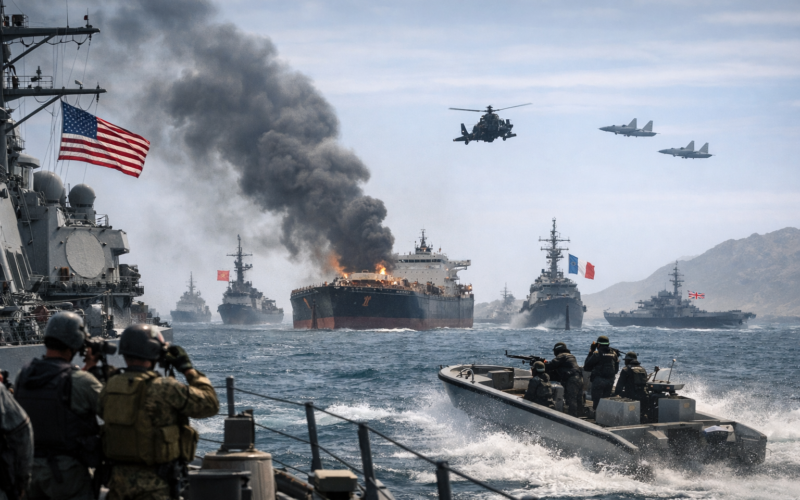
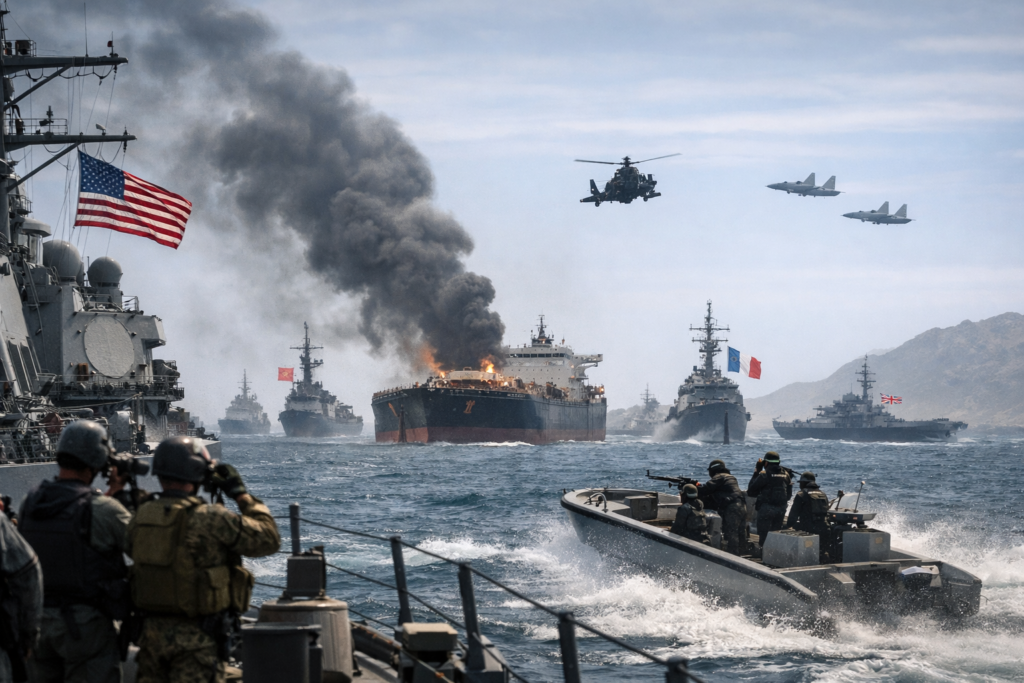
Earlier on the same day, Trump named China, France, Japan, South Korea, and the United Kingdom as countries he hoped would dispatch warships to the area in conjunction with the United States Navy to keep the Strait open and safe. The posts came as the Strait of Hormuz remained effectively closed to tanker traffic, with Iran’s Islamic Revolutionary Guard Corps continuing to threaten and attack vessels attempting to transit the waterway.
What is the current status of the Strait of Hormuz and why has shipping through it virtually stopped?
The Strait of Hormuz, located between Iran and Oman at the mouth of the Persian Gulf, is the world’s most significant maritime chokepoint for energy trade. According to the United States Congressional Research Service, roughly 27 percent of the world’s maritime trade in crude oil and petroleum products passes through the strait. Approximately one-fifth of global liquefied natural gas supply also transits the corridor.
Commercial shipping through the strait collapsed following the launch of joint United States and Israeli military strikes on Iran on 28 February 2026 under Operation Epic Fury. The strikes targeted Iranian military installations, nuclear facilities, and government infrastructure, and resulted in the death of Supreme Leader Ali Khamenei. His son, Mojtaba Khamenei, was subsequently designated as Supreme Leader and issued a statement on 12 March 2026 affirming that the Strait of Hormuz would remain closed as a tool of pressure.
Starting from 4 March 2026, Iran’s Islamic Revolutionary Guard Corps formally declared the strait closed and began threatening and carrying out attacks on ships attempting to pass. Tanker traffic declined by approximately 70 percent in the initial days following the closure declaration, before dropping to near zero. The United Kingdom Maritime Trade Operations Centre had recorded ten attacks on vessels as of 8 March 2026. At least five crew members on two vessels had been killed.
The International Energy Agency has described the disruption as the largest supply shock in history, with its director stating that 15 million barrels of crude and 5 million barrels of other oil products remain stranded in the Persian Gulf each day. The agency coordinated an emergency release of up to 400 million barrels of oil from member government reserves, the largest such release on record, though analysts described this as a stop-gap measure in the absence of a broader resolution.
Why is Trump asking other countries to send warships to the Strait of Hormuz rather than acting unilaterally?
Trump’s call for a multinational naval coalition reflects both a diplomatic signal and the operational constraints facing the United States military in the current conflict. United States Energy Secretary Chris Wright told CNBC on 12 March 2026 that the Navy was not ready to escort oil tankers through the strait, stating that military assets were focused on degrading Iran’s offensive capabilities and the manufacturing infrastructure that supports them. Wright indicated that escort operations could potentially begin by the end of March.
United States Treasury Secretary Scott Bessent told Sky News in an interview broadcast on 12 March 2026 that the United States Navy, and perhaps an international coalition, would begin escorting vessels through the strait as soon as it was militarily possible. Bessent noted that Iranian and Chinese-flagged tankers had continued to transit the waterway, indicating the strait had not been mined.
Trump had previously stated on 3 March 2026 that the United States Navy would begin escorting tankers through the strait as soon as possible, yet traffic reached a virtual standstill in the days that followed. The White House confirmed on 12 March 2026 that a social media post by Energy Secretary Wright claiming the Navy had already escorted an oil ship through the strait was incorrect, and Wright deleted the post.
Defence Secretary Pete Hegseth told reporters on 14 March 2026 that the suggestion that administration officials had underestimated the war’s impact on the Strait of Hormuz was patently ridiculous, pushing back against a CNN report citing multiple sources that said the Pentagon and National Security Council had failed to fully account for Iran’s willingness to close the waterway. Hegseth stated that Iran holding the strait hostage was a tactic the country had threatened for decades.
Which countries have been asked to contribute to a Strait of Hormuz naval coalition and how have they responded?
Trump’s 15 March 2026 posts specifically named China, France, Japan, South Korea, and the United Kingdom as countries he hoped would send ships to the area. He did not provide details on which of these states had confirmed participation or offer a timeline for deployment. Trump said many countries, especially those affected by Iran’s attempted closure, would be sending warships in conjunction with the United States, without naming confirmed contributors.
The Group of Seven industrialised nations, comprising Canada, France, Germany, Italy, Japan, the United Kingdom, and the United States, issued a statement agreeing to establish coordination to prepare for the restoration of freedom of navigation in the region. The G7 statement indicated that work had begun to explore the possibility of escorting vessels when security conditions allow.
An Italian official told The Hill that Italy was coordinating with the United Kingdom, Germany, and other partners to work on options to protect Hormuz, adding that Italy would assume command of the European Union’s Aspides maritime security mission, which covers the Red Sea, the Gulf of Aden, the Arabian Sea, the Gulf of Oman, and the Persian Gulf.
Relations between the United States and the United Kingdom over the conflict had been strained in the preceding week. One week before Trump’s coalition posts, the president appeared to reject possible British assistance after Prime Minister Keir Starmer had initially declined to permit the United States to use British military bases for operations. Trump wrote on Truth Social that he did not need the bases any longer but that he would remember the refusal. Starmer subsequently stated the United States could use British bases for defensive strikes on Iran.
Iran’s Foreign Minister Abbas Araghchi had clarified publicly that the strait was closed only to tankers and ships of enemies and their allies, not to all shipping. Mohsen Rezaee, a member of Iran’s Expediency Discernment Council, stated separately that no American ship had the right to enter the Gulf. Iran’s Islamic Revolutionary Guard Corps Navy chief Alireza Tangsiri said the strait had not been militarily closed and was merely under control, and accused the United States of making false claims about destroying Iran’s navy and escorting oil tankers.
What military operations has the United States conducted to pressure Iran over the Strait of Hormuz closure?
On 14 March 2026, the United States struck military targets on Kharg Island, Iran’s primary oil export terminal located approximately 300 miles northwest of the Strait of Hormuz in the northern Persian Gulf. Approximately 90 percent of Iran’s oil exports pass through the island before entering the Gulf and the strait. United States Central Command confirmed striking more than 90 Iranian military targets on Kharg Island, including naval mine storage facilities and missile storage bunkers, while preserving the island’s oil infrastructure.
Trump stated publicly that the oil infrastructure on Kharg Island had been deliberately spared, but warned that the facilities would be targeted if Iran continued to interfere with safe passage of ships through the Strait of Hormuz. Iran’s Islamic Revolutionary Guard Corps said its Navy remained in control of the Strait of Hormuz following the Kharg Island strikes and reiterated that vessels belonging to aggressors and their allies were barred from the waterway.
The United States was reported to be deploying up to 5,000 additional military personnel, including the 31st Marine Expeditionary Unit, and additional ships to the Arabian Sea as of 15 March 2026. Trump also stated in a Truth Social post on 15 March 2026 that the United States would be bombing the shoreline and shooting Iranian boats and ships out of the water, adding that one way or another the Hormuz Strait would be opened, safe, and free.
Iran’s Islamic Revolutionary Guard Corps acknowledged the threat of United States naval action but said it would welcome escort attempts by the United States Navy, signalling preparedness to strike American vessels in the narrow waterway. United Kingdom Defence Secretary John Healey stated that mine clearance was near impossible during active conflict and that the best path to reopening the shipping route was de-escalation.
What is the broader humanitarian and economic impact of the Strait of Hormuz closure on global markets and food security?
The Fertilizer Institute stated that nearly 50 percent of global urea and sulfur exports, as well as 20 percent of global liquefied natural gas, a key feedstock for nitrogen-based fertilisers, transit through the Strait of Hormuz. United Nations humanitarian chief Tom Fletcher warned that millions of people were at risk if humanitarian cargo could not pass safely. India invoked emergency powers to protect 333 million households dependent on liquefied petroleum gas for cooking amid a critical domestic shortage.
Brent crude oil prices rose from approximately 71 United States dollars per barrel on 27 February 2026 to more than 100 United States dollars per barrel as the conflict continued, with prices at one point reaching 114 United States dollars per barrel, the highest since the COVID-19 pandemic. Saudi Aramco, the world’s largest oil exporter, warned of potentially catastrophic consequences for oil markets if flows through the strait did not resume. Qatar’s energy minister Saad al-Kaabi warned on 6 March 2026 that if the war continued, Gulf energy producers might be forced to halt exports and declare force majeure, with consequences for global economies.
Pakistan formally requested that Saudi Arabia reroute oil supplies through the Red Sea port of Yanbu on 4 March 2026, with Saudi Arabia providing assurances and arranging crude shipments to bypass the closed strait. Japanese refiners, who obtain approximately 95 percent of their crude from Middle Eastern producers with approximately 70 percent of that volume transiting the Strait of Hormuz, asked their government to release stockpiled oil to ensure continued refinery operations.
Andreas Krieg, a Middle East security expert at King’s College London’s School of Security Studies, told Al Jazeera that Trump’s call for a coalition appeared to mask the absence of a comprehensive strategy to address the strait’s closure. Krieg said there was no quick military solution to reopening the waterway because all Iran needed to do was strike occasionally to keep insurers away.
Key takeaways: What Trump’s call for a Strait of Hormuz coalition means for global energy security and the Iran war
- United States President Donald Trump called on 15 March 2026 for oil-importing nations including China, France, Japan, South Korea, and the United Kingdom to send warships to the Strait of Hormuz in conjunction with the United States, framing maritime security as a collective international responsibility.
- The Strait of Hormuz has been effectively closed to Western-aligned tanker traffic since 4 March 2026, following Iranian Islamic Revolutionary Guard Corps declarations and vessel attacks, with Iran’s Supreme Leader Mojtaba Khamenei affirming on 12 March 2026 that the closure would continue as a tool of pressure.
- United States Energy Secretary Chris Wright confirmed on 12 March 2026 that the Navy was not yet ready to escort tankers through the strait, while Treasury Secretary Scott Bessent indicated that naval escorts, possibly with an international coalition, would begin as soon as militarily possible.
- The United States struck more than 90 military targets on Kharg Island, Iran’s primary oil export terminal, on 14 March 2026, deliberately sparing oil infrastructure while warning Iran that further interference with strait passage could result in strikes on those facilities.
- The International Energy Agency described the Strait of Hormuz disruption as the largest oil supply shock in history, with 15 million barrels of crude and 5 million barrels of other oil products stranded in the Persian Gulf daily; Brent crude prices reached 114 United States dollars per barrel during the crisis period.
Discover more from Business-News-Today.com
Subscribe to get the latest posts sent to your email.