



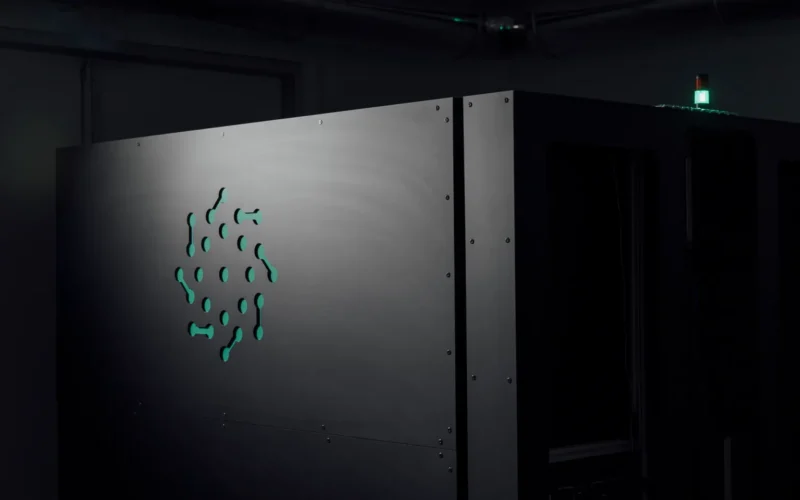
Pasqal Holding SAS, a France-based developer of neutral atom quantum computing systems, has secured financing commitments totaling at least €340 million as part of preparations for a public listing through a business combination with Bleichroeder Acquisition Corp. II. The transaction, which would value Pasqal at approximately $2 billion, represents a major capital milestone for one of Europe’s most prominent quantum technology companies. The funding package includes a €170 million private investment round alongside roughly €170 million in committed convertible financing tied to the merger transaction. Pasqal intends to list on The Nasdaq Stock Market in 2026, with preparatory work underway for a subsequent listing on Euronext Paris that could occur in 2026 or 2027.
The capital raise reflects increasing investor interest in the commercial potential of quantum computing technologies. As governments, technology companies, and research institutions intensify efforts to build scalable quantum machines, firms like Pasqal are transitioning from experimental research platforms toward industrial technology providers. The company’s financing and planned public market debut signal that quantum computing is moving from scientific experimentation into a more competitive commercial phase.
Why are investors backing Pasqal’s neutral atom quantum computing platform with hundreds of millions of euros?
The investment consortium supporting Pasqal’s latest financing round includes a mix of technology companies, industrial investors, and sovereign-linked funds. Participants include Parkway, Quanta Computer, LG Electronics, and CMA CGM, alongside returning investors such as the European Innovation Council Fund, Temasek, Saudi Aramco Entrepreneurship Ventures, and ISAI.
The presence of global corporate investors highlights the strategic importance of quantum computing as a future technology platform. Companies across industries are beginning to explore how quantum systems might transform optimization problems, supply chain simulations, advanced materials research, and artificial intelligence modeling.
Bpifrance, the French state investment bank, remains a significant shareholder and continues to play an influential role in Pasqal’s governance. Bpifrance has supported the company since 2021 and maintains representation on the board of directors. This backing aligns with France’s broader strategy to develop national leadership in quantum technologies through coordinated public and private investment.
The diversity of Pasqal’s investor base suggests that quantum computing is increasingly viewed not only as a research frontier but also as a strategic industrial capability.
How does the business combination with Bleichroeder Acquisition Corp. II create a path to public markets for Pasqal?
Pasqal plans to enter public markets through a merger with Bleichroeder Acquisition Corp. II, a special purpose acquisition company created to pursue business combinations with emerging technology firms. Once the transaction is completed, the combined entity is expected to operate under the Pasqal name and trade on The Nasdaq Stock Market.
The deal structure could generate more than $600 million in gross proceeds once all components are accounted for. This includes funds held in Bleichroeder Acquisition Corp. II’s trust account, the committed convertible financing, and existing cash on Pasqal’s balance sheet.
Special purpose acquisition companies have become an alternative route for high-growth technology companies seeking access to public capital markets. While the broader SPAC market has cooled since its peak several years ago, specialized transactions involving advanced technology companies continue to attract investor interest when supported by credible institutional backers.
For Pasqal, the merger structure provides both capital and visibility as the company attempts to scale its technology globally.
Why is Pasqal concentrating its infrastructure expansion and governance structure in France?
Despite its international ambitions, Pasqal has emphasized that it intends to maintain strong national roots. The company will remain a French legal entity with headquarters in Palaiseau, a research hub near Paris that hosts several major scientific institutions.
The newly raised capital will primarily support expansion of Pasqal’s French operations. The company plans to double its production capacity within the next twenty-four months while expanding its workforce by roughly twenty percent. Approximately fifty new employees are expected to join the company over the next eighteen months, strengthening engineering, research, and operational capabilities.
Pasqal also plans to significantly increase research and development investment as it works toward building an advanced fault-tolerant quantum computer by the end of the decade. Fault tolerance remains one of the most difficult engineering challenges in quantum computing because quantum bits are highly sensitive to environmental noise and operational errors.
Maintaining a strong French base while expanding internationally allows Pasqal to align with European technology sovereignty initiatives while simultaneously accessing global markets.
How does Pasqal’s neutral atom technology differ from other quantum computing architectures competing globally?
Quantum computing is still in an early technological phase, with several competing hardware approaches under development. Pasqal’s architecture is based on neutral atoms trapped in optical lattices and manipulated with precision lasers. These atoms act as quantum bits that can be arranged dynamically and scaled to larger arrays.
This approach differs from the superconducting circuits used by companies such as International Business Machines Corporation and Google LLC, as well as the trapped ion systems pursued by other startups. Each architecture offers different advantages and challenges in terms of scalability, stability, and computational performance.
Neutral atom systems are considered promising because they allow relatively large numbers of qubits to be arranged and controlled simultaneously. This scalability could potentially accelerate progress toward practical quantum advantage, a term used to describe the point at which quantum computers outperform classical machines on meaningful tasks.
Pasqal has already deployed seven quantum computing systems worldwide and currently has three additional systems in production. These deployments suggest that the company is transitioning from experimental prototypes toward commercially accessible quantum platforms.
What commercial traction has Pasqal achieved with enterprise customers and technology partners?
Pasqal reports that it currently serves more than twenty-five customers and partners across multiple industries. These include CMA CGM, OVHcloud, Thales, International Business Machines Corporation, NVIDIA Corporation, and Sumitomo.
Such partnerships demonstrate growing interest from enterprises seeking to explore early quantum computing applications. Logistics companies may use quantum optimization algorithms to improve supply chain efficiency, while pharmaceutical firms may apply quantum simulations to accelerate drug discovery.
Cloud integration also plays an important role in the company’s strategy. By offering quantum systems through cloud access, Pasqal enables organizations to experiment with quantum workloads without needing to operate complex hardware themselves.
The company reported strong commercial momentum in 2025, including approximately one hundred percent revenue growth and around $80 million in booked and awarded business including grants and multi-year customer contracts. While the quantum computing industry remains relatively small in revenue terms, these figures suggest increasing adoption among early enterprise users.
Why is the global race to commercialize quantum computing technologies accelerating rapidly?
Quantum computing is widely viewed as one of the most transformative technologies currently under development. If scalable systems become viable, they could unlock new capabilities in cryptography, material science, pharmaceutical research, and artificial intelligence.
Major technology companies including International Business Machines Corporation, Microsoft Corporation, and Google LLC are investing heavily in quantum research programs. At the same time, venture-backed startups such as IonQ Inc., Rigetti Computing Inc., and PsiQuantum are pursuing their own architectures.
Government investment is also increasing as nations recognize the strategic importance of quantum technologies. Several countries have launched national quantum initiatives designed to accelerate research and commercialization.
Against this backdrop, Pasqal’s expansion plans represent part of a broader effort to position Europe as a meaningful competitor in the global quantum ecosystem.
Could Pasqal’s public listing create one of Europe’s most visible quantum technology companies?
If the proposed merger and listing proceed successfully, Pasqal could become one of the most prominent publicly traded quantum computing companies headquartered in Europe. Listing on The Nasdaq Stock Market would expose the company to the deep capital pools and technology investors of the United States.
A subsequent listing on Euronext Paris would reinforce Pasqal’s European identity and provide regional investors with direct exposure to the company’s growth story.
Dual listings have become increasingly common among European technology firms seeking access to both global and regional investor bases. This strategy allows companies to balance international capital access with domestic strategic alignment.
For Pasqal, the public listing will also bring increased scrutiny from investors who will expect measurable progress toward commercial quantum advantage and scalable revenue growth.
Ultimately, the company’s long-term success will depend on whether quantum computing can transition from research-driven experimentation into reliable industrial tools capable of solving real-world problems more efficiently than classical computers.
What are the keytakeaways on what Pasqal’s funding and listing plans mean for the global quantum computing industry?
- Pasqal Holding SAS has secured at least €340 million in financing as it prepares for a Nasdaq listing through a merger with Bleichroeder Acquisition Corp. II.
- The proposed transaction values the quantum computing company at approximately $2 billion.
- The capital injection is intended to accelerate development of scalable quantum systems and expand industrial production capacity.
- Pasqal plans to double production capacity in France within twenty-four months while expanding its workforce and research capabilities.
- Major international investors including Quanta Computer, LG Electronics, Temasek, and Saudi Aramco Entrepreneurship Ventures participated in the financing round.
- Continued backing from Bpifrance reflects France’s national strategy to build leadership in quantum technologies.
- Pasqal’s neutral atom architecture represents one of several competing approaches in the race to build scalable quantum computers.
- Partnerships with companies such as International Business Machines Corporation and NVIDIA Corporation indicate growing enterprise interest in quantum applications.
- A dual listing strategy involving Nasdaq and Euronext Paris could strengthen Pasqal’s access to global capital markets.
- The company’s future valuation will depend on its ability to demonstrate practical quantum advantage and convert research breakthroughs into commercial products.
Discover more from Business-News-Today.com
Subscribe to get the latest posts sent to your email.