


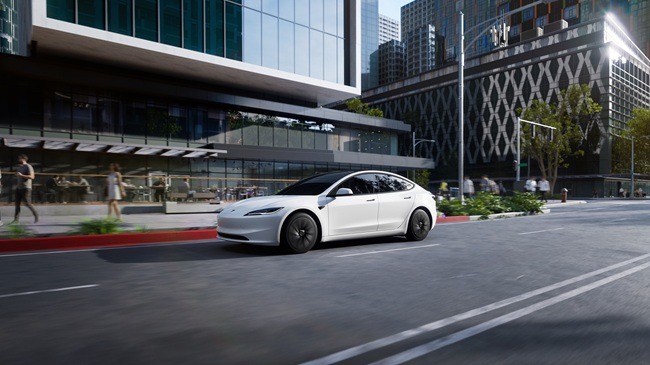
Tesla has launched a new entry level variant of the Model 3 in Europe in a move designed to counter weakening demand and intensifying competition across the region. The newly introduced Model 3 Standard is priced at €37,970 in Germany and rolls out simultaneously in markets like Norway and Sweden. The pricing aligns with the strategy Tesla used when the vehicle was introduced in the United States at 36,990 dollars and signals a renewed effort to bring more affordability into its European product lineup.
The timing of this launch is crucial because Tesla has been losing ground in Europe to a wave of aggressively priced electric vehicles from local and Chinese manufacturers. While the new Model 3 Standard lowers the barrier of entry into Tesla ownership, it does not yet reach the long anticipated mass market range of €25,000 to €30,000 that many consumers and analysts consider the real tipping point for broad EV adoption.
Why Tesla is introducing a lower priced Model 3 in Europe at a moment when EV affordability dominates buyer sentiment
Tesla’s introduction of a lower priced Model 3 in Europe arrives during a period of demand fatigue that has pushed the company to rethink how it positions its core sedan. European electric vehicle buyers are now more value conscious compared to the early stage adoption years. They are also choosing from a broader pool of competitors such as MG Motor, BYD, Volkswagen, Renault and Hyundai, many of which offer cars with competitive range and technology at lower price points.
Tesla’s pricing cuts signal a strategic concession. The company is acknowledging that its traditional premium positioning is being challenged by competitors that have successfully blended affordability with strong feature sets. Analysts view the Model 3 Standard as a tactical intervention that could slow Tesla’s market share erosion while offering buyers a recognisable brand with improved price accessibility.
The strategic logic also reflects Tesla’s need to maintain volume momentum as Europe becomes a battleground for mainstream EV adoption. By adding this entry model, Tesla can re-engage buyers who previously considered the brand out of reach. This is especially relevant in markets like Germany where subsidy rollbacks have increased consumer hesitation.
How Tesla reduced features in the Model 3 Standard and why this stripped back approach is becoming central to its cost competitiveness
Tesla reached its lower price point by reducing a range of premium features in the Model 3 Standard. Buyers will notice fewer interior enhancements, simplified materials, a reduced speaker array and likely fewer comfort or software capabilities compared to the long range and performance models. The company appears to have adjusted the battery configuration as well, which contributes to a more limited range but still keeps operational efficiency within a competitive margin.
Despite the reduction in premium elements, Tesla retains its most powerful differentiators. These include access to the Supercharger network, Tesla’s software ecosystem and the brand’s well established resale strength. The result is a product positioned as the most accessible Tesla yet without diluting the core brand attributes that have historically justified higher price tags.
What makes this strategy important is its alignment with global EV pricing pressure. Tesla is now showing that it is willing to prioritise competitive price points even if that means scaling back features that once defined its premium identity. This shift parallels traditional automakers that have long offered graduated trims to cater to different price segments.
Why competition from European and Chinese EV makers forces Tesla to recalibrate its pricing strategy despite strong brand equity
Tesla continues to face a highly competitive landscape in Europe where EV models below €30,000 are becoming more common. Brands such as BYD and MG Motor have achieved rapid penetration by offering long range vehicles at aggressive prices. Meanwhile, established European brands like Volkswagen and Renault retain deep market familiarity and strong dealership networks.
These trends create substantial friction for Tesla. Pricing alone is no longer enough to differentiate the brand, and the company must compete on delivery timelines, after sales support, insurance affordability and physical service accessibility. Competitors in Europe often have wider retail footprints and offer buyers more options within similar budgets.
This environment forces Tesla to reduce reliance on brand equity as its main competitive lever. While the Tesla brand continues to carry aspirational value, the Model 3 Standard shows that the company must appeal to practical EV shoppers who now expect strong value for money rather than purely technological novelty.
Why investor sentiment toward Tesla’s European strategy remains cautious despite anticipation around future compact EV plans
Investor sentiment reflects cautious optimism combined with structural concerns. Analysts have noted that Tesla’s recent financial performance shows greater dependence on price adjustments to stimulate demand rather than innovation driven growth. The launch of the Model 3 Standard fits that pattern. While it may improve short term volume, it does not deliver the transformational impact investors associate with Tesla’s historical disruptive cycles.
Institutional investors continue to wait for clarity on Tesla’s next generation compact vehicle platform. Expectations around a €25,000 mass market EV remain high because such a model could help Tesla reclaim leadership in affordability while expanding its total addressable market. Without progress toward this goal, pricing cuts alone may not fully satisfy investor expectations for margin stability and sustainable growth.
Some analysts still emphasise that Tesla’s software advantage, energy ecosystem and charging infrastructure remain strong long term differentiators. Yet they also argue that relying on those strengths without aggressive platform innovation could reduce Tesla’s competitive elasticity in an evolving European market.
How Tesla’s long term European outlook hinges on its ability to innovate manufacturing, reduce battery costs and deliver a true mass market EV
The release of the Model 3 Standard should be seen as an interim measure. Tesla may succeed in improving sales, but the broader strategic outcome will depend on its ability to deliver a new generation of vehicles that fundamentally shift the affordability equation.
Europe’s regulatory policies continue to favour electrification, but consumer expectations have changed. Buyers want range, reliability, strong software and reasonable pricing. To meet these expectations, Tesla will need to optimise manufacturing efficiency, leverage next generation battery chemistries and streamline platform architectures for scalability.
Tesla’s long term success in Europe will ultimately rely on its ability to produce a vehicle that meets mass market affordability without depending on deep feature cuts. The Model 3 Standard prepares the market but does not resolve the core challenge.
Key takeaways from Tesla’s Model 3 Standard launch in Europe
- Tesla has launched a new low-cost “Model 3 Standard” variant in Europe, starting at €37,970 in Germany, aiming to appeal to more price-sensitive EV buyers.
- The vehicle is a stripped-down version of the existing Model 3 lineup, with fewer premium features such as downgraded interiors, reduced speaker count, and limited Autopilot functions.
- While Tesla retains its software platform and Supercharger network advantages, the vehicle does not reach the highly anticipated sub-€30,000 price point that many European buyers expect for true mass-market access.
- The launch is seen as a response to increasing competition from European and Chinese electric vehicle manufacturers such as BYD, MG Motor, Renault, and Volkswagen, which are offering similar or greater range at lower prices.
- Institutional analysts view the move as a tactical volume play but not a transformative product change, with investor attention still focused on whether Tesla will introduce a €25,000 compact EV platform in the near term.
- Tesla’s market share in Europe has been slipping amid subsidy reductions and evolving consumer expectations around price-to-feature value.
- The company’s long-term success in the region hinges on its ability to innovate in manufacturing, reduce battery costs, and offer a true mass-market electric vehicle that avoids over-reliance on feature cuts.
- European buyers are becoming more pragmatic and cost-driven, especially as government incentives shrink and new EV brands expand rapidly with local support.
- The Model 3 Standard may temporarily support sales but is unlikely to fundamentally shift Tesla’s positioning without a broader refresh of its product and pricing strategy.
- Investors remain cautiously optimistic but are waiting for deeper cost-efficiency measures and clearer signals on Tesla’s next-generation platform rollout.
Share this:
Discover more from Business-News-Today.com
Subscribe to get the latest posts sent to your email.