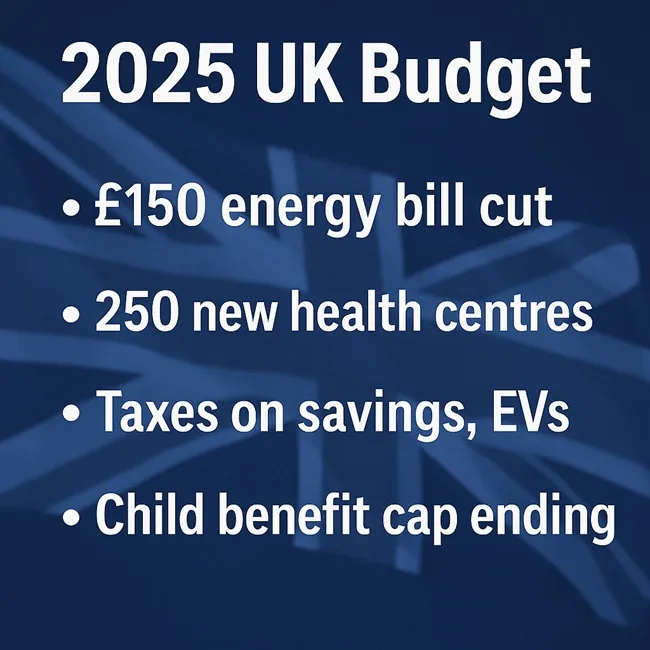
Chancellor of the Exchequer Rachel Reeves unveiled the United Kingdom’s 2025 Budget on 26 November, positioning it as a roadmap for cutting the cost of living, reducing public debt, and fixing long-standing issues in the NHS. The budget promises a £150 reduction in annual energy bills for households, the construction of 250 new Neighbourhood Health Centres, and a series of tax reforms designed to raise more than £26 billion by 2029 through levies on savings, property, and electric vehicle usage.
The fiscal strategy also takes aim at inflation and debt servicing, with the Treasury claiming the UK will cut its borrowing faster than any other G7 country. Forecasts by the Office for Budget Responsibility suggest GDP growth for 2025 has been revised upward from 1 percent to 1.5 percent, while inflation is expected to fall to 0.4 percent in 2026, giving the government more headroom for future spending.
How much will households actually save under the new energy and transport measures?
One of the headline consumer reliefs in the 2025 Budget is the £150 reduction on annual household energy bills, set to take effect from April 2026. The savings are expected to be felt most by lower-income households, who will also benefit from the Warm Homes Discount — together potentially saving up to £300 per year. These measures come alongside a freeze on rail fares, marking the first such freeze in three decades, and an extension of the 5p cut to fuel duty until August 2026.
To cushion the broader working population, the budget outlines minimum wage increases that will deliver a £900 boost for full-time workers on the National Living Wage. Workers aged 18 to 20 on the National Minimum Wage are set to gain around £1,500 annually. Meanwhile, pensioners will see a £575 increase under the government’s commitment to the state pension triple lock.
Despite these headline figures, policy experts have pointed out that many of these benefits will be offset by frozen tax thresholds and new levies. While day-to-day living costs may ease, the medium-term fiscal burden will likely shift toward middle-income households and those with accumulated savings or investments.
Will new neighbourhood health centres meaningfully reduce NHS waiting lists?
Another central plank of the budget is healthcare reform, with £3.4 billion allocated toward improving access to NHS services. This includes the development of 250 Neighbourhood Health Centres across England, designed to serve as localised care hubs integrating general practitioners, nurses, dentists, and pharmacists in a single location.
According to the budget, these investments have already resulted in 5.2 million additional NHS appointments and a reduction of more than 230,000 from the national waiting list — the largest such decline in 15 years. The Department of Health and Social Care stated that the government would not return to austerity-era public spending levels and intends to preserve what it described as the highest investment in the NHS in four decades.
However, scrutiny is building over how these new health centres will be funded. Reports confirm that some of the infrastructure will rely on private financing and public-private partnerships, which have previously been criticised for locking the NHS into expensive long-term contracts. Unions and health professionals have welcomed the expansion but warned that staffing levels and operational budgets must match the infrastructure rollout to avoid hollowed-out services.
How will tax reforms reshape the UK’s approach to wealth, investment, and vehicle usage?
The government is seeking to raise over £26 billion annually by the end of the decade through a wide range of tax reforms. Personal tax thresholds will be frozen from 2028 to 2031, and taxes on dividend, savings, and property income will rise by 2 percentage points — narrowing the gap between earned and unearned income.
New surcharges target high-value homeowners, including a High Value Council Tax Surcharge for properties worth more than £2 million. In a move aimed at making pension relief more equitable, salary sacrifice contributions above £2,000 will attract both employer and employee National Insurance charges starting in 2029.
The budget also halves the capital gains tax relief for business owners transferring assets to Employee Ownership Trusts from 100 percent to 50 percent. Treasury officials argue this maintains the incentive for employee ownership while ensuring business owners contribute more fairly to public finances.
One of the most controversial measures is the introduction of a per-mile road levy for electric and plug-in hybrid vehicles, effective from 2028. The Treasury contends that all vehicles contribute to road wear and that EVs must also fund infrastructure upkeep. To balance this, the government pledged continued incentives for electric vehicle ownership to maintain consumer momentum in the EV market.
Online gambling will face a duty increase that is expected to raise more than £1 billion annually. In-person gambling related to horse racing remains exempt, and the government has scrapped bingo duties entirely, citing the cultural and social role these activities play in communities.
What do Reeves’ welfare and poverty reforms signal about long-term social priorities?
The most headline-grabbing social reform in the budget is the abolition of the two-child benefit cap, a policy that experts say will lift approximately 450,000 children out of poverty. Reeves described this as the largest poverty-reduction measure announced at any UK budget in the past two decades. This decision is expected to have long-term economic benefits as well, given that children raised in poverty are statistically more likely to be out of work or dependent on benefits as adults.
The government is also reforming the Motability scheme, removing eligibility for luxury vehicles and projecting taxpayer savings of £1.5 billion over five years. For younger adults facing long-term unemployment, the budget introduces a guaranteed job offer in place of continued benefits. In another move, the budget closes a loophole that allowed UK state pension purchases by those living overseas at a reduced rate.
The government maintains that these changes are about fairness, prioritising the rebuild of essential services while enforcing fiscal discipline. Rachel Reeves said the goal is to reverse what she described as a “decade of underinvestment and decline” and to position Britain on a path toward long-term stability.
What is the institutional sentiment toward the UK’s new fiscal trajectory?
Initial response from economic institutions has been cautiously optimistic. Analysts at investment banks and think tanks noted that the increase in fiscal headroom to £21.7 billion gives the government some breathing room for future spending without relying on more borrowing. The fall in inflation and upward revision in GDP growth are considered positive signs that the UK economy may be entering a phase of post-shock recovery, provided the global macroeconomic environment remains stable.
At the same time, there is scepticism about whether the tax rises on dividends, property, and EVs will prove politically sustainable. Some commentators believe that these measures may alienate portions of the electorate that supported the current government’s broader cost-of-living agenda. Yet others argue the budget balances immediate relief with longer-term restructuring, a difficult but necessary trade-off.
Market watchers are also keeping an eye on gilts and interest rates. If debt servicing costs fall as projected and borrowing remains under control, the UK could see more room for fiscal manoeuvring by 2027. The government’s refusal to return to austerity-style cuts has been received positively by public sector advocates, particularly given the emphasis on health, housing, and regional infrastructure.
Will the 2025 UK Budget’s mix of bill cuts, tax hikes and NHS expansion create lasting national stability beyond short‑term relief?
The 2025 UK Budget represents a bold attempt to reshape the nation’s fiscal and social priorities. For households, it promises lower bills, better wages, and improved access to care. For savers, landlords, and wealthier property owners, it introduces tougher rules and higher taxes. The long-term impact will hinge on whether Reeves’ economic assumptions hold and whether the revenue raised from new taxes is efficiently reinvested into productive public services.
At its core, the budget tries to blend short-term consumer relief with structural reform, resisting calls for austerity while demanding more from the top of the income pyramid. As Parliament debates the measures and the fiscal watchdogs monitor their implementation, the real test will be whether the promised transformation reaches all corners of the UK — from housing estates and NHS wards to tax offices and public roads.
What are the most important takeaways from the 2025 UK Budget and how do its tax, welfare and energy reforms reshape daily life for households?
- The 2025 UK Budget unveiled by Chancellor Rachel Reeves includes a £150 annual cut in energy bills for households starting April 2026, along with frozen rail fares and extended fuel duty cuts to relieve cost-of-living pressures.
- A total of 250 new Neighbourhood Health Centres will be built to improve community-level access to primary healthcare, supported by £3.4 billion in NHS investment and the largest waiting list reduction in 15 years.
- The budget introduces new taxes on savings, dividend, and rental income, while freezing income tax thresholds until 2031, aiming to raise over £26 billion by 2029 and reduce national debt servicing costs.
- A new per-mile levy for electric and hybrid vehicles will begin in 2028, marking the first time EV drivers will pay road usage taxes comparable to petrol and diesel car owners.
- The two-child welfare cap will be scrapped from April 2026, lifting an estimated 450,000 children out of poverty, alongside reforms to Motability and changes in benefits for the long-term unemployed.
- A High Value Council Tax Surcharge will apply to properties worth more than £2 million, while capital gains tax relief for Employee Ownership Trust sales will be reduced from 100% to 50%.
- The Office for Budget Responsibility has revised UK GDP growth forecasts for 2025 upward to 1.5% and expects inflation to drop to 0.4% in 2026, partly due to the budget’s fiscal measures.
- Public investment levels will remain high, with support for Heathrow and Gatwick expansions, Sizewell C construction, DLR extension to Thamesmead, and rollout of small modular nuclear reactors at Wylfa.
- Online gambling will be taxed more heavily to offset rising social harms, with exemptions maintained for horse racing and bingo to preserve cultural value.
- Analysts view the budget as a blend of short-term relief and structural reform, with mixed sentiment on whether the tax increases and EV levies will hold up politically over the long term.
Share this:
Discover more from Business-News-Today.com
Subscribe to get the latest posts sent to your email.