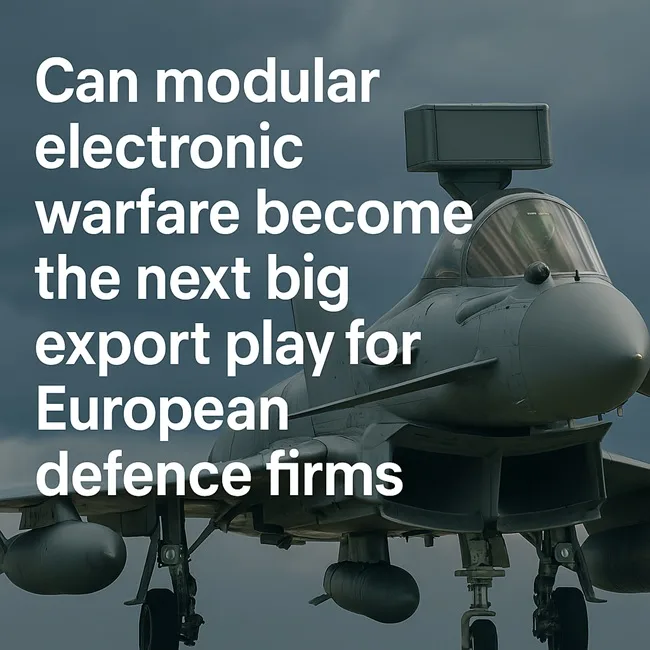
European defence manufacturers are increasingly positioning modular electronic warfare (EW) systems as a critical export growth driver. As global defence spending pivots toward electromagnetic-spectrum superiority, there is mounting demand for EW systems that are platform-agnostic, upgradeable, and operational across multiple mission environments. The strategic shift is prompting companies like Hensoldt AG, Saab AB, and Thales Group to reimagine their export strategy through the lens of modularity. With the global electronic warfare market expected to grow from approximately USD 14.5 billion in 2024 to over USD 30 billion by 2032, modular EW is emerging as one of the most exportable defence technologies to watch this decade.
What is driving the shift toward modular electronic warfare systems among European defence suppliers?
The growing complexity of modern combat scenarios has fundamentally changed the role of electronic warfare. Rather than serving as a passive defensive shield, EW is now an active element of mission planning, targeting, and survivability. In response, defence manufacturers are moving away from monolithic, platform-specific designs in favor of modular systems that can be integrated into various aircraft, unmanned platforms, and land- or sea-based assets.
Modular EW architecture typically involves the use of scalable hardware components, software-defined signal processing units, and AI-enabled decision-making tools. These systems allow for rapid reconfiguration depending on the mission profile, enabling operators to maintain a technological edge without full system overhauls. This approach aligns with growing military demand for faster deployment cycles and the ability to update fielded platforms in response to evolving threats.
European Union member states have also made it a priority to invest in sovereign defence capabilities. Programs coordinated through the European Defence Agency are focusing on interoperable electronic warfare tools that support joint operations across air, land, sea, space, and cyber domains. The combination of industrial collaboration and modular technical architecture is giving European defence suppliers a new degree of flexibility, particularly in markets where legacy fleets are still in operation.
How are European defence firms building modular electronic warfare capability and what are the export implications?
Companies such as Hensoldt AG and Saab AB are already commercialising modular electronic warfare systems with export ambitions. Saab AB’s Arexis suite, developed in partnership with Helsing GmbH, can be configured for pods, manned aircraft, or unmanned vehicles. It features gallium nitride-based AESA arrays, ultra-wideband digital receivers, and AI-enhanced signal processing. With its use in Germany’s Eurofighter EK and Sweden’s Gripen E/F programs, Saab AB is demonstrating the export readiness of Arexis, particularly for air forces seeking to enhance survivability without committing to new fifth-generation airframes.
Hensoldt AG has also emerged as a modular electronic warfare leader. The company’s Kalætron product family features radar warning receivers, electronic support measures, and self-protection jammers that can be adapted across different platform types. Hensoldt AG frequently highlights its focus on European and international markets where modular integration lowers both upfront procurement and long-term lifecycle costs.
The export implications are substantial. Modular EW allows buyers to extend the relevance of legacy fleets, match systems to specific threat environments, and achieve greater operational flexibility. For many countries in Asia, the Middle East, or Latin America, modularity offers a way to access cutting-edge capabilities without the complexity and political risk associated with importing fully integrated systems from major defence powers.
Which export markets are opening up for modular EW systems and how is Europe positioned?
Demand for EW is increasing across nearly every theatre of operations. Market research suggests that the global electronic warfare segment could see a compound annual growth rate of over nine percent through the early 2030s. This growth is not limited to NATO countries or traditional Western buyers. Nations in Southeast Asia, the Gulf Cooperation Council, Eastern Europe, and even Latin America are exploring EW systems to improve survivability, reinforce regional deterrence postures, and offset adversaries’ radar and missile investments.
European manufacturers are well-positioned to compete in this landscape. Unlike their American counterparts, who often bundle electronic warfare tightly with proprietary platforms, European firms tend to offer more flexible integration options. This is particularly attractive to countries operating mixed fleets or looking to upgrade existing systems without entirely new procurement.
Moreover, European suppliers are often perceived as more willing to share technology or localise production. In regions where U.S. International Traffic in Arms Regulations (ITAR) have limited defence cooperation, European firms are stepping in with modular EW packages that avoid restrictive licensing conditions. However, export success will depend heavily on these firms’ ability to navigate regulatory requirements in their own countries and tailor packages to each customer’s platform mix, threat profile, and procurement timelines.
What barriers and risks remain for European firms aiming to make modular electronic warfare a major export growth engine?
Despite its strategic potential, the modular electronic warfare export model is not without obstacles. First, regulatory fragmentation within Europe itself poses a challenge. While the European Defence Fund and other collaborative efforts are designed to encourage cross-border cooperation, national-level export controls often create delays or friction. Each modular system still requires country-specific certification and mission data alignment, which can add complexity for buyers and suppliers alike.
Second, the technical promise of modularity does not eliminate integration risk. Systems still need to communicate effectively with legacy onboard computers, sensors, and mission management software. In some cases, the process of adapting modular electronic warfare components to existing airframes may require more time and capital than initially estimated, particularly in countries without robust in-house technical support.
Third, price competitiveness remains a pressure point. Modular EW systems are often marketed as cost-effective due to their upgrade flexibility, but buyers still compare them against highly subsidised or domestically produced alternatives. In emerging markets, where budget constraints are real, firms may be forced to offer concessional financing, offset agreements, or joint production deals, all of which can affect profitability.
Finally, geopolitical dynamics may influence how certain modular EW systems are perceived. Some buyers may prefer to align with U.S. or Chinese defence suppliers due to broader security arrangements or political considerations, even if European systems offer better technical flexibility.
How will the modular EW sector evolve over the next decade and what should industry watchers look for?
Looking forward, modular electronic warfare is likely to become central to the next phase of defence exports from Europe. As multi-domain operations continue to blur the lines between air, land, sea, and cyber, modular EW systems that can plug into broader battlefield networks will become a critical enabler. Artificial intelligence, sensor fusion, and cloud-integrated EW threat libraries are expected to define the next wave of innovation.
European firms that successfully create export-ready, software-defined EW systems with simplified integration pathways will find themselves in a strong competitive position. The ability to offer not just hardware, but full mission-data support, training, and digital upgrades, will be key to capturing market share.
Industry analysts are closely watching the integration of AI in signal detection and jamming optimization, particularly in systems like Arexis and Kalætron. Another area of interest is how well European suppliers can scale production, reduce costs, and manage logistics as export orders increase.
Whether modular EW becomes a dominant export theme will depend on Europe’s ability to speak with a more unified voice in defence sales, streamline internal coordination, and provide a compelling value proposition against entrenched U.S. and Israeli systems. The technology is mature, the market demand is growing, and the geopolitical opening is clear. The next decade will determine whether modular electronic warfare becomes a long-term strategic pillar for Europe’s defence industry.
Discover more from Business-News-Today.com
Subscribe to get the latest posts sent to your email.