





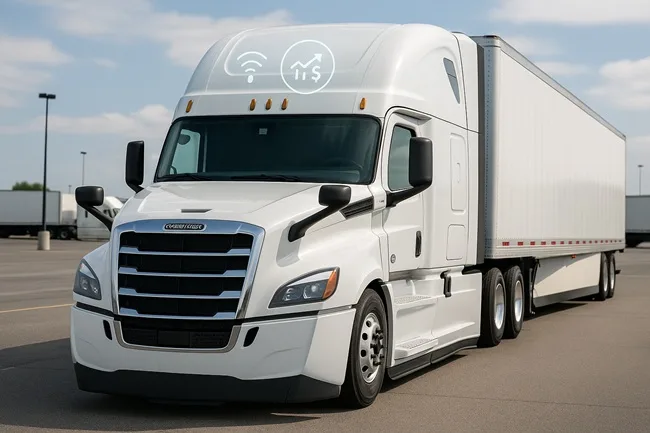
Small fleet operators and independent truckers are navigating an increasingly unforgiving cost landscape in commercial logistics. With insurance premiums soaring, equipment prices remaining high, and fuel and labour costs continuing to compress margins, profitability is now more volatile than ever. In this backdrop, Daimler Truck Financial Services USA LLC and GEICO have launched a data-driven solution that could give smaller players a much-needed edge.
Their new program, Connected Insurance, uses real-time telematics from Detroit Connect—already embedded in Freightliner and Western Star trucks—to help owner-operators and small fleets reduce commercial vehicle insurance premiums by up to 10 percent. This shift to usage- and behavior-based pricing reflects a broader trend in mobility finance: converting operational data into direct cost savings, especially for those outside the mega-fleet economy of scale.
Why are small fleet operators facing disproportionate pressure from rising insurance costs in 2024?
For operators managing fewer than 20 vehicles, the financial burden of insurance has become one of the most destabilizing forces in their cost structure. According to recent estimates from transportation and insurance advisory groups, annual liability coverage for smaller trucking businesses now ranges between USD 18,000 and USD 22,000 per unit—up from levels below USD 10,000 just a few years ago.
These rising costs are not merely cyclical. The commercial insurance market for heavy-duty trucking has been reacting to a spike in claims severity, nuclear verdicts exceeding USD 10 million, and reinsurance volatility, all of which disproportionately impact smaller operators without the risk buffering mechanisms of larger fleets. At the same time, regulators and shippers are demanding tighter compliance, newer equipment, and greater digital visibility—adding further strain to already tight margins.
For many small fleet owners, the result is that operating income has shrunk to a fraction of its former levels. Whereas independent truckers once expected to net USD 150,000 to USD 200,000 annually, many are now reporting figures closer to USD 70,000 or less. This has led to an uptick in fleet consolidation, driver exits, and renewed interest in insurance innovations that can bring relief.
How does Daimler Truck’s Connected Insurance model actually function and what makes it unique?
Connected Insurance, the program jointly launched by Daimler Truck Financial Services USA LLC and GEICO, is built around a relatively simple but impactful model: leverage built-in telematics already present in Daimler Truck North America vehicles to determine premiums based on how trucks are actually driven.
Customers with Freightliner and Western Star models equipped with Detroit Connect can opt in to share telematics data directly with GEICO’s commercial insurance division. This data includes speed, acceleration, braking, route efficiency, idle time, and engine diagnostics. By assessing this data within the GEICO DriveEasy Pro platform, underwriters can dynamically evaluate real-time risk and offer pricing that reflects actual behavior rather than just fleet category or past claims history.
What sets this program apart is the lack of additional hardware requirements. Most existing telematics-based insurance offerings in commercial logistics require fleet operators to retrofit their vehicles with dashcams, diagnostic dongles, or third-party data aggregators. In contrast, Daimler Truck Financial Services USA LLC has eliminated that barrier by tapping into the native Detroit Connect system—lowering the adoption curve and reducing integration complexity.
How does this insurance model fit into the growing value chain of telematics in commercial trucking?
Telematics has evolved from a fleet management tool into a foundational layer for new business models across trucking, leasing, insurance, and predictive maintenance. For Daimler Truck Financial Services USA LLC, the Connected Insurance program is just one example of how connected vehicle data can be monetized across multiple verticals beyond vehicle sales.
Industry analysts estimate that connected services—including usage-based insurance, dynamic leasing, automated compliance reporting, and maintenance forecasting—could unlock billions of dollars in added value over the next several years. For original equipment manufacturers like Daimler Truck North America, embedding finance and insurance into the ownership lifecycle is a strategic move to improve customer stickiness and lifetime value, especially in the small-fleet and owner-operator segments.
Moreover, telematics enables visibility into operations that historically remained opaque. For example, metrics such as hard braking frequency or idle time can be tied to fuel usage, wear and tear, safety risk, and now insurance pricing. This connected value loop allows insurers like GEICO to calibrate coverage and claims more accurately, while enabling fleet owners to directly influence their cost structure through driving behavior.
Can this model materially impact profitability for small trucking operators?
For smaller fleet operators, even modest reductions in fixed overheads can create disproportionate gains in margin resilience. If insurance premiums are currently accounting for 15 to 20 percent of net revenue per truck, a 10 percent reduction in that line item could free up critical cash flow for fuel, maintenance, or driver wages.
More importantly, by participating in a connected insurance model, small fleets gain real-time visibility into the variables that influence their pricing—transforming insurance from a static cost to a dynamic lever. Some operators have already begun to implement driver coaching based on telematics insights to actively reduce high-risk behavior and unlock further discounts.
Additionally, integrated telematics can improve claims handling time, lower legal costs in accident disputes, and improve uptime by predicting mechanical failures before they escalate. The cumulative effect of these benefits means that connected insurance is more than just cheaper coverage—it is part of a broader digital strategy to increase operational efficiency and resilience.
What risks or limitations should operators be aware of before adopting connected insurance?
Despite the promise of cost savings and better visibility, connected insurance is not a silver bullet. For small fleets, the benefits of telematics-based pricing can vary depending on driver behavior, geography, and cargo type. High-risk routes, frequent night driving, or exposure to urban traffic density can still result in elevated premiums despite data transparency.
Privacy and control are also valid concerns. Sharing real-time vehicle and driver data with insurers requires a level of trust in how that data is used, stored, and evaluated. While Daimler Truck Financial Services USA LLC and GEICO have emphasized that the program is opt-in and does not require aftermarket hardware, data sovereignty and transparency in risk scoring will remain top-of-mind for fleet owners.
Another limitation is the base level of safety and operational discipline already required to benefit from the program. Fleets with poor driver safety records, inconsistent maintenance, or lax internal controls may find that the telematics data reinforces higher risk ratings rather than lowering premiums. This model rewards good behavior—it does not insulate poor performers from market realities.
What is the broader market sentiment and investor outlook on telematics-enabled commercial insurance?
Institutional investors tracking original equipment manufacturers and insurers alike are showing increased interest in how connected platforms are unlocking new recurring revenue streams and reducing operational volatility. Daimler Truck Holding AG and Berkshire Hathaway Inc., the parent of GEICO, have not released earnings projections tied specifically to Connected Insurance, but analysts have noted the strategic value of embedded finance.
For Daimler Truck Financial Services USA LLC, connected services like insurance may eventually rival the margins of traditional vehicle sales, particularly in North American markets where fleet replacement cycles are tightening and customers are demanding integrated financial solutions. For GEICO, expansion into commercial trucking represents both a revenue opportunity and a competitive response to newer insurtech players entering the fleet space.
From a policyholder perspective, the increased transparency and fairness of behavior-based pricing is likely to be well-received by operators who maintain clean safety records and modern fleets. That said, adoption will be gradual, and many will wait for data on actual savings, claims experiences, and long-term ROI before making the switch.
What should small fleets and institutional players watch for as connected insurance gains traction?
For small fleet operators, the next 12 months will be critical in assessing the viability of connected insurance as a long-term cost management strategy. Key indicators will include actual premium reductions achieved through participation, frequency of claims, time to settlement, and any operational changes resulting from telematics-driven driver feedback.
For Daimler Truck Financial Services USA LLC, success will hinge on how widely the Connected Insurance model is adopted, how it integrates with other financial services such as leasing and maintenance forecasting, and how effectively it can scale across geographies and vehicle categories. For GEICO, the focus will be on underwriting accuracy, loss ratios, and customer retention.
At a sector level, Connected Insurance is a bellwether for how OEMs and insurers will partner to turn data into dollars, particularly for the underserved small-fleet segment that is often left behind by legacy providers. As macroeconomic pressures persist, more stakeholders are likely to seek solutions that turn vehicle connectivity into financial performance.
Share this:
Discover more from Business-News-Today.com
Subscribe to get the latest posts sent to your email.